Analyzing Mental Constructs of Communication in Iranian Couples
DOI:
https://doi.org/10.61838/kman.aftj.6.3.2Keywords:
mental construct , marriage , empathy , satisfactionAbstract
Objective: The aim of this study is to examine the sources that shape mental constructs in the minds of the participants and their strategies for bringing their own lives closer to that of a successful marriage.
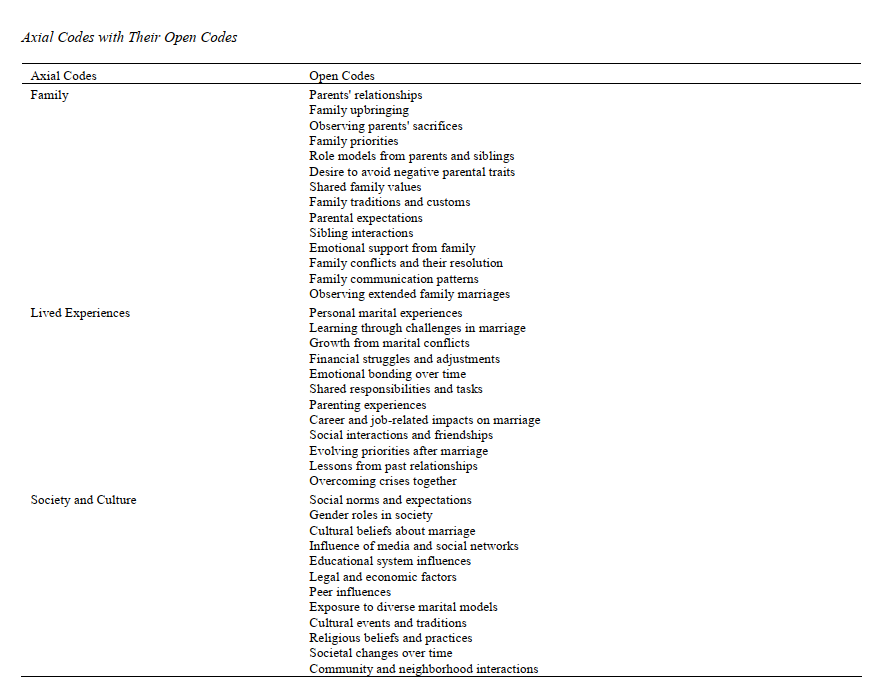
Methods: This study employs a qualitative method. Research data were collected through 30 in-depth interviews with 15 Tehranian couples. The data were coded using MAXQDA software, version 2020. The number of participants was determined upon reaching saturation. In the first stage of coding, a total of 860 codes or initial concepts were extracted from the interview transcripts.
Findings: The findings of the study indicate that mental constructs of marriage are acquired, modifiable, and constructed entities that are the result of family upbringing and parental relationships, the dominant society and culture, and personal experiences after marriage. The strategies provided by participants for maintaining or achieving a successful marriage amounted to 51 suggestions and strategies, with the highest levels of agreement and recurrence around concepts such as patience, mutual respect, learning problem-solving skills, self-restraint, and communication.
Conclusion: This study highlights that mental constructs of successful marriage are shaped by family, lived experiences, and societal influences, emphasizing the importance of empathy, mutual respect, and communication for marital satisfaction and stability.
Downloads
References
Akhavan, M. (2022). Determining the Effectiveness of Bowen Family Therapy on Couples' Empathy and Adaptability Master's Thesis, General Psychology, Motahar Rationalists Higher Education Institute, Department of Psychology].
Ali Mohammadi, F., & Aghajani, A. (2021). Predicting Marital Quality Based on Commitment and Empathy Among Married Students at Islamic Azad University, Qom Branch. Cognitive Psychology and Psychiatry, 8(4), 135-145. https://doi.org/10.32598/shenakht.8.4.135
Bahari, Z. (2015). The Role of Lifestyle in Marital Satisfaction of Couples. Counseling and Psychotherapy Culture, 6(2), 125-145. https://qccpc.atu.ac.ir/article_4212.html
Carasso, E., & Dikla, S. (2024). Marital strain and emotional intimacy in midlife couples: The moderating role of empathy. Personal Relationships. https://doi.org/10.1111/pere.12559
Creswell, J. W., & Creswell, D. (2008). Research Design: Qualitative, and Mixed Methods Approach. Sage. https://books.google.com/books/about/Research_Design.html?hl=id&id=335ZDwAAQBAJ
Diener, E., Lucas, R. E., & Oishi, S. (2018). Advances and open questions in the science of subjective wellbeing. Collabra: Psychology, 4(1), 15. https://doi.org/10.1525/collabra.115
Ebrahimi, L., & Mohamadlou, M. (2019). Role of relationship beliefs and cognitive insight on the quality of marital relationship among divorced women. Preventive Care In Nursing and Midwifery Journal, 9(2), 28-35. https://doi.org/10.29252/pcnm.9.2.28
Kasapoğlu, F., & Yabanigül, A. (2018). Marital Satisfaction and Life Satisfaction: The Mediating Effect of Spirituality. Spiritual Psychology and Counseling. https://doi.org/10.37898/spc.2018.3.2.0048
Kázmierczak, M., & Karasiewicz, K. (2021). Dyadic empathy in Polish samples: validation of the Interpersonal Reactivity Index for Couples. Current Issues in Personality Psychology, 9, 354-365. https://doi.org/10.5114/cipp.2021.103541
Khezri, Z., Hassan, S. A., & Nordin, M. H. M. (2020). Factors affecting marital satisfaction and marital communication among marital women: literature of review. International Journal of Academic Research in Business and Social Sciences, 10(16), 220-236. https://doi.org/10.6007/IJARBSS/v10-i16/8306
Kulik, L., & Kitaichik, D. (2014). Marital Intimacy and Selected Correlates of Gender Roles: A Comparative Analysis of Israeli Husbands and Wives. Women's Studies, 43, 823-842. https://doi.org/10.1080/00497878.2014.921509
Lucas-Thompson, R. G., Lunkenheimer, E. S., & Dumitrache, A. (2017). Associations between marital conflict and adolescent conflict appraisals, stress physiology, and mental health. Journal of Clinical Child and Adolescent Psychology, 46(3), 379-393. https://doi.org/10.1080/15374416.2015.1046179
Lyusin, D. B. (2016). Emotional intelligence as a mixed construct. European Journal of Social Psychology, 44(6), 54-68. https://doi.org/10.2753/RPO1061-0405440604
Marmola, M., Ochojska, D., & Wańczyk-Welc, A. (2021). The quality of communication between spouses raised in nuclear and single-parent families. Kwartalnik Naukowy Fides et Ratio. https://doi.org/10.34766/fetr.v47i3.889
McNulty, J. K. (2018). Forgiveness in marriage: Putting the benefits into context. Journal of Family Psychology, 22(1), 171-175. https://doi.org/10.1037/0893-3200.22.1.171
Nawabi Far, F., Ateshpour, H., & Golparvar, M. (2019). Constructing and evaluating the effectiveness of a training package based on nine personality types (Enneagram) on the expression of emotion of marriage applicants (Vol. 26). https://doi.org/10.32598/ijpcp.26.1.3128.1
Niakani, S. S. (2022). Comparing Love Styles, Marriage Stability, Fear of Intimacy, and Empathy in Traditional and Modern Marriages Master's Thesis, General Psychology, Feyz-al-Islam Higher Education Institute, Faculty of Humanities].
Plopa, M., Kázmierczak, M., & Karasiewicz, K. (2019). The quality of parental relationships and dispositional empathy as predictors of satisfaction during the transition to marriage. Journal of Family Studies, 25, 170-183. https://doi.org/10.1080/13229400.2016.1211550
Rastgoftar, S., & Khodadadi, J. (2024). Antecedents and Consequences of Marital Adjustment in Satisfied Couples. Women's and Family Cultural-Educational Quarterly, 12(66), 79-110. https://cwfs.ihu.ac.ir/article_208462.html
Sabournejad, R., Bagheri, F., & Pourhossein, R. (2023). Examining the Paradigmatic Model of Mate Selection and Satisfaction Among Satisfied Couples in Tehran: A Grounded Theory Study. Cognitive Psychology and Psychiatry, 10(6), 45-61. https://shenakht.muk.ac.ir/browse.php?a_id=1768&sid=1&slc_lang=en&ftxt=1
Sadeghi Miyab, A., Shafiabadi, A., Sheyvandi Chelcheh, K., Sa'adati Shamir, A., & Jafari, A. (2022). The Effectiveness of Pre-marriage Education Based on Risk Factors with a Cognitive-Behavioral Approach on the Resilience and Quality of Life of Engaged Couples. Clinical Psychology and Personality (Daneshvar Behavior), 20(2), 1-15. https://cpap.shahed.ac.ir/article_3918.html?lang=en
Safari, S., Heydarnia, A., & Abbasi, H. (2021). Identifying Culture-Based Marital Enrichment Skills. Family Research, 17(3), 328-351. https://doi.org/10.52547/JFR.17.3.328
Safarpoor, A. (2021). Providing a Structural Model Between Self-Differentiation and Referential Thinking in Marital Life with the Mediating Role of Marital Empathy Among Couples in Shiraz Master's Thesis, Psychology, Payame Noor University of Semnan Province, Semnan Center].
Saldaña, J. (2014). The Coding Manual for Qualitative Researchers. SAGE Publications. https://books.google.com/books/about/The_Coding_Manual_for_Qualitative_Resear.html?id=ZhxiCgAAQBAJ
Shirdel, E., Hassani, M., & Hami Kargar, F. (2021). The Construction of Successful Interfaith Marriages and Their Formation Contexts: A Qualitative Study Among Couples in Sistan and Baluchestan Province. Sociology of Social Institutions, 8(18), 373-397. https://ssi.journals.umz.ac.ir/article_3609.html?lang=en
Strauss, A., & Corbin, J. (2014). Basics of Qualitative Research: Techniques and Procedures for Developing Grounded Theory. London: SAGE. https://books.google.com/books/about/Basics_of_Qualitative_Research.html?id=hZ6kBQAAQBAJ
Weryszko, M. (2020). Miłość małżeńska - uwarunkowania powodzenia fundamentalnej relacji w rodzinie. https://fidesetratio.com.pl/ojs/index.php/FetR/article/view/140
Zandi, N., Ahmadian, H., & Goodarzi, M. (2024). Structural Modeling of the Relationships Between Family of Origin Health, Alexithymia, and Communication Beliefs with Couples' Mental Well-being: The Mediating Role of Forgiveness. Disability Studies Journal(14), 1-11. https://www.magiran.com/paper/2781137/modeling-the-structural-relationships-between-the-original-family-health-alexithymia-and-communication-beliefs-with-the-mental-wellbeing-of-couples-the-mediating-role-of-forgiveness?lang=en
Downloads
Additional Files
Publication Timeline
- Submitted
- Revised
- Accepted
Issue
Section
License
Copyright (c) 2025 Mahtab Yahyapour (Author); Hossein Davoodi (Corresponding Author); Mohamad Mahdi Jahangiri (Author)

This work is licensed under a Creative Commons Attribution-NonCommercial 4.0 International License.