Analyzing the Phenomenon of Divorce from the Perspective of Expert Family Therapists: A Grounded Theory Sample
DOI:
https://doi.org/10.61838/kman.aftj.3887Keywords:
divorce, family therapists, experts, grounded theoryAbstract
Objective: This study was conducted with the aim of analyzing the phenomenon of divorce from the perspective of expert family therapists.
Method: The research method was qualitative, based on grounded theory (Charmaz, 2014). The research setting included all family therapists in the city of Isfahan in the year 2024, and the participants consisted of ten of the most prominent therapists who were purposefully selected. The research tool was interviews conducted in the form of focus groups. The collected data were analyzed using Charmaz’s (2014) method: first, coding was carried out, followed by conceptualization. Then, during the process of integration, categories were extracted, and finally, the core categories were identified and the theory was formed.
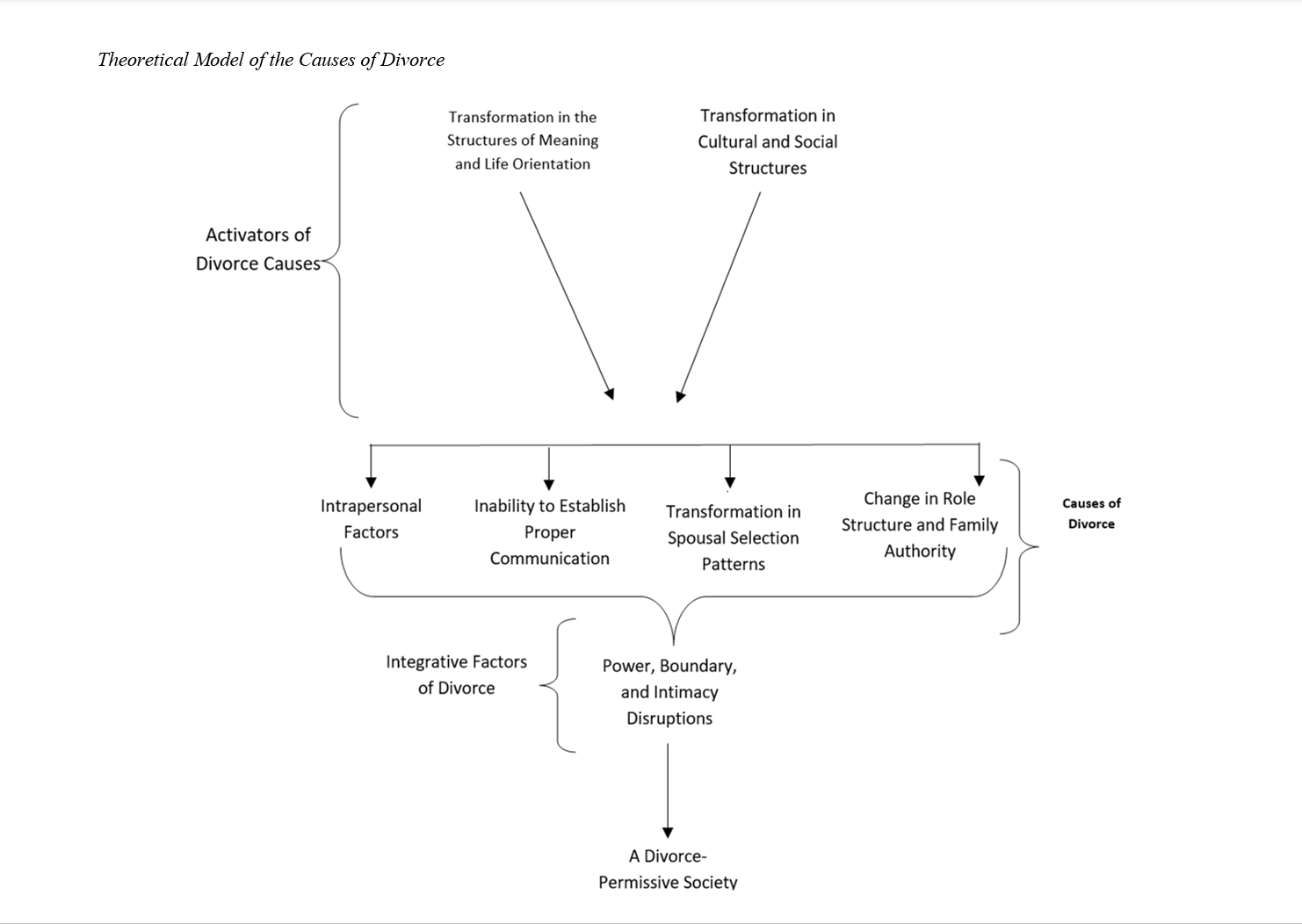
Results: The results indicated that the phenomenon of divorce includes three main categories: (1) the reasons behind the occurrence of divorce: the activators of divorce causes, with categories such as changes in cultural and social structures and the prioritization of individuality over couplehood; (2) the nature of divorce causes: causes of divorce categorized as changes in family roles and authority, poor spouse selection, inappropriate communication, and individual problems; and (3) the process through which the causes interconnect: integrators of divorce causes (disturbance-power, disturbance-intimacy, and boundary disturbances).
Conclusion: Based on the findings, this study suggests that in order to reduce divorce, the activators of divorce cannot be ignored, as they render society more prone to facilitating the grounds for divorce rather than preserving family stability. Additionally, the identified causes of divorce indicate that many revolve around the philosophy of individualism. Therefore, society and societal discourse must reinforce the value of collectivism so that this value can function as a socio-psychological superstructure acting as a barrier to divorce.
Downloads
References
Abazari, M., & Barati Ahmadabadi, H. (2017). The Mediating Role of Emotional Divorce in the Relationship Between Sexual Divorce and Psychological Divorce in Couples on the Verge of Divorce. Congress of the Iranian Psychological Association,
Abolhassan Tanhai, H., & Aghajani Beigi, Z. (2021). Sociological Explanation of the Transformation of the Family Institution in the Light of Extramarital Affairs with the GT Approach. Journal of Woman and Family Studies, 9(4), 21-42. https://en.civilica.com/doc/1425355/
Alavi, T. S., Moghaddamzadeh, A., Mazaheri, M. A., Hejazi Moghari, E., Salehi, K., & Afrooz, G. (2018). Representing the Components of Divorce Risk: A Phenomenological Study. Journal of Clinical Psychology and Counseling Research (Educational and Psychological Studies), 8(2), 61-83. https://sid.ir/paper/204925/fa
Alizadeh Akbari, A., & Garzin Motaii, F. Z. (2024). The Relationship of Emotion Regulation Strategies and Learned Helplessness with Marital Burnout Based on the Mediating Role of Attachment Styles in Divorced Individuals. Sixth International and Seventh National Conference on New Findings in Management, Psychology, and Accounting,
Allen, S., & Hawkins, A. J. (2017). Theorizing the decision‐making process for divorce or reconciliation. Journal of Family Theory & Review, 9(1), 50-68. https://doi.org/10.1111/jftr.12176
Bahonar, F., Keshavarz Afshar, H., & Salehi, K. (2020). Development and Validation of a Marriage Monitoring Program. Applied Psychological Research Quarterly, 11(2), 121-141. https://japr.ut.ac.ir/article_77292.html?lang=en
Balali, E., Naghdi, A., & Jafari, R. (2019). Socialization and Divorce: Examining the Divorce Phenomenon with a Process-Oriented Approach. Qualitative Research in Health Sciences, 8(1), 44-56. https://sid.ir/paper/215553/fa
Becvar, R. J., Becvar, D. S., & Reif, L. V. (2023). Systems theory and family therapy: A primer. Rowman & Littlefield. https://books.google.co.uk/books/about/Systems_Theory_and_Family_Therapy.html?id=ckrYEAAAQBAJ&redir_esc=y
Boss, P. (2024). Family stress. In Encyclopedia of quality of life and well-being research (pp. 2422-2429). https://doi.org/10.1007/978-3-031-17299-1_1008
Cabılar, B. Ö., & Yılmaz, A. E. (2022). Divorce and post-divorce adjustment: Definitions, models and assessment of adjustment. Psikiyatride Guncel Yaklasimlar, 14(1), 1-11. https://doi.org/10.18863/pgy.910766
Dehghani Sheshdehd, Z., & Yousefi, Z. (2019). Structural Equation Modeling of Inclination to Divorce Based on Systemic Variables (Triangulation, Relationship with Spouse), Psychological Variables (Agreeableness and Control Styles), and Social Variable (Leisure Activities) Among Mothers in Isfahan. Family Research, 15(1), 155-170. https://jfr.sbu.ac.ir/article_97713.html
Firdaus, R., Nursamsiah, Q., & Dede, U. (2021). The Influence of Social Media on Hedonism Lifestyles Among Students of the Faculty of Communication Sciences. The International Journal of Politics and Sociology Research, 8(4), 132-138. https://ijobsor.pelnus.ac.id/index.php/ijopsor/article/view/44
Ghorayshi, F., Shirmohammadi, D., & Barjvand, A. (2014). Understanding Divorce Factors from the Perspective of Men and Women in the Process or After Divorce: A Case Study of Saqqez City. Strategic Research on Iranian Social Issues (Strategic Research on Security and Social Order), 3(1), 19-30. https://sid.ir/paper/236841/fa
Kavehei Sedeh, S., Yousefi, Z., & Torkan, H. (2022). A Study of Premarital Counseling Methods by Counseling Experts and Extraction of a Competency-Based Counseling Model. Knowledge and research in applied psychology, 23(1), 26-37. https://sid.ir/paper/1031997/fa
Khatibi, A., & Ali Khanipour, A. (2022). The Impact of Social Factors and Perception of Positive Outcomes After Divorce on Mutual Divorce (From the Perspective of Divorce Applicants in Hamedan County). Family Research, 18(1), 75-96. https://doi.org/10.52547/JFR.18.1.75
Khayyat Ghiyasi, P., Moein, L., & Rousta, L. (2010). Investigating Social Causes of Inclination Toward Divorce Among Women Referring to the Family Court of Shiraz. Women and Society (Women's Sociology), 1(3), 77-103. https://sid.ir/paper/169248/fa
Kordzangeneh, J. (2023). A Qualitative Study of Underlying Factors of Divorce from the Perspective of Experts and Individuals on the Verge of Divorce, and Proposed Solutions (Case Study: Ahvaz City). Strategic Women's Studies, 26(102), 125-155. https://www.jwss.ir/article_190127.html?lang=en
Mączka, E. (2021). Some reflections on marriage and family in (post) modern social space. Forum Teologiczne(22), 111-123. https://doi.org/10.31648/ft.6925
Mansournejad, Z., Pourseyed, S. R., Kiani, F., & Khodabakhsh, M. R. (2013). Effectiveness of Communication Skills Training on Emotional Maturity Development in Female Students at the Verge of Marriage. Journal of Mental Health Principles, 15(59), 158-170. https://jfmh.mums.ac.ir/article_1826.html
Moradi, A., & Mirzaei, M. (2023). Lived Experience of Couples Applying for Divorce: With Emphasis on Typology of Divorce Meaning and the Role of Life Course Changes in Divorce Occurrence. Family Research, 19(3), 415-436. https://www.sid.ir/paper/1115289/en
Ogihara, Y. (2017). Temporal changes in individualism and their ramification in Japan: Rising individualism and conflicts with persisting collectivism. Frontiers in psychology, 8, 695. https://doi.org/10.3389/fpsyg.2017.00695
Padash, Z., Yousefi, Z., Abedi, M., & Torkan, H. (2022). Designing a Divorce Withdrawal Educational Package and Its Effectiveness on Divorce Inclination in Married Women Inclined Toward Divorce Compared to the Gottman Method. Scientific Journal of Psychological Methods and Models, 13(50), 55-68. https://jpmm.marvdasht.iau.ir/article_5834.html
Shahriari, M., & Navah, A. (2022). Lived Experience of Women Requesting Divorce Regarding the Divorce Process. Iranian Cultural Studies, 15(1), 97-120. https://sid.ir/paper/1051888/fa
Soltanian, V., Yousefi, Z., Khayyatan, & Floor. (2023). Exploring Power Dynamics in the Family: A Qualitative Study. Applied Family Therapy, 4(4), 300-316. https://doi.org/10.61838/kman.aftj.4.4.17
Downloads
Additional Files
Publication Timeline
- Submitted
- Revised
- Accepted
Issue
Section
License
Copyright (c) 2025 Maraym Hojaji (Author); Zahra Naghsh (Corresponding Author); Keyvan Salehi, Gholamali Afrooz (Author)

This work is licensed under a Creative Commons Attribution-NonCommercial 4.0 International License.