Ethnic-Racial Socialization in Mixed Heritage Families: A Grounded Theory Study
DOI:
https://doi.org/10.61838/kman.aftj.6.1.16Keywords:
Ethnic-racial socialization, mixed heritage families, identity transmission, grounded theoryAbstract
Objective: This study aimed to explore how parents in mixed heritage families in Malaysia engage in ethnic-racial socialization and transmit cultural identity to their children within the context of a multicultural society.
Methods: Using a qualitative grounded theory approach, data were collected through semi-structured interviews with 25 parents from diverse mixed heritage backgrounds residing in Malaysia. Participants were selected through purposive sampling and theoretical saturation guided the endpoint of data collection. Interviews focused on participants’ practices, challenges, and perspectives regarding cultural identity transmission in the home. Verbatim transcripts were analyzed using NVivo software, employing open, axial, and selective coding to generate a conceptual framework grounded in participants’ narratives.
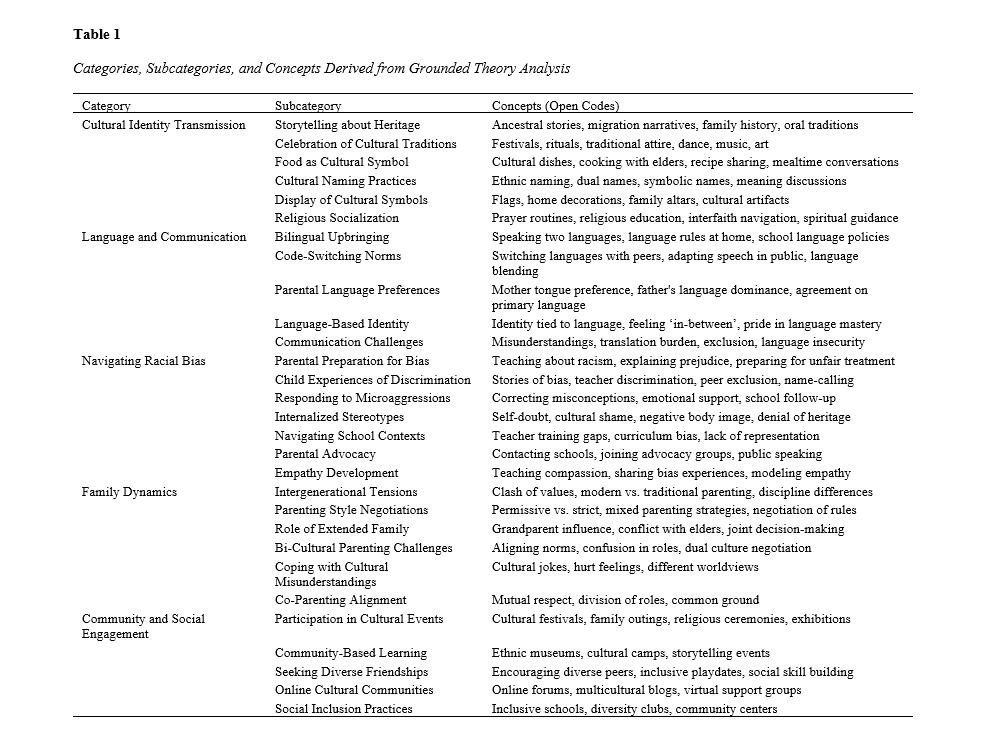
Findings: Five main categories emerged: Cultural Identity Transmission, Language and Communication, Navigating Racial Bias, Family Dynamics, and Community and Social Engagement. Parents engaged in intentional practices such as storytelling, celebration of traditions, and bilingual upbringing to reinforce cultural heritage. They also described emotional and strategic responses to racial bias, as well as negotiation between co-parenting and intergenerational influences. Language was both a bridge and a barrier, shaping identity and familial cohesion. Parents sought external support through cultural events and digital communities to validate and enrich their children’s mixed identities. These findings highlight the emotional labor and adaptive strategies involved in raising bicultural children in socially stratified environments.
Conclusion: Ethnic-racial socialization in mixed heritage families is a complex, multifaceted process involving intentional practices, emotional negotiations, and contextual adaptations. Parents act as cultural mediators, balancing heritage preservation with societal integration.
Downloads
References
Akbar, S., & Woods, K. (2019). The Experiences of Minority Ethnic Heritage Parents Having a Child With SEND: A Systematic Literature Review. British Journal of Special Education, 46(3), 292-316. https://doi.org/10.1111/1467-8578.12272
Cho, H. S., Gürsoy, H., Cheah, C. S. L., Zong, X., & Ren, H. (2024). To Maintain or Conceal One’s Cultural Identity? Chinese American Parents’ Ethnic–racial Socialization During COVID-19. Journal of Family Psychology, 38(1), 26-37. https://doi.org/10.1037/fam0001169
Fatima, S. (2025). Family Language Policy and Heritage Language Transmission in Pakistan—the Intersection of Family Dynamics, Ethnic Identity and Cultural Practices on Language Proficiency and Maintenance. Frontiers in psychology, 16. https://doi.org/10.3389/fpsyg.2025.1560755
Ison, A., Satterthwaite‐Freiman, M., Sladek, M. R., & Umaña‐Taylor, A. J. (2023). The Role of Family Ethnic Socialization and Generational Status in White Adolescents’ Ethnic-Racial Identity Development. Journal of Adolescent Research. https://doi.org/10.1177/07435584231166118
Kádár, J. (2022). Ethnic Positioning in Southwestern Mixed Heritage Writing. https://doi.org/10.5771/9781793607911
Kulis, S., Robbins, D., Baker, T. M., Denetsosie, S., & Parkhurst, N. A. D. (2016). A Latent Class Analysis of Urban American Indian Youth Identities. Cultural Diversity and Ethnic Minority Psychology, 22(2), 215-228. https://doi.org/10.1037/cdp0000024
Li, G., Mei, Z., & Zhen, F. (2024). Friend or Foe? A Mixed-Methods Study on the Impact of Digital Device Use on Chinese–Canadian Children’s Heritage Language Learning. 1(1-2), 55-84. https://doi.org/10.1515/dsll-2024-0022
Li, S. (2020). Home Language-Learning Strategies Chosen by Chinese Immigrant Families. International Journal of English Linguistics, 10(5), 155. https://doi.org/10.5539/ijel.v10n5p155
Mitchell, B., & Lai, Y. Y. L. (2014). Intergenerational Conflict in Ethnically Diverse Ageing Families. Families Relationships and Societies, 3(1), 79-96. https://doi.org/10.1332/204674313x670151
Mu, Z., & Francis‐Tan, A. (2024). Follow Father or Mother? Understanding the Monoethnic Identification of Biethnic Children in China. Social Forces. https://doi.org/10.1093/sf/soae022
Nwanesi, P. K. (2024). The Bidayuh Cultural Identity “Issues” of the Progeny of Mixed Marriages. Journal of Borneo-Kalimantan, 10(1), 11-20. https://doi.org/10.33736/jbk.7196.2024
Sander‐Montant, A., Bissonnette, R., & Byers‐Heinlein, K. (2024). Like Mother Like Child: Differential Impact of Mothers' and Fathers' Individual Language Use on Bilingual Language Exposure. Child development, 96(2), 662-678. https://doi.org/10.1111/cdev.14196
Sibanda, R. (2023). Echoes From the Motherland: Heritage Language Transmission Within the Malawian Community in South Africa. Per Linguam, 39(2). https://doi.org/10.5785/39-2-1009
Sitinjak, V. N., & Harianja, N. (2022). Maintain or Shift? Focus on Inter-Ethnic Families in Indonesia. International Journal on Linguistics of Sumatra and Malay, 1(1), 39-45. https://doi.org/10.32734/ijlsm.v1i1.10572
Soliz, J., Cronan, S., Bergquist, G., Nuru, A. K., & Rittenour, C. E. (2017). Perceived Benefits and Challenges of a Multiethnic-Racial Identity: Insight From Adults With Mixed Heritage. Identity, 17(4), 267-281. https://doi.org/10.1080/15283488.2017.1379907
Souza, J. D., Gillett, K., Salifu, Y., & Walshe, C. (2023). Living and Dying Between Cultural Traditions in African &Amp;amp; Caribbean Heritage Families: A Constructivist Grounded Theory. https://doi.org/10.21203/rs.3.rs-3621438/v1
Souza, J. D., Gillett, K., Salifu, Y., & Walshe, C. (2024). Living and Dying Between Cultural Traditions in African &Amp; Caribbean Heritage Families: A Constructivist Grounded Theory. BMC Palliative Care, 23(1). https://doi.org/10.1186/s12904-024-01503-6
Walsh, A. S., & Azmitia, M. (2022). Mexican-Heritage Ethnic Identity: How Coco Serves as Context for Ethnic Socialization. Hispanic Journal of Behavioral Sciences, 44(1), 44-70. https://doi.org/10.1177/07399863221112484
Wang, J. (2018). The Relationship Between the Implementation of Parent's Educative Right and the Inheritance of Culture. https://doi.org/10.2991/iccese-18.2018.49
Yu, S.-C. (2015). The Relationships Among Heritage Language Proficiency, Ethnic Identity, and Self-Esteem. Fire Forum for International Research in Education, 2(2). https://doi.org/10.18275/fire201502021039
Zhou, X., Kim, J., Lee, H. W., & Lee, R. M. (2020). Korean Adoptees as Parents: Intergenerationality of Ethnic, Racial, and Adoption Socialization. https://doi.org/10.31234/osf.io/kxd74
Zhu, Q., Wang, C., & Cheah, C. S. L. (2024). Parental Identity and Socialization Mediate Parental Racial Discrimination's Impact on Child Adjustment. Journal of marriage and family, 86(4), 965-987. https://doi.org/10.1111/jomf.12992
Танатова, Д. К., Korolev, I., Yudina, T., Королева, С. В., & Lidzer, E. A. (2018). Self-Identification in Mixed Ethnic Family. International Journal of Engineering & Technology, 7(4.38), 546-550. https://doi.org/10.14419/ijet.v7i4.38.24620
Downloads
Additional Files
Publication Timeline
- Submitted
- Revised
- Accepted
Issue
Section
License

This work is licensed under a Creative Commons Attribution-NonCommercial 4.0 International License.