Effectiveness of Existential Group Therapy on Event Impact and Self-Monitoring in Parents Experiencing Anticipatory Disabling Grief Related to Their Child
DOI:
https://doi.org/10.61838/kman.aftj.4045Keywords:
Existential group therapy, event impact, self-monitoring, parents with debilitating anticipatory griefAbstract
Objective: The present study aimed to determine the effectiveness of existential group therapy on the impact of the event and self-monitoring in parents experiencing anticipatory disabling grief related to their child.
Methods: This research employed a quasi-experimental method with a pretest-posttest two-group design. The statistical population consisted of all parents experiencing anticipatory disabling grief related to their child in Tehran, who sought psychological treatment at the "Lost Piece" Counseling and Psychotherapy Center in 2024. A total of 20 individuals were selected using a non-random purposive sampling method and then randomly assigned to two groups: 10 participants in the experimental group and 10 in the control group. The experimental group participated in ten 90-minute sessions of existential group therapy. Ultimately, following attrition, 8 participants successfully completed the treatment. The control group did not receive any intervention. It should be noted that in order to maintain equivalence between the experimental and control groups, a number of participants equal to the attrition in the experimental group were randomly removed from the control group as well. This study utilized the Revised Impact of Event Scale (IES-R), the Self-Monitoring Questionnaire, and the Anticipatory Grief Questionnaire. The collected data were analyzed using multivariate analysis of covariance (MANCOVA) and univariate analysis of covariance (ANCOVA). The
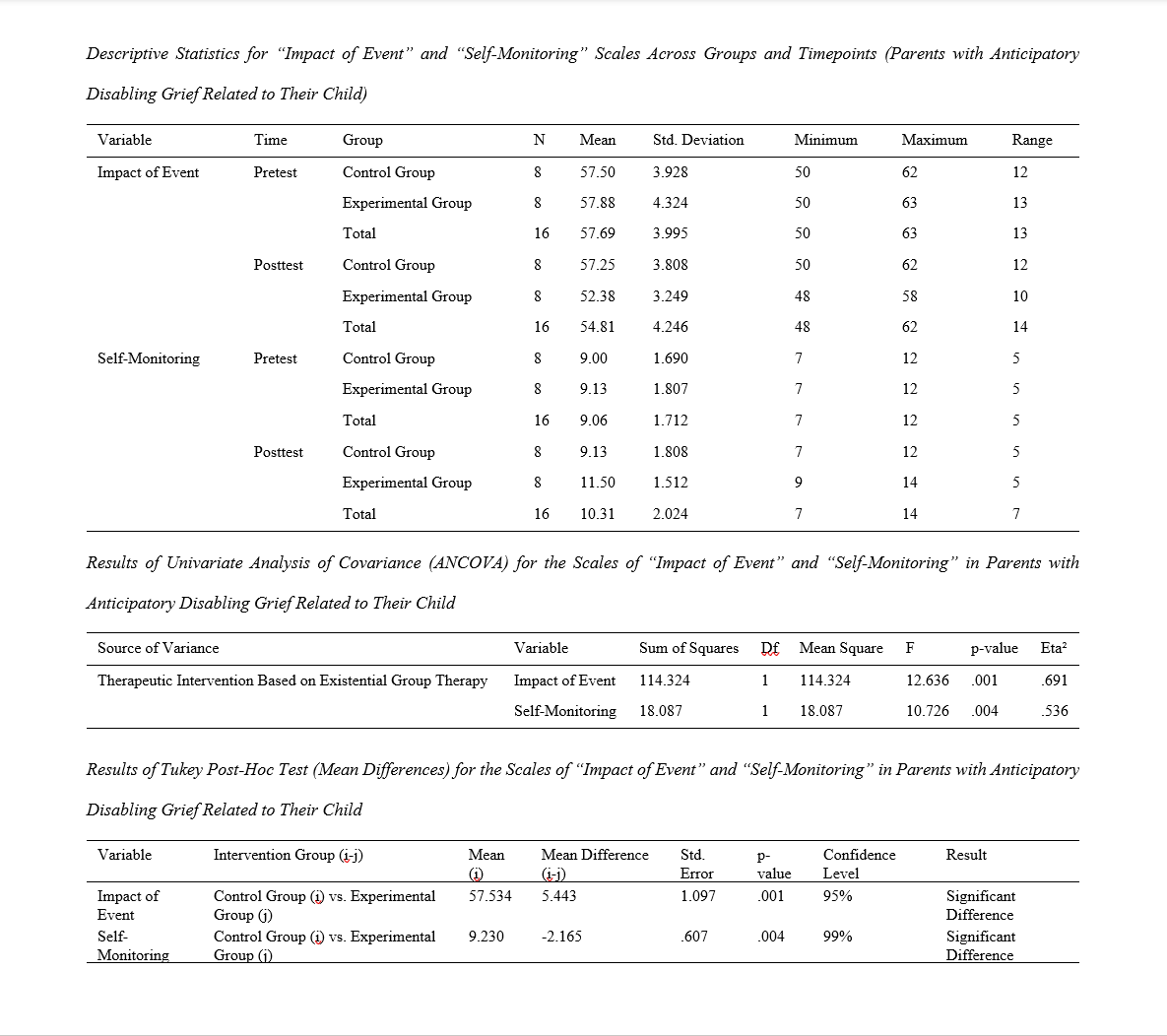
Findings: results indicated a significant difference between the posttest mean scores of the experimental and control groups. Existential group therapy significantly improved both the impact of the event and self-monitoring among parents experiencing anticipatory disabling grief related to their child.
Conclusion: These findings highlight its therapeutic value in addressing anticipatory disabling grief through meaning-making and emotional integration.
Downloads
References
Breen, L. J., Greene, D., Rees, C. S., Black, A., & Cawthorne, M. (2022). A Systematic Review and Meta-Analysis of the Efficacy of Grief Interventions for Anxiety and Depression in Young People. https://doi.org/10.31234/osf.io/gy9wv
Champion, M. J., & Kilcullen, M. (2023). Complicated Grief Following the Traumatic Loss of a Child: A Systematic Review. OMEGA - Journal of Death and Dying. https://doi.org/10.1177/00302228231170417
D’Antoni, F. (2025). Induced After-Death Communication (IADC) Therapy: An Effective and Quick Intervention to Cope With Grief. Psychology International, 7(1), 25. https://doi.org/10.3390/psycholint7010025
Das, M. K., Arora, N. K., Gaikwad, H., Chellani, H., Debata, P., Rasaily, R., Meena, K. R., Kaur, G., Malik, P., Joshi, S., & Kumari, M. (2021). Grief Reaction and Psychosocial Impacts of Child Death and Stillbirth on Bereaved North Indian Parents: A Qualitative Study. PLoS One, 16(1), e0240270. https://doi.org/10.1371/journal.pone.0240270
deMontigny, F., Verdon, C., Meunier, S., & Dubeau, D. (2017). Women’s Persistent Depressive and Perinatal Grief Symptoms Following a Miscarriage: The Role of Childlessness and Satisfaction With Healthcare Services. Archives of Women S Mental Health. https://doi.org/10.1007/s00737-017-0742-9
Ein Beigi, A., Soleimanian, A., & Jajarmi, M. (2020). Comparing the effectiveness of acceptance and commitment therapy and existential therapy in enhancing psychological capital in the elderly. Aging Psychology, 2(6), 165-178. https://jap.razi.ac.ir/article_1521.html?lang=en
Ghezeljeh, T. N., Seyedfatemi, N., Bolhari, J., Kamyari, N., & Rezaei, M. (2023). Effects of Family-Based Dignity Intervention and Expressive Writing on Anticipatory Grief in Family Caregivers of Patients With Cancer: A Randomized Controlled Trial. BMC psychiatry, 23(1). https://doi.org/10.1186/s12888-023-04715-x
Hatami Arad, T. N. F. S. (2023). The Effectiveness of Existential Therapy on Emotional Capital, Emotion Regulation, and Mental Well-Being of Female Undergraduate Students with Social Anxiety: A Semi-Experimental Study. Rafsanjan University of Medical Sciences Journal, 22(2), 129-146. https://doi.org/10.52547/jrums.22.2.129
Kumar, R. M. (2021). The Many Faces of Grief: A Systematic Literature Review of Grief During the COVID-19 Pandemic. Illness, Crisis & Loss, 31(1), 100-119. https://doi.org/10.1177/10541373211038084
Mansoori, J., Khodabakhshi-Koolaee, A., Falsafinejad, M. R., & Kashani Vahid, L. (2023). Bereavement for a Loved Person: A Look at the Opinions and Process of Coping With Grief in the COVID-19 Era. PCP, 11(3), 223-238. https://doi.org/10.32598/jpcp.11.3.746.4
Monemiyan, G., Mardanirad, M., Ghanbari Panah, A., & Omidi, A. (2021). Comparison of the effectiveness of cognitive-existential therapy and compassion-focused therapy in groups on psychological well-being of divorced female heads of household. Journal-of-Psychological-Science, 20(99), 439-452. http://psychologicalscience.ir/article-1-850-en.html
Nameni, E., Jajarmi, M., & Soliemanian, A. (2021). Comparison of the Effectiveness of Existential Therapy and Compassion-based therapy on Psychological Well-being and Marital Disturbance of Conflicting Women. Journal of Sabzevar University of Medical Sciences, 28(4), 608-620. https://jsums.medsab.ac.ir/article_1450_23870c2330fc5c68434926fb98fa5235.pdf?lang=en
Peña-Vargas, C., Armaiz-Peña, G. N., & Castro, E. (2021). A Biopsychosocial Approach to Grief, Depression, and the Role of Emotional Regulation. Behavioral Sciences, 11(8), 110. https://doi.org/10.3390/bs11080110
Poxon, L. (2024). An Antidote to the Pathologizing of Grief: Applying the Power–Threat–Meaning Framework. Ethical Human Psychology and Psychiatry, 26(1), 74-81. https://doi.org/10.1891/ehpp-2023-0016
Roozbehaneh, M. (2021). Frankl's existential therapy in alignment with the thoughts of Molavi. National Conference on Professional Research in Psychology and Counseling from the Teacher's Perspective, Minab.
Sajadipour, F. S., Dehghan Manshadi, M., Sedrpushan, N., & Fallah, M. H. (2024). Phenomenological Examination of Spiritual and Religious Coping Styles of Mothers Grieving a Child with Cancer. Psychology of Woman Journal, 5(1), 52-58. https://doi.org/10.61838/kman.pwj.5.1.6
Salloum, A., Bjoerke, A., & Johnco, C. (2017). The Associations of Complicated Grief, Depression, Posttraumatic Growth, and Hope Among Bereaved Youth. OMEGA - Journal of Death and Dying, 79(2), 157-173. https://doi.org/10.1177/0030222817719805
Sartipzadeh, A., Golparvar, M., & Aghaei, A. (2019). The effectiveness of spiritually-based existential therapy and Islamic spiritual therapy on emotional capital in elderly women. Journal of Behavioral Sciences Research, 17(4), 684-694. https://doi.org/10.52547/rbs.17.4.684
Sharif, Z., Marati, A., & Yousefvand, M. (2024). Comparing the Effectiveness of Acceptance and Commitment Therapy and Existential Therapy on Resilience in Female Students with Generalized Anxiety Disorder. Ruyesh Psychology, 13(6), 170-159. https://frooyesh.ir/article-1-5271-fa.html
Tang, S. (2024). Healing Grief – An Online Self-Help Intervention Programme for Bereaved Chinese With Prolonged Grief: Study Protocol for a Randomised Controlled Trial. European Journal of Psychotraumatology, 15(1). https://doi.org/10.1080/20008066.2024.2323422
Vos, J., Craig, M., & Cooper, M. (2023). Integrative existential therapy for cancer patients: Combining cognitive and spiritual approaches. J Psychosoc Oncol, 41(1), 1-18. https://doi.org/10.1080/07347332.2022.2124567
Zekri, S. M., Yasagh, F., Jalalvand, A., Mokarram, M., & Eghbalpour, F. (2024). The Effectiveness of Integrative Approach Logo Therapy and Hope Therapy on Dysfunctional Metacognitive Beliefs of Mothers of Autistic Children: The effectiveness of integrated method on mothers of autistic children. International Journal of Body, Mind and Culture, 11(5), 687-701. https://doi.org/10.22122/ijbmc.v11i5.646
Zhou, N., Zhao, Y., Smith, K., Killikelly, C., Stelzer, E., Maercker, A., & Helm, P. (2023). Existential isolation and prolonged grief in bereaved people: the moderating role of culture. Clinical Psychology & Psychotherapy, 30(4), 862-872. https://doi.org/10.1002/cpp.2846
Downloads
Additional Files
Publication Timeline
- Submitted
- Revised
- Accepted
Issue
Section
License
Copyright (c) 2025 Efat Ataie (Author); Mehryar Anasseri (Corresponding Author)

This work is licensed under a Creative Commons Attribution-NonCommercial 4.0 International License.