Effectiveness of Couple Therapy Based on Reality Therapy Approach on Marital Forgiveness and Empathy in Couples
DOI:
https://doi.org/10.61838/kman.aftj.4104Keywords:
couple therapy based on reality therapy approach, marital empathy, marital forgiveness, couplesAbstract
Objective: The present study aimed to determine the effectiveness of couple therapy based on the reality therapy approach on marital empathy and marital forgiveness among couples.
Methods and Materials: The research method was quasi-experimental with a pretest-posttest control group design including a follow-up phase. The statistical population consisted of all couples who referred to counseling centers in Tehran in 2023. From among the eligible individuals, 30 couples were selected using purposive sampling and were randomly assigned to two groups (15 couples in the experimental group and 15 couples in the control group). Data collection instruments included the Marital Empathy Questionnaire by Joliffe and Farrington (2006) and the Marital Forgiveness Questionnaire by Rye et al. (2001). The intervention group received nine 90-minute in-person group sessions over two months based on the reality therapy approach, while the control group received standard counseling services. Data were analyzed using SPSS version 24 and repeated measures ANOVA, adhering to statistical assumptions.
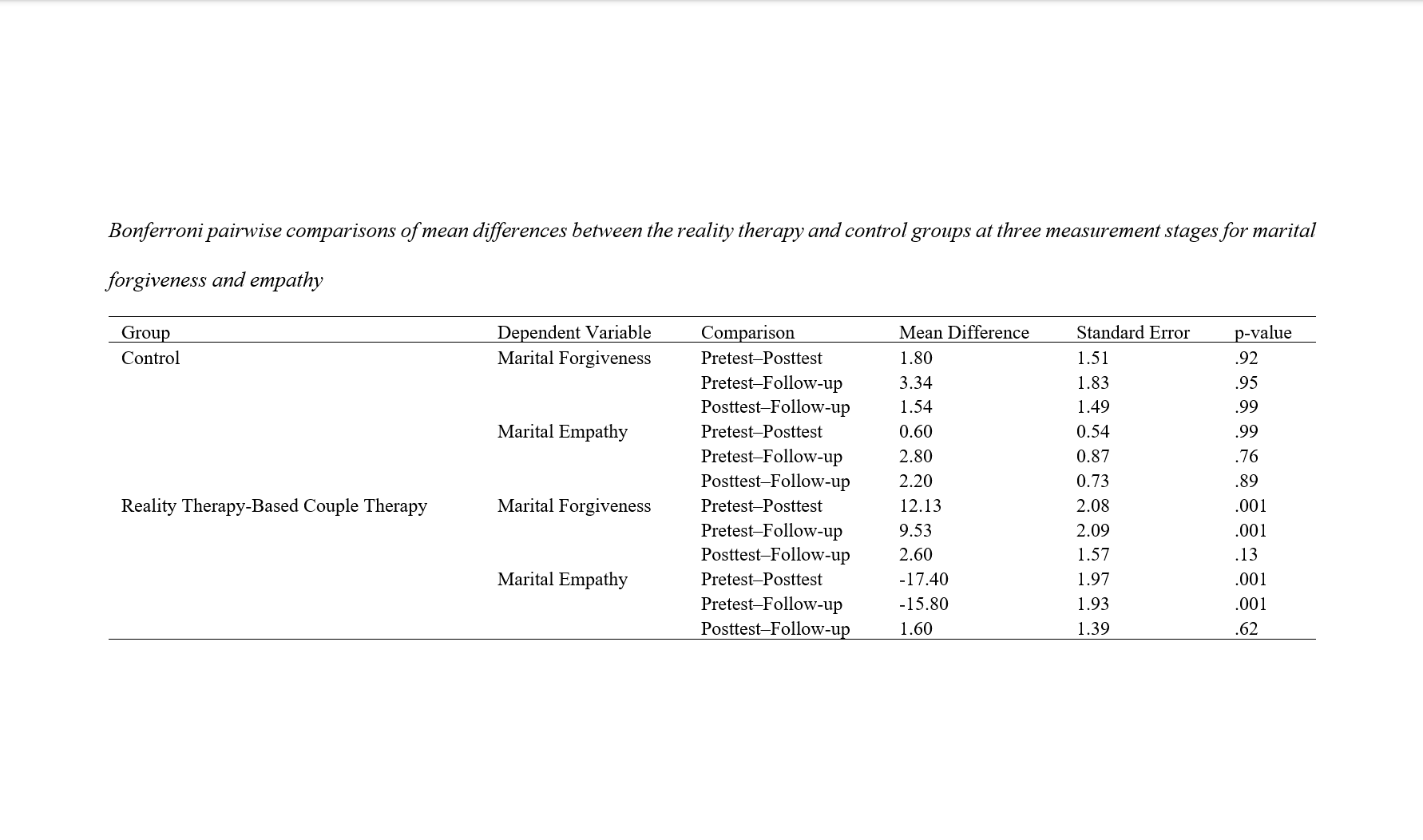
Findings: The results indicated significant differences in the mean scores of marital empathy and marital forgiveness between the pretest, posttest, and follow-up phases (P < .01). These effects remained stable during the follow-up phase, indicating that couple therapy based on the reality therapy approach significantly improved marital empathy and marital forgiveness.
Conclusion: Based on the findings of this study, couple therapy using the reality therapy approach can be considered an effective therapeutic method for enhancing marital forgiveness and empathy among couples
Downloads
References
Abreu-Afonso, J., Ramos, M. M., Queiroz-Garcia, I., & Leal, I. (2022). How couple's relationship lasts over time? A model for marital satisfaction. Psychological reportsVL - 125(3), 1601-1627. https://doi.org/10.1177/00332941211000651
Badakhshan, F., & Ghaffari, A. (2021). Comparison of the effectiveness of dialectical behavior therapy and reality therapy on family functions of women with conflict. Journal of Police Medicine, 10(4), 263-270. http://jpmed.ir/article-1-962-fa.html
Behrang, K., Koraei, A., Shahbazi, M., & Abbaspour, Z. (2022). Effects of Emotionally Focused Therapy on Sexual Assertiveness, Marital Forgiveness, and Marital Harmony in Maladjusted Couples. Journal of Research and Health, 12(3), 177-184. https://doi.org/10.32598/JRH.12.3.1986.1
Bogdan, I., Turliuc, M. N., & Candel, O. S. (2022). Transition to parenthood and marital satisfaction: A meta-analysis. Frontiers in psychology, 13, 901362. https://doi.org/10.3389/fpsyg.2022.901362
Brudek, P., & Kaleta, K. (2023). Marital offence-specific forgiveness as mediator in the relationships between personality traits and marital satisfaction among older couples: Perspectives on Lars Tornstam's theory of gerotranscendence. Ageing & Society, 43(1), 161-179. https://doi.org/10.1017/S0144686X21000465
Dong, S., Dong, Q., & Chen, H. (2022). Mothers' parenting stress, depression, marital conflict, and marital satisfaction: The moderating effect of fathers' empathy tendency. Journal of affective disorders, 299, 682-690. https://doi.org/10.1016/j.jad.2021.12.079
Farhadi, A., Salehin, S., Aghayan, S., Keramat, A., & Talebi, S. (2020). The effectiveness of reality therapy based on choice theory on marital intimacy and sexual satisfaction of newly married women. Avicenna Journal of Nursing and Midwifery Care, 28(2), 83-92. https://doi.org/10.30699/ajnmc.28.2.83
Goudarzi, A., & et al. (2020). The effectiveness of reality therapy on marital flexibility, marital burnout and social commitment in couples seeking divorce in Malayer. Women and Family Studies, 13(49), 7-27. https://jwsf.tabriz.iau.ir/article_675786.html
Hittner, E. F., & Haase, C. M. (2021). Empathy in context: Socioeconomic status as a moderator of the link between empathic accuracy and well-being in married couples. Journal of Social and Personal Relationships, 38(5), 1633-1654. https://doi.org/10.1177/0265407521990750
Jolliffe, D., & Farrington, D. P. (2006). Development and validation of the Basic Empathy Scale. Journal of adolescence, 29(4), 589-611. https://doi.org/10.1016/j.adolescence.2005.08.010
Kaleta, K., & Jaśkiewicz, A. (2024). Forgiveness in marriage: From incidents to marital satisfaction. Journal of Family Issues, 45(7), 1764-1788. https://doi.org/10.1177/0192513X231194294
Kazim, S. M., & Rafique, R. (2021). Predictors of marital satisfaction in individualistic and collectivist cultures: A mini review. Journal of Research in Psychology, 3(1), 55-67. https://doi.org/10.31580/jrp.v3i1.1958
Koleshtajani, E. J., Zabihi, R., & Yekta, M. A. (2022). The effectiveness of reality therapy on sexual satisfaction and marital intimacy of infertile women. Journal of education and health promotion, 11(1), 275. https://doi.org/10.4103/jehp.jehp_1106_21
Mahmoodian, L., Zanganeh Motlagh, F., & Dehstani, M. (2021). The effectiveness of" reality therapy" on marital disaffection and psychological welfare of married women. Journal of Health Promotion Management, 10(4), 96-107. https://jhpm.ir/article-1-1363-fa.html
Moridi, H., Kajbaf, M. B., & Mahmoodi, A. (2019). Study the effectiveness of Glaser's reality therapy on couples' marital satisfaction, life satisfaction, and communication skills. Armaghane Danesh, 24(5), 1013-1027. https://armaghanj.yums.ac.ir/article-1-2384-fa.html
Pavlenko, V., & Krasnikova, K. (2024). The Interconnection Between Empathy and the Quality of Marital Relations with Different Length of Marriage. Visnyk of VN Karazin Kharkiv National University. Series Psychology, 27(77). https://periodicals.karazin.ua/psychology/article/view/24748
Reza, F. A., Sudirman, S. A., & Mubarak, M. (2021). Marriage harmony: The role of empathy and forgiveness. Jurnal Studia Insania, 9(1), 32-50. https://doi.org/10.18592/jsi.v9i1.4085
Rye, M. S., & et al. (2001). Evaluation of the psychometric properties of two forgiveness scales. Current Psychology, 20, 260-277. https://doi.org/10.1007/s12144-001-1011-6
Sarı, F. B., & Cıhan, H. (2024). Development of Marital Forgiveness Scale in Turkish Culture: A Validity and Reliability of the Study. Turkish Psychological Counseling and Guidance Journal, 14(75), 538-554. https://eurekamag.com/research/093/832/093832679.php?srsltid=AfmBOoqfpSfANn9tr1iWbASEOOKWD6jheti9uQISZPSpOYO-XkgK21Tm
Wang, X., & Zhao, K. (2023). Partner phubbing and marital satisfaction: The mediating roles of marital interaction and marital conflict. Social Science Computer Review, 41(4), 1126-1139. https://doi.org/10.1177/08944393211072231
Downloads
Additional Files
Publication Timeline
- Submitted
- Revised
- Accepted
Issue
Section
License
Copyright (c) 2025 Mina Zargari Nejad (Author); Alizadeh Fard Sousan (Corresponding Author); Abdolvahid Davoodi (Author)

This work is licensed under a Creative Commons Attribution-NonCommercial 4.0 International License.