Exploring the Experiences of Women with OCD in Workplace: A Qualitative Study
DOI:
https://doi.org/10.61838/kman.aftj.5.4.29Keywords:
ADHD, women, professional settings, workplace challenges, coping strategies, workplace support, professionalAbstract
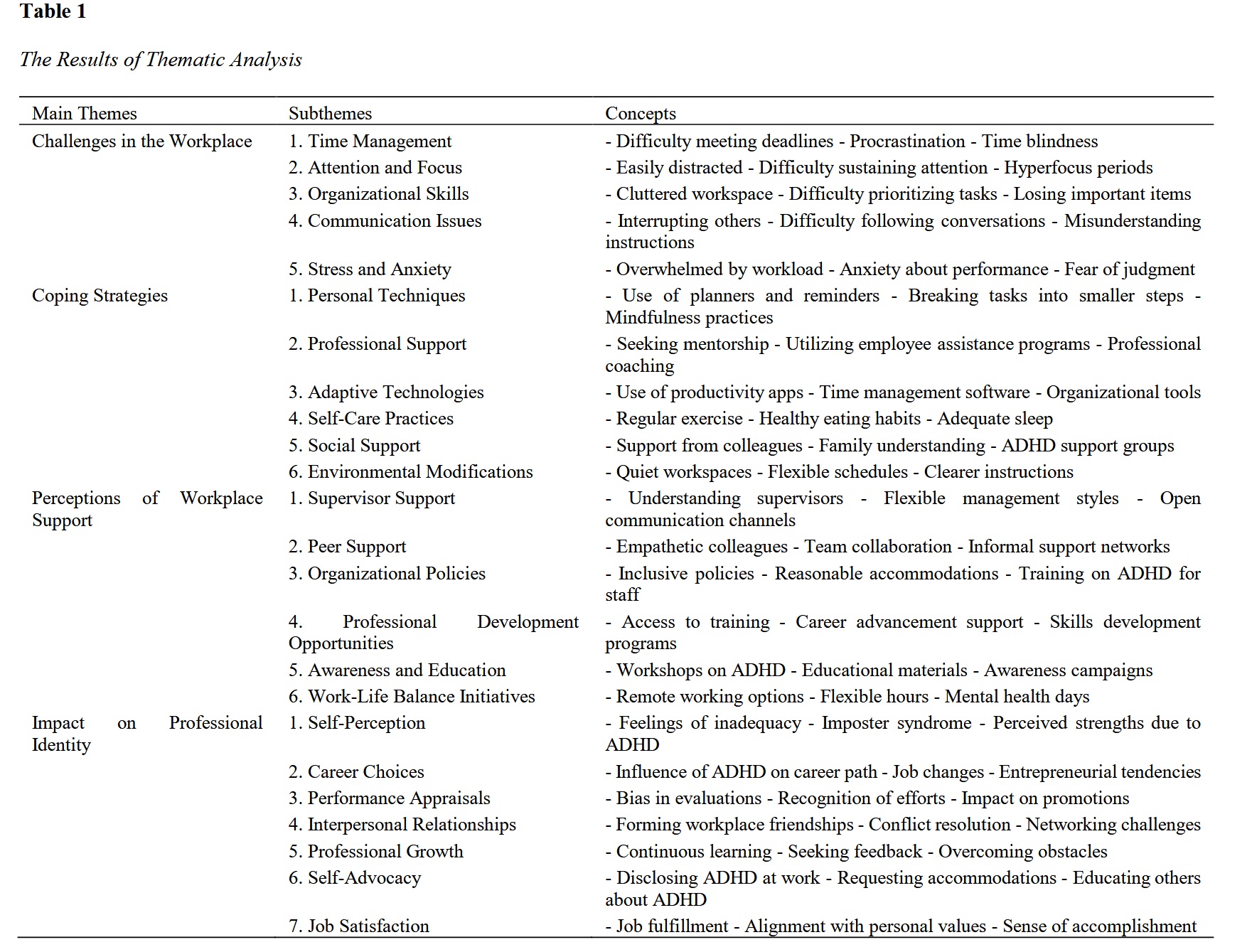
Obsessive-Compulsive Disorder (OCD) in women remains underexplored in occupational contexts, despite its significant impact on functioning and well-being. This study aims to explore the lived experiences of women with OCD in the workplace. Utilizing a qualitative, phenomenological approach, the research was conducted in Tehran, Iran. Semi-structured interviews were conducted with 19 employed women formally diagnosed with OCD across diverse professional sectors. Sampling continued until theoretical saturation was achieved. Interview transcripts were analyzed thematically using NVivo software. Four core themes emerged: Workplace Challenges, Coping Mechanisms, Perceived Organizational Support, and Effects on Professional Identity. Participants reported challenges such as intrusive thoughts during tasks, compulsive checking behaviors, time-consuming rituals, perfectionism, and heightened anxiety in high-pressure environments. Coping mechanisms included cognitive-behavioral strategies, medication adherence, mindfulness practices, supportive routines, and seeking social or therapeutic support. Perceptions of organizational support ranged widely, with positive experiences linked to empathetic supervisors, mental health accommodations, and flexible work structures. OCD also influenced participants’ professional identity, contributing to both self-doubt and the recognition of strengths such as attention to detail, reliability, and conscientiousness. These findings underscore the necessity for workplace awareness, mental health inclusivity, and targeted interventions to support women with OCD. Creating supportive and stigma-free environments can enhance these employees’ job satisfaction, engagement, and career development
Downloads
References
Abas, N. Q., & Qasim, S. (2023). Prevalence of Obsessive-Compulsive Disorder Among Psychology Students. Journal of Garmian University, 10(1), 274-283. https://doi.org/10.24271/jgu.2023.101023
Aboujaoude, E., & Starčević, V. (2021). Case Report: Doubts and Pre-Occupations About Being Transgender: Questioning One's Gender Identity or a Case of Obsessive-Compulsive Disorder? Frontiers in Psychiatry, 12. https://doi.org/10.3389/fpsyt.2021.644114
Azzahra, S. S., Akhyar, G., Yenny, S. W., Raveinal, & Burhan, I. R. (2025). Factors Associated With the Incidence of Occupational Contact Dermatitis of the Hands Among Cleaning Service Workers. Berkala Ilmu Kesehatan Kulit Dan Kelamin, 37(1), 21-27. https://doi.org/10.20473/bikk.v37.1.2025.21-27
Chen, Y., Ou, Y., Lv, D., Ma, J., Zhan, C., Yang, R., Jia, C., Shang, T., Sun, L., Wang, Y., Sun, Z., Zhang, G., Wang, X., Guo, W., & Li, P. (2021). Decreased Nucleus Accumbens Connectivity at Rest in Medication-Free Patients With Obsessive-Compulsive Disorder. Neural plasticity, 2021, 1-7. https://doi.org/10.1155/2021/9966378
Dessoki, H., Nasreldin, M., Elrassol, H. A. A., El-Sayed, S. G., & Soltan, M. R. (2021). Gender-Related Romantic Attachment and Serum Oxytocin Level Difference in Adult Patients With Obsessive Compulsive Disorder. Middle East Current Psychiatry, 28(1). https://doi.org/10.1186/s43045-021-00159-9
Febriana, S. A., Erdina, Dewi, K., Ridora, Y., Anggraeni, A., Indrastuti, N., Waskito, F., Oginawati, K., Tanziha, I., & Prakoeswa, C. R. S. (2023). Risk Factors of Occupational Skin Diseases Among Traditional Batik Manufacturing Workers in Yogyakarta, Indonesia. BMC research notes, 16(1). https://doi.org/10.1186/s13104-022-06105-0
Hühne, V., Santos-Ribeiro, S. d., Moreira‐de‐Oliveira, M. E., Menezes, G. B. d., & Fontenelle, L. F. (2024). Towards the Correlates of Stressful Life Events as Precipitants of Obsessive-Compulsive Disorder: A Systematic Review and Metanalysis. CNS Spectrums, 29(4), 252-260. https://doi.org/10.1017/s1092852924000269
Jabeen, S., & Kausar, R. (2020). Obsessive Compulsive Disorder: Frequency and Gender Estimates. Pakistan Journal of Medical Sciences, 36(5). https://doi.org/10.12669/pjms.36.5.1870
Jalalifar, E., Arad, A., Rastkar, M., & Beheshti, R. (2023). The COVID-19 Pandemic and Obsessive-Compulsive Disorder: A Systematic Review of Comparisons Between Males and Females. Acta Neuropsychiatrica, 35(5), 270-291. https://doi.org/10.1017/neu.2023.15
Jianliang, L. (2023). Gender Differences in the Symptoms and Physiological Basis of Obsessive-Compulsive Disorder. Theoretical and Natural Science, 8(1), 103-108. https://doi.org/10.54254/2753-8818/8/20240366
K, K., & Zaboski, B. A. (2024). Social Support in Obsessive-Compulsive Disorder: The Relationships Between Social Support and Readiness to Change. Bulletin of the Menninger clinic, 88(4), 320-335. https://doi.org/10.1521/bumc.2024.88.4.320
Knapton, O. (2020). Framing the Onset of Obsessive-Compulsive Disorder (OCD). 281-304. https://doi.org/10.1075/dapsac.87.10kna
Li, Q., Yan, J., Liao, J., Zhang, X., Liu, L., Fu, X., Tan, H. Y., Zhang, D., & Yan, H. (2020). Distinct Effects of Social Stress on Working Memory in Obsessive-Compulsive Disorder. Neuroscience Bulletin, 37(1), 81-93. https://doi.org/10.1007/s12264-020-00579-3
Lieneman, C., Guastello, A. D., Munson, M. S., Barthle-Herrera, M. A., Bailey, B. A., Higham, M., Druskin, L. R., & McNeil, C. B. (2024). Conceptualizing Co-Occurring Autism Spectrum Disorder, Obsessive-Compulsive Disorder, and Gender Diversity in Adolescents: A Narrative Review. Journal of Indian Association for Child and Adolescent Mental Health, 20(2), 97-110. https://doi.org/10.1177/09731342241252560
Ma, X., Megli, A., Pittenger, C., & Pushkarskaya, H. (2021). OCD Influences Evidence Accumulation During Decision Making in Males but Not Females During Perceptual and Value-Driven Choice. Frontiers in Psychiatry, 12. https://doi.org/10.3389/fpsyt.2021.687680
Moreira‐de‐Oliveira, M. E., Menezes, G. B. d., Laurito, L. D., Loureiro, C. P., Santos-Ribeiro, S. d., & Fontenelle, L. F. (2022). A Longitudinal Evaluation of Free Will Related Cognitions in Obsessive–compulsive Disorder. BMC psychiatry, 22(1). https://doi.org/10.1186/s12888-022-04108-6
Pinciotti, C. M., Nuñez, M., Riemann, B. C., & Bailey, B. E. (2022). Clinical Presentation and Treatment Trajectory of Gender Minority Patients With Obsessive-Compulsive Disorder. Journal of Cognitive Psychotherapy, 36(1), 42-59. https://doi.org/10.1891/jcpsy-d-20-00022
Pozza, A., Marazziti, D., Mucci, F., & Dèttore, D. (2019). Propensity to Sexual Response Among Adults With Obsessive-Compulsive Disorder. Clinical Practice and Epidemiology in Mental Health, 15(1), 126-133. https://doi.org/10.2174/1745017901915010126
Ranjan, L. K., Gujar, N. M., & Gupta, P. R. (2022). Sociodemographic Predictors of Perceived Expressed Emotions and Self-Esteem in Persons With Obsessive-Compulsive Disorder. Journal of Mental Health and Human Behaviour, 27(1), 35-40. https://doi.org/10.4103/jmhhb.jmhhb_171_21
Rao, A., Kelleher, D., Miller, C., Sandler, J., Stuart, R., & Principe, T. (2016). Gender at Work: An Experiment in “Doing Gender”. 155-173. https://doi.org/10.1007/978-3-319-47045-0_10
Tyagi, H., & Bundies, G. L. (2021). Resolving the Discrepancies of Suicide Risk in Obsessive-Compulsive Patients: A Review of Incidence Rates and Risk Factors of Suicide and Suicide Attempts in OCD. BJPsych Open, 7(S1), S297-S297. https://doi.org/10.1192/bjo.2021.787
Williams, M. T., Taylor, R. J., Mouzon, D. M., Oshin, L. A., Himle, J. A., & Chatters, L. M. (2017). Discrimination and Symptoms of Obsessive–compulsive Disorder Among African Americans. American Journal of Orthopsychiatry, 87(6), 636-645. https://doi.org/10.1037/ort0000285
Zandt, M. V., Olfson, E., Stahnke, B., Taylor, S., Bloch, M. H., Pittenger, C., & Pushkarskaya, H. (2025). Sex and Gender Differences in OCD: A Scoping Review. https://doi.org/10.1101/2025.02.08.25321933
Downloads
Additional Files
Publication Timeline
- Submitted
- Revised
- Accepted
Issue
Section
License
Copyright (c) 2024 Suzan Khazaeipul, Mitra Teymouri, Hengame Alimardani, Raziyeh Bagheri (Author); Zeinab Ghorbanzadeh Korani (Corresponding Author)

This work is licensed under a Creative Commons Attribution-NonCommercial 4.0 International License.