Comparison of the Effectiveness of Cognitive-Behavioral Interventions in Two Approaches: Coaching and Self-Learning on Marital Satisfaction and Intimacy of Couples
DOI:
https://doi.org/10.61838/kman.aftj.4117Keywords:
cognitive-behavioral interventions, coaching, self-learning, marital satisfaction, marital intimacyAbstract
Objective: This study aimed to compare the effectiveness of cognitive-behavioral interventions using coaching and self-learning methods on marital satisfaction and couple intimacy.
Methods and Materials: This semi-experimental study followed a pre-test–post-test design with a control group and two experimental groups (coaching and self-learning). The statistical population consisted of couples who visited family counseling centers in District 8 of Tehran in 2022 and reported low levels of marital satisfaction and intimacy. A purposive sampling method was used to select 45 participants, who were equally divided into three groups of 15. The coaching group received eight 90-minute cognitive-behavioral sessions, while the self-learning group was given a structured 73-page manual to follow independently over two months. The control group received no intervention. Data were collected using the ENRICH Marital Satisfaction Questionnaire and the Thompson and Walker Marital Intimacy Scale. Analysis of covariance (ANCOVA) and multivariate analysis of covariance (MANCOVA) were used to analyze the results.
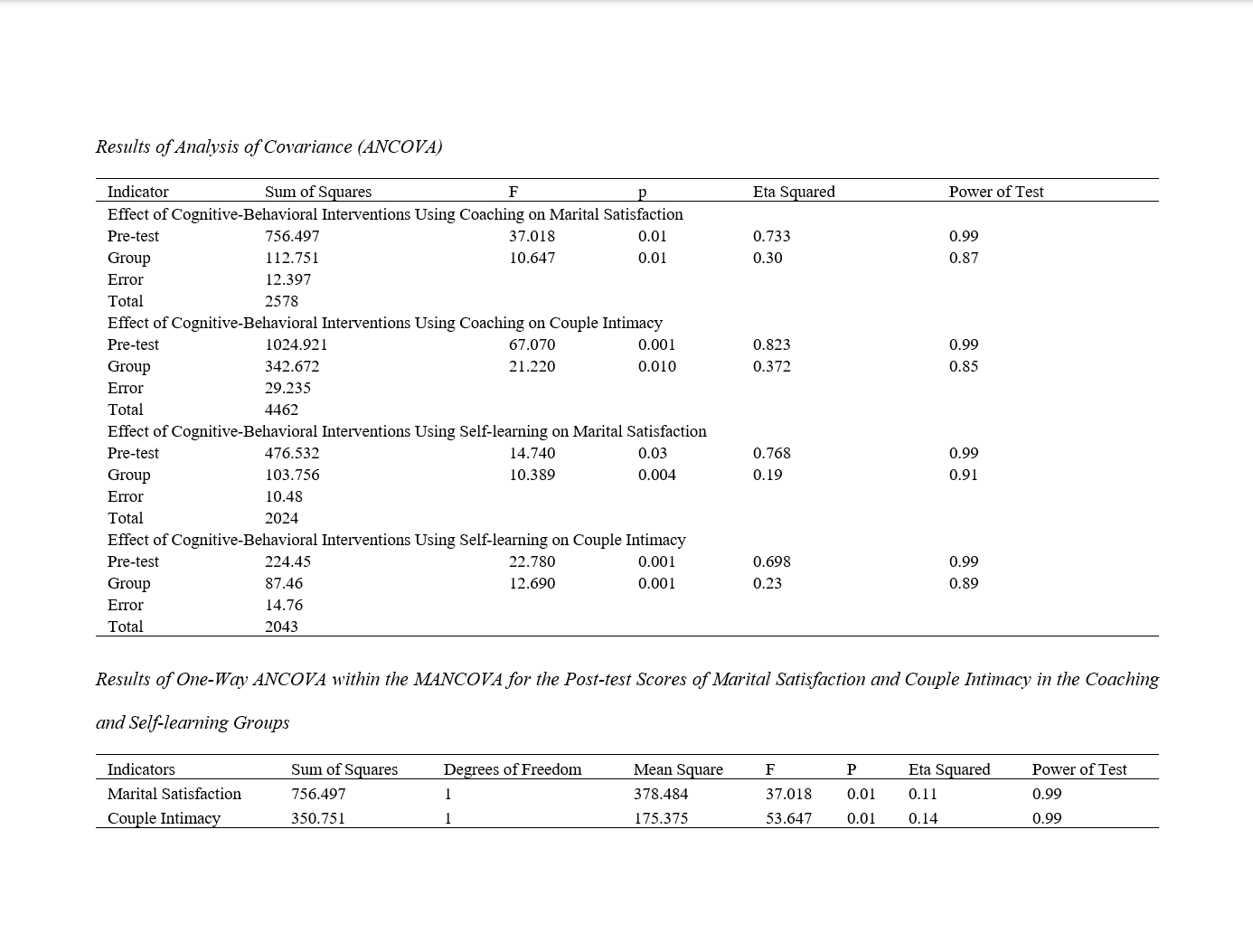
Findings: ANCOVA results indicated that cognitive-behavioral interventions using the coaching method significantly improved marital satisfaction (η² = 0.30, p < .01) and couple intimacy (η² = 0.372, p < .01), compared to the control group. Similarly, the self-learning method showed significant improvement in marital satisfaction (η² = 0.19, p < .01) and intimacy (η² = 0.23, p < .01), although the effect sizes were smaller.
Conclusion: Cognitive-behavioral interventions, particularly through coaching, are effective in enhancing marital satisfaction and intimacy. The presence of a coach facilitates deeper understanding, accountability, and behavioral change, making it a more impactful approach compared to self-directed learning.
Downloads
References
Abdekhodaie, Z. (2021). Cognitive-Behavioral and Existential Therapies for Marital Satisfaction in Women: A Comparative Investigation of the Efficacy, Stability and Mechanisms of Changes. Journal of Contemporary Psychotherapy, 51(2), 173-179. https://doi.org/10.1007/s10879-020-09488-y
Akbari, B., Moghaddar, L., & Khakbiz, K. (2018). Comparison of the Effectiveness of Communication Skills Training and Cognitive Behavioral Therapy in Enhancing Marital Satisfaction and Happiness of Couples with Sexual Desire Disorders. Research Journal of Sabzevar University of Medical Sciences, 27(4), 605-612. https://jsums.medsab.ac.ir/article_1334.html
Alizadeh, M., AkbariTorkestani, N., Oohadi, B., & Mehrabirazveh, F. (2018). Effectiveness of Cognitive-Behavioral Counseling Based on Film Therapy on the Marital Satisfaction of Women with Low Sex Drive. Preventive Care In Nursing and Midwifery Journal, 8(1), 19-27. https://doi.org/10.29252/pcnm.8.1.19
Bagarozzi, D. A. (2014). Enhancing intimacy in marriage: A clinician's guide. routledge. https://doi.org/10.4324/9781315787053
Bedair, K., Hamza, E. A., & Gladding, S. T. (2020). Attachment style, marital satisfaction, and mutual support attachment style in Qatar. The Family Journal, 28(3), 329-336. https://doi.org/10.1177/1066480720934377
Bélanger, C., Laporte, L., Sabourin, S., & Wright, J. (2015). The effect of cognitive-behavioral group marital therapy on marital happiness and problem solving self-appraisal. The American Journal of Family Therapy, 43(2), 103EP - 118. https://doi.org/10.1080/01926187.2014.956614
Bossio, J. A., Higano, C. S., & Brotto, L. A. (2021). Preliminary development of a mindfulness-based group therapy to expand couples' sexual intimacy after prostate cancer: a mixed methods approach. Sexual Medicine, 9(2), 100310. https://doi.org/10.1016/j.esxm.2020.100310
Defanti, R. (2025). The Role of Emotional Intelligence in Moderating the Relationship Between Perceived Interparental Conflict and Marital Satisfaction Among Married Individuals. Jurnal Ilmu Keluarga Dan Konsumen, 18(1), 53-65. https://doi.org/10.24156/jikk.2025.18.1.53
Dowlati, Y., Segal, Z. V., Ravindran, A. V., Steiner, M., Stewart, D. E., & Meyer, J. H. (2014). Effect of dysfunctional attitudes and postpartum state on vulnerability to depressed mood. Journal of affective disorders, 161, 16-20. https://doi.org/10.1016/j.jad.2014.02.047
Ebadi, Z., Pasha, R., Hafezi, F., & Eftekhar, Z. (2018). The effectiveness of cognitive behavioral therapy on marital intimacy and identification of the basic psychological needs among couples referring to counseling centers. Avicenna Journal of Neuro Psycho Physiology, 5(4), 189-196. https://doi.org/10.32598/ajnpp.4.3.290
Ellis, A., Sichel, J. L., Yeager, R. J., DiMattia, D. J., & DiGiuseppe, R. (2019). Rational-emotive couples therapy. Pergamon Press. https://www.amazon.com/Rational-Emotive-Couples-Therapy-Albert/dp/008035758X
Epstein, N. B., & Baucom, D. H. (2018). Enhanced cognitive-behavioral therapy for couples: A contextual approach. American Psychological Association. https://www.apa.org/pubs/books/431790A
Ghochani, M., Toosi, M. S., & Khoynezhad, G. (2020). A comparison between the effectiveness of the combined couple therapy and emotionally focused therapy for couples on the improvement of intimacy and PTSD. Learning and Motivation, 71SP - 101637. https://doi.org/10.1016/j.lmot.2020.101637
Golyan, G. F., Sadeghifard, M., & Yosefi, E. (2025). Comparing the Effectiveness of Solution-Focused Narrative Therapy and Solution-Focused Therapy on Resilience and Marital Intimacy of Couples in Conflict (Counseling Centers of Shirvan County). Hn, 3(1), 21-32. https://doi.org/10.61838/kman.hn.3.1.4
Hosseinpour, M., Shahrooyi, S., Abadi, N., & Heydari, D. (2018). Examining the Effectiveness of Family Therapy Training Using the Cognitive-Behavioral Approach on Marital Satisfaction The Impact of Cognitive Behavioral Couple Therapy on Couples' Intimacy. New Findings in Psychology Journal, 19(2), 95-106. https://www.sid.ir/fa/journal/ViewPaper.aspx?id=124234
Ismail, R., Hafezi, M. H., MohdNor, R., & Baghini, M. S. (2014). Study of happiness rate and life satisfaction in Malaysia. Research Journal of Applied Sciences, Engineering and Technology, 7(7), 1426-1431. https://doi.org/10.19026/rjaset.7.412
Kajbaf, M., Farahmarzi, S., & Hosseini, F. (2012). Examining the Effectiveness of Cognitive-Behavioral Therapy on Female Arousal Disorders and Couples' Intimacy in Women with Low Sexual Desire in Bandar Abbas. Quarterly Journal of Family Counseling and Psychotherapy, 2(3), 307-321. https://fcp.uok.ac.ir/article_9554.html
Khalatbari, J., & Karimi, B. (2017). The Effectiveness of Cognitive Behavioral Therapy on Marital Boredom, Marital Satisfaction, and Couples' Intimacy. Quarterly Journal of Educational Psychology, 8(1), 65-74. https://journals.iau.ir/article_595337.html
Khojasteh Mehr, R., Ahmadi Ghozlojeh, A., Sodani, M., & Shirali Nia, K. (2016). Eeffectiveness of brief integrative couples counseling on emotional intimacy and marital quality of couples. Contemporary Psychology, Biannual Journal of the Iranian Psychological Association, 10(2), 29-40. https://bjcp.ir/browse.php?a_id=896&sid=1&slc_lang=fa
Marker, N. (2025). A Strained Relationship With the Mother-in-Law: Can It Affect a Woman’s Marital Satisfaction? International Journal of Neurolinguistics & Gestalt Psychology, 5(1). https://doi.org/10.52522/ijngp.v5i1.8
Mohammadi, F., Bayat, M. R., & Gholami Korherodi, S. (2023). Evaluating the Effect of Relationship Enrichment Program Based on Cognitive Behavior Therapy and Emotion-Oriented Couple Therapy on Marital Intimacy and Adjustment in Couples Involved in Domestic Violence. mui-jbs, 21(2), 289-303. https://rbs.mui.ac.ir/article-1-1521-en.pdf
Odebunmi, O., & Сабіна, Н. Ю. (2025). Emotional Regulation as a Mediator of Personality Traits and Marital Satisfaction Among Academic Staff in Colleges of Education in Oyo State. Mejaee. https://doi.org/10.70382/mejaee.v7i8.028
Omidpour, S., Attari, A., & Hamid, N. (2015). Examining the Effectiveness of Communication Skills Training Using the Cognitive Behavioral Approach on Enhancing Intimacy and Marital Satisfaction of Couples. Jundishapur Medical Sciences Journal, 14(2), 223-229. https://jsmj.ajums.ac.ir/article_47012.html
Poulsen, S. (2015). Interracial couples, intimacy, and therapy: Crossing racial boundaries. Journal of marital and family therapy, 41(1), 128. https://doi.org/10.1111/jmft.12072
Pouya, F. H. (2025). The Structural Model for Predicting Marital Burnout Based on Attachment Styles With the Mediating Role of Marital Self-Regulation and Marital Intimacy in Married Individuals. Aftj, 6(1), 29-36. https://doi.org/10.61838/kman.aftj.6.1.4
Rahimi, A., Amiri, H., Afsharriniya, K., & Arefi, M. (2020). Comparing the Effectiveness of Cognitive Behavioral Therapy (CBT) with Acceptance and Commitment Therapy (ACT) in the Enhancement of Marital Satisfaction and Sexual Intimacy in Couples Referred to Counseling Centers. Avicenna Journal of Neuro Psycho Physiology, 7(2), 126-132. https://doi.org/10.32592/ajnpp.2020.7.2.107
Rajabi, G., Karjou, S., & Jabari, H. (2011). The Impact of Cognitive Couple Therapy on Reducing Depression and Increasing Marital Satisfaction. Clinical Psychology Journal, 2(4), 9-17. https://jcp.semnan.ac.ir/article_2034.html
Sadegh, J., & Kazemi, R. (2014). Examining the Effectiveness of Cognitive Behavioral Therapy on Increasing Marital Satisfaction in Vasectomized Men. Third National Conference on Mental Health and Well-beingER -,
Sousa, D. A. U. P. A., & Tavares, A. (2019). Self-awareness, verbalization and new meanings as the heart and soul of significant events in existential psychotherapy. Journal of Contemporary Psychotherapy, 49(3), 161-167. https://doi.org/10.1007/s10879-018-9410-2
Tavakkolizadeh, J., & Haji Vosough, N. (2013). Investigating the Impact of Cognitive-Behavioral Training on Marital Satisfaction in Women with Low Sexual Desire. Research Journal of Ilam University of Medical Sciences, 21(5), 44-50. https://sjimu.medilam.ac.ir/browse.php?a_id=502&sid=1&slc_lang=fa
Weiss, M., Murray, C., Wasdell, M., Greenfield, B., Giles, L., & Hechtman, L. (2012). A randomized controlled trial of CBT therapy for adults with ADHD with and without medication. BMC psychiatry, 12(1), 1-8. https://doi.org/10.1186/1471-244X-12-30
Downloads
Additional Files
Publication Timeline
- Submitted
- Revised
- Accepted
Issue
Section
License
Copyright (c) 2025 Negar Sedaghat (Author); Majid Safarinia (Corresponding Author); Elaheh Sadeghi (Author)

This work is licensed under a Creative Commons Attribution-NonCommercial 4.0 International License.