Components of Collective Coping in Families Facing Chronic Illness
DOI:
https://doi.org/10.61838/kman.aftj.4410Keywords:
Collective coping, communal coping, chronic illness, family resilience, qualitative study, IrelandAbstract
Objective: This study aimed to explore the core components of collective coping in families managing the challenges of chronic illness, focusing on how emotional, relational, and social processes interact to sustain resilience.
Methods and Materials: A qualitative research design was employed using semi-structured interviews with 20 family members of patients living with chronic illness in Ireland. Participants were recruited through purposive sampling to ensure variation in roles, including spouses, parents, adult children, and siblings. Interviews were conducted either face-to-face or via secure online platforms, with each lasting between 60 and 90 minutes. Data collection continued until theoretical saturation was reached. Transcripts were analyzed thematically using NVivo software version 14, following an iterative coding process of open coding, categorization, and theme development. Reflexivity and peer debriefing were used to enhance credibility and trustworthiness.
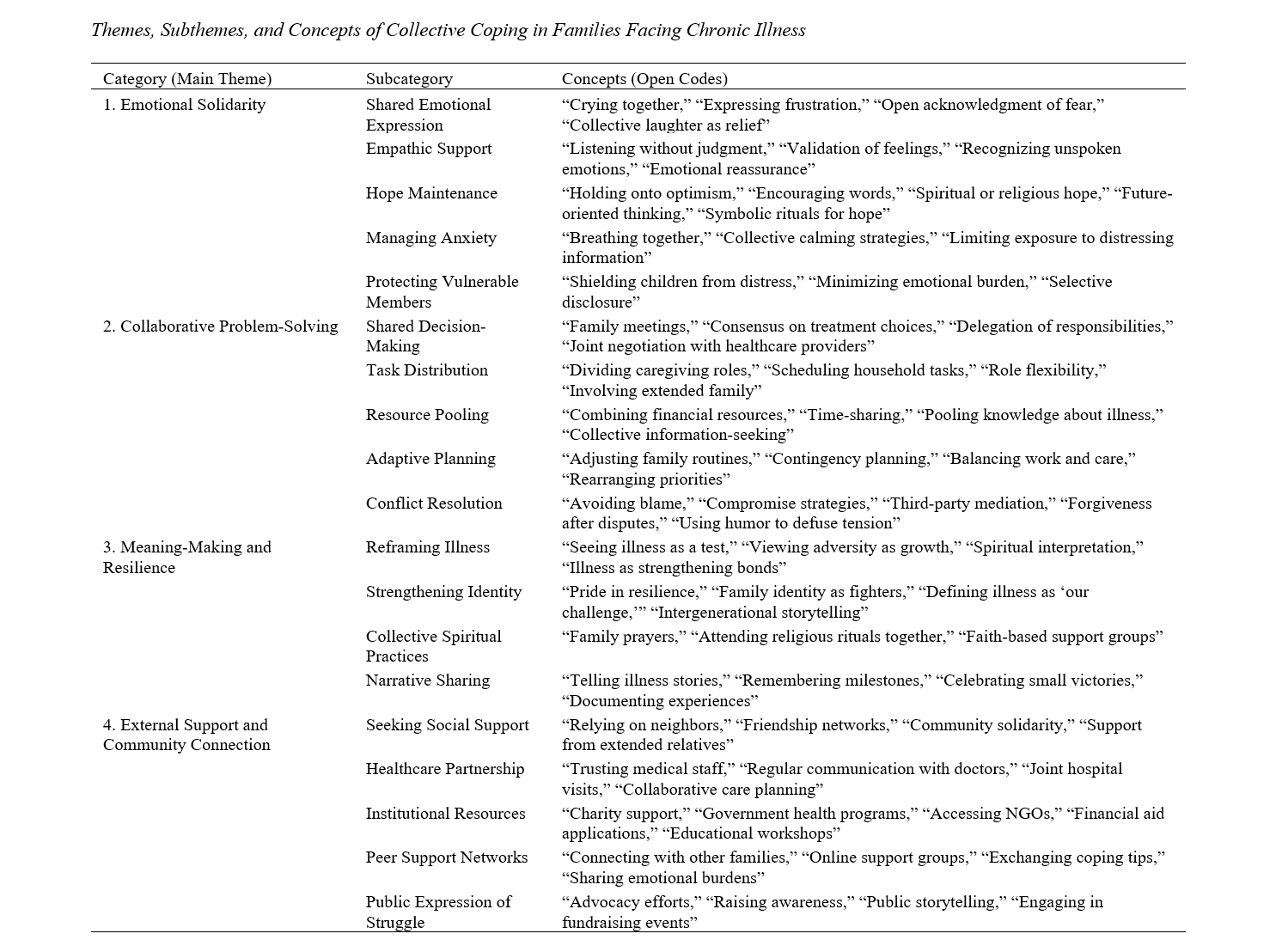
Findings: Four overarching themes emerged, each encompassing multiple subthemes. Emotional solidarity captured shared emotional expression, empathic support, hope maintenance, anxiety management, and the protection of vulnerable members. Collaborative problem-solving included shared decision-making, role and task distribution, resource pooling, adaptive planning, and conflict resolution. Meaning-making and resilience reflected reframing illness as a shared challenge, strengthening family identity, engaging in collective spiritual practices, and narrative sharing. External support and community connection encompassed reliance on social networks, healthcare partnerships, institutional support, peer networks, and advocacy. Collectively, these themes highlighted coping as a relational and communal process rather than an individual endeavor.
Conclusion: The findings underscore that coping with chronic illness within families is fundamentally collective, rooted in shared appraisals, collaboration, and external resource integration. Recognizing these dynamics offers valuable insights for healthcare professionals and policy makers seeking to design family-centered interventions that enhance resilience and well-being.
Downloads
References
Albuquerque, S., Ferreira, L. C., Narciso, I., & Pereira, M. (2017). Parents’ Positive Interpersonal Coping After a Child’s Death. Journal of Child and Family Studies, 26(7), 1817-1830. https://doi.org/10.1007/s10826-017-0697-5
Basinger, E. D. (2017). Explicating the Appraisal Dimension of the Communal Coping Model. Health Communication, 33(6), 690-699. https://doi.org/10.1080/10410236.2017.1300208
Basinger, E. D., Wehrman, E. C., Delaney, A. L., & McAninch, K. G. (2021). Couples Managing Chronic Illness: A Test of the Extended Theoretical Model of Communal Coping. Journal of Social and Personal Relationships, 38(5), 1611-1632. https://doi.org/10.1177/0265407521999461
Ben‐Zur, H., Yagil, D., & Oz, D. (2005). Coping Strategies and Leadership in the Adaptation to Social Change: The Israeli Kibbutz. Anxiety Stress & Coping, 18(2), 87-103. https://doi.org/10.1080/10615800500093702
Berg, C. A., Helgeson, V. S., Tracy, E. L., Butner, J., Kelly, C. S., Vleet, M. V., & Litchman, M. L. (2020). Daily Illness Appraisal and Collaboration in Couples With Type 1 Diabetes. Health Psychology, 39(8), 689-699. https://doi.org/10.1037/hea0000871
Berg, C. A., Skinner, M., Ko, K. J., Butler, J., Palmer, D. L., Butner, J., & Wiebe, D. J. (2009). The Fit Between Stress Appraisal and Dyadic Coping in Understanding Perceived Coping Effectiveness for Adolescents With Type 1 Diabetes. Journal of Family Psychology, 23(4), 521-530. https://doi.org/10.1037/a0015556
Bippus, A. M., & Young, S. L. (2012). Using Appraisal Theory to Predict Emotional and Coping Responses to Hurtful Messages. Interpersona an International Journal on Personal Relationships, 6(2), 176-190. https://doi.org/10.5964/ijpr.v6i2.99
Bubeck, P., Botzen, W. J. W., Laudan, J., Jeroen, C. J. H. A., & Thieken, A. H. (2017). Insights Into Flood‐Coping Appraisals of Protection Motivation Theory: Empirical Evidence From Germany and France. Risk Analysis, 38(6), 1239-1257. https://doi.org/10.1111/risa.12938
Cho, H., Li, P., & Goh, Z. H. (2020). Privacy Risks, Emotions, and Social Media. Acm Transactions on Computer-Human Interaction, 27(6), 1-28. https://doi.org/10.1145/3412367
Dunkley, D. M., Ma, D., Lee, I. A., Preacher, K. J., & Zuroff, D. C. (2014). Advancing Complex Explanatory Conceptualizations of Daily Negative and Positive Affect: Trigger and Maintenance Coping Action Patterns. Journal of counseling psychology, 61(1), 93-109. https://doi.org/10.1037/a0034673
Guribye, E., Sandal, G. M., & Oppedal, B. (2011). Communal Proactive Coping Strategies Among Tamil Refugees in Norway: A Case Study in a Naturalistic Setting. International Journal of Mental Health Systems, 5(1), 9. https://doi.org/10.1186/1752-4458-5-9
Helgeson, V. S., Jakubiak, B. K., Seltman, H., Hausmann, L. R. M., & Korytkowski, M. T. (2016). Implicit and Explicit Communal Coping in Couples With Recently Diagnosed Type 2 Diabetes. Journal of Social and Personal Relationships, 34(7), 1099-1121. https://doi.org/10.1177/0265407516669604
Helgeson, V. S., Jakubiak, B. K., Vleet, M. V., & Zajdel, M. (2017). Communal Coping and Adjustment to Chronic Illness: Theory Update and Evidence. Personality and Social Psychology Review, 22(2), 170-195. https://doi.org/10.1177/1088868317735767
Helgeson, V. S., Naqvi, J. B., Seltman, H., Vaughn, A. K., Korytkowski, M. T., Hausmann, L. R. M., & Gary‐Webb, T. L. (2019). Links of Communal Coping to Relationship and Psychological Health in Type 2 Diabetes: Actor–partner Interdependence Models Involving Role, Sex, and Race. Annals of Behavioral Medicine, 54(5), 346-359. https://doi.org/10.1093/abm/kaz052
Helgeson, V. S., Naqvi, J. B., Zajdel, M., & Horner, F. S. (2021). Communal Coping Manifested in Daily Life: A Focus on Gender. Journal of Social and Personal Relationships, 39(4), 1023-1042. https://doi.org/10.1177/02654075211052633
Helgeson, V. S., & Vleet, M. V. (2019). Short Report: Inclusion of Other in the Self Scale: An Adaptation and Exploration in a Diverse Community Sample. Journal of Social and Personal Relationships, 36(11-12), 4048-4056. https://doi.org/10.1177/0265407519848491
Horner, F. S., & Helgeson, V. S. (2022). Actor and Partner Effects of Positive Affect on Communal Coping. Journal of Social and Personal Relationships, 39(12), 3799-3820. https://doi.org/10.1177/02654075221110628
Jordan, E. J., & Vogt, C. A. (2017). Appraisal and Coping Responses to Tourism Development-Related Stress. Tourism Analysis, 22(1), 1-18. https://doi.org/10.3727/108354217x14828625279573
Kelley, Z., & Helgeson, V. S. (2025). The Links of Communal Coping With Racial Discrimination to Relationship and Well-Being Outcomes. Journal of Social and Personal Relationships. https://doi.org/10.1177/02654075251334478
Novak, J. R., Johnson, A. L., Gast, J., Peak, T., & Arnell, M. (2020). A Qualitative Inquiry on Religious Married Men’s Perceptions of Relationship Dynamics During Everyday Sickness. Journal of Health Psychology, 26(11), 2040-2055. https://doi.org/10.1177/1359105319900277
Ort, A., & Fahr, A. (2018). Using Efficacy Cues in Persuasive Health Communication Is More Effective Than Employing Threats – An Experimental Study of a Vaccination Intervention Against Ebola. British Journal of Health Psychology, 23(3), 665-684. https://doi.org/10.1111/bjhp.12310
Rentscher, K. E. (2019). Communal Coping in Couples With Health Problems. Frontiers in psychology, 10. https://doi.org/10.3389/fpsyg.2019.00398
Scheinfeld, E., Tenzek, K. E., & Cherry, J. (2024). Embracing Endings: Unveiling the Connection Between Final Conversations, the Opportunity Model for Presence, and Coping With the Death of Our Parents. OMEGA - Journal of Death and Dying. https://doi.org/10.1177/00302228241278770
Thompson, S. F., Lengua, L. J., & Garcia, C. M. (2015). Appraisal and Coping as Mediators of the Effects of Cumulative Risk on Preadolescent Adjustment. Journal of Child and Family Studies, 25(5), 1416-1429. https://doi.org/10.1007/s10826-015-0338-9
Thompson, S. F., Zalewski, M., & Lengua, L. J. (2014). Appraisal and Coping Styles Account for the Effects of Temperament on Pre‐adolescent Adjustment. Australian Journal of Psychology, 66(2), 122-129. https://doi.org/10.1111/ajpy.12048
Vleet, M. V., Helgeson, V. S., Seltman, H., Korytkowski, M. T., & Hausmann, L. R. M. (2018a). Communally Coping With Diabetes: An Observational Investigation Using the Actor-Partner Interdependence Model. Journal of Family Psychology, 32(5), 654-663. https://doi.org/10.1037/fam0000414
Vleet, M. V., Helgeson, V. S., Seltman, H., Korytkowski, M. T., & Hausmann, L. R. M. (2018b). An Examination of the Communal Coping Process in Recently Diagnosed Diabetes. Journal of Social and Personal Relationships, 36(4), 1297-1316. https://doi.org/10.1177/0265407518761226
Wolf, B., & Fisher, C. L. (2022). Stress, Appraisal, and Coping Theory. 1-6. https://doi.org/10.1002/9781119678816.iehc0669
Yi, Y., Xu, D., Tao, W., & Lee, Y. (2024). We Are Sidekicks! Concretizing the Antecedents and Outcomes of Communal Coping in the COVID‐19 Crisis Renewal. Journal of Contingencies and Crisis Management, 32(1). https://doi.org/10.1111/1468-5973.12557
Zajdel, M., & Helgeson, V. S. (2020). Communal Coping: A Multi-Method Approach With Links to Relationships and Health. Journal of Social and Personal Relationships, 37(5), 1700-1721. https://doi.org/10.1177/0265407520903811
Zajdel, M., & Helgeson, V. S. (2021). An Experimental Approach to Communal Coping. Journal of Social and Personal Relationships, 38(4), 1380-1400. https://doi.org/10.1177/0265407521992464
Zajdel, M., & Helgeson, V. S. (2024). A Communal Coping Intervention for Couples Managing Chronic Illness: Proof-of-Concept Study. Couple and Family Psychology Research and Practice, 13(3), 188-201. https://doi.org/10.1037/cfp0000234
Zajdel, M., Helgeson, V. S., Butner, J., Tracy, E. L., & Berg, C. A. (2022). A Multimethod Approach to Measuring Communal Coping in Adults With Type 1 Diabetes. Health Psychology, 41(1), 23-31. https://doi.org/10.1037/hea0001123
Zajdel, M., Naqvi, J. B., Niezink, N. M. D., & Helgeson, V. S. (2022). Links of Daily Shared Appraisal and Collaboration to Support, Mood, and Self-Care in Type 2 Diabetes. Journal of Social and Personal Relationships, 40(6), 1961-1986. https://doi.org/10.1177/02654075221135873
Zalewski, M., Lengua, L. J., Wilson, A. C., Trancik, A., & Bazinet, A. (2011). Associations of Coping and Appraisal Styles With Emotion Regulation During Preadolescence. Journal of Experimental Child Psychology, 110(2), 141-158. https://doi.org/10.1016/j.jecp.2011.03.001
Zheng, H., Fan, X., Liu, Y., Wu, Y., Liu, Y., Xu, Y., Zhi, J., Yang, C., & Liao, J. (2024). How Dyadic Appraisal Moderate the Association Between Dyadic Coping and Diabetes Management Efficacy. Journal of Health Psychology, 30(5), 845-857. https://doi.org/10.1177/13591053241240735
Downloads
Additional Files
Publication Timeline
- Submitted
- Revised
- Accepted
Issue
Section
License

This work is licensed under a Creative Commons Attribution-NonCommercial 4.0 International License.