The Lived Experiences of Middle-Aged Couples Engaged in Infidelity: A Grounded Theory Study
DOI:
https://doi.org/10.61838/kman.aftj.4465Keywords:
Infidelity, Middle-aged couples, Grounded theory, Marital dissatisfaction, Emotional needs, Secrecy, ConsequencesAbstract
Objective: This study aimed to explore and conceptualize the lived experiences of middle-aged couples involved in marital infidelity using a grounded theory approach.
Methods and Materials: The research employed grounded theory methodology to systematically analyze the narratives of twelve men and women aged 40–65 years who sought counseling in family consultation centers in Shiraz and who had engaged in infidelity. Participants were selected through purposive sampling until theoretical saturation was achieved. Semi-structured, in-depth interviews served as the primary data collection method, supported by document reviews and field notes. Data analysis followed Strauss and Corbin’s coding procedures—open, axial, and selective coding—with constant comparison and memo writing used to refine categories and develop a coherent theoretical model. Credibility was enhanced through member checking, peer debriefing, and triangulation of perspectives.
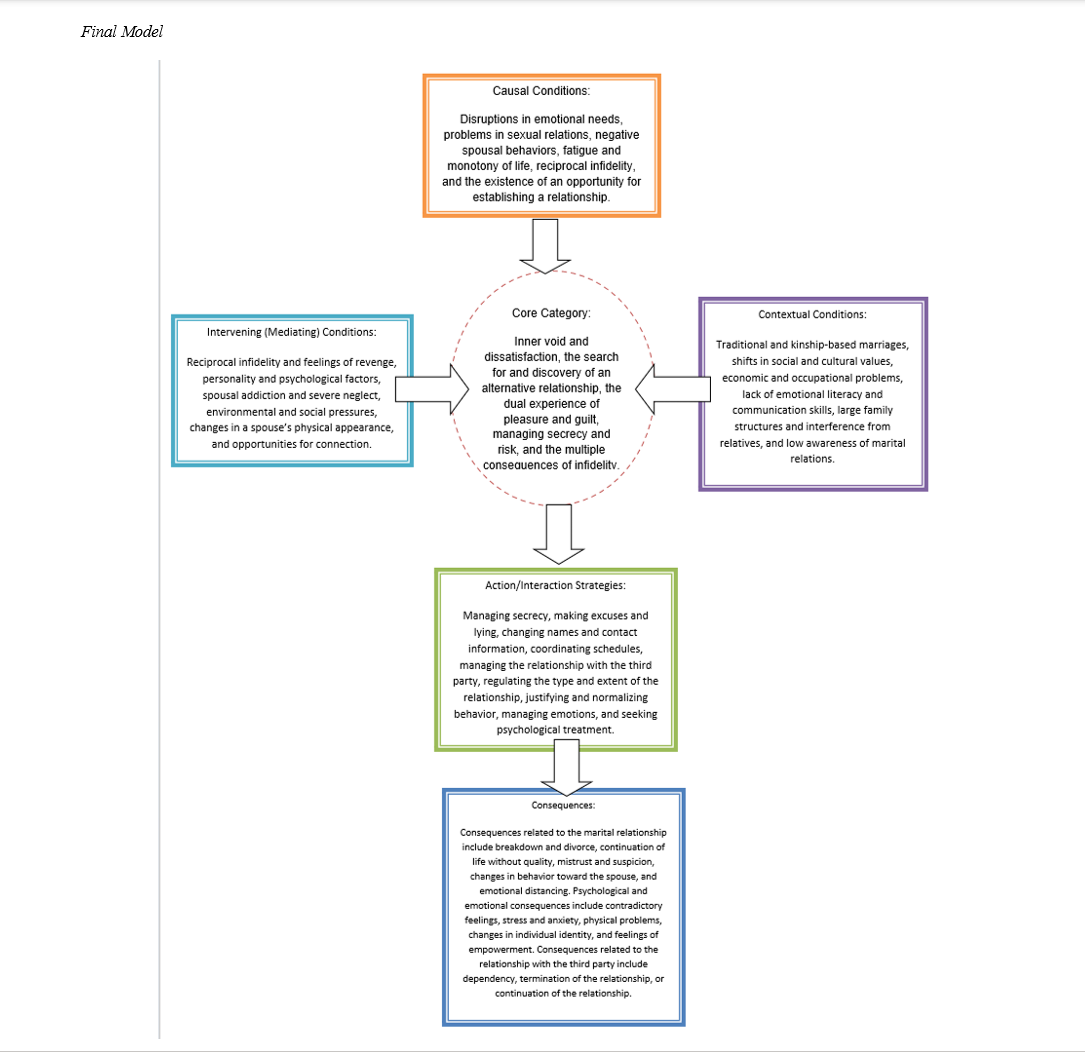
Findings: The analysis revealed a multi-layered model in which causal conditions such as unmet emotional needs, sexual dissatisfaction, negative spousal behaviors, monotony in marital life, reciprocal betrayal, and situational opportunities fostered extramarital involvement. Contextual factors such as traditional marriages, shifting cultural values, economic stress, low emotional literacy, and family interference further shaped the dynamics. Intervening conditions—including revenge motives, personality traits, spousal neglect, addiction, and social pressures—intensified vulnerability. Participants described a central phenomenon of inner void and dissatisfaction, leading to the search for substitute relationships. Their experiences reflected ambivalence, combining pleasure, novelty, and empowerment with guilt, stress, and anxiety. Strategies centered on secrecy management, deception, and regulation of relationships with third parties. Consequences included divorce, mistrust, emotional detachment, or continuation of hollow marriages, alongside psychological distress, identity disruption, and dependency on the third party.
Conclusion: The study highlights the paradoxical duality of infidelity as both a source of excitement and a trigger for guilt and long-term damage, underscoring the need for culturally sensitive interventions in therapy and social support systems.
Downloads
References
Beltrán-Morillas, A. M., Villanueva‐Moya, L., Sánchez-Hernández, M. D., Alonso-Ferres, M., Garrido‐Macías, M., & Expósito, F. (2023). Infidelity in the Adolescence Stage: The Roles of Negative Affect, Hostility, and Psychological Well-Being. International journal of environmental research and public health, 20(5), 4114. https://doi.org/10.3390/ijerph20054114
Budyningrum, F. S., & Ariana, A. D. (2025). Psychological Distress of Female Young Adults Who Experienced Infidelity in Dating Relationships. Observasi, 3(1), 287-293. https://doi.org/10.61132/observasi.v3i1.970
Dębska, J., & Walęcka-Matyja, K. (2024). The Role of Managing Information About Infidelity and Differentiation of Self in the Adaptation of Spouses After Infidelity. Family Forum, 14, 87-105. https://doi.org/10.25167/ff/5515
Fife, S. T., Gossner, J., Theobald, A. C., Allen, E., Rivero, A., & Koehl, H. (2023). Couple Healing From Infidelity: A Grounded Theory Study. Journal of Social and Personal Relationships, 40(12), 3882-3905. https://doi.org/10.1177/02654075231177874
Hong, S. H., Kim, K., Chung, G. H., & Han, G.-H. (2024). Worrying About Our Children: Parental Worry and Psychological Well-Being Among Korean Middle-Aged Couples. Journal of Family Psychology, 38(3), 476-483. https://doi.org/10.1037/fam0001190
Imtinan, G., Z, S. P. R., Anindya, S., & Malin, A. (2023). The Impact of Infidelity on Children’s Psychological Development. World Psychology, 2(2), 114-130. https://doi.org/10.55849/wp.v2i2.156
Jojonikus, J. (2024). Pemulihan Moral Dan Spiritual: Peran Pastoral Dalam Mendukung Pasangan Terlibat Dalam Perselingkuhan. Scripta Jurnal Teologi Dan Pelayanan Kontekstual, 18(2), 73-89. https://doi.org/10.47154/sjtpk.v18i2.291
Khaneghahi, S., Poorjanebollahi, M. F., Koroghli, M., & Karimi, M. (2024). Effectiveness of Acceptance and Commitment-Based Couple Therapy on Communication Patterns and Marital Infidelity in Married Individuals. Aftj, 5(2), 218-226. https://doi.org/10.61838/kman.aftj.5.2.24
Khezrlou, E., Aghayousefi, A., & Moghadam, H. E. (2024). Predicting Attitudes Toward Marital Infidelity in Couples Based on Attachment Styles and Personality Traits With the Mediation of Coping Strategies (Gender Comparison). Aftj, 5(3), 256-269. https://doi.org/10.61838/kman.aftj.5.3.27
Nasab, R. J., Toosi, M. R. S., Naseri, N. S., & Amarghan, H. A. (2022). Comparing the Effectiveness of Reality Therapy Couple Therapy With Imago-Based Couple Therapy on Improving the Quality of Life and Increasing Marital Intimacy in Women Affected by Marital Infidelity. Jayps, 3(1), 161-172. https://doi.org/10.61838/kman.jayps.3.1.13
Ngwasheng, M. B., & Mbedzi, R. P. (2024). Infidelity Amongst Young Married Couples: Suggestions for Social Work Intervention. Social Work/Maatskaplike Werk, 60(1). https://doi.org/10.15270/60-1-1255
Pasha, D., Hatamipour, K., & Nezhad, M. R. (2024). Effectiveness of Schema Therapy on Marital Relationship Quality and Emotion Regulation in Couples Affected by Infidelity. Jarac, 6(2), 71-78. https://doi.org/10.61838/kman.jarac.6.2.9
Putri, R. E. (2023). The Psychological Impact of Women and Children's Education After Divorce From Infidelity and Domestic Violence. Agenda Jurnal Analisis Gender Dan Agama, 5(2), 130. https://doi.org/10.31958/agenda.v5i2.9899
Riada, M. R., Manubulu, F. F., Mangngi, E. A., & Lasibey, F. S. (2024). Pastoral Counseling Approach in Overcoming Christian Family Problems at GMIT Maranatha Teunbaun. Transformasi Jurnal Pengabdian Pada Masyarakat, 4(3), 320. https://doi.org/10.31764/transformasi.v4i3.26313
Shrestha, P. S., Shaver, S. R., Perlman, T. T., & Walsham, W. (2023). Emotional Dimensions of Infidelity: An Analysis of Psychological and Emotional Factors Affecting Relationship Infidelity. Sosateris, 11(2), 88-103. https://doi.org/10.35335/85rbw180
Taheri, E., Didehban, E., Ranjbarmoqadam, A., & Kanaghestani, A. (2024). The Mediating Role of Social-Emotional Loneliness in the Relationship of the Quality of Marital Relationships and Dark Personality Traits With Online Infidelity. Iranian Journal of Psychiatry and Clinical Psychology, 30(1), 0-0. https://doi.org/10.32598/ijpcp.30.5019.1
Tauy, J. J. M., & Perez, J. (2023). Mediating Role of Infidelity-Related Posttraumatic Symptoms in the Relationship Between Forgiveness and Psychological Health Concerns. Psikoislamika Jurnal Psikologi Dan Psikologi Islam, 20(2), 579-598. https://doi.org/10.18860/psikoislamika.v20i2.23871
Taziki, Z., Choobforoushzadeh, A., & Rezapour, Y. (2024). The Mediating Role of Marital Intimacy in Relation With Midlife Crisis With a Tendency Toward Infidelity in Middle-Aged Men. Journal of counseling research. https://doi.org/10.18502/qjcr.v23i90.16071
Wade, T. J., Burch, R. L., & Fisher, M. L. (2022). Renewed Love Between Partners Following Infidelity. 471-492. https://doi.org/10.1093/oxfordhb/9780197502891.013.24
Yousefpouri, M., Zomorodi, S., & Bazzāziān, S. (2024). Effectiveness of Acceptance and Commitment-Based Couples Therapy on Attitudes Towards Marital Infidelity and Emotional Regulation in Married Women. Aftj, 5(2), 103-111. https://doi.org/10.61838/kman.aftj.5.2.12
Downloads
Additional Files
Publication Timeline
- Submitted
- Revised
- Accepted
Issue
Section
License
Copyright (c) 2025 Parvaneh Hemadi (Author); Nazanin Honarparvaran (Corresponding Author)

This work is licensed under a Creative Commons Attribution-NonCommercial 4.0 International License.