The Effectiveness of Emotion-Focused Therapy on Improving Marital Intimacy and Marital Adjustment
DOI:
https://doi.org/10.61838/kman.aftj.4473Keywords:
Emotion-Focused Therapy, Marital Intimacy, Marital AdjustmentAbstract
Objective: This study aimed to investigate the effectiveness of Emotion-Focused Therapy (EFT) in enhancing marital intimacy and marital adjustment among couples.
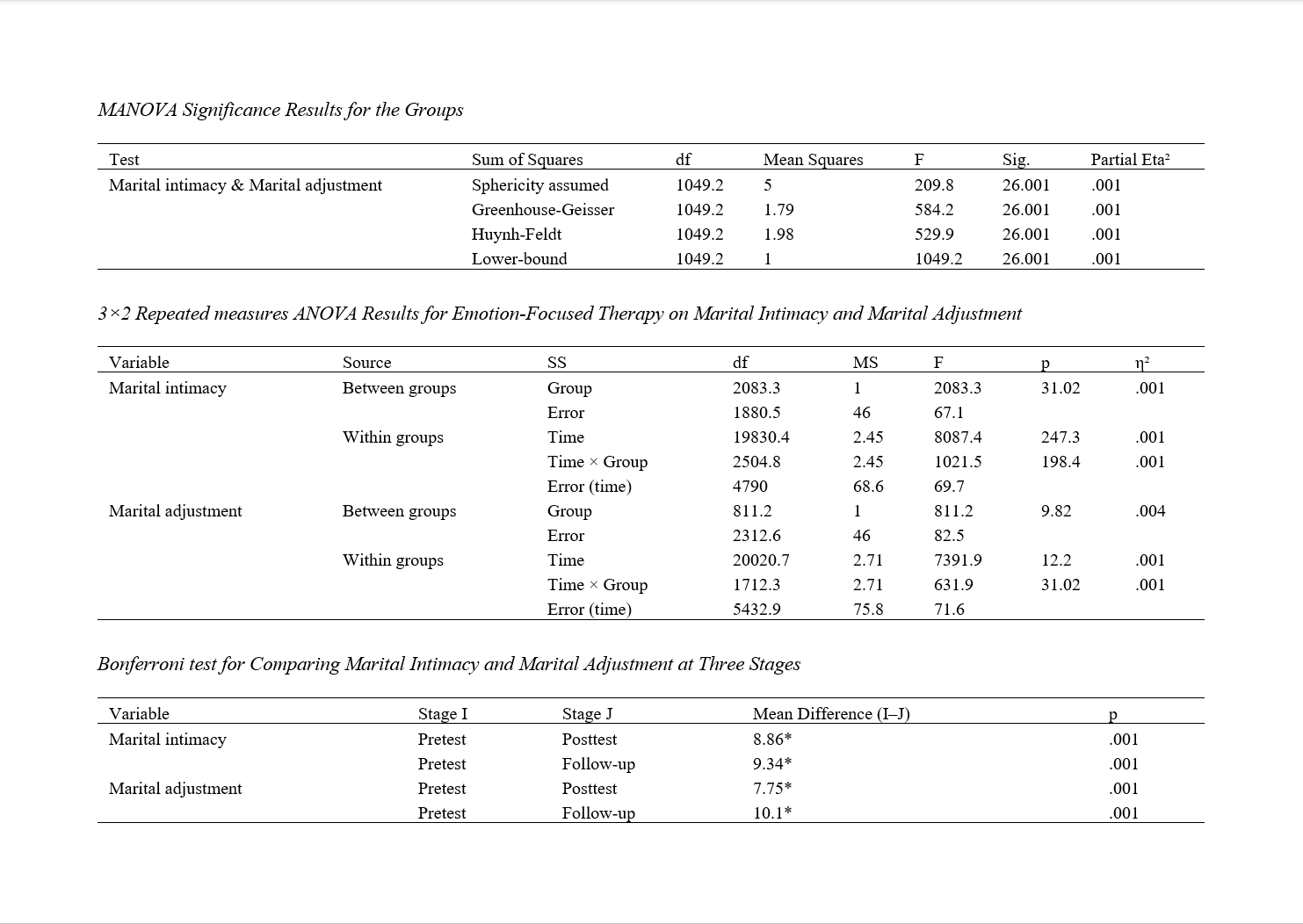
Methods and Materials: This research utilized a quasi-experimental design with pretest–posttest and a control group, including a three-month follow-up. The statistical population consisted of couples who attended counseling centers in Qom in 2021. Using convenience sampling and based on sample size estimation via G*Power (effect size = 0.36, α = 0.05, power = 0.95), 48 individuals (24 couples) were selected and randomly assigned to experimental and control groups. The intervention group participated in eight weekly 90-minute group sessions of EFT based on the protocol by Leslie Greenberg and colleagues (2008; as cited in Fathi et al., 2021), while the control group received no intervention. Data were collected using the Bagarozzi Marital Intimacy Questionnaire (2001) and the Spanier Dyadic Adjustment Scale (1976). Data analysis was performed using 3×2 repeated measures ANOVA in SPSS version 26.
Findings: Results showed a significant main effect of group on marital intimacy (F = 247.3, p < .05, η² = .662) and marital adjustment (F = 232.06, p < .05, η² = .89). The main effect of time (pretest, posttest, follow-up) was also significant for marital intimacy (F = 198.4, p < .05, η² = .686) and marital adjustment (F = 12.2, p < .05, η² = .31). Bonferroni test comparisons indicated significant increases from pretest to posttest and follow-up in both variables (p < .001).
Conclusion: The findings suggest that EFT is an effective intervention for improving marital intimacy and marital adjustment, with effects sustained at follow-up, making it a promising approach to enhance relational functioning among couples.
Downloads
References
Asayesh, M. H., Taran, M., & Eftekhari, M. (2024). Consequences of emotional divorce from men's perspective: A phenomenological study. Royesh-e Psychology, 13(1), 41-52. https://frooyesh.ir/article-1-4175-fa.html
Asfaw, L., & Alene, G. (2023). Effectiveness of a marital relationship skills training intervention on marital adjustment among individuals in hosanna town, southwest ethiopia: a randomized‐controlled trial. Journal of marital and family therapy, 49(3), 541-560. https://doi.org/10.1111/jmft.12641
Bab Sor, P., & Karimi, K. (2025). Effectiveness of group therapy based on self-compassion on psychological well-being and marital adjustment of women affected by domestic violence. Royesh-e Psychology, 14(1), 135-144. https://frooyesh.ir/article-1-5739-fa.html
Bailey, G., Halamová, J., & Gablíková, M. (2022). Qualitative analysis of chair tasks in emotion-focused therapy video sessions. International journal of environmental research and public health, 19(19), 12942. https://doi.org/10.3390/ijerph191912942
Bazyari, K. (2024). Effectiveness of emotionally focused therapy for couples in improving emotion regulation and relationship distress of emotionally divorced couples. Zahedan Journal of Research in Medical Sciences, 26(2). https://doi.org/10.5812/zjrms-142128
Brigoli, M., & Sandoval, L. (2023). The mediating effect of marital satisfaction on the relationship between quality family life and well-being of married couples. European Journal of Education Studies, 10(8). https://doi.org/10.46827/ejes.v10i8.4929
Didani, R., Tabrizi, M., Mardani Rad, M., & Karami, A. (2020). Comparing the effectiveness of positive psychotherapy and logotherapy on positive feelings toward spouse and marital conflicts in married women. Positive Psychology Research Letters, 6(1), 83-98. https://ppls.ui.ac.ir/article_25285.html
Fathalian, M., Lotfi, R., Faramarzi, M., & Qorbani, M. (2022). The effect of virtual cognitive-behavioral sexual counseling on sexual function and sexual intimacy in pregnant women: a randomized controlled clinical trial. BMC Pregnancy and Childbirth, 22(1). https://doi.org/10.1186/s12884-022-04932-4
Fathi, S., Pouyamanesh, J., Ghamari, M., & Fathi Aghdam, G. (2021). The Effectiveness of Emotion-based Therapy and Acceptance & Commitment Therapy on the Pain Severity and Resistance in Women with Chronic Headaches. Community Health Journal, 14(4), 75-87. https://chj.rums.ac.ir/article_126398_en.html?lang=fa
Gonzales, A. (2020). Marital adjustment and prenatal breastfeeding efficacy of first-time mothers in a low-income community in the philippines. Jurnal Ners, 15(1), 7-13. https://doi.org/10.20473/jn.v15i1.17191
Gunst, E., Desmet, M., Watson, J., Willemsen, J., Loeys, T., & Vanhooren, S. (2022). Sexual pleasure as forbidden secret: a single-case study into emotion-focused therapy with an emotionally avoidant client who committed sexual offences. Journal of Sexual Aggression, 29(1), 86-102. https://doi.org/10.1080/13552600.2021.2019845
Gurung, S., Chapagain, R., & Sharma, S. (2023). Exploring the lived experiences of marital intimacy among nepali married couples: a transcendental phenomenological approach. Asian Journal of Population Sciences, 17-36. https://doi.org/10.3126/ajps.v2i1.51088
Hellinia, G. (2023). Prediction of women's marital intimacy based on sexual satisfaction and health literacy among husbands with diabetes in ahvaz, 2021. Iranian Journal of Diabetes and Obesity. https://doi.org/10.18502/ijdo.v15i2.12968
Khajeh Hasani Raberi, F., Rezaei, F., Mirzaei, F., & Sedighi, F. (2024). Effectiveness of emotion-focused therapy on fear of intimacy, hostile attributions, and hyperarousal in women affected by marital infidelity. Royesh-e Psychology, 13(1), 233-242. https://frooyesh.ir/article-1-4874-fa.html&sw=
Kim, Y., & Nho, J. (2022). Factors influencing quality of life in low-income women with young children in korea: a cross-sectional study. Korean Journal of Women Health Nursing, 28(1), 56-64. https://doi.org/10.4069/kjwhn.2022.03.03
Lee, M., & Kim, Y. (2021). The mediating effect of marital intimacy on the relationship between spouse-related stress and prenatal depression in pregnant couples: an actor-partner interdependent model test. International journal of environmental research and public health, 18(2), 487. https://doi.org/10.3390/ijerph18020487
Moon, K., Chung, M., & Hwang, S. (2020). The perceived marital intimacy of spouses directly influences the rehabilitation motivation of hospitalized stroke survivors. Clinical Nursing Research, 30(4), 502-510. https://doi.org/10.1177/1054773820924573
Park, C., & Harris, V. (2022). The impact of attachment styles on attitudes toward marriage: the mediating role of emotional intimacy. The Family Journal, 31(2), 269-277. https://doi.org/10.1177/10664807221124271
ŞEnol, A., GÜRbÜZ, F., & Dost, M. (2023). Emotion-focused couple therapy: a review of theory and practice. Psikiyatride Guncel Yaklasimlar - Current Approaches in Psychiatry, 15(1), 146-160. https://doi.org/10.18863/pgy.1090793
Shamsaei, Z., Karimi, K., & Akbari, M. (2022). Causal modeling of domestic violence based on marital intimacy, self-regulation, and marital conflict. Royesh-e Psychology, 11(8), 59-68. https://frooyesh.ir/browse.php?a_id=4077&sid=1&slc_lang=fa
Sharifi, G., Nazarpoor, D., Davarnia, M., & Davarnia, R. (2021). Effectiveness of positive psychotherapy on the well-being of obese women with type 2 diabetes. Journal of Psychological Sciences, 20(97), 89-102. https://psychologicalscience.ir/browse.php?a_id=829&slc_lang=fa&sid=1&printcase=1&hbnr=1&hmb=1
Siregar, A. (2022). Positive Psychology in Islamic Counseling Perspective; Analysis of The Trilogy of Life Dimensions. Al-Fikru: Jurnal Ilmiah, 16(2), 226-238. https://doi.org/10.51672/alfikru.v16i2.114
Tahir, K., & Khan, N. (2020). Mediating role of body image between sexual functioning and marital intimacy in pakistani women with breast cancer. Psycho-Oncology, 30(2), 260-266. https://doi.org/10.1002/pon.5563
Tolan, Ö. (2021). Predictive role of attachment styles and personality traits in marital adjustment. Opus Uluslararası Toplum Araştırmaları Dergisi. https://dergipark.org.tr/en/doi/10.26466/opus.926516
Warwar, S. (2023). The use of homework in emotion‐focused therapy for depression. Journal of Clinical Psychology, 80(4), 744-761. https://doi.org/10.1002/jclp.23618
Yunike, & Eprila. (2022). Dynamics of mother's psychological condition as a caregiver for thalassemia children. International Journal Scientific and Professional, 1(2), 71-77. https://doi.org/10.56988/chiprof.v1i2.11
Zadafshar, B., Sharifi, T., Ahmadi, R., & Chorami, M. (2021). Effects of emotion-focused therapy and existential group therapy on depression, anxiety, and stress in the victims of child sexual harassment. Journal of Client-Centered Nursing Care, 7(3), 227-236. https://doi.org/10.32598/JCCNC.7.3.379.1
Downloads
Additional Files
Publication Timeline
- Submitted
- Revised
- Accepted
Issue
Section
License
Copyright (c) 2025 Elham Shafieefar (Author); Majid Zargham Hajebi (Corresponding Author); Reihane Tabarraei (Author)

This work is licensed under a Creative Commons Attribution-NonCommercial 4.0 International License.