Identifying Patterns of Inconsistency in Parenting Practices and Their Interpretations by Adolescents: A Narrative Inquiry
DOI:
https://doi.org/10.61838/kman.aftj.4509Keywords:
Parenting inconsistency, adolescent interpretation, narrative inquiry, communication, discipline, emotional climate, coping strategiesAbstract
Objective: The objective of this study was to explore how adolescents perceive and interpret patterns of inconsistency in parenting practices and the implications of these interpretations for their emotional and behavioral adjustment.
Methods and Materials: This qualitative research employed a narrative inquiry design to capture adolescents’ lived experiences of inconsistent parenting. Twenty-two adolescents from Spain, aged 14 to 18 years, participated in semi-structured interviews that focused on parental communication, discipline, and emotional support. Participants were selected through purposive sampling to ensure diversity in gender, family structure, and socioeconomic background. Interviews lasted between 45 and 60 minutes, were audio-recorded with informed consent, and transcribed verbatim. Data collection continued until theoretical saturation was reached. Transcripts were coded and analyzed thematically using NVivo 14 software, following open coding, categorization, and constant comparison to identify recurring themes and patterns.
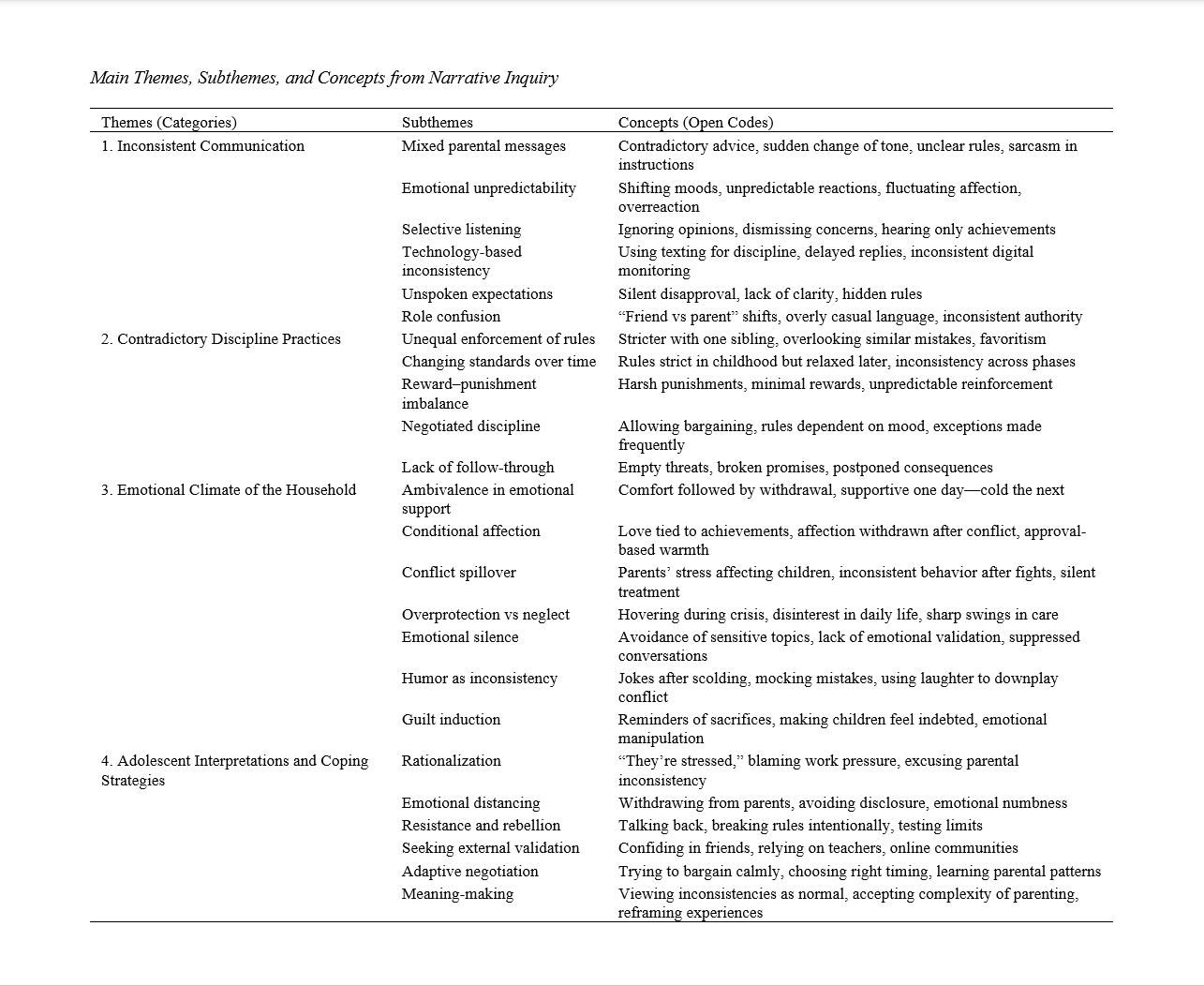
Findings: Analysis revealed four main themes: inconsistent communication, contradictory discipline practices, unstable emotional climate, and adolescent interpretations and coping strategies. Subthemes included mixed parental messages, unequal rule enforcement, conditional affection, and coping mechanisms such as rationalization, distancing, rebellion, and meaning-making. Adolescents reported that inconsistent parenting created confusion, insecurity, and tension but also described strategies to reinterpret or resist such practices. These narratives align with prior studies linking inconsistent parenting to both internalizing and externalizing symptoms, while also highlighting adolescents’ agency in constructing meaning from their experiences.
Conclusion: The study underscores the significance of consistency in parental communication, discipline, and emotional availability for adolescent well-being. Adolescents actively interpret and cope with inconsistencies, which shapes their developmental trajectories. Narrative inquiry provides valuable insights into these processes, suggesting the need for interventions that promote mindful, predictable parenting and supportive environments that strengthen adolescent resilience.
Downloads
References
Cutrín, O., Maneiro, L., Chowdhury, Y., Kulis, S., Marsiglia, F. F., & Fraguela, J. A. G. (2021). Longitudinal Associations Between Parental Support and Parental Knowledge on Behavioral and Emotional Problems in Adolescents. Journal of youth and adolescence, 51(6), 1169-1180. https://doi.org/10.1007/s10964-021-01559-0
Donohue, E., Halgunseth, L. C., Chilenski, S. M., & Perkins, D. F. (2022). Parent–Child Recurring Conflict: A Mediator Between Parental Anger Management and Adolescent Behavior. Family and Consumer Sciences Research Journal, 51(1), 6-19. https://doi.org/10.1111/fcsr.12450
Farnsworth, M. L., & O’Neal, C. W. (2022). How Work‐related Guilt Informs Parenting and Adolescent Psychological Distress in Military Families. Family Relations, 71(4), 1575-1592. https://doi.org/10.1111/fare.12685
Halgunseth, L. C., Perkins, D. F., Lippold, M. A., & Nix, R. L. (2013). Delinquent-Oriented Attitudes Mediate the Relation Between Parental Inconsistent Discipline and Early Adolescent Behavior. Journal of Family Psychology, 27(2), 293-302. https://doi.org/10.1037/a0031962
Kapetanovic, S., & Boson, K. (2020). Discrepancies in Parents’ and Adolescents’ Reports on Parent-Adolescent Communication and Associations to Adolescents’ Psychological Health. Current Psychology, 41(7), 4259-4270. https://doi.org/10.1007/s12144-020-00911-0
Linda, M. A. v. L., Ven, M. O. M. v. d., Karin, T. M. v. D., Hosman, C., & Witteman, C. (2015). Factors Promoting Mental Health of Adolescents Who Have a Parent With Mental Illness: A Longitudinal Study. Child & Youth Care Forum, 44(6), 777-799. https://doi.org/10.1007/s10566-015-9304-3
Liu, T.-H., Li, S. D., Zhang, X., & Xia, Y. (2019). The Spillover Mechanisms Linking Family Conflicts and Juvenile Delinquency Among Chinese Adolescents. International journal of offender therapy and comparative criminology, 64(2-3), 167-186. https://doi.org/10.1177/0306624x19842057
Maat, D. A. d., Jansen, P. W., Prinzie, P., Keizer, R., Franken, I. H. A., & Lucassen, N. (2021). Examining Longitudinal Relations Between Mothers’ and Fathers’ Parenting Stress, Parenting Behaviors, and Adolescents’ Behavior Problems. Journal of Child and Family Studies, 30(3), 771-783. https://doi.org/10.1007/s10826-020-01885-0
McGee, Z. T. (2017). The Impact of Maternal Incarceration on Emotional and Behavioral Outcomes: Research Findings From a National Longitudinal Study on Adolescent Health. Soj Nursing & Health Care, 3(1), 1-7. https://doi.org/10.15226/2471-6529/3/1/00124
Nieri, T., Grindal, M., Adams, M., Cookston, J. T., Fabricius, W. V., Parke, R. D., & Saenz, D. S. (2016). Reconsidering the “Acculturation Gap” Narrative Through an Analysis of Parent–Adolescent Acculturation Differences in Mexican American Families. Journal of Family Issues, 37(14), 1919-1944. https://doi.org/10.1177/0192513x14551175
Ouyang, Y., Xu, X., & Ouyang, Z. (2023). Confidence in the Future and Adolescent Problem Behavior. Sustainability, 15(6), 5191. https://doi.org/10.3390/su15065191
Royuela-Colomer, E., Orue, I., Visu‐Petra, L., & Fernández‐González, L. (2023). The Association Between Mindful Parenting, and Internalizing and Externalizing Symptoms in Adolescence. Journal of Child and Family Studies, 33(6), 1844-1856. https://doi.org/10.1007/s10826-023-02704-y
Therriault, D., Lemelin, J. P., Toupin, J., Martin‐Storey, A., & Déry, M. (2024). Associations Between Externalizing Behavior Problems and Risky Sexual Behaviors in Adolescence: Attachment as a Mediator. Journal of adolescence, 96(2), 394-410. https://doi.org/10.1002/jad.12285
Voort, A. v. d., Linting, M., Juffer, F., Bakermans‐Kranenburg, M. J., Schoenmaker, C., & Ijzendoorn, M. H. v. (2013). The Development of Adolescents’ Internalizing Behavior: Longitudinal Effects of Maternal Sensitivity and Child Inhibition. Journal of youth and adolescence, 43(4), 528-540. https://doi.org/10.1007/s10964-013-9976-7
Walters, G. D. (2023). Punishment and Personality: Low Agreeableness and Low Conscientiousness as Mediators of the Inconsistent/Angry Parenting–delinquency Relationships. Criminology & Criminal Justice, 25(3), 950-968. https://doi.org/10.1177/17488958231159367
Wang, F. L., Chassin, L., Lee, M., Haller, M., & King, K. M. (2016). Roles of Response Inhibition and Gene–Environment Interplay in Pathways to Adolescents' Externalizing Problems. Journal of Research on Adolescence, 27(2), 258-277. https://doi.org/10.1111/jora.12270
Yang, P., Schlomer, G. L., Lippold, M. A., & Feinberg, M. E. (2021). Longitudinal Discrepancy in Adolescent Aggressive Behavior Problems: Differences by Reporter and Contextual Factors. Journal of youth and adolescence, 50(8), 1564-1581. https://doi.org/10.1007/s10964-021-01431-1
Zhang, N., Wang, W., & ginsburg, g. (2025). Expressed Emotion of Parents With Anxiety Disorders: Associations With Growth Trajectories of Parental Warmth and Discipline Consistency Over Six Years. https://doi.org/10.31219/osf.io/8wj9m
Zheng, Y., Li, K., Zheng, H., & Pasalich, D. S. (2025). Daily Associations Between Parental Warmth and Discipline and Adolescent Conduct Problems and Callous-Unemotional Traits. https://doi.org/10.31234/osf.io/2nrm4_v1
Zhu, X., & Shek, D. T. L. (2020). The Influence of Adolescent Problem Behaviors on Life Satisfaction: Parent–Child Subsystem Qualities as Mediators. Child Indicators Research, 13(5), 1767-1789. https://doi.org/10.1007/s12187-020-09719-7
Downloads
Additional Files
Publication Timeline
- Submitted
- Revised
- Accepted
Issue
Section
License

This work is licensed under a Creative Commons Attribution-NonCommercial 4.0 International License.