Comparison of the Effectiveness of Emotion-Focused Therapy and Cognitive-Behavioral Therapy on Family Functioning and Attitudes Toward Extramarital Relationships in Infertile Marginalized Women in Tehran
DOI:
https://doi.org/10.61838/kman.aftj.4519Keywords:
Emotion-Focused Therapy (EFT), Cognitive-Behavioral Therapy (CBT), family functioning, attitudes toward extramarital relationships, infertilityAbstract
Objective: This study aimed to compare the effectiveness of Emotion-Focused Therapy (EFT) and Cognitive-Behavioral Therapy (CBT) on family functioning and attitudes toward extramarital relationships in infertile marginalized women in Tehran.
Methods and Materials: The research method was quasi-experimental with a pretest–posttest design, a two-month follow-up, and a control group. The statistical population included all infertile women who attended the clinic of Dr. Elina Bayramzadeh (gynecologist, obstetrician, and infertility specialist) in the second half of 2024. Out of 120 screened individuals, 45 participants were randomly assigned to three groups (15 in each): two experimental groups (EFT and CBT) and one control group. Research instruments included the Whatley Attitudes Toward Infidelity Scale (2006) and the Family Assessment Device by Epstein et al. (1983). Data were analyzed using mixed-design ANOVA and Bonferroni post hoc tests in SPSS-26.
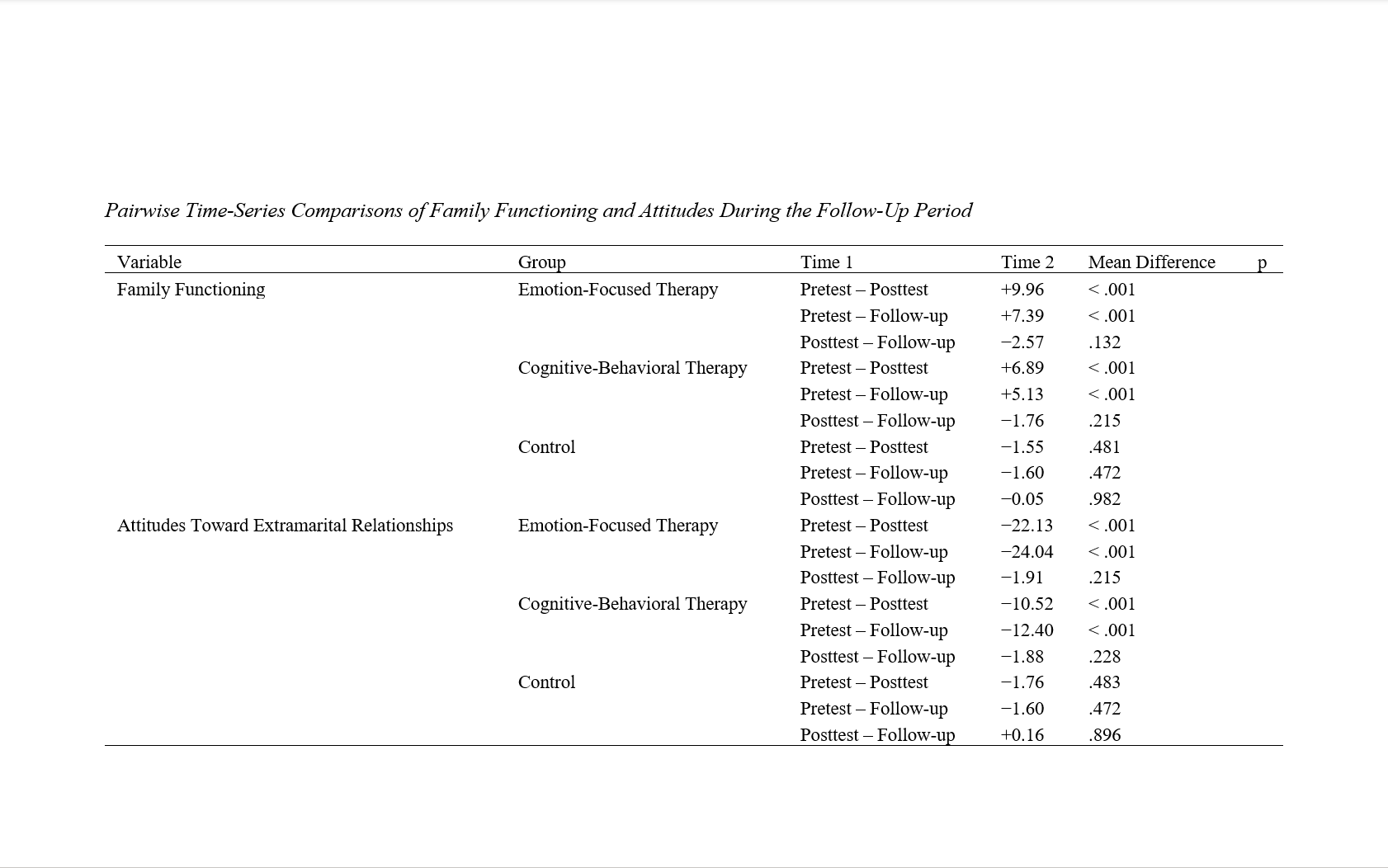
Findings: Findings indicated that both interventions significantly improved family functioning and reduced attitudes favorable to extramarital relationships (p < .05). However, Emotion-Focused Therapy demonstrated greater effectiveness compared to Cognitive-Behavioral Therapy (p < .002). The effect size of EFT for family functioning (η² = .68) and attitudes toward extramarital relationships (η² = .81) was significantly larger than that of CBT. Moreover, the effects of both interventions remained stable at the follow-up stage.
Conclusion: It was concluded that both therapeutic approaches are effective; however, Emotion-Focused Therapy holds superiority, particularly in enhancing emotional and relational variables. These findings can inform the design of targeted psychological interventions for infertile marginalized women.
Downloads
References
Abdollahzadeh, H. (2010). Introducing the Mark Watley's attitude scale toward infidelity. Payamyar Test Institute.
Ahramian, A., Sudani, M., & Gholamzadeh Jafareh, M. (2022). The effectiveness of solution-focused therapy on attitudes toward extramarital relationships and marital intimacy in married individuals. Journal of Psychological Sciences, 20(101), 799-811. https://psychologicalscience.ir/article-1-1048-en.html
Akintayo, A. A., Aduloju, O. P., Dada, M. U., Abiodun-Ojo, O. A., Oluwole, L. O., & Ade-Ojo, I. P. (2022). Comparison of self-esteem and depression among fertile and infertile women in a low resource setting. Journal of Obstetrics and Gynaecology, 42(5), 1198-1203. https://doi.org/10.1080/01443615.2021.1945002
Allan, R., Edwards, C., & Lee, N. (2023). Cultural adaptations of emotionally focused therapy. Journal of Couple & Relationship Therapy, 22(1), 43-63. https://doi.org/10.1080/15332691.2022.2052391
Bakhshipoor, B., Asadi, M., Kiani, A. R., Shirali Poor, A., & Ahmad Doost, H. (2012). The relationship between family functioning and marital conflicts of couples on the brink of divorce. Knowledge and research in applied psychology, 13(2), 19-28. https://www.sid.ir/paper/163666/en
Dattilio, F. M. (2009). Cognitive-behavioral therapy with couples and families: A comprehensive guide for clinicians. Guilford Press. https://books.google.de/books/about/Cognitive_Behavioral_Therapy_with_Couple.html?id=ErZ8Be5s2GAC&redir_esc=y
Forough Amiri, F. (2022). The effectiveness of cognitive-behavioral therapy on infertility stress and health-promoting behaviors of infertile women. Journal of Health Psychology, 12(2), 45-56.
Furrow, J. L., Palmer, G., Johnson, S. M., Faller, G., & Palmer-Olsen, L. (2019). Emotionally focused family therapy: Restoring connection and promoting resilience. Routledge. https://doi.org/10.4324/9781315669649
Ghaforian Mohabi, F., Ali Vandi Vafa, M., Rasouli, R., & Ramazani, M. A. (2025). A comparison of the effectiveness of emotion-focused therapy in couple vs. individual formats on experiences of close relationships-relationship structure (attachment security) in couples with extramarital affairs. Clinical Psychology and Personality, 8(4), 101-112. https://cpap.shahed.ac.ir/article_4834.html?lang=en
Gouveia, F., Gouveia-Pereira, M., & Portugal, A. (2024). COVID-19, family and love relationships: Perception of stress, relational quality, family functioning and online infidelity behaviors. Journal of Couple & Relationship Therapy, 23(3), 213-228. https://doi.org/10.1080/15332691.2024.2309221
Greenman, P. S., & Johnson, S. M. (2013). Process research on emotionally focused therapy (EFT) for couples: Linking theory to practice. Family Process, 52(1), 46-61. https://doi.org/10.1111/famp.12015
Hamid, N., Sayed, S., & Firoozi, A. A. (2021). The effectiveness of cognitive-behavioral family therapy on family functioning, adaptability, and academic performance of their sons. Educational Psychology Studies, 17(41), 65-89. https://ensani.ir/fa/article/455023/
Kiai Rad, H., Pasha, R., Asgari, P., & Makvandi, B. (2020). The effectiveness of cognitive-behavioral therapy on attitudes toward extramarital relationships and violence in women experiencing emotional divorce. Iranian Nursing Research Journal, 15(5), 49-60. https://ijnr.ir/browse.php?a_id=2411&sid=1&slc_lang=en
Kremer, F., Ditzen, B., & Wischmann, T. (2023). Effectiveness of psychosocial interventions for infertile women: A systematic review and meta -analysis with a focus on a method -critical evaluation. PLoS One, 18(2), e0282065. https://doi.org/10.1371/journal.pone.0282065
Labrecque, L. T., & Whisman, M. A. (2020). Extramarital sex and marital dissolution: Does identity of the extramarital partner matter? Family Process, 59(3), 1308-1318. https://doi.org/10.1111/famp.12472
Le, T. T., Jin, R., Nguyen, M. H., & Vuong, Q. H. (2024). Fair but Irresponsible: How moral senses affect young males' attitudes toward extramarital affairs. Sage Open, 14(3), 21582440241264190. https://doi.org/10.1177/21582440241264190
Maadi, M., Abolqasemi, A., Kafi, M., & Sharami, S. H. (2022). A comparison of family functioning in infertile women with and without pelvic inflammatory diseases. 6(1), 19-26. https://ijohp.journals.pnu.ac.ir/article_9470.html
Marren, C., Mikoška, P., O'Brien, S., & Timulak, L. (2022). A qualitative meta‐analysis of the clients' experiences of emotion‐focused therapy. Clinical Psychology & Psychotherapy, 29(5), 1611-1625. https://doi.org/10.1002/cpp.2745
Meyer, K., Attar, C. H., Fiebig, J., Stamm, T., Bassett, T. R., Bauer, M., Dannlowski, U., Ethofer, T., Falkenberg, I., Jansen, A., Juckel, G., Kircher, T., Mulert, C., Leicht, G., Rau, A., Rauh, J., Ritter, D., Ritter, P., Trost, S., . . . Bermpohl, F. (2023). Daring to feel: emotion-focused psychotherapy increases amygdala activation and connectivity in euthymic bipolar disorder-a randomized controlled trial. Biological Psychiatry: Cognitive Neuroscience and Neuroimaging, 8(7), 750-759. https://doi.org/10.1016/j.bpsc.2023.02.008
Nawaz, S., Sultan, S., & Batool, A. (2025). Efficacy of Cognitive Restructuring in Reducing Depression in Women with Infertility. Social Science Review Archives, 3(1), 595-602. https://doi.org/10.70670/sra.v3i1.338
Radosavljevic, D. (2025). Engaging Caregivers In The Service Of Their Child?s Mental Health: An Examination Of Emotion Focused Family Therapy In Relation To Parental Reflective Functioning. https://yorkspace.library.yorku.ca/items/49377dc9-8e11-47d5-aff1-ec79bbfa403b
Reuman, L., & Thompson-Hollands, J. (2025). Enhancing CBT Through Family and Peer Engagement. Springer. https://doi.org/10.1007/978-3-031-74838-7
Rezai, S. M., Safar Arah, M., & Mousavi Nejad, S. M. (2021). The role of infertility stress and feelings of failure in predicting the quality of marital relationships in infertile women. Journal of Qom University of Medical Sciences, 15(2), 140-149. https://doi.org/10.52547/qums.15.2.140
Seyed Ali Tabr, S. H., Mohammadalipour, Z., Habibi, F., Sarvestani, A., & Javan Bakht, A. (2015). Assessing the validity and reliability of the attitude scale toward extramarital relationships. Research Quarterly, 20(60), 342-349.
Shahabi, S., & Sanagoi Maharrar, G. (2019). The effectiveness of emotion-focused couple therapy on attitudes toward extramarital relationships and marital burnout of couples. Social Health, 7(1), 87-94. https://www.sid.ir/paper/392248/en
Sharma, R., Saha, S. C., & Gupta, A. (2022). Cultural perspectives on infertility: A systematic review. Reproductive Health, 19(1), 1-12. https://doi.org/10.1186/s12978-022-01456-0
Smith, J. A., Bandealy, A., & Browne, D. T. (2023). A case study of virtually delivered emotion‐focused family therapy. Journal of marital and family therapy, 49(3), 692-713. https://doi.org/10.1111/jmft.12648
Tajbakhsh, G. (2021). Analysis of the underlying factors of extramarital affairs. Woman in Development & Politics, 19(4), 595-614. https://jwdp.ut.ac.ir/article_85507.html?lang=en
Thoma, N. C., & Greenberg, L. S. (2015). Integrating emotion-focused therapy into cognitive-behavioural therapy. In Working with emotion in cognitive-behavioral therapy: Techniques for clinical practice (pp. 239-262). https://www.psycnet.org/record/2014-57879-011
Vioreanu, A. M. (2023). Using CBT for depression: a case study of a patient with depressive disorder due to a medical condition (infertility). Mental Health: Global Challenges Journal, 6(1), 2-15. https://doi.org/10.56508/mhgcj.v6i1.149
Wang, G., Liu, X., & Lei, J. (2023). Cognitive behavioural therapy for women with infertility: A systematic review and meta‐analysis. Clinical Psychology & Psychotherapy, 30(1), 38-53. https://doi.org/10.1002/cpp.2792
Yousefi, N. (2012). An examination of the psychometric indicators of the McMaster Family Assessment Device scales. Educational Measurement Quarterly, 3(7), 85-114. https://jem.atu.ac.ir/article_5626.html
Zarei, N. (2019). A comparison of communication patterns between couples, family functioning, and marital adaptability in infertile and fertile women Mohaghegh Ardabili University].
Zhao, J., Sohn, A., & Tadros, E. (2025). Disability and infidelity with a cross-cultural couple: An emotionally focused therapy case study. Person-Centered & Experiential Psychotherapies, 24(2), 130-152. https://doi.org/10.1080/14779757.2024.2402694
Downloads
Additional Files
Publication Timeline
- Submitted
- Revised
- Accepted
Issue
Section
License
Copyright (c) 2025 Mona Fadaei (Author); Bahman Akbari (Corresponding Author); Leila Moghtader (Author)

This work is licensed under a Creative Commons Attribution-NonCommercial 4.0 International License.