Alexithymia and Relationship Dissatisfaction: The Role of Conflict Communication Patterns
DOI:
https://doi.org/10.61838/kman.aftj.6.3.20Keywords:
Alexithymia, Relationship dissatisfaction, Conflict communication, Mediation, Structural equation modeling, Romantic relationships, MalaysiaAbstract
Objective: To test a structural model in which alexithymia predicts relationship dissatisfaction both directly and indirectly through destructive conflict communication patterns among Malaysian adults.
Methods and Materials: A descriptive correlational design was used with 423 adults in ongoing romantic relationships recruited across Malaysian states. Measures included the Toronto Alexithymia Scale–20 (TAS-20), the Communication Patterns Questionnaire (CPQ), and the Couples Satisfaction Index (CSI; reverse-scored to indicate dissatisfaction). Data screening confirmed statistical assumptions before analyses. IBM SPSS 27 was used for descriptive statistics and Pearson correlations, and AMOS 21 for structural equation modeling (SEM) with maximum likelihood estimation. Model fit was evaluated using χ², χ²/df, GFI, AGFI, CFI, TLI, and RMSEA; mediation was tested via indirect paths.
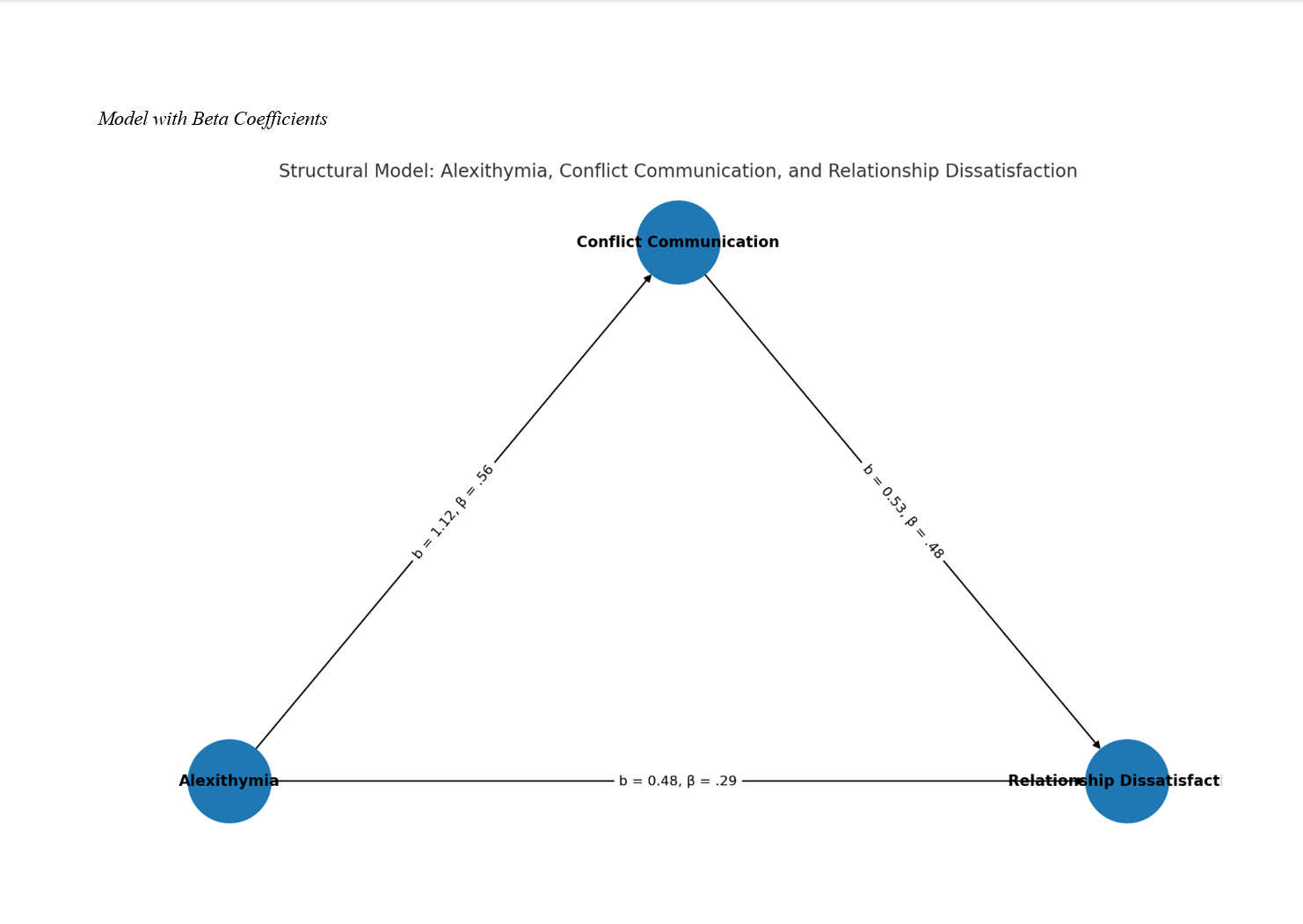
Findings: Alexithymia correlated positively with destructive conflict communication (r = .56, p < .001) and relationship dissatisfaction (r = .48, p < .001); conflict communication correlated most strongly with dissatisfaction (r = .62, p < .001). The SEM demonstrated good fit: χ²(132) = 287.43, χ²/df = 2.18, GFI = .93, AGFI = .91, CFI = .96, TLI = .95, RMSEA = .053. Direct paths were significant from alexithymia → conflict communication (b = 1.12, β = .56, p < .001), alexithymia → dissatisfaction (b = 0.48, β = .29, p < .001), and conflict communication → dissatisfaction (b = 0.53, β = .48, p < .001). The indirect effect of alexithymia on dissatisfaction via conflict communication was significant (b = 0.59, β = .27, p < .001), yielding a total effect of β = .56 (p < .001), consistent with partial mediation.
Conclusion: Alexithymia is a robust interpersonal risk factor for relationship dissatisfaction, and its impact is partly transmitted through destructive conflict communication. Findings highlight dual intervention targets—enhancing emotional awareness and improving conflict-management skills—to mitigate dissatisfaction in intimate relationships within a multicultural Malaysian context.
Downloads
References
Adıgüzel, V., & Topbaş, Z. S. (2025). Anxious Attachment Style Predicts Pathological Internet Use in Nursing Students: The Mediating Role of Alexithymia. Perspectives in psychiatric care, 2025(1). https://doi.org/10.1155/ppc/4067485
Aliş, N. (2022). Comparison of Attachment Problems in Romantic Relationships Between Individuals With Bipolar Diagnosis and Individuals Without a Known Psychiatric Diagnosis. Advances in Social Sciences Research Journal, 9(10), 471-478. https://doi.org/10.14738/assrj.910.13323
Bredicean, C. (2025). The Connection Between Alexithymia and Attachment Style in the Bipolar Pathology. European Psychiatry, 68(S1), S503-S503. https://doi.org/10.1192/j.eurpsy.2025.1047
Ding, Y., Huang, H., Zhang, Y., Peng, Q., Yu, J., Lu, G., Wu, H., & Chen, C. (2022). Correlations Between Smartphone Addiction and Alexithymia, Attachment Style, and Subjective Well-Being: A Meta-Analysis. Frontiers in psychology, 13. https://doi.org/10.3389/fpsyg.2022.971735
Freeman, B., Salivar, E. G., & Thayer, K. K. (2024). The Impact of the Military Lifestyle on Adult Military Children Relationships. Couple and Family Psychology Research and Practice, 13(1), 1-14. https://doi.org/10.1037/cfp0000252
Frenn, Y. E., Akel, M., Hallit, S., & Obeïd, S. (2022). Couple’s Satisfaction Among Lebanese Adults: Validation of the Toronto Alexithymia Scale and Couple Satisfaction Index-4 Scales, Association With Attachment Styles and Mediating Role of Alexithymia. BMC psychology, 10(1). https://doi.org/10.1186/s40359-022-00719-6
G., D., & R., S. (2025). Role of Alexithymia in Coping Strategies and Attachment Style Among Middle-Adults. International Journal for Multidisciplinary Research, 7(1). https://doi.org/10.36948/ijfmr.2025.v07i01.37175
Iqbal, S., Zachariades, F., Obeid, N., & Jansman, R. (2024). The Role of Alexithymia in Attachment and Binge Eating. Canadian Journal of General Internal Medicine, 19(3), 137-145. https://doi.org/10.3138/cjgim.2024.0006
Jahangir, M., & Zehra, A. (2024). Understanding Alexithymia: A Psychosocial Perspective. J Pak Psychiatr Soc, 21(03). https://doi.org/10.63050/jpps.21.03.299
Jin, X., Jiang, Q., Xiong, W., & Zhao, W. (2023). Effects of Use Motivations and Alexithymia on Smartphone Addiction: Mediating Role of Insecure Attachment. Frontiers in psychology, 14. https://doi.org/10.3389/fpsyg.2023.1227931
Kahya, Y., & Uluç, S. (2023). Maternal Childhood Trauma and Postpartum Well-Being in a Turkish Sample: The Path From Attachment to Alexithymia. Klinik Psikoloji Dergisi, 7(1), 1-10. https://doi.org/10.57127/kpd.26024438m000076x
Karmakar, A., Tanwar, S., & Parmar, V. (2024). Reducing Alexithymic Traits Using an Ideal Attachment Style Approach; A Correlational Study. Eatp. https://doi.org/10.53555/kuey.v30i5.3616
Kaur, J. (2024). Romantic Relationship Satisfaction, Attachment Style and Love Style Among College Going Students. Eatp. https://doi.org/10.53555/kuey.v30i5.4252
Kaya, C. E. (2025). Is Alexithymia in Pregnant Women Associated With Prenatal Attachment? Bratislava Medical Journal, 126(9), 2386-2395. https://doi.org/10.1007/s44411-025-00249-8
Lyvers, M., Pickett, L., Needham, K., & Thorberg, F. A. (2021). Alexithymia, Fear of Intimacy, and Relationship Satisfaction. Journal of Family Issues, 43(4), 1068-1089. https://doi.org/10.1177/0192513x211010206
Lyvers, M., Ryan, N., & Thorberg, F. A. (2022). Alexithymia, Attachment Security and Negative Mood. Australian Psychologist, 57(2), 86-94. https://doi.org/10.1080/00050067.2022.2045173
Mahmoudi, M., Saberi, H., & Bashardoust, S. (2022). A Model for Psychological Distress Based on Insecure Attachment Mediated by Alexithymia in Students at Islamic Azad Universities in Tehran. Journal of Health Reports and Technology, 8(2). https://doi.org/10.5812/ijhls-122195
Miri, S. S., & Zahiri, H. (2024). Investigating the Relationship Between Coping Styles, Alexithymia, and Management Styles With Job Satisfaction (Case Study: The Employees of the Maad Group). Jarac, 6(2), 1-10. https://doi.org/10.61838/kman.jarac.6.2.1
Nascimento, B. d. S., Little, A. C., Monteiro, R. P., Hanel, P. H. P., & Vione, K. C. (2022). Attachment Styles and Mate-Retention: Exploring the Mediating Role of Relationship Satisfaction. Evolutionary Behavioral Sciences, 16(4), 362-370. https://doi.org/10.1037/ebs0000272
Nowicki, P. (2025). Style Przywiązania Matek a Przywiązanie Matczyno-Płodowe. Rola Mediacji Seryjnej Aleksytymii Oraz Objawów Depresyjnych. Kwartalnik Naukowy Fides et Ratio, 62(2), 76-85. https://doi.org/10.34766/1pb4hw72
Reddy, C. B., & Naila, P. N. A. (2024). Attachment Style and Relationship Satisfaction Among Early Adults. World Journal of Biology Pharmacy and Health Sciences, 19(1), 282-289. https://doi.org/10.30574/wjbphs.2024.19.1.0440
Romeo, A., Benfante, A., Castelli, L., & Tella, M. D. (2025). To Be or Not to Be in a Romantic Relationship: Associations With Alexithymia, Adult Attachment, and Psychological Distress. Canadian Journal of Behavioural Science/Revue canadienne des sciences du comportement, 57(Suppl), S157-S162. https://doi.org/10.1037/cbs0000434
Romeo, A., Tella, M. D., Ghiggia, A., Tesio, V., Fusaro, E., Geminiani, G., & Castelli, L. (2020). Attachment Style and Parental Bonding: Relationships With Fibromyalgia and Alexithymia. PLoS One, 15(4), e0231674. https://doi.org/10.1371/journal.pone.0231674
Scalone, A., Santoro, G., Cavallo, J., Melita, A., Gori, A., & Schimmenti, A. (2023). Press Play to Feel: The Role of Attachment Styles and Alexithymic Features in Problematic Gaming. International journal of environmental research and public health, 20(20), 6910. https://doi.org/10.3390/ijerph20206910
Shahmardi, S., Pourebrahim, T., & Hoobi, M. B. (2022). The Role of Family Emotional Atmosphere and Attachment Styles in Alexithymia of Married People. Journal of Client-Centered Nursing Care, 8(4), 273-280. https://doi.org/10.32598/jccnc.8.4.449.1
Shinde, S., Sanghvi, N., & Hinduja, D. (2023). Attachment Styles and Marital Satisfaction: A Study to Associate Attachment Patterns and Satisfaction in Marriages. International Journal of Research Publications, 132(1). https://doi.org/10.47119/ijrp1001321920235455
Toqeer, S. (2021). Attachment Styles, Facebook Addiction, Dissociation and Alexithymia in University Students; A Mediational Model. NNJP, 1(1). https://doi.org/10.53107/nnjp.v1i1.9
Troisi, A., Nanni, R. C., Giunta, A., Manfreda, V., Duca, E. D., Criscuolo, S., Bianchi, L., & Esposito, M. (2021). Cutaneous Body Image in Psoriasis: The Role of Attachment Style and Alexithymia. Current Psychology, 42(9), 7693-7700. https://doi.org/10.1007/s12144-021-02032-8
Vergés-Báez, L., Lozano‐Paniagua, D., Requena, M., García‐González, J., García-Álvarez, R., & Alarcón, R. (2021). Alexithymia and Insecure Attachment Among Male Intimate Partner Violence Aggressors in the Dominican Republic. Healthcare, 9(12), 1626. https://doi.org/10.3390/healthcare9121626
Witami, A. N., Dannisworo, C. A., Nurwianti, F., & Hanum, L. (2024). Interparental Conflict and Offspring Marital Satisfaction: The Mediating Role of Communication Patterns. Konselor, 13(4), 355-367. https://doi.org/10.24036/02024134101-0-86
Yılmaz, Y., Çiçek, A. U., Kanak, M., Bahadır, E., & GÜLtÜRk, E. (2024). The Mediator Role of Empathy and Emotional Intelligence in the Relationship Between Alexithymia and Emotional Expression Styles. Ayna Klinik Psikoloji Dergisi, 11(1), 93-114. https://doi.org/10.31682/ayna.1255194
Zdankiewicz-Ścigała, E., & Ścigała, D. (2020). Attachment Style, Early Childhood Trauma, Alexithymia, and Dissociation Among Persons Addicted to Alcohol: Structural Equation Model of Dependencies. Frontiers in psychology, 10. https://doi.org/10.3389/fpsyg.2019.02957
Downloads
Additional Files
Publication Timeline
- Submitted
- Revised
- Accepted
Issue
Section
License

This work is licensed under a Creative Commons Attribution-NonCommercial 4.0 International License.