Discovery of Factors Influencing Marital Dissatisfaction in Spouses of Military Personnel
DOI:
https://doi.org/10.61838/kman.aftj.4930Keywords:
Marital dissatisfaction, spouses, military personnel, thematic analysisAbstract
ABSTRACT
Objective: The present study aimed to identify the factors influencing marital dissatisfaction among spouses of military personnel.
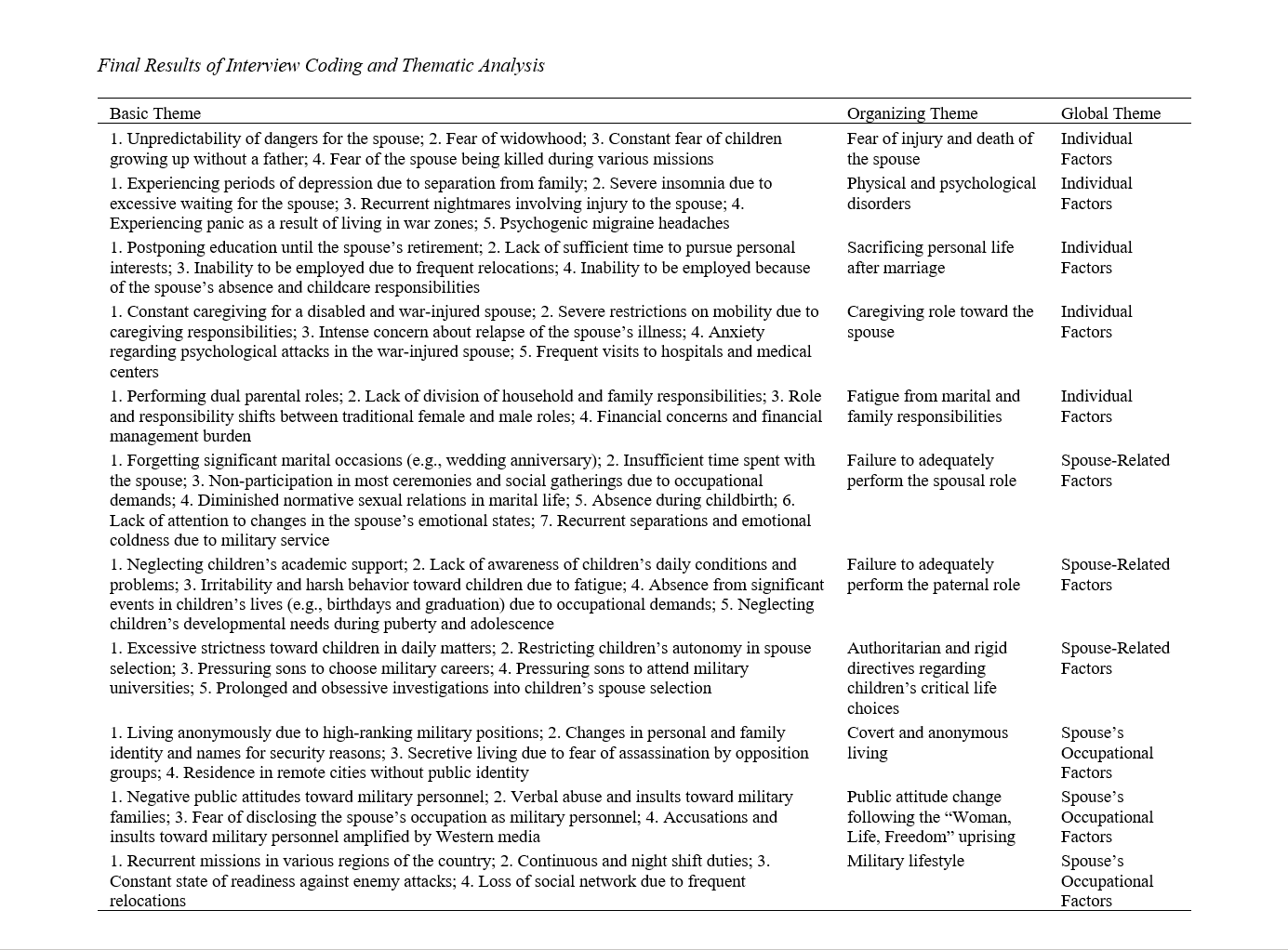
Method: This study employed a qualitative research design, and data were collected through semi-structured interviews. The statistical population consisted of spouses (women) of military personnel residing in the city of Isfahan in 2025. The participants were selected using purposive sampling. After conducting interviews with 12 spouses (women) of military personnel, the factors influencing marital dissatisfaction were identified and data saturation was achieved. Data analysis was performed using the thematic analysis method proposed by Stirling (2001), and the themes were categorized into three levels: basic, organizing, and global themes.
Findings: Based on the findings of the study, the basic themes comprised 50 concepts, the organizing themes included 11 concepts, and the global themes were classified into three overarching categories entitled individual factors, spouse-related factors, and spouse’s occupational factors, which were identified and extracted.
Conclusion: According to the results of this study, identifying and understanding the factors influencing marital dissatisfaction among spouses of military personnel can contribute to the reduction of marital dissatisfaction and enhance individuals’ awareness of the issues and challenges associated with marriage to military personnel in premarital counseling.
Downloads
References
Aknin, L. B., Norton, M. I., & Dunn, E. W. (2009). From wealth to well-being? Money matters, but less than people think. The Journal of Positive Psychology, 4(6), 523-527. https://doi.org/10.1080/17439760903271421
Borah, E., & Fina, B. (2017). Military spouses speak up: A qualitative study of military and Veteran spouses' perspectives. Journal of Family Social Work, 20(2), 144-161. https://doi.org/10.1080/10522158.2017.1284702
Briggs, E. C., Fairbank, J. A., Tunno, A. M., Lee, R. C., Corry, N. H., Pflieger, J. C., Stander, V. A., & Murphy, R. A. (2020). Military life stressors, family communication and satisfaction: Associations with children's psychosocial outcomes. Journal of Child & Adolescent Trauma, 13(1), 75-87. https://doi.org/10.1007/s40653-019-00259-z
Carbajal, V. (2025). Military Spouses' Lived Experiences in Remote Assignments Overseas: A Heuristic Study https://digitalcommons.liberty.edu/doctoral/7030/
Clark, A. E., & Georgellis, Y. (2013). Back to baseline in Britain: adaptation in the British household panel survey. Economica, 80(319), 496-512. https://doi.org/10.1111/ecca.12007
Cole, R. F. (2014). Understanding military culture: A guide for professional school counselors. Professional Counselor, 4(5), 497-504. https://doi.org/10.15241/rfc.4.5.497
Cozza, S. J., Ogle, C. M., Fisher, J. E., Zhou, J., Zuleta, R. F., Fullerton, C. S., & Ursano, R. J. (2022). The effect of war injury and combat deployment on military wives' mental health symptoms. Depression and Anxiety, 39(10-11), 686-694. https://doi.org/10.1002/da.23274
Edem Iniedu, A. O. (2010). Assessing the impact of posttraumatic stress disorder (PTSD) among wives of veterans: A phenomenological study of life changing experiences of wives of war veterans diagnosed with PTSD Capella University]. https://www.proquest.com/docview/597927628
Fairbank, J. A., Briggs, E. C., Lee, R. C., Corry, N. H., Pflieger, J. C., Gerrity, E. T., Amaya-Jackson, L. M., Stander, V., & Murphy, R. A. (2018). Mental health of children of deployed and nondeployed US military service members: The Millennium Cohort Family Study. Journal of Developmental & Behavioral Pediatrics, 39(9), 683-692. https://doi.org/10.1097/DBP.0000000000000606
Fisher, H. E., Xu, X., Aron, A., & Brown, L. L. (2016). Intense, passionate, romantic love: a natural addiction? How the fields that investigate romance and substance abuse can inform each other. Frontiers in psychology, 7, 687. https://doi.org/10.3389/fpsyg.2016.00687
Gottfried, A. E. (2021). Maternal employment in the family setting: Developmental and environmental issues. In Employed Mothers and Their Children (pp. 63-84). https://doi.org/10.4324/9781315860695-4
Just-Bourgeois, C. L. S. (2019). The Lived Experiences of Military Spouses Who Choose to Live Separately Walden University]. https://scholarworks.waldenu.edu/dissertations/6726/
Khayat, A. M., Alshareef, B. G., Alharbi, S. F., AlZahrani, M. M., Alshangity, B. A., Tashkandi, N. F., & Alshareef, B. G. (2024). Consanguineous marriage and its association with genetic disorders in Saudi Arabia: a review. Cureus, 16(2). https://doi.org/10.7759/cureus.53888
Kim, J., & Kwon, K. Y. (2024). Marital dissatisfaction and functional performance in older adults: Heterogeneity in the association by educational level. Social Science & Medicine, 340, 116460. https://doi.org/10.1016/j.socscimed.2023.116460
Kuo, P. X., & Johnson, V. J. (2021). Whose parenting stress is more vulnerable to marital dissatisfaction? A within-couple approach examining gender, cognitive reappraisal, and parental identity. Family Process, 60(4), 1470-1487. https://doi.org/10.1111/famp.12642
Lewy, C. S., Oliver, C. M., & McFarland, B. H. (2014). Barriers to mental health treatment for military wives. Psychiatric Services, 65(9), 1170-1173. https://doi.org/10.1176/appi.ps.201300325
Mansfield, A. J., Schaper, K. M., Yanagida, A. M., & Rosen, C. S. (2014). One day at a time: The experiences of partners of veterans with posttraumatic stress disorder. Professional psychology: Research and practice, 45(6), 488. https://doi.org/10.1037/a0038422
O'Keefe, P. H. (2016). Using Facebook to communicate with husbands while deployed: A qualitative study of Army wives' experiences Capella University]. https://www.proquest.com/openview/670148813d45deb0c8284e7142cb0cb2/1?pq-origsite=gscholar&cbl=18750
Park, N. (2011). Military children and families: strengths and challenges during peace and war. American psychologist, 66(1), 65. https://doi.org/10.1037/a0021249
Richardson, S. M., Pflieger, J. C., Woodall, K. A., Stander, V. A., & Riviere, L. A. (2020). A model of deployment readiness among military spouses: The role of mental health and deployment-related personal growth. Military Behavioral Health, 8(4), 378-395. https://doi.org/10.1080/21635781.2020.1825240
Sayehmiri, K., Kareem, K. I., Abdi, K., Dalvand, S., & Gheshlagh, R. G. (2020). The relationship between personality traits and marital satisfaction: a systematic review and meta-analysis. BMC psychology, 8(1), 15. https://doi.org/10.1186/s40359-020-0383-z
Schvey, N. A., Burke, D., Pearlman, A. T., Britt, T. W., Riggs, D. S., Carballo, C., & Stander, V. (2022). Perceived barriers to mental healthcare among spouses of military service members. Psychological Services, 19(2), 396. https://doi.org/10.1037/ser0000523
Steenkamp, M. M., Corry, N. H., Qian, M., Li, M., McMaster, H. S., Fairbank, J. A., Stander, V. A., Hollahan, L., & Marmar, C. R. (2018). Prevalence of psychiatric morbidity in United States military spouses: the millennium cohort family study. Depression and Anxiety, 35(9), 815-829. https://doi.org/10.1002/da.22768
Taylor, M. K., Markham, A. E., Reis, J. P., Padilla, G. A., Potterat, E. G., Drummond, S. P., & Mujica-Parodi, L. R. (2008). Physical fitness influences stress reactions to extreme military training. Military medicine, 173(8), 738-742. https://doi.org/10.7205/MILMED.173.8.738
Toomey, R., Alpern, R., Reda, D. J., Baker, D. G., Vasterling, J. J., Blanchard, M., & Eisen, S. A. (2019). Mental health in spouses of US Gulf War veterans. Psychiatry research, 275, 287-295. https://doi.org/10.1016/j.psychres.2019.03.043
VanLaningham, J., Johnson, D. R., & Amato, P. (2001). Marital happiness, marital duration, and the U-shaped curve: Evidence from a five-wave panel study. Social Forces, 79(4), 1313-1341. https://doi.org/10.1353/sof.2001.0055
Wellman, T. E. (2017). Employment Discrimination Against Military Spouses: Illegal Contrary to Popular Belief and Practice The George Washington University]. https://scholarspace.library.gwu.edu/concern/gw_etds/5h73pw23g
Woods, S. B., Priest, J. B., Signs, T. L., & Maier, C. A. (2019). In sickness and in health: The longitudinal associations between marital dissatisfaction, depression and spousal health. Journal of Family Therapy, 41(1), 102-125. https://doi.org/10.1111/1467-6427.12207
Yambo, T. W., Johnson, M. E., Delaney, K. R., Hamilton, R., Miller, A. M., & York, J. A. (2016). Experiences of military spouses of veterans with combat-related posttraumatic stress disorder. Journal of Nursing Scholarship, 48(6). https://doi.org/10.1111/jnu.12237
Downloads
Additional Files
Publication Timeline
- Submitted
- Revised
- Accepted