Conceptual Framework of Healthy Divorce in Iran: A Qualitative Study
DOI:
https://doi.org/10.61838/kman.aftj.4972Keywords:
Healthy divorce, multidimensional factors, qualitative researchAbstract
Objective: This study aimed to develop and validate a culturally grounded, multidimensional conceptual framework of healthy divorce in Iran by identifying and prioritizing the biological, psychological, social, cultural, ethical, and spiritual factors shaping the divorce process.
Methods and Materials: The study employed a qualitative, integrative design combining systematic literature review, qualitative content analysis, semi-structured interviews, and the fuzzy Delphi method. Participants included experts in family and divorce studies from psychology, social sciences, and social work, as well as married, divorcing, and divorced individuals selected through purposive sampling. Initial indicators were extracted from Persian and English literature and refined through expert consensus. Pairwise comparisons were conducted to calculate fuzzy weights for indicators within each dimension, followed by defuzzification to determine their relative importance. Thematic analysis was used to analyze interview data, and methodological triangulation ensured the credibility and rigor of findings.
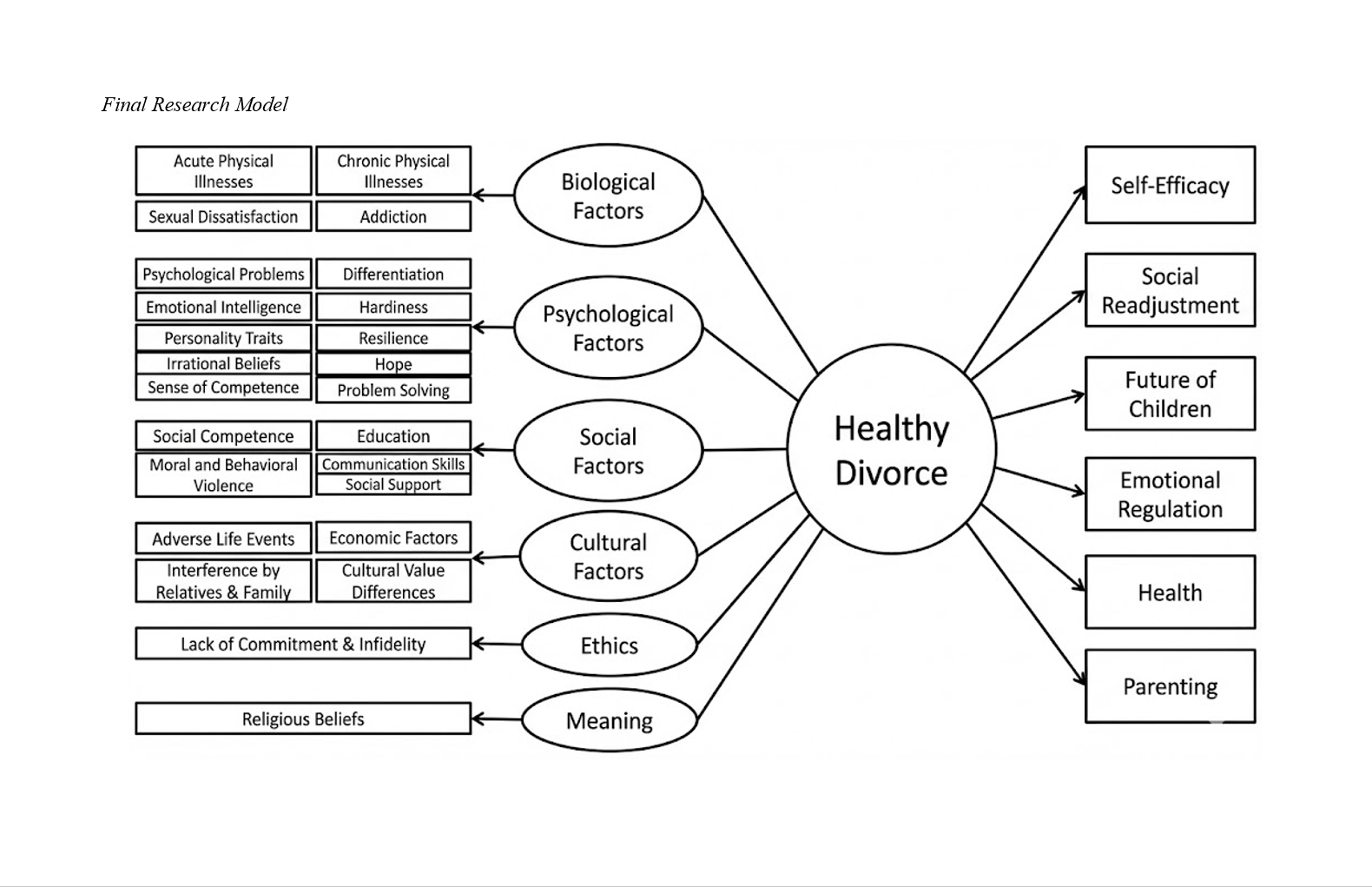
Findings: The results indicated that healthy divorce is a dynamic outcome of interaction among six dimensions. Psychological factors showed the strongest influence, particularly psychological problems, hardiness, irrational beliefs, and differentiation of self. In the biological dimension, chronic physical illness, addiction, and sexual dissatisfaction were most salient. Social competence, moral–behavioral violence, and communication skills emerged as key social determinants. Cultural factors were dominated by adverse life events, family interference, and value differences. Ethical factors, especially lack of commitment and infidelity, held the highest weights overall. The spiritual dimension, although not weighted due to its single-indicator structure, functioned as a regulating conceptual component in the final model.
Conclusion: Healthy divorce in Iran should be understood not as the absence of conflict or a purely legal resolution, but as a multidimensional, ethically grounded, and culturally embedded process whose quality depends on the effective management of individual, relational, and contextual resources.
Downloads
References
Abbasi, A., & Rezapour, D. (2025). A Systematic Review and Meta-Analysis of Factors Related to Changes in Family Values and Attitudes toward Divorce and Marriage in Iran. Social Continuity and Change, 4(2), 311-348. https://jscc.yazd.ac.ir/article_3641.html?lang=en
Abdi, S. (2025). A comparative study of differentiation of self, communication patterns, and conflict resolution tactics between divorce seeking and normal couples. Journal of Preventive Counselling, 6(2). https://journal.uma.ac.ir/article_3945.html?lang=en
Agustini, N. I. (2020). Hardiness personality in young adults with divorced parents. 5th ASEAN Conference on Psychology, Counselling, and Humanities (ACPCH 2019),
Ajayi, S. D. (2016). When divorce could be a child of necessity: A moral argument for situational divorce. American Journal of Biblical Theology, 17, 36. https://www.biblicaltheology.com/Research/AjayiSA01.pdf
Arcangeli, O. J., & Ejova, A. (2025). Does Time Heal All Wounds? Life Satisfaction Trajectories in Australian Middle-Aged Women Before and After Relationship Dissolution. Journal of Happiness Studies, 26(3), 1-36. https://doi.org/10.1007/s10902-024-00853-5
Arvidsson, H. G. (2025). Dispossessed Fathers, Disadvantaged Children: The Mental Health Fallout of Custody Inequity in Divorce Courts. Venture Visionaries.
Ayadi, N., Fatehizadeh, M., & Etemad, A. (2025). Identifying the Challenges and Issues of Remarriage after Divorce in Iran: A Systematic Qualitative Review. Journal of Applied Psychological Research, 16(3), 107-126. https://japr.ut.ac.ir/article_97574.html?lang=en
Behtoei, S., Golshani, F., Baghdasarians, A., & Emamipour, S. (2025). Identifying the causes of compromise and withdrawal of divorce in couples applying for consensual divorce: A qualitative study. Journal of Psychological Science, 24(149), 197-219. https://psychologicalscience.ir/article-1-2457-en.html
Burhanuddin, A., Hadaiyatullah, S. S., & Wisesha, P. (2025). Peace in Divorce Matters at the Regular Legal Efforts Level. Kne Social Sciences. https://doi.org/10.18502/kss.v10i8.18481
Çelik, O., & Nazlı, S. (2025). The Effect Of Post-Divorce Adjustment Program on Life Satisfaction, Adjustment to Divorce and Psychological Symptoms of Divorced Individuals. Turkish Psychological Counseling and Guidance Journal, 15(76), 178-212. https://doi.org/10.17066/tpdrd.1539049
Cosco, T. D., Hardy, R., Howe, L. D., & Richards, M. (2019). Early-life adversity, later-life mental health, and resilience resources: A longitudinal population-based birth cohort analysis. International Psychogeriatrics, 31(9), 1249-1258. https://doi.org/10.1017/S1041610218001795
Faizi, I. (2023). Sexual dissatisfaction and divorce: Reality or illusion? Journal of Iranian Social Studies, 17(2), 81-105. http://www.jss-isa.ir/article_710141.html?lang=en
Ghorishi, F., Shirmohammadi, D., & Borjvand, A. (2014). Understanding the Factors of Divorce from the Perspective of Men and Women Facing Divorce or Already Divorced: A Case Study of Saqqez City. Strategic Research on Social Problems in Iran (Strategic Research on Security and Social Order), 3(1), 19-30. https://ssoss.ui.ac.ir/article_17103_en.html
Guetto, R., Bernardi, F., & Zanasi, F. (2022). Parental education, divorce, and children's educational attainment. Demographic Research, 46, 65-96. https://doi.org/10.4054/DemRes.2022.46.3
Hald, G. M., Ciprić, A., Sander, S., & Strizzi, J. M. (2022). Anxiety, depression and associated factors among recently divorced individuals. Journal of Mental Health, 31(4), 462-470. https://doi.org/10.1080/09638237.2020.1755022
Harsoyo, Y., & Darmawan, I. (2023). Socio-economic factors leading to divorce in Gunungkidul Regency. International Journal of Social Sciences, 6(2), 83-89. https://doi.org/10.21744/ijss.v6n2.2085
Jarwan, A. S., & Al-Frehat, B. M. (2020). Emotional divorce and its relationship with psychological hardiness. International Journal of Education and Practice, 8(1), 72-85. https://doi.org/10.18488/journal.61.2020.81.72.85
Kalantari, A., Roshanfekr, P., & Javaheri, J. (2011). A Review of Three Decades of Research on the "Causes of Divorce" in Iran. Strategic studies of women, 14(53), 129-162. https://www.jwss.ir/article_12238.html
Libson, A. H. (2018). Not my fault: Morality and divorce law in the liberal state. Tulane Law Review, 93, 599. https://www.tulanelawreview.org/pub/volume93/issue3/not-my-fault
Lo, C. K. M., Chen, Q., Chen, M., Chan, K. L., & Ip, P. (2024). Changes in, and factors associated with family functioning: results of four cross-sectional household surveys from 2011 to 2017 in Hong Kong. BMC public health, 24(1), 160. https://doi.org/10.1186/s12889-024-17643-6
Markoç, İ. (2022). Feeling like home again: After divorce processes from different family perspective. Journal of Family Counseling and Education, 7(2), 55-72. https://doi.org/10.32568/jfce.1175330
Mentser, S., & Sagiv, L. (2025). Cultural and personal values interact to predict divorce. Communications Psychology, 3(1), 12. https://doi.org/10.1038/s44271-025-00185-x
Moral, M. A., Chimpén-López, C. A., Lyon, T. R., & Adsuar, J. C. (2021). The relationship between differentiation of self and psychological adjustment to separation. Healthcare, 9(6), 738. https://doi.org/10.3390/healthcare9060738
Mortelmans, D. (2020). Economic consequences of divorce: A review. In Parental life courses after separation and divorce in Europe (pp. 23-41). https://doi.org/10.1007/978-3-030-44575-1_2
Myranika, A., Ramdhani, D., Pandia, H., Mulatsih, S. N., Yusuf, Y., & Febriantika, D. (2024). Divorce perspectives: A juridical and economic analysis. Ijtihad, 18(1). https://doi.org/10.21111/ijtihad.v18i1.12419
Sbarra, D. A., & Whisman, M. A. (2022). Divorce, health, and socioeconomic status: An agenda for psychological science. Current opinion in psychology, 43, 75-78. https://doi.org/10.1016/j.copsyc.2021.06.007
Solgi, E. M., Asaseh, M., Kashani Vahid, L., Ebrahimpoor, M., & Vakili, S. (2024). The effectiveness of teaching life skills with a solution-oriented approach. Iranian Journal of Psychiatric Nursing, 12(4), 1-12. https://ijpn.ir/browse.php?a_code=A-10-2427-1&sid=1&slc_lang=en
Walsh, F., Jacob, L., & Simons, V. (1995). Facilitating healthy divorce processes: Therapy and mediation approaches. In N. S. Jacobson & A. S. Gurman (Eds.), Clinical Handbook of Couple Therapy (pp. 340-365). The Guilford Press. https://psycnet.apa.org/record/1995-98358-016
Downloads
Additional Files
Publication Timeline
- Submitted
- Revised
- Accepted