The Effectiveness of Emotional Intelligence Training on Marital Burnout and the Quality of Marital Relationships in Couples Aged 20 to 50
DOI:
https://doi.org/10.61838/kman.aftj.5014Keywords:
emotional intelligence training, marital burnout, quality of marital relationships, couples aged 20 to 50.Abstract
Objective: This study aimed to examine the effectiveness of emotional intelligence training on reducing marital burnout and improving marital relationship quality among couples aged 20 to 50 who referred to counseling centers.
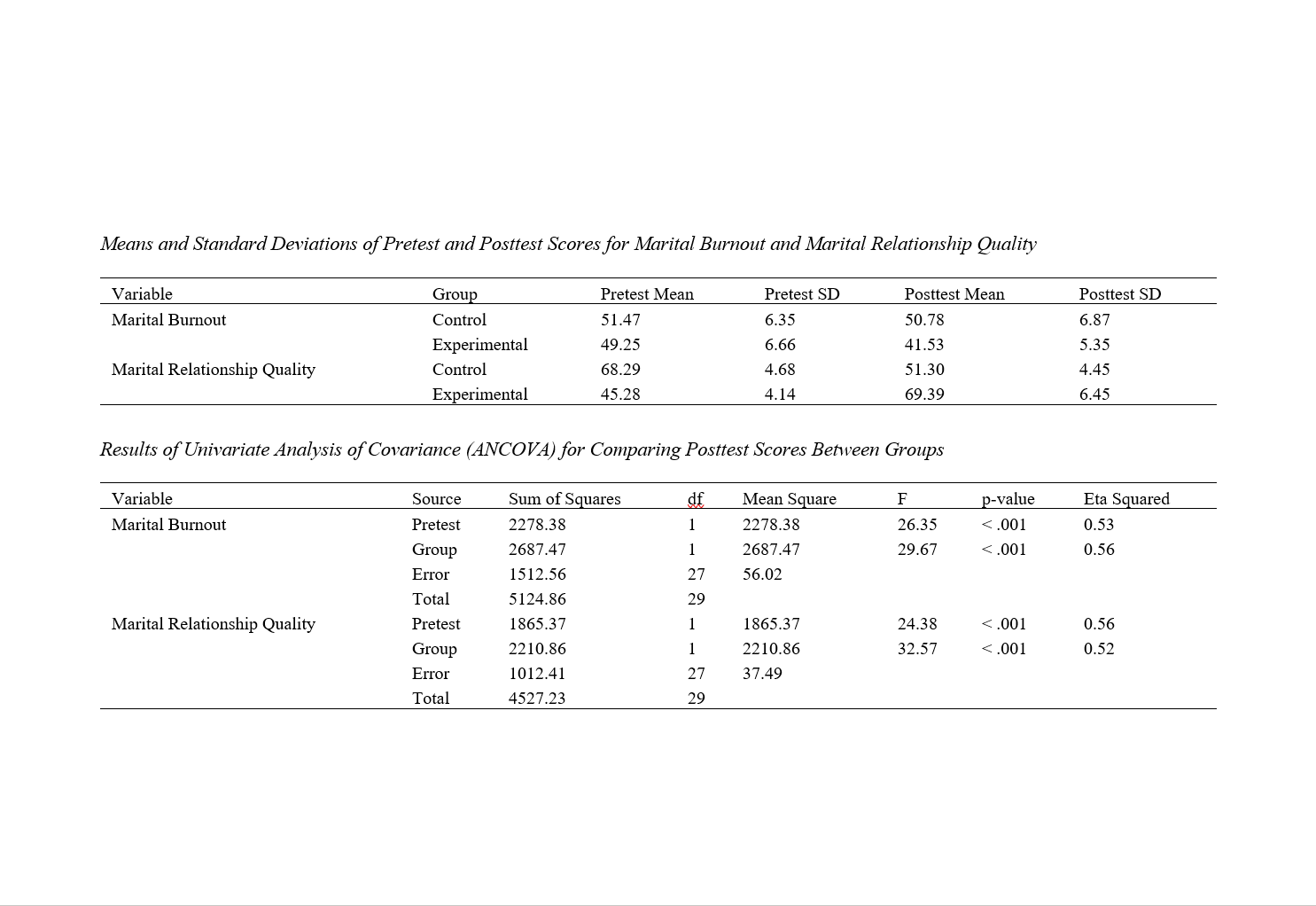
Methods and Materials: The study employed a quasi-experimental design with a pretest–posttest control group. The statistical population consisted of couples aged 20 to 50 who referred to counseling centers in Babol County in 2024. Using convenience sampling, 32 couples were selected and randomly assigned to an experimental group and a control group, each comprising 16 participants. Data were collected using the Pines Marital Burnout Questionnaire and the Marital Relationship Quality Questionnaire. The experimental group received emotional intelligence training in 12 structured sessions of 90 minutes, conducted twice weekly, while the control group received no intervention. Pretest and posttest assessments were administered to both groups, and data were analyzed using descriptive statistics and univariate analysis of covariance (ANCOVA) in SPSS version 27.
Findings: After controlling for pretest scores, ANCOVA results revealed a statistically significant group effect for marital burnout, indicating that the experimental group reported significantly lower posttest burnout scores compared to the control group. Similarly, a significant group effect was found for marital relationship quality, demonstrating that participants who received emotional intelligence training showed significantly higher posttest marital quality scores than those in the control group. Effect size indices indicated large and meaningful intervention effects for both outcome variables.
Conclusion: The findings indicate that emotional intelligence training is an effective intervention for reducing marital burnout and enhancing marital relationship quality among couples seeking counseling services, highlighting the importance of emotional competence development in marital counseling and preventive family interventions.
Downloads
References
Aidoo, E. B., Mensah, R. O., & Oteng, B. (2024). Marital satisfaction of college of education tutors within the greater Accra region: the influence of emotional intelligence and other factors. Cogent Education, 11(1), 2389324. https://doi.org/10.1080/2331186X.2024.2389324
Ashouri, A., Rostami, K., Rahmani, S., Gholizadeh, S., & Hossein, M. (2023). Investigating the Role of Emotional Expression and Spiritual Intelligence in Predicting Marital Quality of Life. Islamic lifestyle with a focus on health, 7(1), 442-448. https://www.sid.ir/paper/1130929/fa
Azkhosh, M., Salimi, G., Jafari, P., & Mersa, R. (2024). The relationship between moral intelligence and attitude towards extramarital relationship with the mediation of perfectionism in married men. Social Psychology Research, 13(52), 69-84. https://doi.org/10.22034/spr.2024.411817.1853
Barzegar Kahnemooi, S., Fattahi Andebil, A., & Mirhashemi, M. (2022). The Effect of Differentiation, Attachment Styles, and Family Functioning on Marital Burnout with the Mediating Role of Emotional Intelligence. Knowledge and research in applied psychology, 23(2), 76-63. https://www.sid.ir/paper/1032930/fa
Batool, S. S. (2009). Development and validation of emotional intelligence scale and emotional intelligence as a predictor of marital quality UNIVERSITY OF THE PUNJAB, LAHORE, PAKISTAN]. http://142.54.178.187:9060/xmlui/handle/123456789/6377
Batool, S. S., & Khalid, R. (2012). Emotional Intelligence: A Predictor of Marital Quality in Pakistani Couples. Pakistan Journal of Psychological Research, 27(1). https://www.proquest.com/openview/e6a7cf198cca5b99c696a1f81f274673/1?pq-origsite=gscholar&cbl=25757
Čikeš, A. B., Marić, D., & Šincek, D. (2018). Emotional intelligence and marital quality: Dyadic data on Croatian sample. Studia psychologica, 60IS - 2, 108-122. https://doi.org/10.21909/sp.2018.02.756
Defanti, R., Hanum, L., Dannisworo, C. A., & Nurwianti, F. (2025). The Role of Emotional Intelligence in Moderating the Relationship Between Perceived Interparental Conflict and Marital Satisfaction Among Married Individuals. Jurnal Ilmu Keluarga Dan Konsumen, 18(1), 53-65. https://doi.org/10.24156/jikk.2025.18.1.53
Etele, A. V., Ezebude, N. C., Mokwelu, O. B., & Azuji, I. M. (2023). Do Emotional Intelligence and Self-Efficacy Correlate With Marital Satisfaction of Married Teachers in Anambra State? Journal of Education Society and Behavioural Science, 36(8), 111-120. https://doi.org/10.9734/jesbs/2023/v36i81251
Farsole, A., & Soni, M. (2023). Relationship Between Emotional Intelligence and Marital Satisfaction. International Research Journal of Modernization in Engineering Technology and Science. https://doi.org/10.56726/irjmets44313
Ghorbani, F., Heydari Rad, H., Almardani, S., amp, & eh, S. (2017). The Comparison of Emotional Intelligence and Marital Burnout in Women Demanding Divorce and Normal Women. Clinical Psychology Achievements, 2(4), 21-36. https://doi.org/10.22055/jacp.2018.22128.1037
Kocyigit, M. (2025). Emotion regulation and couple burnout in marriage: The mediating role of marital satisfaction. Current Psychology. https://doi.org/10.1007/s12144-024-07253-1
Navabinejad, S., Rostami, M., & Parsakia, K. (2024). The Mediating Role of Emotional Intelligence In The Relationship Between Marital Conflicts And Tendency To Marital Infidelity In Couples. Journal of Assessment and Research in Applied Counseling, 5(1), 1-8. https://doi.org/10.61838/kman.jarac.5.1.1
O’Connor, P. J., Izadikhah, Z., Abedini, S., & Jackson, C. J. (2018). Can Deficits in Emotional Intelligence Explain the Negative Relationship Between Abandonment Schema and Marital Quality? Family Relations, 67(4), 510-522. https://doi.org/10.1111/fare.12320
Ogwuche, C. H., Tyav-Tersoo, K. I., Onah, C., & Orafa, D. T. (2024). Marital Infidelity Among Married Couples: Roles of Emotional Intelligence and Narcissistic Personality Traits in Makurdi, Benue State. Jiped, 28(1), 27-26. https://doi.org/10.29081/jiped.2024.28.1.03
Sadeghi, I., Salahyan, A., & Salehy, M. (2022). The role of self-knowledge, love and emotional intelligence in predicting marital conflicts. Counseling Culture and Psychotherapy, 13(50), 69-97. https://qccpc.atu.ac.ir/article_13453_264e445a07bbe21838c2ce4fb14bc46f.pdf
Sánchez, J. G. S. (2024). Resilience and Emotional Intelligence Levels in Military Personnel of the Spanish Army According to Marital Status. https://doi.org/10.20944/preprints202412.0786.v1
Sarhammami, A. P., Neudehi, M. F., Bouzari, B., Ramezani, N., & Zekri, F. A. (2024). Investigating the Effect of Emotional Intelligence and Moral Intelligence on Marital Satisfaction Among Married Students. Ijbmc, 11(6), 115-122. https://doi.org/10.61838/rmdn.ijbmc.11.6.14
Shah Noush Foroushani, A. H., Jahangir, P., & Basiri, A. (2022). The mediating role of emotional intelligence in the relationship between personality traits and marital stability among clients at family counseling centers in Tehran in 2019: A descriptive study. Journal of Rafsanjan University of Medical Sciences, 21(8), 817-834. https://doi.org/10.52547/jrums.21.8.817
Shareh, H., & Foshtanqi, K. (2019). The role of emotional intelligence and marital satisfaction in women's quality of life: Structural equation modeling. Journal of Fundamentals of Mental Health, 21(2), 109-120. https://jfmh.mums.ac.ir/jufile?ar_sfile=280421&lang=en
Shayesteh Fard, Z., Sobhi Gharamaleki, N., & Zargham Hajabi, M. (2023). Designing an emotional intelligence model in reconciling emotional relationships with mediated communication skills in married women. Journal of Applied Family Therapy, 3(5), 55-83. https://doi.org/10.22034/aftj.2022.332927.1449
Tayebi, S. T., Jadidi, M., & Qudsi, P. (2024). The effectiveness of emotionally focused couple therapy on marital burnout in women affected by spousal infidelity. Quarterly Journal of Research in Psychological Health, 18(1), 16-27. https://rph.khu.ac.ir/article-1-4449-fa.html
Zeidner, M., Kloda, I., & Matthews, G. (2013). Does Dyadic Coping Mediate the Relationship Between Emotional Intelligence (EI) and Marital Quality? Journal of Family Psychology, 27(5), 795-805. https://doi.org/10.1037/a0034009
Downloads
Additional Files
Publication Timeline
- Submitted
- Revised
- Accepted