Identifying Relational Growth Trajectories in Couples Following Infertility Treatment
DOI:
https://doi.org/10.61838/kman.aftj.5024Keywords:
Infertility, Couples, Relational growth, Emotional resilience, Dyadic coping, Thematic analysis, ChileAbstract
Objective: This study aimed to explore and identify the relational growth trajectories experienced by couples in Chile following infertility treatment, focusing on emotional, communicative, and identity-based transformations emerging after treatment completion.
Methods and Materials: This qualitative research employed a phenomenological design to capture couples’ lived experiences of relational change after infertility treatment. The sample consisted of 18 participants (9 couples) recruited purposively from fertility clinics and support networks in Santiago, Valparaíso, and Concepción. Semi-structured, in-depth interviews lasting 60–90 minutes were conducted until theoretical saturation was achieved. All interviews were transcribed verbatim and analyzed using Braun and Clarke’s six-step thematic analysis framework with the support of NVivo 14 software. Credibility was ensured through member checking, peer debriefing, and maintenance of an analytic audit trail.
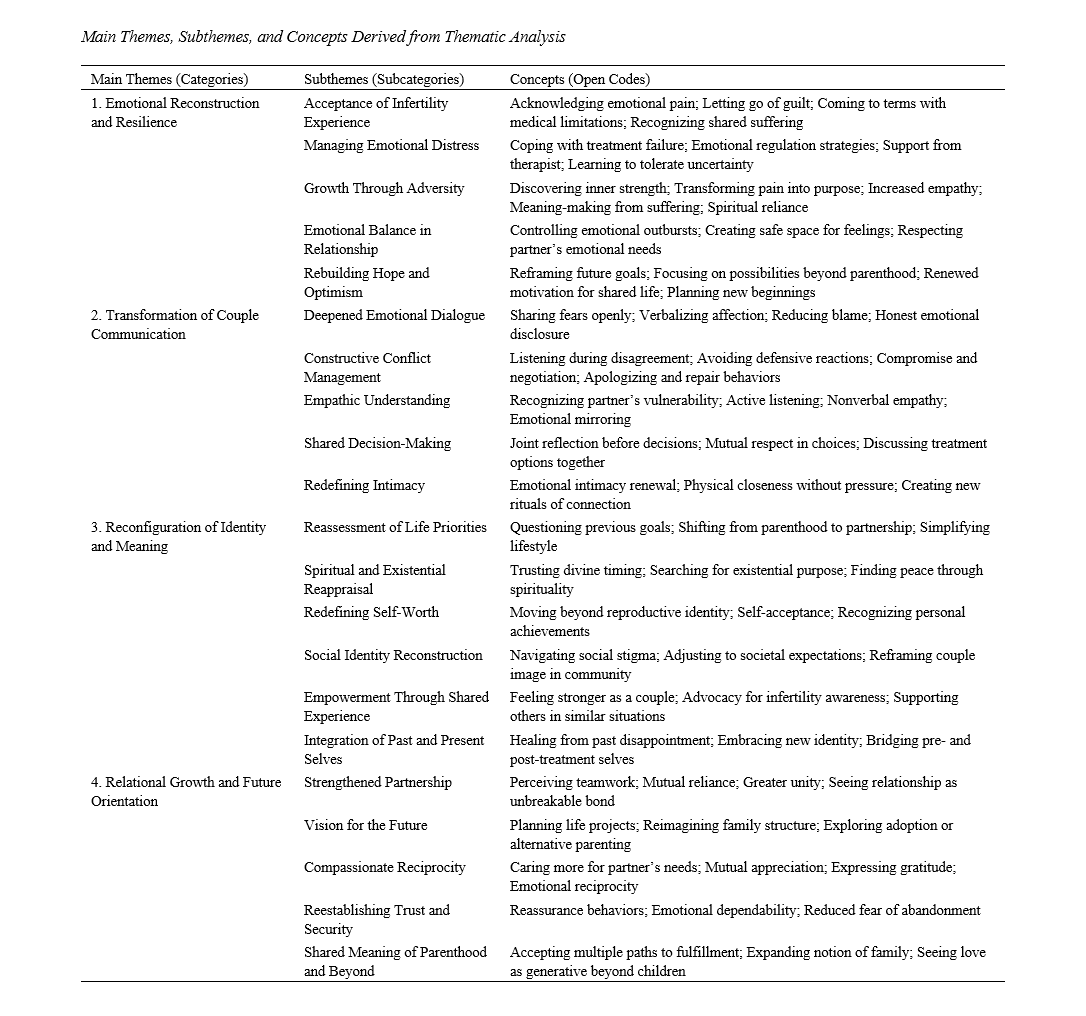
Findings: Thematic analysis revealed four overarching themes that described couples’ post-treatment experiences: (1) Emotional reconstruction and resilience, encompassing acceptance, emotional regulation, and rediscovery of hope; (2) Transformation of couple communication, marked by open dialogue, empathy, and constructive conflict resolution; (3) Reconfiguration of identity and meaning, reflecting shifts in self-worth, spirituality, and relational purpose; and (4) Relational growth and future orientation, capturing strengthened partnerships, gratitude, and shared visions beyond biological parenthood. Couples reported that infertility, while initially distressing, ultimately fostered deeper intimacy, mutual empathy, and adaptive meaning-making. These relational growth trajectories aligned with prior research emphasizing post-traumatic growth and dyadic coping in infertility contexts.
Conclusion: Infertility, despite its emotional burden, can serve as a catalyst for relational and psychological growth. Couples who engage in mutual support, empathic communication, and meaning reconstruction often emerge from treatment with stronger emotional bonds and renewed partnership. Integrating relational and psychological support within fertility care may enhance couples’ resilience and promote long-term well-being.
Downloads
References
Babakhani, N., Farokhzad, P., & Khalili, M. (2024). Determining the Predictive Model of Depression in Infertile Women Based on the Components of Lifestyle and Social Health Through the Mediation of Marital Satisfaction. Journal of Health Reports and Technology, 10(4). https://doi.org/10.5812/jhrt-149293
Besharat, M. A., Lashkari, Mahdieh, Rezazadeh, Mohammad Reza. (2021). Explaining adjustment to infertility according to relationship quality, couples' beliefs and social support. Journal of Family Psychology, 1(2), 41-54. https://www.ijfpjournal.ir/article_245497
Dehqan Manshadi, M., Fallah Mohammad, H., Sadrpoushan, N., & Mohammadi, F. (2024). Exploring the Psychological Experiences of Infertile Couples with Adopted Children. Health Dawn, 23(4), 80-101. https://tbj.ssu.ac.ir
Derakhshan , N., Shafiabadi , A., & Naeimi , E. (2023). Evaluation of effective factors in family continuity in infertile couples with marital satisfaction. Journal of Woman and Study of Family, 16(60), 227-244. https://www.magiran.com/paper/2638717
Ebrahimi, M., Mohsenzade, Farshad, Zahrakar, Kianoush. (2022). Marital Challenges of Infertile Couples: A Phenomenological Study. Journal of Applied Family Therapy, 3(2), 67-84. https://doi.org/10.22034/aftj.2022.314257.1252
Fathi, A., Alipour, A., & Malekirad, A. A. (2023). Comparison of the effectiveness of emotion-focused couples therapy and Gottman couples therapy on sexual function, marital sexual satisfaction, and depression in infertile couples. Journal of Family Psychology, 9(2), 69-84. https://jams.arakmu.ac.ir
Fernandes, J., Pedro, J., Costa, M. E., & Martins, M. V. (2023). Effect of depression and anxiety on sexual functioning in couples trying to conceive with and without an infertility diagnosis. Psychology & Health, 38(1), 58-75. https://doi.org/10.1080/08870446.2021.1955115
Iordachescu, D.-A., Vladislav, E.-O., Paica, C.-I., Gică, C., Panaitescu, A. M., Peltecu, G., & Gică, N. (2021). Do the Infertile Couples Need Psychological Support? Romanian Medical Journal, 68(4), 473-476. https://doi.org/10.37897/rmj.2021.4.11
Jain, B., & Tiwari, N. (2024). Anxiety, Depression, and Stress: A Comparative Study Between Couples With Male and Female Infertility. 75-78. https://doi.org/10.36106/gjra/1806570
Joseph, S. A., El Amiri, S., Brassard, A., Carranza-Mamane, B., & Péloquin, K. (2024). The role of partner support in infertility-related quality of life in couples seeking fertility treatment. Sexual and Relationship Therapy, 1, 22. https://doi.org/10.1080/14681994.2024.2304113
Malina, A., & Piotrowski, J. (2024). The role of social support for hormonal regulation for couples treated due to infertility. General Medicine & Health Sciences/Medycyna Ogólna i Nauki o Zdrowiu, 30(4). https://doi.org/10.26444/monz/197734
Moghadam, F. S., Nikorad, M., Sanagouye, G. M., Madadi, P., & Alimardani, S. (2024). Predicting Marital Intimacy Based on Infertility Stigma and Coping Strategies in Infertile Women. Aftj, 5(1), 229-237. https://doi.org/10.61838/kman.aftj.5.1.25
Nazemi, M., Majd, M. A., Ghamari, M., & Asadi, M. (2023). Qualitative Comparison of Satisfactory Stable Marriages and Marriages With Dissatisfaction in Infertile Couples. Jayps, 4(7), 1-13. https://doi.org/10.61838/kman.jayps.4.7.1
Nezami, M., Amirimajd, M., Ghamari, M., & Asadi, M. (2023). Aconceptual model for stable satisfied marriage among couple applying for adoption. Journal of Applied Family Therapy, 4(1), 34-63. https://doi.org/10.22034/aftj.2023.331209.1420
Ngai, F. W., & Loke, A. Y. (2022). Relationships between infertility-related stress, family sense of coherence and quality of life of couples with infertility. Human Fertility, 25(3), 540-547. https://doi.org/10.1080/14647273.2021.1871781
Pozzi, E., Boeri, L., Candela, L., Capogrosso, P., Cazzaniga, W., Fallara, G., & Salonia, A. (2021). Infertile couples still undergo assisted reproductive treatments without initial andrological evaluation in the real‐life setting: A failure to adhere to guidelines? Andrology, 9(6), 1843-1852. https://doi.org/10.1111/andr.13071
Rasheed, S., Fatima, I., & Qayyum, S. (2024). Perceived Control, Marital Satisfaction, Social Support and Infertility Related Stress: A Mediated Moderation. J. Asian Dev. Studies, 13(3), 1506-1516. https://doi.org/10.62345/jads.2024.13.3.122
Salimi, L. (2023). The effectiveness of emotion-focused couples therapy on positive feelings towards spouses and frustration due to indecision in infertile couples seeking divorce. Psychology Growth, 12(8), 201-210. https://frooyesh.ir/browse.php?a_id=4612&slc_lang=fa&sid=1&printcase=1&hbnr=1&hmb=1
Tang, N., Pei, M., Xie, L., Liang, X., Hu, J., & Gao, Y. (2023). Relationship Between Dyadic Coping with Anxiety and Depression in Infertile Couples: Gender Differences and Dyadic Interaction. Psychology research and behavior management, 4909-4919. https://www.tandfonline.com/doi/abs/10.2147/PRBM.S437808
Vakilian, K., Ebrahimi, S., Fouladvand, M., Moslemi, A., & Najdi, N. (2024). Predicting Commitment of Married Women Based on Emotional Intimacy, Cognitive Flexibility, and Irrational Beliefs of Infertile Couples in Arak City in the 2021:A Cross-Sectional Study. The Open Public Health Journal, 17(1). https://doi.org/10.2174/0118749445267020240209073345
Downloads
Additional Files
Publication Timeline
- Submitted
- Revised
- Accepted