Identifying Attachment-Based Resilience in Families Experiencing Domestic Displacement
DOI:
https://doi.org/10.61838/kman.aftj.5027Keywords:
Attachment-based resilience, domestic displacement, family adaptation, intergenerational copingAbstract
Objective: This study aimed to identify the attachment-based resilience processes that enable displaced families in Taiwan to preserve emotional security, cohesion, and intergenerational stability amid conditions of forced relocation.
Methods and Materials: This qualitative research employed an interpretive phenomenological design to explore how displaced families reconstruct attachment and resilience following domestic displacement. A total of 24 participants (13 women and 11 men) aged 27–58 years were recruited through community organizations and social service centers in Taiwan. Data were collected through semi-structured, in-depth interviews focusing on emotional bonds, family trust, and adaptive coping. Interviews continued until theoretical saturation was reached. All data were transcribed and analyzed thematically using NVivo 14 software following Braun and Clarke’s six-phase method. Credibility was enhanced through member checking, peer debriefing, and reflexive journaling.
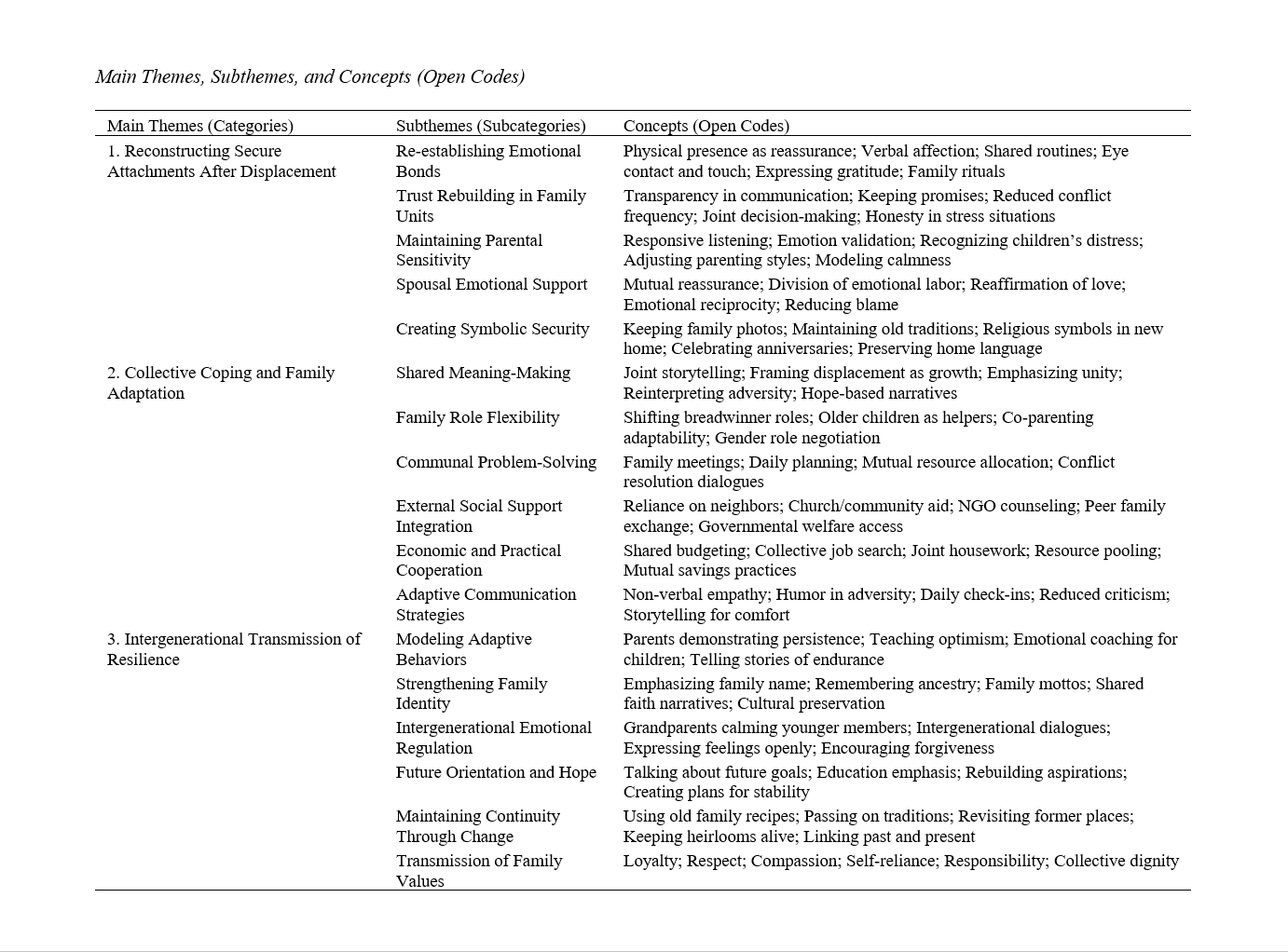
Findings: The analysis yielded three overarching themes: (1) Reconstructing secure attachments after displacement, emphasizing the rebuilding of trust, emotional closeness, and symbolic security; (2) Collective coping and family adaptation, highlighting cooperative problem-solving, flexible role negotiation, and reliance on community support; and (3) Intergenerational transmission of resilience, involving modeling adaptive behaviors, maintaining cultural continuity, and reinforcing family identity through shared narratives. Families demonstrated that emotional reciprocity, meaning-making, and intergenerational caregiving were critical in transforming displacement from a source of trauma into an opportunity for relational growth. These results underscore that resilience emerges through relational, rather than individual, mechanisms of attachment repair.
Conclusion: Attachment-based resilience among displaced families in Taiwan reflects a dynamic interplay between emotional reconstruction, collective coping, and cultural continuity. Strengthening attachment relationships, promoting family-centered interventions, and supporting intergenerational communication can enhance psychological stability and social reintegration in displaced populations.
Downloads
References
Arënliu, A., Bertelsen, N., Saad, R., Abdulaziz, H., & Weine, S. (2020). War and Displacement Stressors and Coping Mechanisms of Syrian Urban Refugee Families Living in Istanbul. Journal of Family Psychology, 34(4), 392-401. https://doi.org/10.1037/fam0000603
Arumugam, C. T., Said, M. A., & Farid, N. D. N. (2021). Screen-Based Media and Young Children: Review and Recommendations. Malaysian Family Physician, 16(2), 7-13. https://doi.org/10.51866/rv1143
Babiker, E., Eisa, E., Ahmed, M., Ibrahim, S. M., & Salah, A. (2025). Prevalence of PTSD and Anxiety Among Internally Displaced Sudanese Children in During War in Al Jabalain White Nile State, Sudan, 2024. European Psychiatry, 68(S1), S549-S549. https://doi.org/10.1192/j.eurpsy.2025.1126
Bauch, N. G. (2022). Art Therapy With Refugee and Asylum-Seeking Children and Their Parents: Preliminary Findings of a Thorough Literature Review. 5, 245-249. https://doi.org/10.36315/2022inpact058
Demsie, G. T. (2024). The Psychosocial Experiences of Internally Displaced Children Due to Armed Conflict in the Case of North East Ethiopia: Implications for Intervention. Conflict Resolution Quarterly. https://doi.org/10.1002/crq.21430
Ezenwanne, D. N. (2025). Investigating Challenges Among the Families of Children With Autism Spectrum Disorder (ASD) in Internally Displaced People (IDP) Camps in South East and North Central Regions of Nigeria. Ijed, 2(1), 38-51. https://doi.org/10.61132/ijed.v2i1.186
Frederiksen, N. W., Christoffersen, N. M., Haugaard, A. K., Ahmadi, A., Poulsen, A., Nørredam, M., & Kruse, A. (2021). Health Screening Among Children Newly Granted Asylum in Denmark. Acta Paediatrica, 110(8), 2389-2395. https://doi.org/10.1111/apa.15879
Gerrand, V., Lam, K., Magee, L., Nilan, P., Walimunige, H., & Cao, D. (2023). What Got You Through Lockdown? M/C Journal, 26(4). https://doi.org/10.5204/mcj.2991
Haar, K., El‐Khani, A., Hawng, H., Brang, T. T., Mar, W., Lynn, Z. K. K., & Maalouf, W. (2025). Implementation of a Family Skills Programme in Internally Displaced People Camps in Kachin State, Myanmar. Healthcare, 13(9), 1090. https://doi.org/10.3390/healthcare13091090
Jim, O. (2025). Impact of Climate Change on Early Childhood Education in Mashonaland East Province of Zimbabwe. International Journal of Educational Research & Social Sciences, 6(5), 523-531. https://doi.org/10.51601/ijersc.v6i5.999
Johansen, J. D., Varvin, S., & Sagbakken, M. (2025). Family Life Under Strain: The Impact of Forced Migration on Refugee Parenting in Reception Centers. Frontiers in psychology, 16. https://doi.org/10.3389/fpsyg.2025.1554692
Kaptan, S. K., Varese, F., Yılmaz, B., Andriopoulou, P., & Husain, N. (2022). “Online Delivery Gave Me Privacy and Distance From Others”: Feasibility Trial and Qualitative Evaluation of an Online Intervention for Refugees and Asylum Seekers; LTP + EMDR G‐tep. Counselling and Psychotherapy Research, 22(4), 876-888. https://doi.org/10.1002/capr.12580
Kemei, J., Salami, B., Soboka, M., Gommaa, H., Okeke‐Ihejirika, P., & Lavin, T. (2023). The Forms and Adverse Effects of Insecurities Among Internally Displaced Children in Ethiopia. BMC public health, 23(1). https://doi.org/10.1186/s12889-023-15109-9
Lee, A. (2025). Editorial: Respect and Protect Vulnerability: The Role of Medical Law. Medicine and Law, 327. https://doi.org/10.63776/medlaw2025.44.3.editorial
Mares, S., & Ziersch, A. (2024). How Immigration Detention Harms Children: A Conceptual Framework to Inform Policy and Practice. Psychological Trauma Theory Research Practice and Policy, 16(Suppl 2), S367-S378. https://doi.org/10.1037/tra0001474
Mendzhul, M. V. (2023). State Protection of Family Rights of Internally Displaced Persons. Uzhhorod National University Herald Series Law, 1(75), 193-197. https://doi.org/10.24144/2307-3322.2022.75.1.31
Menzhul, M. V. (2023). Certain Aspects of Guaranteeing the Implementation of the Rights of Internally Displaced Children in Ukraine. Analytical and Comparative Jurisprudence(1), 106-109. https://doi.org/10.24144/2788-6018.2023.01.17
Nimpa, M. M., Mwana-Wabene, A. C., Otomba, J., Mukendi, J.-C., Danovaro‐Holliday, M. C., Mboussou, F., Mwamba, D., Kambala, L., Ngwanga, D., Mwanga, C., Sume, G. E., Compaore, I. P., Yapi, M. D., & Ishoso, D. K. (2024). Characterizing Zero-Dose and Under-Vaccinated Children Among Refugees and Internally Displaced Persons in the Democratic Republic of Congo. Tropical Diseases Travel Medicine and Vaccines, 10(1). https://doi.org/10.1186/s40794-024-00225-0
Ogbu, T. J., Scales, S. E., Almeida, M. M. d., Joris Adriaan Frank van, L., Speybroeck, N., & Guha‐Sapir, D. (2022). Predictors of Exceeding Emergency Under-Five Mortality Thresholds Using Small-Scale Survey Data From Humanitarian Settings (1999 – 2020): Considerations for Measles Vaccination, Malnutrition, and Displacement Status. Archives of Public Health, 80(1). https://doi.org/10.1186/s13690-022-00916-0
Omelchenko, Y. (2024). Features of Psychological Assistance to Children of Forcedly Displaced Persons in War Conditions. Psychological Journal, 10(4), 19-30. https://doi.org/10.31108/1.2024.10.4.2
Popham, C., McEwen, F., Karam, E. G., Fayyad, J., Karam, G., Saab, D., Moghames, P., & Pluess, M. (2022). The Dynamic Nature of Refugee Children's Resilience: A Cohort Study of Syrian Refugees in Lebanon. Epidemiology and Psychiatric Sciences, 31. https://doi.org/10.1017/s2045796022000191
Shaw, S. A., Pillai, V., Yang, C., & Saasa, S. (2020). Parenting Among Rohingya and Afghan Refugee Parents Residing in Malaysia. Family Relations, 70(2), 514-528. https://doi.org/10.1111/fare.12518
Shtrygol, D., Mikhanovska, N., & Lutsenko, О. (2023). The Impact of Domestic Violence on the Mental Health and Psychosocial Functioning of Children and Adolescents: Abroad Experience of Diagnostics. Psychiatry Neurology and Medical Psychology(22), 6-13. https://doi.org/10.26565/2312-5675-2023-22-01
Sim, A., Bowes, L., Maignant, S., Magber, S., & Gardner, F. (2020). Acceptability and Preliminary Outcomes of a Parenting Intervention for Syrian Refugees. Research on Social Work Practice, 31(1), 14-25. https://doi.org/10.1177/1049731520953627
Slabu, L. (2025). Music for Displaced Dyads: A Mixed Methods Feasibility Study on the Impact of Music Therapy on the Mental Health and Wellbeing of Ukrainian Refugee Families. Frontiers in Psychiatry, 16. https://doi.org/10.3389/fpsyt.2025.1707023
Västhagen, M. (2025). Evaluating Health-Promoting Parenting Programs for Migrant Families. https://doi.org/10.69622/28731983
Veronese, G., Mahamid, F., Diab, M., Hassouna, B., & Bdier, D. (2025). Beyond Survival: A Qualitative Study on the Intersection of Caregiving, Coping, and Mental Health in Gaza’s Ongoing Mass Massacre. Journal of interpersonal violence. https://doi.org/10.1177/08862605251336360
Downloads
Additional Files
Publication Timeline
- Submitted
- Revised
- Accepted