Comparison of the Effectiveness of Acceptance and Commitment–Based Couple Therapy and Integrative Couple Therapy on Dysfunctional Beliefs, (Cognitive/Experiential) Avoidance, Conflict Resolution, and Sexual Satisfaction in Infertile Couples
DOI:
https://doi.org/10.61838/kman.aftj.5038Keywords:
Acceptance and commitment couple therapy, integrative couple therapy, dysfunctional beliefs, cognitive avoidance, experiential avoidance, conflict resolution, sexual satisfaction, infertile couplesAbstract
Objective: This study aimed to compare the effectiveness of Acceptance and Commitment–Based Couple Therapy (ACT-C) and Integrative Couple Therapy (IBCT) on dysfunctional relationship beliefs, cognitive and experiential avoidance, conflict resolution styles, and sexual satisfaction in infertile couples.
Methods and Materials: Using a quasi-experimental pretest–posttest–follow-up design with a control group, infertile couples were recruited through purposive sampling and randomly assigned to ACT-C, IBCT, or a waitlist control. Both interventions were delivered in twelve 90-minute sessions across three months. Standardized self-report measures assessed dysfunctional relationship beliefs, cognitive and experiential avoidance, conflict resolution styles, and sexual satisfaction at pretest, posttest, and three-month follow-up. Data were analyzed using repeated-measures analysis of variance, followed by Bonferroni post hoc comparisons to examine within- and between-group differences over time.
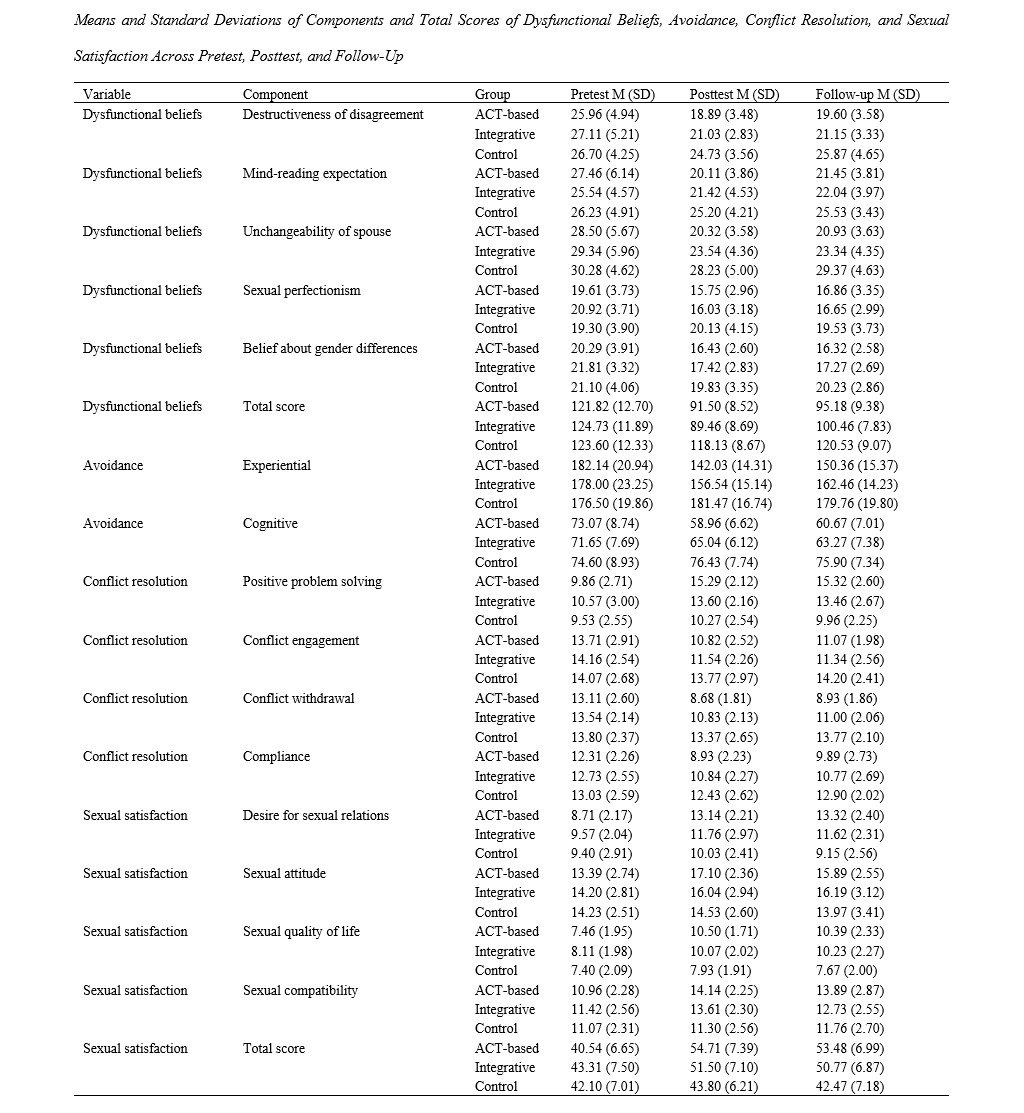
Findings: Repeated-measures analyses revealed significant group × time interaction effects for dysfunctional beliefs (total score and selected components), experiential avoidance, and conflict resolution dimensions, indicating differential change trajectories across groups (p < .05). ACT-C produced significantly greater reductions than IBCT in belief in the destructiveness of disagreement, belief in spouse unchangeability, total dysfunctional beliefs, and experiential avoidance (p < .05). ACT-C also led to greater improvements in positive problem solving and greater reductions in withdrawal and compliance compared with IBCT (p < .05). No significant between-group differences were found for cognitive avoidance. Both ACT-C and IBCT demonstrated significant improvements over time relative to the control group on sexual satisfaction components and total score; however, between-therapy differences on sexual satisfaction were not statistically significant (p > .05). Treatment gains were largely maintained at follow-up.
Conclusion: Both ACT-C and IBCT are effective interventions for improving relational and sexual outcomes in infertile couples, with ACT-C showing incremental advantages on experiential avoidance, specific dysfunctional beliefs, and key conflict resolution styles, suggesting added value of flexibility-focused processes in this population.
Downloads
References
Adriani, S. R., & Ratnasari, Y. (2021). Conflict resolution styles and marital satisfaction in men and women: Study in the first five years of marriage. 53-66. https://doi.org/10.22492/issn.2187-4743.2021.6
Aghighi, N. (2023). The effectiveness of Acceptance and Commitment-based therapy on improving sexual functioning and increasing sexual self-efficacy in couples. https://www.transoscience.ir/article_232113_9010eb15ef70dec38b910409c0653994.pdf
Ahmadi, Z. (2025). The effectiveness of Acceptance and Commitment-based couple therapy on the spouse's understanding, approach-avoidance, and sexual satisfaction in infertile couples. Emotional and Behavioral Disorders, 2(2), 19-34. https://ebd.shirazu.ac.ir/article_8227.html?lang=en
Azar, M., Lamaa, S., Kordahi Badr, L., & Sneifer, E. (2024). The Psychological and Sexual Impact of Infertility on Couples. J. Women Health Care and Issues, 7(1), 124-148. https://auctoresonline.org/article/the-psychological-and-sexual-impact-of-infertility-on-couples
Barbosa, C., Santos, S., & Pedro, J. (2024). Mapping acceptance and commitment therapy outcomes in the context of infertility: a systematic review. Current Psychology, 43(16), 14634-14644. https://doi.org/10.1007/s12144-023-05294-6
Barraca, J., Nieto, E., & Polanski, T. (2021). An integrative behavioral couple therapy (IBCT)-based conflict prevention program: A pre-pilot study with non-clinical couples. International journal of environmental research and public health, 18(19). https://doi.org/10.3390/ijerph18199981
Barraca, J., Polanski, T., Duarte-Díaz, A., & Perestelo-Pérez, L. (2024). Acceptance and Commitment Therapy for Couples: A Systematic Review and Meta-Analysis. Journal of Contextual Behavioral Science. https://doi.org/10.1016/j.jcbs.2024.100867
Behbahani, M., & Ghorban Shiroudi, S. (2020). The effectiveness of Acceptance and Commitment-based group therapy on marital intimacy and sexual satisfaction in pre-menopausal women. Journal of Applied Psychology, 14(4), 369-389. https://www.noormags.ir/view/fa/articlepage/1831070/
Bortolon, C., & Raffard, S. (2019). Affective and cognitive factors associated with hallucination proneness in the general population: the role of shame and trauma-related intrusions. Cognitive Neuropsychiatry, 24(6), 406-420. https://doi.org/10.1080/13546805.2019.1670152
Briggs, J. G., Finley, M. A., & Sprenkle, D. H. (2015). A Substantive and methodological review of the integrative behavioral couple therapy research program: Clinical implications for a research informed practice. Journal of Couple & Relationship Therapy, 14(3), 219-253. https://doi.org/10.1080/15332691.2014.959229
Christensen, A., Atkins, D. C., Berns, S., Wheeler, J., Baucom, D. H., & Simpson, L. E. (2004). Traditional versus integrative behavioral couple therapy for significantly and chronically distressed married couples. Journal of consulting and clinical psychology, 72(2), 176. https://doi.org/10.1037/0022-006X.72.2.176
Christensen, A., & Doss, B. D. (2017). Integrative behavioral couple therapy. Current opinion in psychology, 13, 111-114. https://doi.org/10.1016/j.copsyc.2016.04.022
Dideh Dar, S., Norouzi, S., & Gharibi Asl, A. (2021). The impact of Acceptance and Commitment-based therapy (ACT) on marital satisfaction and conflict resolution styles in married women in Tehran. Studies and Research in Behavioral Sciences, 3(6), 127-141. https://ensani.ir/fa/article/461904/
Diehimi, M., Karimian, N., & Azadfar, Z. (2019). The effectiveness of cognitive-behavioral therapy on dysfunctional attitudes and irrational beliefs in infertile women. Psychological Growth, 8(12), 99-106. https://htainaction.tums.ac.ir/index.php/hta/article/download/109/75
Dong, S., Dong, Q., & Chen, H. (2022). Mothers' parenting stress, depression, marital conflict, and marital satisfaction: The moderating effect of fathers' empathy tendency. Journal of affective disorders, 299, 682-690. https://doi.org/10.1016/j.jad.2021.12.079
Faraji, S., Agah Haris, M., & Shibani, H. (2022). The effectiveness of Acceptance and Commitment-based training on cognitive avoidance and marital satisfaction in women with marital problems. Social Cognition, 10(19), 119-134. https://sc.journals.pnu.ac.ir/article_7843.html?lang=en
Fredriksen, K., & et al. (2015). Psychological interventions for infertility: A review of the impact of psychological therapy on marital and sexual satisfaction. Journal of Reproductive and Infant Psychology, 33(1), 24-37. https://ouci.dntb.gov.ua/en/works/l1X2opB4/
Galhardo, A., Alves, J., Moura-Ramos, M., & Cunha, M. (2020). Infertility-related stress and depressive symptoms-the role of experiential avoidance: a cross-sectional study. Journal of Reproductive and Infant Psychology, 38(2), 139-150. https://doi.org/10.1080/02646838.2019.1612046
Gámez, W., Chmielewski, M., Kotov, R., Ruggero, C., & Watson, D. (2011). Development of a measure of experiential avoidance: The multidimensional experiential avoidance questionnaire. Psychological assessment, 23(3), 692-713. https://doi.org/10.1037/a0023242
Ghasemi Taqab, F., Bakhshipour Rudesari, A., & Farnam, A. (2022). The effectiveness of Acceptance and Commitment-based therapy on experiential avoidance and depression in female students with love trauma syndrome. Clinical Psychology, 14(2), 51-61. https://jcp.semnan.ac.ir/article_6738.html
Greil, A. L., Slauson‐Blevins, K., & McQuillan, J. (2010). The experience of infertility: a review of recent literature. Sociology of Health & Illness, 32(1), 140-162. https://doi.org/10.1111/j.1467-9566.2009.01213.x
Grunberg, P., Miner, S., & Zelkowitz, P. (2022). Infertility and perceived stress: the role of identity concerns in treatment-seeking men and women. Human fertility (Cambridge, England), 25(1), 117-127. https://doi.org/10.1080/14647273.2019.1709667
Hasani, E., & Parandin, S. (2022). Comparing the effectiveness of Acceptance and Commitment-based couple therapy and compassion-based couple therapy on marital conflicts and sexual intimacy in infertile couples in Kermanshah. Health Psychology and Social Behavior, 7(2), 19-31. https://ajnpp.umsha.ac.ir/article-1-325-en.pdf
Hayes, S. C., Strosahl, K. D., & Wilson, K. G. (2011). Acceptance and commitment therapy: The process and practice of mindful change. Guilford press. https://psycnet.apa.org/record/2012-00755-000
Hicks, L. L., McNulty, J. K., Meltzer, A. L., & Olson, M. A. (2021). A dual-process perspective on how sexual experiences shape automatic versus explicit relationship satisfaction: Reply to Brody, Costa, Klapilová, and Weiss (2018). Psychological Science, 29, 670-672. https://doi.org/10.1177/0956797618760848
Hossein Panahi, M., & Mir Khafordvand, M. (2020). The effect of Acceptance and Commitment-based counseling on the mental health and quality of life of infertile couples: A randomized controlled trial. Journal of Health Education and Health Promotion, 9. https://doi.org/10.4103/jehp.jehp_512_20
Jan Ali Pour Chenaroudkhani, M. (2023). The effectiveness of Acceptance and Commitment-based couple therapy (ACT) on sexual satisfaction and couple intimacy in infertile couples. https://civilica.com/doc/1998587/
Kirk, A., Meyer, J. M., Whisman, M. A., Deacon, B. J., & et al. (2019). Safety behaviors, experiential avoidance, and anxiety: A path analysis approach. Journal of anxiety disorders, 64, 9-15. https://doi.org/10.1016/j.janxdis.2019.03.002
Kurdek, L. A. (1994). Conflict resolution styles in gay, lesbian, heterosexual nonparent, and heterosexual parent couples. Journal of Marriage and the Family, 56(3), 705-722. https://doi.org/10.2307/352880
Larson, J. H., Anderson, S. M., Holman, T. B., & Niemann, B. K. (1998). A longitudinal study of the effects of premarital communication, relationship stability, and self-esteem on sexual satisfaction in the first year of marriage. Journal of sex & marital therapy, 24, 193-206. https://doi.org/10.1080/00926239808404933
Lebow, J. (2015). Integrative approaches to couple and family therapy BOOKTITLE - Handbook of family therapy. https://doi.org/10.4324/9780203123584-11 10.4324/9780203123584-1
Mahmoudpour, A., Dehghanpour, T., Yousofi, N., & Ejadi, S. (2020). Predicting marital intimacy in women based on mindfulness, conflict resolution patterns, perceived social support, and social well-being. Social Psychological Research, 10(39), 83-102. https://www.socialpsychology.ir/article_120662.html
Mazaheri, M. A., & Pour Etemad, H. R. (2001). The communication beliefs scale, unpublished. https://ijbmc.org/index.php/ijbmc/article/download/941/583/8229
Meyer, D., & Sledge, R. (2021). The Relationship Between Conflict Topics and Romantic Relationship Dynamics. Journal of Family Issues, 43(2), 306-323. https://doi.org/10.1177/0192513X21993856
Mohammadian, S., Asgari, P., Makvandi, B., & Naderi, F. (2021). Effectiveness of acceptance and commitment therapy on anxiety, cognitive avoidance, and empathy of couples visiting counseling centers in Ahvaz City, Iran. Journal of Research and Health, 11(6), 393-402. https://doi.org/10.32598/JRH.11.6.1889.1
Mokhtari Serkhani, T., Alidoosti, K., Ahmadi, A., Mirzaei, M., & Habibzadeh, V. (2021). The impact of infertility counseling on the quality of life of infertile couples with a couple therapy approach: A clinical trial. Journal of Arak University of Medical Sciences, 24(6), 820-833. https://doi.org/10.32598/jams.24.6.6462.1
Mousavi Diva, S. R., Heydari, S., & Ghanadzadegan, H. A. (2023). The effectiveness of integrative couple therapy on the quality of marital relationships and cognitive emotion regulation in incompatible couples. Applied Family Therapy, 4(5), 100-114. https://doi.org/10.61838/kman.aftj.4.5.6
Mousavi Haghighi, S. E., Rishehri, P., & Mousavi, S. A. (2022). Effectiveness of acceptance and commitment therapy and integrated behavioral couples therapy on intimacy and family functioning in divorce-seeking couples. Journal of Research and Health, 12(3), 167-176. https://doi.org/10.32598/JRH.12.3.1972.1
Nakić Radoš, S., Soljačić Vraneš, H., Tomić, J., & Kuna, K. (2022). Infertility-related stress and sexual satisfaction: a dyadic approach. Journal of Psychosomatic Obstetrics & Gynecology, 43(1), 18-25. https://doi.org/10.1080/0167482X.2020.1752658
Ngai, F. W., & Loke, A. Y. (2022). Relationships between infertility-related stress, family sense of coherence and quality of life of couples with infertility. Human Fertility, 25(3), 540-547. https://doi.org/10.1080/14647273.2021.1871781
Oehler, L., Freeman, L., & Hughes, A. A. (2021). Sex therapy with couples experiencing infertility: an intersystem approach. Sexual and Relationship Therapy, 38(4), 860-873. https://doi.org/10.1080/14681994.2021.1915472
Ong, C. W., & Eustis, E. H. (2021). Psychological flexibility BOOKTITLE - The Oxford handbook of acceptance and commitment therapy. Oxford University Press. https://doi.org/10.1093/oxfordhb/9780197550076.013.7
Ortega-Otero, M., Montesinos, F., & Charrabe, L. (2023). Influence of psychological inflexibility and mindfulness on hypersexuality and sexual satisfaction in a Spanish sample. Frontiers in psychology, 14. https://doi.org/10.3389/fpsyg.2023.1182222
Pasch, L. A., & Sullivan, K. T. (2017). Stress and coping in couples facing infertility. Current opinion in psychology, 13, 131-135. https://doi.org/10.1016/j.copsyc.2016.07.004
Pásztor, N., Hegyi, B. E., Dombi, E., & Németh, G. L. (2019). Psychological distress and coping mechanisms in infertile couples. Open Psychology Journal, 12(1), 169-173. https://doi.org/10.2174/1874350101912010169
Pintea, S., Pop, R., & Kallay, E. (2019). The effect of integrative behavioral therapy versus emotion-focused therapy for couples: A meta-analysis. Studia Universitatis Babes-Bolyai, Psychologia-Paedagogia, 64(1), 23-44. https://doi.org/10.24193/subbpsyped.2019.1.02
Pour, M. M., Ahmadi, V., & Mami, S. (2024). Comparing The Efficacy Of Mindfulness-Based Cognitive Therapy And Acceptance And Commitment-Based Therapy On Adolescent Rumination And Cognitive Avoidance In Kermanshah City. Journal of Advanced Zoology, 45(2). https://frooyesh.ir/article-1-2937-fa.html
Rabiei, M., Ebrahimi Moghadam, H., & Hasani, F. (2023). The effect of Acceptance and Commitment-based therapy on self-differentiation and irrational beliefs in women with marital conflicts. Studies in Women and Family, 11(2), 99-123. https://jwfs.alzahra.ac.ir/article_7240_en.html
Rahimi, A., Amiri, H., Afsharnia, K., & Arefi, M. (2022). Comparing the effectiveness of cognitive-behavioral therapy with Acceptance and Commitment-based therapy on increasing marital satisfaction and reducing anxiety in couples visiting counseling centers. Disability Studies, 12, 0-0. https://www.sid.ir/paper/1121735/en
Rooney, K. L., & Domar, A. D. (2018). The relationship between stress and infertility. Dialogues in clinical neuroscience, 20(1), 41-47. https://doi.org/10.31887/DCNS.2018.20.1/klrooney
Rouhanai, M. R. (2022). Examining the correlation between depression and the level of marital conflict and conflict resolution styles with emotional intelligence as a mediator. New Advances in Psychology, Educational Sciences, and Teaching, 5(49), 274-286. https://ensani.ir/fa/article/download/511818
Sahiner, E., & Boz, I. (2022). Experiences of women undergoing infertility treatment from embryo transfer until pregnancy test and their conceptualization of their embryo. Journal of Psychosomatic Obstetrics & Gynecology, 43(2), 153-164. https://doi.org/10.1080/0167482X.2020.1865909
Seçer, İ., & Ulaş, S. (2021). An Investigation of the Effect of COVID-19 on OCD in Youth in the Context of Emotional Reactivity, Experiential Avoidance, Depression and Anxiety. International journal of mental health and addiction, 19(6), 2306-2319. https://doi.org/10.1007/s11469-020-00322-z
Selmasi, E., Yadegar Tirandaz, S., & Ghafran, P. (2022). Sexual satisfaction in infertile couples: A review article. https://civilica.com/doc/1485352/
Smith, B. M., Smith, G. S., & Dymond, S. (2020). Relapse of anxiety‐related fear and avoidance: Conceptual analysis of treatment with acceptance and commitment therapy. Journal of the Experimental Analysis of Behavior, 113(1), 87-104. https://doi.org/10.1002/jeab.573
Snyder, D., Castellani, A., & Washman, M. (2019). Current status and future directions in couple therapy. Journal Annual Review of psychology, 57, 417-344. https://doi.org/10.1146/annurev.psych.56.091103.070154
Snyder, D. K., & Balderrama-durbin, C. (2022). Integrative approaches to couple therapy: Implications for clinical practice and rerearch. Behavior therapy, 43, 13-24. https://doi.org/10.1016/j.beth.2011.03.004
Taghavi Soreh Barq, M., & Mahdizadeh, A. (2022). The effectiveness of integrative couple therapy on dysfunctional attitudes in married women. Psychology and Educational Sciences in the Third Millennium, 6(2), 103-112. https://www.noormags.ir/view/fa/articlepage/1972205/
Tang, Q., Zhou, X., Wang, N., & Qian, X. (2024). Irrational parenthood cognition and infertility stigma among infertile women: A cross-sectional study in Changsha, China. Heliyon, 10(15). https://doi.org/10.1016/j.heliyon.2024.e34428
Tyndall, I., Waldeck, D., Pancani, L., Whelan, R., Roche, B., & Dawson, D. L. (2019). The Acceptance and Action Questionnaire-II (AAQ-II) as a measure of experiential avoidance: Concerns over discriminant validity. Journal of Contextual Behavioral Science, 12, 278-284. https://doi.org/10.1016/j.jcbs.2018.09.005
Vaziri Nia, F., Karimi, J., Goudarzi, K., & Sadeghi, M. (2021). Comparing the effectiveness of integrative behavioral couple therapy and emotion-focused therapy on the health (self-efficacy component of infertility) of infertile couples. Islamic Lifestyle, 5(2), 38-49. https://www.noormags.ir/view/fa/articlepage/1762658/
Vazirnia, F., Karimi, J., Goodarzi, K., & Sadeghi, M. (2021). Effects of integrative behavioral couple therapy on infertility self-efficacy, dyadic adjustment, and sexual satisfaction in infertile couples. Journal of Client-Centered Nursing Care, 7(1), 43-54. https://doi.org/10.32598/JCCNC.7.1.354.1
Walser, R. D., & O'Connell, M. (2023). Alliance rupture and repair in acceptance and commitment therapy BOOKTITLE - Rupture and repair in psychotherapy: A critical process for change. https://doi.org/10.1037/0000306-008
Wang, Y. X., Farland, L. V., Wang, S., Gaskins, A. J., Wang, L., Rich-Edwards, J. W., & et al. (2022). Association of infertility with premature mortality among US women: Prospective cohort study. The Lancet Regional Health-Americas, 7 DI. https://www.thelancet.com/journals/ebiom/article/PIIS2352-3964(22)00428-5/fulltext
Downloads
Additional Files
Publication Timeline
- Submitted
- Revised
- Accepted