The Role of Schema Therapy and Cognitive–Behavioral Therapy in Reducing Alexithymia in Maladjusted Couples: A Comparative Study
DOI:
https://doi.org/10.61838/kman.aftj.5040Keywords:
schema therapy, cognitive–behavioral therapy, alexithymia, maladjusted couplesAbstract
Objective: The present study aimed to compare the effectiveness of schema therapy and cognitive–behavioral therapy (CBT) in reducing alexithymia in maladjusted couples.
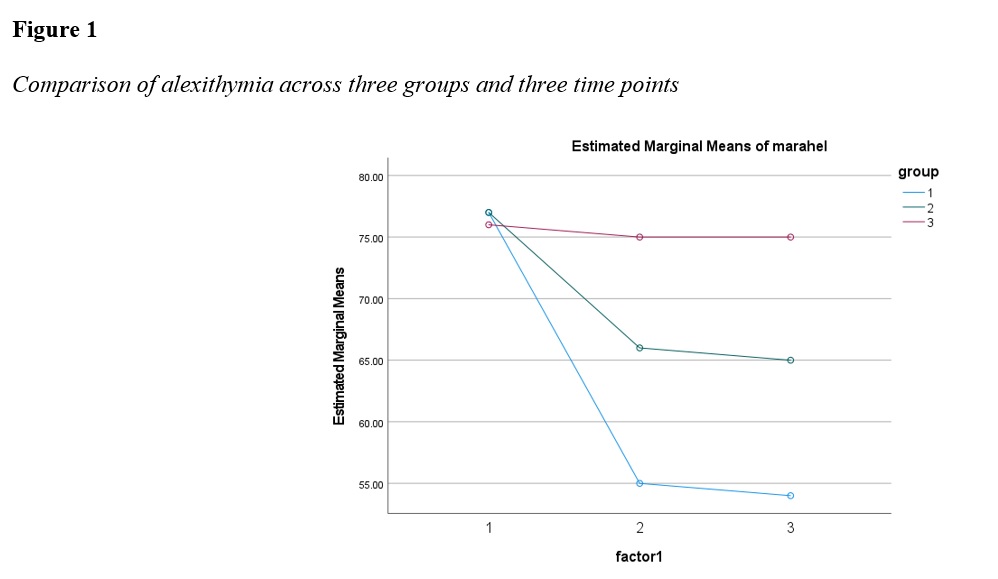
Methods and Materials: This applied, quasi-experimental study employed a pretest–posttest design with a control group and a two-month follow-up. The statistical population comprised couples who referred to psychology clinics in District 2 of Tehran during the first half of 2025 due to marital conflict. Using convenience sampling, 45 couples were recruited and randomly assigned to three groups: schema therapy (n = 15), cognitive–behavioral therapy (n = 15), and a control group (n = 15). Following attrition of one couple from the CBT group, analyses were conducted on 44 couples. The experimental groups received ten sessions of their respective interventions, while the control group received no treatment during the study period. Data were collected using the Toronto Alexithymia Scale (TAS-20) at pretest, posttest, and follow-up, and analyzed using repeated-measures analysis of variance.
Findings: Repeated-measures ANOVA revealed a significant main effect of time on alexithymia scores (p < .001) and a significant interaction effect between group and time (p < .001). Post hoc comparisons indicated that both schema therapy and CBT produced significant reductions in alexithymia from pretest to posttest (p < .001). However, schema therapy resulted in significantly greater reductions than CBT at posttest (p < .01), and these effects remained significantly more stable at the two-month follow-up (p < .01). No significant changes were observed in the control group across measurement points (p > .05).
Conclusion: Both schema therapy and cognitive–behavioral therapy are effective in reducing alexithymia among maladjusted couples, but schema therapy demonstrates superior effectiveness and greater durability of outcomes, suggesting that emotion-focused and schema-based interventions may be particularly beneficial for couples with pronounced emotional processing deficits.
Downloads
References
Aghaei, F., Abbasi, G., & Hassanzadeh, R. (2024). The Effectiveness of Mindfulness-Based Schema Therapy on Emotional Reaction and Internal Shame in Betrayed Women. Journal of Psychological Science, 23(144), 141-158. https://doi.org/10.61186/jps.23.144.8
Alexander, R., Aragón, O. R., Bookwala, J., Cherbuin, N., Gatt, J. M., Kahrilas, I. J. K. N., Lawrence, A., Lowe, L., Morrison, R. G., Mueller, S. C., Nusslock, R., Papadelis, C., Polnaszek, K. L., Helene Richter, S., Silton, R. L., & Styliadis, C. (2021). The neuroscience of positive emotions and affect: Implications for cultivating happiness and wellbeing. Neuroscience & Biobehavioral Reviews, 121, 220-249. https://doi.org/10.1016/j.neubiorev.2020.12.002
Alwhaibi, R. M., Almuwais, A. K., Alotaibi, M., AlTaleb, H. M., Alsamiri, S. M., & Khan, R. (2024). Health beliefs of unmarried adult Saudi individuals toward safe marriage and the role of premarital screening in avoiding consanguinity: a nationwide cross-sectional study. Frontiers in Public Health, 12, 1379326. https://doi.org/10.3389/fpubh.2024.1379326
Bach, B., Lockwood, G., & Young, J. E. (2018). A new look at the schema therapy model: organization and role of early maladaptive schemas. Cognitive behaviour therapy, 47(4), 328-349. https://doi.org/10.1080/16506073.2017.1410566
Bodenmann, G., Kessler, M., Kuhn, R., Hocker, L., & Randall, A. K. (2020). Cognitive-behavioral and emotion-focused couple therapy: Similarities and differences. Clinical psychology in Europe, 2(3). https://doi.org/10.32872/cpe.v2i3.2741
Bouchard, K. N., Bergeron, S., & Rosen, N. O. (2024). Feasibility of a cognitive-behavioral couple therapy intervention for sexual interest/arousal disorder. The Journal of Sex Research, 1-11. https://doi.org/10.1093/jsxmed/qdae054.018
Bunt, S., & Hazelwood, Z. J. (2017). Walking the walk, talking the talk: Love languages, self‐regulation, and relationship satisfaction. Personal Relationships, 24(2), 280-290. https://doi.org/10.1111/pere.12182
Doherty, W. J., Harris, S. M., & Mussa, K. (2024). Relationship Undermining in Couple Therapy. Contemporary Family Therapy, 1-6. https://doi.org/10.1007/s10591-024-09702-2
Esmaeili Anamogh, B., Paknejad, H., & Narimani, M. (2024). The relationship between emotional alexithymia and marital satisfaction: A meta-analytic study. Cultural-Educational Journal of Women and Family, 19(67), 167-188. https://cwfs.ihu.ac.ir/article_209059.html
Fiedler, S. A., Lee, K. M., Nook, E. C., Lindquist, K. A., Gendron, M., & Satpute, A. B. (2025). Affective abstraction predicts variation in alexithymia, depression, and autism spectrum quotient. Emotion. https://doi.org/10.1037/emo0001497
Gkintoni, E., & Nikolaou, G. (2024). The cross-cultural validation of neuropsychological assessments and their clinical applications in cognitive behavioral therapy: A scoping analysis. International journal of environmental research and public health, 21(8), 1110. https://doi.org/10.3390/ijerph21081110
Kool, M., Van, H., Arntz, A., Bartak, A., Peen, J., Dil, L., De Boer, K., & Dekker, J. (2024). Dosage effects of psychodynamic and schema therapy in people with comorbid depression and personality disorder: four-arm pragmatic randomised controlled trial. The British Journal of Psychiatry, 225(1), 274-281. https://doi.org/10.1192/bjp.2024.56
Mason, E. C., Grierson, A. B., Sie, A., Sharrock, M. J., Li, I., Chen, A. Z., & Newby, J. M. (2022). Co-occurring insomnia and anxiety: a randomized controlled trial of internet cognitive behavioral therapy for insomnia versus internet cognitive behavioral therapy for anxiety. Sleep, 46(2). https://doi.org/10.1093/sleep/zsac205
Moghaddam, N. E., Shahbazi, M., & Moghaddam, K. K. (2024). Marital Commitment Mediates the Effects of Forgiveness and Alexithymia on Marriage Quality in Nursing Students. Journal of Client Centered Nursing Care, 10(4). https://doi.org/10.32598/JCCNC.10.4.658.1
Nosrat Talab Haghi, A., Jajarmi, M., & Bakhshipour, A. (2024). Comparing the Effectiveness of Emotionally Focused Couple Therapy and Schema Therapy on Marital Forgiveness and Cognitive Emotion Regulation in Conflicting Couples. Rooyesh-e-Ravanshenasi Journal, 13(12), 157-166. https://frooyesh.ir/browse.php?a_id=5917&slc_lang=en&sid=1&printcase=1&hbnr=1&hmb=1
Patel, A., Daros, A. R., Irwin, S. H., Lau, P., Hope, I. M., Perkovic, S. J. M., Laposa, J. M., Husain, M. I., Levitan, R. D., Kloiber, S., & Quilty, L. C. (2023). Associations between rumination, depression, and distress tolerance during CBT treatment for depression in a tertiary care setting. Journal of affective disorders, 339, 74-81. https://doi.org/10.1016/j.jad.2023.06.063
Salehi, M., Abkenar, B. N., & Rashidi, T. (2024). The Effectiveness of Gottman's Systemic Cognitive Couple Therapy on Marital Conflicts, Communication Patterns, and Alexithymia in Couples With Marital Conflict. Jarac, 6(3), 145-152. https://doi.org/10.61838/kman.jarac.6.3.16
Young, J. E., Klosko, J. S., & Weishaar, M. E. (2003). Schema therapy: A practitioner's guide. Guilford Press. https://books.google.com/books/about/Schema_Therapy.html?id=1x7TDwAAQBAJ
Zandi, N., Ahmadian, H., & Goodarzi, M. (2024). Structural Modeling of the Relationships Between Family of Origin Health, Alexithymia, and Communication Beliefs with Couples' Mental Well-being: The Mediating Role of Forgiveness. Disability Studies Journal(14), 1-11. https://www.magiran.com/paper/2781137/modeling-the-structural-relationships-between-the-original-family-health-alexithymia-and-communication-beliefs-with-the-mental-wellbeing-of-couples-the-mediating-role-of-forgiveness?lang=en
Downloads
Additional Files
Publication Timeline
- Submitted
- Revised
- Accepted