Forecasting Internalizing Psychopathology in Adolescents: A Gradient Boosting Approach to Parental Expressed Emotion, Adverse Childhood Experiences (ACEs), and Cognitive Reappraisal
DOI:
https://doi.org/10.61838/kman.aftj.5225Keywords:
Internalizing Psychopathology, Machine Learning, Gradient Boosting, Adverse Childhood Experiences (ACEs), Parental Expressed Emotion, Cognitive ReappraisalAbstract
Objective: The objective of this study was to prospectively forecast adolescent internalizing psychopathology over an 18-month period by modeling the complex, non-linear interactions between cumulative adverse childhood experiences (ACEs), parental expressed emotion, and habitual cognitive reappraisal using a machine learning framework.
Methods and Materials: This prospective longitudinal study utilized a sample of German adolescent-parent dyads. Baseline (T1) predictors included cumulative trauma assessed via the Adverse Childhood Experiences Questionnaire (ACE-Q), habitual emotion regulation measured by the Emotion Regulation Questionnaire (ERQ), and Parental Expressed Emotion (criticism and emotional over-involvement) derived from the Five-Minute Speech Sample (FMSS). The primary outcome, adolescent internalizing psychopathology at an 18-month follow-up (T2), was assessed using the Youth Self-Report (YSR). Data were analyzed using a gradient boosting regression ensemble, evaluated via an train-test split and 10-fold cross-validation, to capture higher-order non-linear predictive topologies without requiring a priori specification.
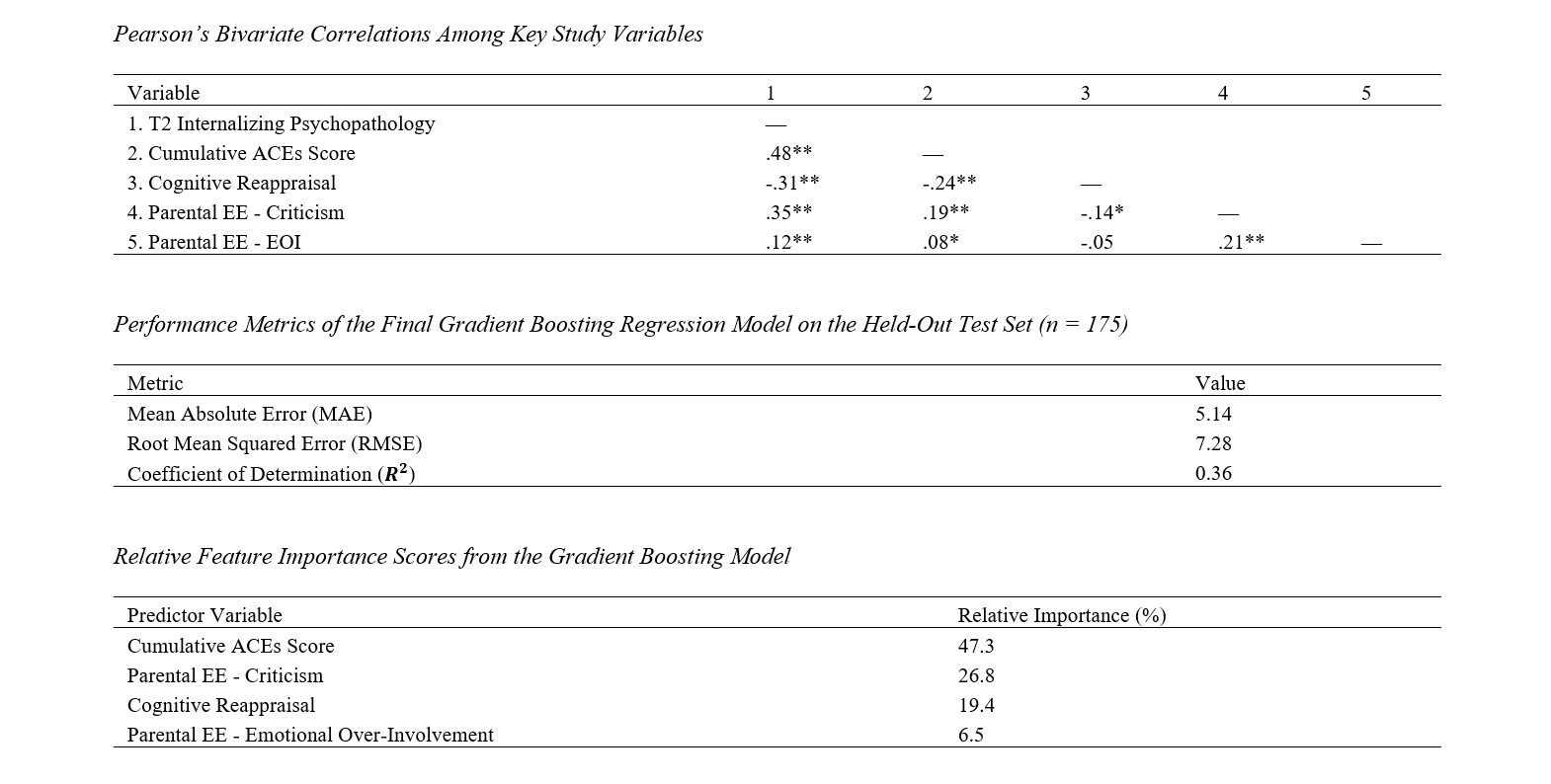
Findings: The gradient boosting regression model demonstrated robust forecasting accuracy on the unseen test set, successfully predicting a significant portion of the variance in T2 internalizing symptoms ( , ), yielding a coefficient of determination of , with a Mean Absolute Error ( ) of and a Root Mean Square Error ( ) of . Bivariate analyses confirmed foundational relationships, showing positive correlations between ACEs and T2 internalizing symptoms ( ) and protective, negative correlations for cognitive reappraisal ( ). Multivariate feature importance extraction revealed a distinct predictive hierarchy: cumulative ACEs emerged as the single most dominant forecasting variable ( relative importance), followed significantly by parental criticism ( ), cognitive reappraisal ( ), and parental emotional over-involvement ( ).
Conclusion: Cumulative childhood trauma and proximal parental criticism serve as the primary structural catalysts for future adolescent internalizing distress, whereas the adolescent’s habitual capacity for cognitive reappraisal offers a vital, quantifiable counterweight for psychological resilience.
Downloads
References
Adkins, T., Reisz, S., Doerge, K., & Nulu, S. (2020). Adverse Childhood Experience histories in foster parents: Connections to foster children's emotional and behavioral difficulties. Child abuse & neglect, 104SP - 104475. https://doi.org/10.1016/j.chiabu.2020.104475
Bick, J., Palmwood, E. N., Zajac, L., Simons, R. F., & Dozier, M. (2019). Early Parenting Intervention and Adverse Family Environments Affect Neural Function in Middle Childhood. Biological Psychiatry, 85(4), 326-335. https://doi.org/10.1016/j.biopsych.2018.09.020
Boccia, M. L., Cook, C., Marson, L., & Pedersen, C. (2021). Parental divorce in childhood is related to lower urinary oxytocin concentrations in adulthood. Journal of Comparative Psychology, 135(1), 74-81. https://doi.org/10.1037/com0000248
Chachar, A. S., Younus, S., & Ali, W. (2021). Developmental Understanding of Death and Grief Among Children During COVID-19 Pandemic: Application of Bronfenbrenner's Bioecological Model [Perspective]. Frontiers in Psychiatry, 12. https://doi.org/10.3389/fpsyt.2021.654584
Datu, J. A. D., Yang, W., & Lau, W. K. (2022). Does Mindfulness Matter for Cognitive Reappraisal and Academic Engagement? A Cross-Lagged Panel Model Study in Filipino High School Students. The Journal of Early Adolescence, 43(8), 993-1015. https://doi.org/10.1177/02724316221137951
Ding, R., Wu, N., Tang, S., Liu, T., Li, W., & Ni, S. (2022). Relations between parental response to children's negative emotions and suicidal ideation in chinese adolescents: Internalizing problems, emotion regulation, and perceived relationship quality with parents as mediators. Journal of affective disorders, 301, 205-216. https://doi.org/10.1016/j.jad.2022.01.043
Griffin, M. L., & Amodeo, M. (2010). Predicting long-term outcomes for women physically abused in childhood: Contribution of abuse severity versus family environment. Child abuse & neglect, 34(10), 724-733. https://doi.org/10.1016/j.chiabu.2010.03.005
Hodge, R. T., Guyer, A. E., Carlo, G., & Hastings, P. D. (2022). Cognitive Reappraisal and Need to Belong Predict Prosociality in Mexican‐origin Adolescents. Social Development, 32(2), 633-650. https://doi.org/10.1111/sode.12651
Hughes, P. M., Graaf, G., deJong, N. A., & Thomas, K. C. (2023). Emotional support among parents of children with adverse childhood experiences. Journal of Pediatric Health Care, 37(5), 557-565. https://doi.org/10.1016/j.pedhc.2023.05.003
Kiani Chalmardi, A., Shahbazi, N., Jahanbakhshie, Z., & Ahmadbookani, S. (2022). Developing a Model for Predicting Women's Marital Satisfaction based on Parental Intervention, Perception of Parents' Marriage, Adverse Childhood Experiences, Depression and Communication Patterns. Journal of Family Research, 18(2), 265-285. https://doi.org/10.48308/jfr.18.2.265
Kuhlman, K. R., Straka, K., Mousavi, Z., Tran, M.-L., & Rodgers, E. (2021). Predictors of Adolescent Resilience During the COVID-19 Pandemic: Cognitive Reappraisal and Humor. Journal of Adolescent Health, 69(5), 729-736. https://doi.org/10.1016/j.jadohealth.2021.07.006
Lavrič, M., Naterer, A., & Lawson, C. M. C. (2020). The power of authoritative parenting: A cross-national study of effects of exposure to different parenting styles on life satisfaction The impact of pre-military therapy on post-military posttraumatic stress disorder severity in veterans with adverse childhood experiences. Children and Youth Services Review, 116, 105274. https://doi.org/10.1016/j.childyouth.2020.105274
Lereya, S. T., Samara, M., & Wolke, D. (2013). Parenting behavior and the risk of becoming a victim and a bully/victim: A meta-analysis study. Child abuse & neglect, 37(12), 1091-1108. https://doi.org/10.1016/j.chiabu.2013.03.001
Lian, W. (2025). Emotional Granularity and Cognitive Reappraisal Affect Social Anxiety and Interpersonal Relationships in Adolescents: A Bayesian Network Analysis. Depression and Anxiety, 2025(1). https://doi.org/10.1155/da/8658973
Miccoli, A., Song, J., Romanowicz, M., Howie, F., Simar, S., & Lynch, B. (2022). Impact of Parental Adverse Childhood Experiences on Offspring Development in Early Head Start: Parental Adversity and Offspring Development. Journal of Primary Care & Community Health, 13, 215013192210841. https://doi.org/10.1177/21501319221084165
Nguyen, K. T., & Shaw, L. (2020). The aetiology of non-clinical narcissism: Clarifying the role of adverse childhood experiences and parental overvaluation. Personality and individual differences, 154, 109615. https://doi.org/10.1016/j.paid.2019.109615
Ochoa, L. G., Fernández, A., Lee, T. K., Estrada, Y., & Prado, G. (2021). The Intergenerational Impact of Adverse Childhood Experiences on Hispanic Families: The Mediational Roles of Parental Depression and Parent–Adolescent Communication. Family Process, 61(1), 422-435. https://doi.org/10.1111/famp.12652
Park, Y. W., & Gentzler, A. L. (2023). Parenting and courage: Exploring the mediating role of self-esteem and emotion regulation among adolescents. Journal of Applied Developmental Psychology, 87, 101558. https://doi.org/10.1016/j.appdev.2023.101558
Polese, D., Belli, A., Esposito, D., Evangelisti, M., Luchetti, A., Di Nardo, G., Parisi, P., & Bruni, O. (2022). Psychological disorders, adverse childhood experiences and parental psychiatric disorders in children affected by headache: a systematic review. Neuroscience & Biobehavioral Reviews, 140, 104798. https://doi.org/10.1016/j.neubiorev.2022.104798
Saleem, F. T., Christophe, N. K., Anyiwo, N., Bernard, D. L., Jones, S. C. T., Anderson, R. E., Stein, G. L., & Kiang, L. (2025). The Talk and Walk in Black Families: Exploring Racial Socialization Content and Competency in the Context of Parental Worries About Racial Profiling and Adolescents' Internalizing Outcomes. Family Process, 64(1). https://doi.org/10.1111/famp.13095
Sanders, M. R., & Turner, K. M. T. (2018). The Importance of Parenting in Influencing the Lives of Children. In M. R. Sanders & A. Morawska (Eds.), Handbook of Parenting and Child Development Across the Lifespan (pp. 3-26). Springer International Publishing. https://doi.org/10.1007/978-3-319-94598-9_1
Schickedanz, A., Halfon, N., Sastry, N., & Chung, P. J. (2018). Parents' Adverse Childhood Experiences and Their Children's Behavioral Health Problems. Pediatrics, 142(2), e20180023. https://doi.org/10.1542/peds.2018-0023
Sokol, R. L., Qin, B., & Poti, J. M. (2017). Parenting styles and body mass index: a systematic review of prospective studies among children. Obesity Reviews, 18(3), 281-292. https://doi.org/10.1111/obr.12497
Tadros, E., & Durante, K. A. (2021). Coparenting, Negative Educational Outcomes, and Familial Instability in Justice-involved Families. International journal of offender therapy and comparative criminology, 66(2-3), 267-287. https://doi.org/10.1177/0306624X211013740
Thimm, J. C. (2010). Mediation of early maladaptive schemas between perceptions of parental rearing style and personality disorder symptoms. Journal of Behavior Therapy and Experimental Psychiatry, 41(1), 52-59. https://www.sciencedirect.com/science/article/pii/S0005791609000597
Uddin, J., Alharbi, N., Uddin, H., Hossain, M. B., Hatipoğlu, S. S., Long, D. L., & Carson, A. P. (2020). Parenting stress and family resilience affect the association of adverse childhood experiences with children's mental health and attention-deficit/hyperactivity disorder. Journal of affective disorders, 272, 104-109. https://doi.org/10.1016/j.jad.2020.03.132
Xu, Y. (2023). Cognitive Reappraisal and Empathy Chain-Mediate the Association Between Relative Deprivation and Prosocial Behavior in Adolescents. Frontiers in psychology, 14. https://doi.org/10.3389/fpsyg.2023.1238308
Ylitervo, L., Veijola, J., & Halt, A. H. (2023). Emotional Neglect and Parents’ Adverse Childhood Events. European Psychiatry, 66(1). https://doi.org/10.1192/j.eurpsy.2023.2420
Zemp, M., Fang, S., & Johnson, M. D. (2024). Family shapes child development: The role of codevelopmental trajectories of interparental conflict and emotional warmth for children's longitudinal development of internalizing and externalizing problems. Development and Psychopathology, 1-14. https://doi.org/10.1017/S0954579424001524
Zeynel, Z., & Uzer, T. (2020). Adverse childhood experiences lead to trans-generational transmission of early maladaptive schemas. Child abuse & neglect, 99, 104235. https://doi.org/10.1016/j.chiabu.2019.104235
Downloads
Additional Files
Publication Timeline
- Submitted
- Revised
- Accepted