A Random Forest Analysis Predicting Intergenerational Attachment Insecurity from Parental Reflective Functioning and Childhood Trauma Phenotypes
DOI:
https://doi.org/10.61838/kman.aftj.5254Keywords:
Intergenerational Transmission, Attachment Insecurity, Childhood Trauma, Parental Reflective FunctioningAbstract
Objective: The primary objective of this study was to utilize a Random Forest machine learning approach to predict the variance in intergenerational attachment insecurity using distinct childhood trauma phenotypes and multidimensional facets of parental reflective functioning.
Methods and Materials: A cross-sectional, correlational, and predictive design was employed with a community sample of Romanian primary caregivers of children aged to years. Data were collected via self-report instruments, including the Childhood Trauma Questionnaire (CTQ) to assess five trauma phenotypes, the Parental Reflective Functioning Questionnaire (PRFQ) to evaluate mentalizing dimensions, and the Experiences in Close Relationships-Revised (ECR-R) alongside the Child Attachment Questionnaire (CAQ) to index intergenerational attachment insecurity. During data preprocessing, missing values were resolved using K-nearest neighbors imputation, and independent variables were subjected to Z-score standardization. A Random Forest regression algorithm was trained on an data split and evaluated on the remaining testing set, with feature importance mathematically derived via the mean decrease in node impurity.
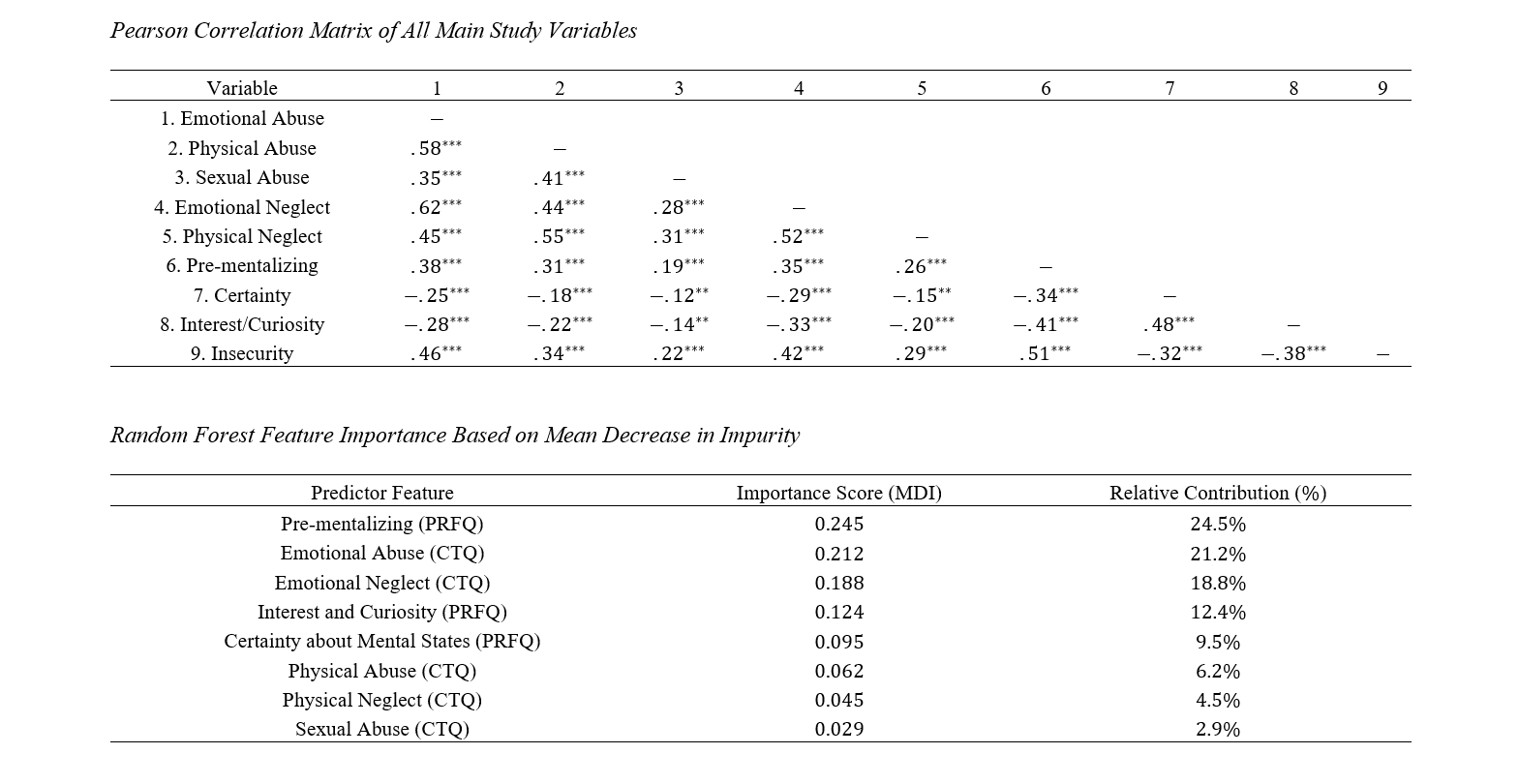
Findings: Descriptive statistics indicated that emotional neglect was the most frequently endorsed historical trauma phenotype ( , ), while participants generally demonstrated moderate to high levels of interest and curiosity in their children’s mental states ( , ). The standardized outcome variable of intergenerational attachment insecurity ( , ) showed significant positive bivariate correlations with emotional abuse ( , ) and emotional neglect ( , ). Feature importance extraction from the Random Forest model identified emotional neglect and emotional abuse as the most powerful distal trauma predictors. Among proximal psychological mechanisms, maladaptive pre-mentalizing modes emerged as the strongest positive predictor of insecurity ( , ), whereas adaptive reflective capacities—specifically interest and curiosity ( , ) and certainty about mental states ( , )—functioned as significant negative predictors.
Conclusion: Advanced machine learning successfully mapped the non-linear pathways of relational risk, revealing that historical emotional maltreatment and current pre-mentalizing deficits are the primary drivers of intergenerational attachment insecurity, while adaptive reflective functioning serves as a crucial protective buffer.
Downloads
References
Borelli, J. L., Slade, A., Pettit, C., & Shai, D. (2020). I “get” you, babe: Reflective functioning in partners transitioning to parenthood. Journal of Social and Personal Relationships, 37(6), 1785-1805. https://doi.org/10.1177/0265407520905641
Burkhart, M. L., Borelli, J. L., Rasmussen, H. F., Brody, R., & Sbarra, D. A. (2017). Parental mentalizing as an indirect link between attachment anxiety and parenting satisfaction. Journal of Family Psychology, 31(2), 203-213. https://doi.org/10.1037/fam0000270
Ensanimehr, N., Dehshiri, G., & Mousavi, S. F. (2024). Childhood Trauma and Parental Burnout: The Mediating Role of Difficulties in Emotion Regulation and Reflective Functioning. Psychological Reports. https://doi.org/10.1177/00332941241282569
Ensink, K., Bégin, M., Martin-Gagnon, G., Biberdzic, M., Berthelot, N., Normandin, L., Fonagy, P., Bernazzani, O., & Borelli, J. L. (2023). Post-Traumatic-Stress in the Context of Childhood Maltreatment: Pathways From Attachment Through Mentalizing During the Transition to Parenthood. Frontiers in psychology, 14. https://doi.org/10.3389/fpsyg.2023.919736
Flanagan, M. (2024). Exploring the Impact of Parental Bonding on a Father's Mentalization With His Children Through the Moderating Effects of Attachment to God https://search.proquest.com/openview/03a0028126b08f469e6c10750081c87d/1?pq-origsite=gscholar&cbl=18750&diss=y
Halfon, S., & Beşiroğlu, B. (2021). Parental Reflective Function and Children’s Attachment-Based Mental State Talk as Predictors of Outcome in Psychodynamic Child Psychotherapy. Psychotherapy, 58(1), 81-94. https://doi.org/10.1037/pst0000347
Karimnejad Isfahani, R., Ansari Shahidi, M., & Dehghani, A. (2025). Examining the Effectiveness of Reflective Parenting Training on Emotion Regulation and Parent-Child Relationship in Mothers with Children Under 6 Years. Applied Family Therapy Journal (AFTJ), 6(3), 1-10. https://doi.org/10.61838/kman.aftj.6.3.9
Knapen, S. R. Y., Mensink, W., Hoogendoorn, A. W., Swildens, W. E., Duits, P., Hutsebaut, J., & Beekman, A. T. F. (2025). Associations between Childhood Trauma and Epistemic Trust, Attachment, Mentalizing, and Symptoms of Borderline Personality Disorder. Psychopathology, 58(3), 187-198. https://doi.org/10.1159/000542919
Lavenda, O., & Hertz, O. (2024). Mentalization and Attachment Style as Underlying Mechanisms of Linking Collective Efficacy With Parental Self-Efficacy. Social Sciences, 13(11), 591. https://doi.org/10.3390/socsci13110591
Luyten, P., Mayes, Linda C, Nijssens, Liesbet, Fonagy, Peter. (2017). The parental reflective functioning questionnaire: Development and preliminary validation. PLoS One, 12(5), e0176218. https://doi.org/10.1371/journal.pone.0176218
Mesbahi, M., Hosseinian, S., & Rasouli, R. (2021). The Effectiveness of Reflective Parenting Education on Attachment and Parenting Stress Mothers of Children 3 to 6 Years. The Journal of New Thoughts on Education, 17(1), 29-52. https://doi.org/10.22051/jontoe.2020.29774.2939
Mohammadi, H., Naderi Nobandegani, Z., Asadi, S., & Sadeghiyeh, T. (2023). The mediating Role of Reflective Functioning Dimensions in the Relationship Between Parental Insecure Attachment Styles and Parenting Stress in Parents of Child with Attention Deficit-Hyperactivity Disorder. Psychology of Exceptional Individuals, 13(52), 1-30. https://jpe.atu.ac.ir/article_16936_en.html
Nijssens, L., Bleys, D., Casalin, S., Vliegen, N., & Luyten, P. (2018). Parental Attachment Dimensions and Parenting Stress: The Mediating Role of Parental Reflective Functioning. Journal of Child and Family Studies, 27(6), 2025-2036. https://doi.org/10.1007/s10826-018-1029-0
Ordway, M. R., Sadler, L. S., Dixon, J., & Slade, A. (2014). Parental reflective functioning: analysis and promotion of the concept for paediatric nursing. Journal of clinical nursing, 23(23-24), 3490-3500. https://doi.org/10.1111/jocn.12600
Pazzagli, C., Delvecchio, E., Raspa, V., Mazzeschi, C., & Luyten, P. (2018). The Parental Reflective Functioning Questionnaire in Mothers and Fathers of School-Aged Children. Journal of Child and Family Studies, 27(1), 80-90. https://doi.org/10.1007/s10826-017-0856-8
Radosavljevic, D. (2025). Engaging Caregivers In The Service Of Their Child?s Mental Health: An Examination Of Emotion Focused Family Therapy In Relation To Parental Reflective Functioning. https://yorkspace.library.yorku.ca/items/49377dc9-8e11-47d5-aff1-ec79bbfa403b
Rostad, W. L., & Whitaker, D. J. (2016). The Association Between Reflective Functioning and Parent–Child Relationship Quality. Journal of Child and Family Studies, 25(7), 2164-2177. https://doi.org/10.1007/s10826-016-0388-7
Slade, A. (2023). Enhancing attachment and reflective parenting in clinical practice. Guilford Publications. https://books.google.com/books?hl=en&lr=&id=J6S9EAAAQBAJ&oi=fnd&pg=PP1&dq=Slade,+A.+(2023).+Enhancing+attachment+and+reflective+parenting+in+clinical+practice,+Guilford+Publications.+%09&ots=w8m8MFXJdn&sig=rXVQbD_hDEpr2wQjSXRIQowhpes
Steele, K. R., Townsend, M. L., & Grenyer, B. F. (2020). Parenting stress and competence in borderline personality disorder is associated with mental health, trauma history, attachment and reflective capacity. Borderline personality disorder and emotion dysregulation, 7(1), 1-14. https://doi.org/10.21203/rs.2.24346/v1
Wang, X. (2022). Intergenerational effects of childhood maltreatment: The roles of parents’ emotion regulation and mentalization. Child abuse & neglect, 128, 104940. https://doi.org/10.1016/j.chiabu.2021.104940
Yaakov, O. B., Shlomo, S. B., & Keini, N. L. (2023). Parental stress among parents of young children-the contribution of parental self- awareness, attachment orientation, quality of couple relationship and child's temperament. Current Psychology, 42(16), 13669-13679. https://doi.org/10.1007/s12144-022-02721-y
Yang, L. (2025). Childhood Maltreatment and Non-Suicidal Self-Injury: The Mediating Role of Mentalization and Depression. European Journal of Psychotraumatology, 16(1). https://doi.org/10.1080/20008066.2025.2466279
Downloads
Additional Files
Publication Timeline
- Submitted
- Revised
- Accepted