A Causal Model of Parenting Stress Based on Child Behavioral Problems, Parental Perfectionism, Psychological Inflexibility, and Family Conflict: The Mediating Role of Parental Self-Compassion
DOI:
https://doi.org/10.61838/kman.aftj.5417Keywords:
Parenting Stress, Child Behavioral Problems, Parental Perfectionism, Psychological Inflexibility, Family Conflict, Parental Self-CompassionAbstract
Objective: The present study aimed to develop and test a causal model of parenting stress based on child behavioral problems, parental perfectionism, psychological inflexibility, and family conflict, with parental self-compassion serving as a mediating variable among Canadian parents.
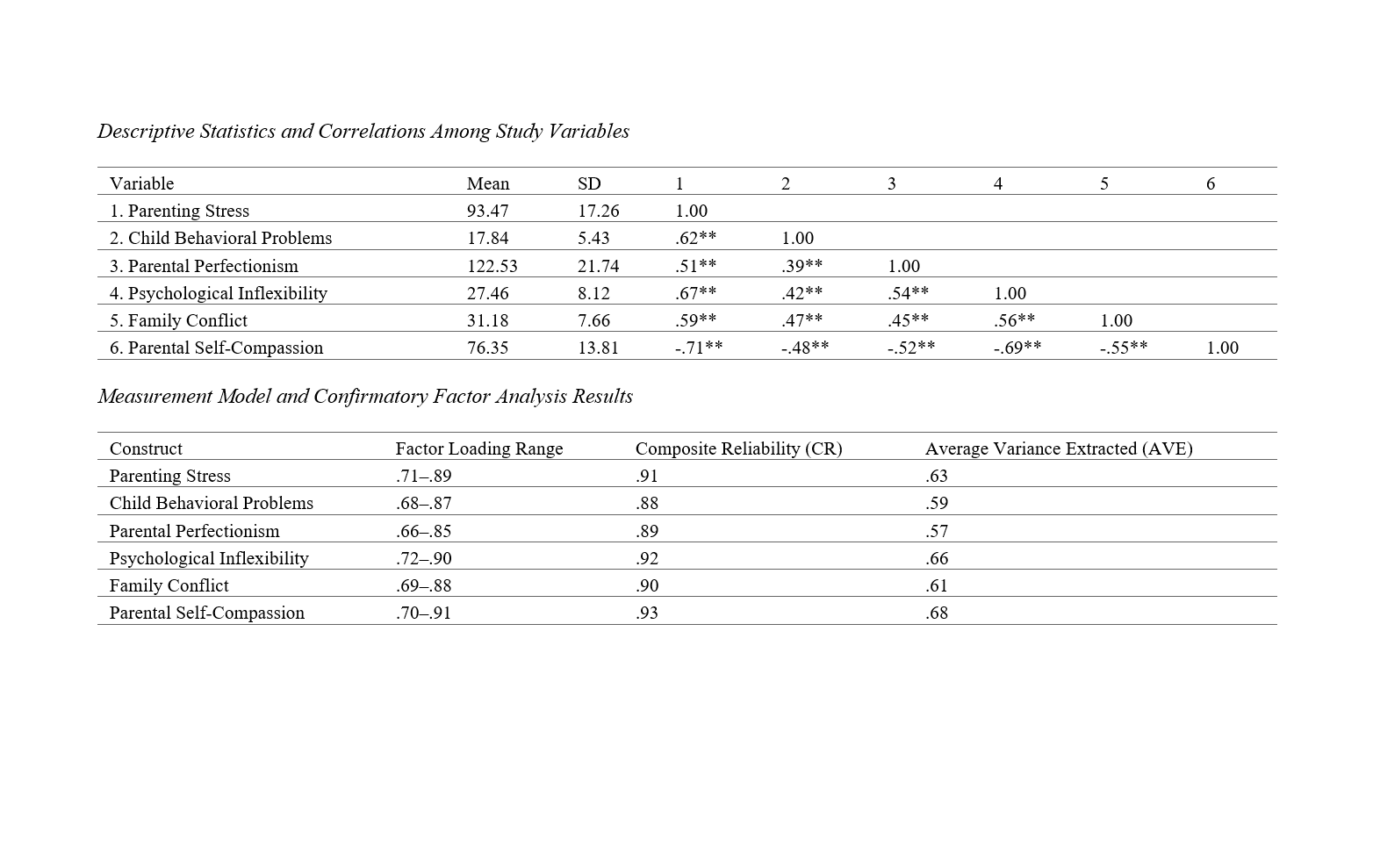
Methods and Materials: This study employed a cross-sectional correlational design using structural equation modeling (SEM). The statistical population consisted of Canadian parents with at least one child aged 6–16 years. Using purposive sampling, 620 parents were recruited from schools, community family centers, parenting organizations, and online parenting networks across several Canadian provinces. Data were collected using the Parenting Stress Index–Short Form (PSI-SF), Strengths and Difficulties Questionnaire (SDQ), Multidimensional Perfectionism Scale (MPS), Acceptance and Action Questionnaire-II (AAQ-II), Family Environment Scale (FES–Conflict Subscale), and Self-Compassion Scale (SCS). Data were analyzed using SPSS version 27 and AMOS version 24. Descriptive statistics, Pearson correlation coefficients, confirmatory factor analysis, and structural equation modeling were conducted. The mediating role of parental self-compassion was examined using bootstrap analysis with 5,000 resamples and 95% bias-corrected confidence intervals.
Findings: The proposed structural model demonstrated satisfactory fit to the data (χ²/df = 2.58, CFI = .95, TLI = .95, IFI = .95, GFI = .92, RMSEA = .051). Child behavioral problems (β = .24, p < .001), parental perfectionism (β = .17, p < .001), psychological inflexibility (β = .31, p < .001), and family conflict (β = .22, p < .001) had significant positive direct effects on parenting stress. Child behavioral problems (β = -.16, p < .001), parental perfectionism (β = -.23, p < .001), psychological inflexibility (β = -.41, p < .001), and family conflict (β = -.19, p < .001) significantly predicted lower parental self-compassion. Parental self-compassion had a significant negative effect on parenting stress (β = -.46, p < .001). Bootstrap analyses confirmed significant indirect effects of all predictor variables on parenting stress through parental self-compassion (p < .001). The model explained 68% of the variance in parenting stress and 57% of the variance in parental self-compassion.
Conclusion: The findings indicate that parenting stress is influenced by a complex interplay of child-related, parent-related, and family-system factors. Child behavioral problems, parental perfectionism, psychological inflexibility, and family conflict increase parenting stress both directly and indirectly through reductions in parental self-compassion. Among the predictors, psychological inflexibility emerged as the strongest risk factor, whereas parental self-compassion functioned as a significant protective mechanism. These results highlight the importance of interventions targeting self-compassion, psychological flexibility, and family relationship quality to reduce parenting stress and promote parental well-being.
Downloads
References
Agarwal, T., & Dhenwal, S. (2024). Investigating the Relationship of Parenting Styles With Neuroticism and Perfectionism. Eatp. https://doi.org/10.53555/kuey.v30i5.4644
Çerkez, Y., & Sorakın, Y. (2023). Investigation of Burnout and Perfectionism Levels of Parents With Children Aged 0-18 During the Pandemic. Cyprus Turkish Journal of Psychiatry and Psychology, 5(4), 322. https://doi.org/10.35365/ctjpp.23.4.04
Chyu, E. P. Y., & Chen, J. K. (2022). The Correlates of Academic Stress in Hong Kong. International journal of environmental research and public health, 19(7), 4009. https://doi.org/10.3390/ijerph19074009
Flett, G. L., & Hewitt, P. L. (2022). Perfectionism in Children and Adolescents: A Historical Perspective. 25-39. https://doi.org/10.1037/0000289-003
Hameed, N., & Arzeen, S. (2023). Perfectionism, Self-Esteem and DSM-IV-Based Symptoms of Anxiety Disorders in Adolescents. PJMHS, 17(3), 310-314. https://doi.org/10.53350/pjmhs2023173310
Haspolat, N. K., & Yalçın, İ. (2023). Psychological Symptoms in High Achieving Students: The Multiple Mediating Effects of Parental Achievement Pressure, Perfectionism, and Academic Expectation Stress. Psychology in the Schools, 60(11), 4721-4739. https://doi.org/10.1002/pits.23012
Khanam, H., Toor, A. H., Nair, S., Pradhan, A., & Saha, A. (2024). The Perfectionist's Dilemma: A Closer Look at Its Impact on Mental Health. Eatp. https://doi.org/10.53555/kuey.v30i5.4637
Larionow, P. (2024). How Are Different Perfectionism Traits Related to Mental Health in Students? Behavioral Sciences, 14(3), 187. https://doi.org/10.3390/bs14030187
Lea, K., Richardson, T., & Rauze, N. (2023). The Relationship Between Mood Symptom Severity and Perfectionism Subtypes in Mood Disorders: A Systematic Review and Meta-Analysis. Brain Sciences, 13(3), 377. https://doi.org/10.3390/brainsci13030377
Leung, J. T. Y. (2026). Actor-Partner Interdependence Between Socially Prescribed Parenting Perfectionism and Overparenting Among Chinese Parents Over Time: Does Family Income Matter? Journal of Social and Personal Relationships. https://doi.org/10.1177/02654075261424362
Lin, J., & Guo, W. (2024). The Research on Risk Factors for Adolescents’ Mental Health. Behavioral Sciences, 14(4), 263. https://doi.org/10.3390/bs14040263
López, M. D., Jiménez‐Iglesias, A., Paniagua, C., & García‐Moya, I. (2023). The Role of Perfectionism and Parental Expectations in the School Stress and Health Complaints of Secondary School Students. Youth & Society, 56(5), 885-906. https://doi.org/10.1177/0044118x231205929
Michałowska, S., Chęć, M., & Podwalski, P. (2025). The Mediating Role of Maladaptive Perfectionism in the Relationship Between Childhood Trauma and Depression. Scientific reports, 15(1). https://doi.org/10.1038/s41598-025-03783-1
Molnar, D. S. (2026). Under Pressure: Teacher Perspectives and Understandings of Perfectionism Among Students. American Educational Research Journal. https://doi.org/10.3102/00028312251412913
Mousavi, S. F., Dehshiri, G., Asghari, M., & Parastanpoor, M. (2025). Perfectionism and Burnout in Parents of Visually Impaired Offspring: The Mediating Role of Parenting Conflict and Resilient Coping. Journal of Visual Impairment & Blindness, 119(1), 47-60. https://doi.org/10.1177/0145482x251319329
Năstase, A.-C. (2021). Risky Parental Practices and Their Implications in Adult Psychopathology. Studia Doctoralia, 12(2), 100-109. https://doi.org/10.47040/sdpsych.v12i2.133
Nazir, Z. (2021). Maladaptive Perfectionism in Asian International Students. Journal of Student Research, 10(1). https://doi.org/10.47611/jsrhs.v10i1.1370
Nouri, Z., Nashrodkoli, R. H., & Habibzadeh, K. (2024). The Relationship Between Narcissism, Perfectionism, and Parenting Styles: The Mediating Role of Coping Styles. Jarac, 6(3), 90-98. https://doi.org/10.61838/kman.jarac.6.3.10
Peroš, A., & Buljan, I. (2025). Association Between Resilience, Perfectionism and Job Satisfaction Among Medical Residents in Croatia: A Cross-Sectional Study. BMC psychology, 13(1). https://doi.org/10.1186/s40359-025-03692-y
Piotrowski, K. (2020). How Good It Would Be to Turn Back Time: Adult Attachment and Perfectionism in Mothers and Their Relationships With the Processes of Parental Identity Formation. Psychologica Belgica, 60(1), 55. https://doi.org/10.5334/pb.492
Piotrowski, K. (2022). Trajectories of Parental Burnout in the First Year of the COVID-19 Pandemic. https://doi.org/10.31234/osf.io/k9756
Piotrowski, K., Nowicka, A., Janowicz, K., & Smith, M. M. (2024). The Big Three Perfectionism Scale: Validation of the Polish Version. Journal of Psychoeducational Assessment, 42(3), 276-292. https://doi.org/10.1177/07342829241227767
Piredda, M., Cascio, A. L., Marchetti, A., Campanozzi, L. L., Pellegrino, P., Mondo, M., Latina, R., Maria, M. D., Alvaro, R., & Marinis, M. G. D. (2025). Development and Psychometric Testing of Perfectionism Inventory to Assess Perfectionism and Academic Stress in University Students: A Cross-Sectional Multi-Centre Study. European Journal of Investigation in Health Psychology and Education, 15(6), 94. https://doi.org/10.3390/ejihpe15060094
Saini, J., & S., M. M. (2024). The Relationship Between Procrastination and Perfectionism. International Journal for Multidisciplinary Research, 6(2). https://doi.org/10.36948/ijfmr.2024.v06i02.16744
Sederlund, A. P., Burns, L. R., & Rogers, W. M. (2020). Multidimensional Models of Perfectionism and Procrastination: Seeking Determinants of Both. International journal of environmental research and public health, 17(14), 5099. https://doi.org/10.3390/ijerph17145099
Seong, H., Lee, S., & Lee, S. M. (2022). Is Autonomy-Supportive Parenting Universally Beneficial? Combined Effect of Socially Prescribed Perfectionism and Parental Autonomy Support on Stress in Emerging Adults in South Korea. Current Psychology, 42(15), 13182-13191. https://doi.org/10.1007/s12144-021-02520-x
Wegerer, M. (2023). Cognitive-Behavioral Treatment of Perfectionism: An Overview of the State of Research and Practical Therapeutical Procedures. Verhaltenstherapie, 34(1), 1-10. https://doi.org/10.1159/000532044
Zhang, L., Liu, L., Wang, P., Wu, X., & Wang, W. (2025). Parents’ Behavioural Control Affects Chinese College Students’ School Burnout and Perceived Employment Stress: Different Effects via Self-Oriented, Other-Oriented, and Socially Prescribed Perfectionism. Emerging Adulthood, 13(2), 395-409. https://doi.org/10.1177/21676968241312263
Zheng, Y. (2023). Parenting Styles and Adolescents Depression, Anxiety, and Stress in Chinese Culture: A Test of the Mediating Effect of Perfectionism. Lecture Notes in Education Psychology and Public Media, 26(1), 29-40. https://doi.org/10.54254/2753-7048/26/20230809
Downloads
Additional Files
Publication Timeline
- Submitted
- Revised
- Accepted