The Effect of Intergenerational Trauma on Marital Stability: The Mediating Roles of Cognitive Emotion Regulation, Trust, and Intimacy
DOI:
https://doi.org/10.61838/kman.aftj.5425Keywords:
Intergenerational trauma, Marital stability, Cognitive emotion regulation, Trust, IntimacyAbstract
Objective: The present study aimed to examine the effect of intergenerational trauma on marital stability among married adults in Canada and to investigate the mediating roles of cognitive emotion regulation, trust, and intimacy in explaining this relationship.
Methods and Materials: This study employed a cross-sectional correlational design using structural equation modeling (SEM). The study population consisted of married adults residing in Canada. A total of 642 participants were recruited through community organizations, counseling centers, social media platforms, and online advertisements, of whom 618 completed questionnaires were retained for analysis after data screening. Participants completed the Intergenerational Trauma Scale, Cognitive Emotion Regulation Questionnaire (CERQ), Dyadic Trust Scale, Personal Assessment of Intimacy in Relationships (PAIR), and Marital Stability Scale. Data were analyzed using SPSS 29 and AMOS 29. Descriptive statistics, Pearson correlation analyses, confirmatory factor analysis, and structural equation modeling were performed. The significance of indirect effects was assessed using bootstrapping procedures with 5,000 resamples and 95% confidence intervals.
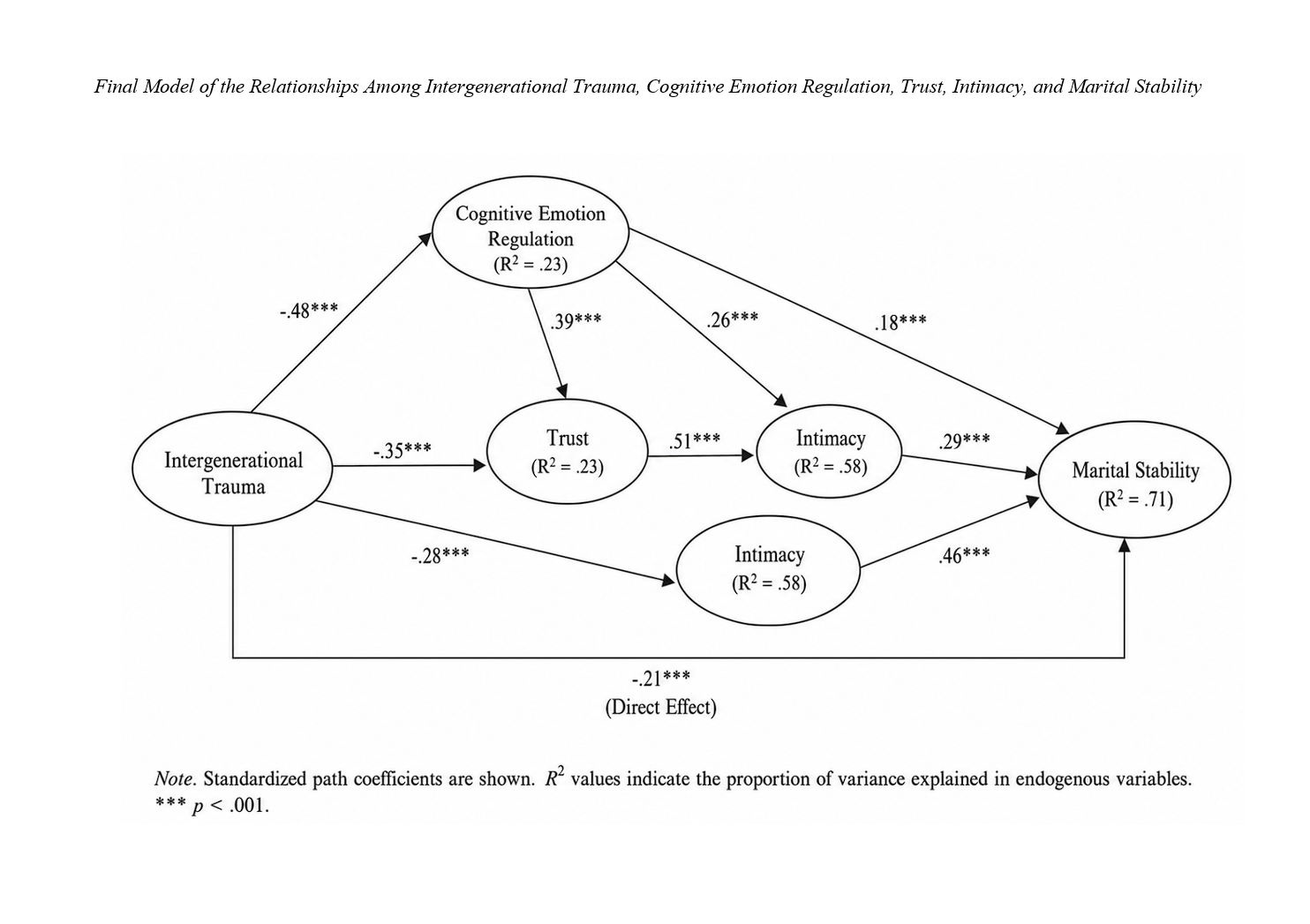
Findings: The structural model demonstrated excellent fit to the data (χ²/df = 2.37, CFI = 0.961, TLI = 0.955, RMSEA = 0.047, SRMR = 0.039). Intergenerational trauma negatively predicted cognitive emotion regulation (β = -0.48, p < .001), trust (β = -0.35, p < .001), intimacy (β = -0.28, p < .001), and marital stability (β = -0.21, p < .001). Cognitive emotion regulation positively predicted trust (β = 0.39, p < .001), intimacy (β = 0.26, p < .001), and marital stability (β = 0.18, p < .001). Trust significantly predicted intimacy (β = 0.51, p < .001) and marital stability (β = 0.29, p < .001). Intimacy emerged as the strongest direct predictor of marital stability (β = 0.46, p < .001). Bootstrapping analyses confirmed significant indirect effects of intergenerational trauma on marital stability through cognitive emotion regulation, trust, and intimacy (β = -0.42, p < .001), indicating partial mediation. The model explained 71% of the variance in marital stability.
Conclusion: The findings demonstrate that intergenerational trauma exerts a substantial negative influence on marital stability through its detrimental effects on emotional regulation, interpersonal trust, and intimacy.
Downloads
References
Brites, R., Nunes, O., Hipólito, J., Brandao, T., Correia, A., & Nunes, C. (2026). Living With a Veteran With Trauma: Impact on Family Functioning Using the Genogram as a Research Tool. The Family Journal. https://doi.org/10.1177/10664807261415864
Čepukienė, V., & Neophytou, K. (2024). Intergenerational Transmission of Familial Relational Dysfunction: A Test of a Complex Mediation Model Based on Bowen Family Systems Theory. Journal of Social and Personal Relationships, 41(11), 3385-3408. https://doi.org/10.1177/02654075241265472
Gorden, A. (2025). Somatic Work in Couple Therapy. The Family Journal, 33(4), 509-517. https://doi.org/10.1177/10664807251348210
Ibrahim, M., Palit, M., & Matthews, R. (2023). Intergenerational Attachment Styles, Emotional Regulation and Relational Outcomes in Couples Therapy. https://doi.org/10.5772/intechopen.108492
K., S., & S., I. (2024). Social and Cultural Implications of Live-in Relationships in India. International Journal for Multidisciplinary Research, 6(3). https://doi.org/10.36948/ijfmr.2024.v06i03.20396
Kateregga, A. (2026). Towards Culturally Responsive Practices: A Scoping Review of Systemic Family Therapy Interventions in Africa. https://doi.org/10.21203/rs.3.rs-8717252/v1
Lappan, S. N. (2025). Suggested Guidelines for Applying a Systemic Lens to Psychedelic-Assisted Psychotherapy. Psychedelic Medicine. https://doi.org/10.1177/28314425251404021
Larouche, K., Deschênes, K., Pierce, T., Lacharité, C., & Berthelot, N. (2025). Examining How Fathers’ Experience of Childhood Trauma and Current Coparenting Quality Contribute to Paternal Involvement. Family Relations. https://doi.org/10.1111/fare.70039
Navabinejad, S., Rostami, M., & Parsakia, K. (2024). Influences of Family Structure and Intimacy on Emotional Divorce: A Cross-Sectional Analysis. JPRFC, 23-30. https://doi.org/10.61838/kman.jprfc.2.1.5
Okonkwo, K. (2024). The Role of Attachment Styles in Marital Stability: A Psychological Approach to Strengthening Relationships. American Journal of Psychology, 6(4), 35-50. https://doi.org/10.47672/ajp.2474
Oliver, C. (2026). Psychological Health Outcomes of Female Genital Mutilation/Cutting Among Women of Reproductive Age in Southeast Nigeria. https://doi.org/10.21203/rs.3.rs-8492256/v1
Olsson, C. M., Greenwood, C., Letcher, P., Tan, E. S., Opie, J. E., Booth, A., McIntosh, J., & Olsson, C. A. (2023). Adverse Experiences in Early Intimate Relationships and Next‐generation Infant–mother Attachment: Findings From the ATP Generation 3 Study. Australian and New Zealand Journal of Family Therapy, 44(4), 537-548. https://doi.org/10.1002/anzf.1564
Pan, X., Mo, L., Liu, Q., Guo, X., & Zhang, S. (2022). Factors Influencing Emotional and Behavioral Problems in Preschool Children With Cancer Based on Self-Regulation Shift Theory. Clinical Child Psychology and Psychiatry, 27(3), 755-768. https://doi.org/10.1177/13591045211061799
Perkins, J. (2025). Racism's Impact on Black Intimacy. The Family Journal, 33(4), 598-606. https://doi.org/10.1177/10664807251349846
Quan, L., Zhang, K., & Chen, H. (2025). The Relationship Between Childhood Trauma and Romantic Relationship Satisfaction: The Role of Attachment and Social Support. Frontiers in Psychiatry, 15. https://doi.org/10.3389/fpsyt.2024.1519699
Rawicka, I. (2022). Attitudes of Spouses Towards Abortion and the Quality of Their Mutual Relations. Kwartalnik Naukowy Fides et Ratio, 3(51), 94-105. https://doi.org/10.34766/fetr.v3i51.1109
Rokach, A., & Chan, S. H. (2023). Love and Infidelity: Causes and Consequences. International journal of environmental research and public health, 20(5), 3904. https://doi.org/10.3390/ijerph20053904
Rokach, A., & Clayton, S. (2023). The Consequences of Child Abuse. Healthcare, 11(11), 1650. https://doi.org/10.3390/healthcare11111650
Rowland, D. L., Ehsan, M. K., & Cooper, S. E. (2024). Changes in Spousal Intimacy in Women Suffering Trauma Symptoms From Domestic Abuse: A Culturally Embedded Intervention Study in Pakistan. International journal of environmental research and public health, 21(8), 1045. https://doi.org/10.3390/ijerph21081045
Sahoo, M. K., & Biswas, H. (2024). Unraveling the Complexity of Vaginismus in Marital Relationship: A Case Series. Cureus. https://doi.org/10.7759/cureus.73414
Shmakova, A. I. (2023). Parenting and Family Relationships Factors in the Intergenerational Transmission of Partnerships: A Research Review. Perspectives of Science and Education, 62(2), 536-548. https://doi.org/10.32744/pse.2023.2.31
Suresh, S., Das, A., Lokesh, S., Shah, A., & Satyanarayana, V. A. (2025). Couple Enrichment Clinic as a Model of Promotive and Preventive Mental Health Care in South India. Journal of marital and family therapy, 51(4). https://doi.org/10.1111/jmft.70067
Wang, P. (2025). A Tracking Study of Intergenerational Conflict in Chinese Rural Elderly Families. https://doi.org/10.21203/rs.3.rs-8186047/v1
Wu, Q., Han, S., Tawfiq, D., Jalapa, K., Lee, C., & Pocchio, K. (2024). A Family Systems Investigation on Couple Emotional Intimacy, Parent–child Relationships, and Child Social Skills in Middle Childhood. Child development, 95(6), 2195-2214. https://doi.org/10.1111/cdev.14155
Zamir, O., Adar, O., Cohen, D. K., Goldberg, C., Regev, G., & Shapira, M. (2025). Intergenerational Transmission: Observed Negative Communication Mediates Dyadic Associations Between Childhood Maltreatment and Marital Quality. Family Process, 64(3). https://doi.org/10.1111/famp.70059
Zamir, O., Gewirtz‐Meydan, A., & Finzi‐Dottan, R. (2025). Childhood Maltreatment and Perceived Partner Responsiveness: A Dyadic Analysis of Posttraumatic Symptoms as a Mediator. Psychological Trauma Theory Research Practice and Policy. https://doi.org/10.1037/tra0002048
Zhao, S. (2022). Transgenerational Transmission of Suffering: State Violence, Memory, and Aspiration for Alternative Intimate Lives in Contemporary China. Ethos, 50(4), 511-527. https://doi.org/10.1111/etho.12374
Zhou, X., & Zhen, R. (2022). Posttraumatic Stress Symptoms Between Parents and Their Children Following a Natural Disaster: An Integrated Model Under a Dyadic Approach. Psychological Trauma Theory Research Practice and Policy, 14(1), 141-150. https://doi.org/10.1037/tra0001082
Downloads
Additional Files
Publication Timeline
- Submitted
- Revised
- Accepted