LightGBM-Based Prediction of Marital Commitment Using Sexual Satisfaction, Trust, Emotional Intimacy, and Attachment Security
DOI:
https://doi.org/10.61838/kman.aftj.5470Keywords:
Marital Commitment, LightGBM, Machine Learning, Emotional Intimacy, Trust, Sexual Satisfaction, Attachment Security, Predictive Modeling, Family Psychology, Explainable Artificial Intelligence (XAI)Abstract
Objective: The present study aimed to develop and evaluate a Light Gradient Boosting Machine (LightGBM) model for predicting marital commitment based on sexual satisfaction, trust, emotional intimacy, and attachment security among married adults in Argentina.
Methods and Materials: This cross-sectional predictive study was conducted among 1,248 married adults residing in Argentina. Participants were selected using a stratified convenience sampling method from major urban areas, including Buenos Aires, Córdoba, Rosario, and Mendoza. Data were collected using standardized measures of marital commitment, sexual satisfaction, trust, emotional intimacy, and attachment security. Following data preprocessing, including missing-value imputation and data quality screening, the dataset was randomly divided into training (80%) and testing (20%) subsets. A LightGBM algorithm was implemented to predict marital commitment. Hyperparameter optimization was conducted using five-fold cross-validation and grid-search procedures. Model performance was evaluated using the coefficient of determination (R²), Root Mean Squared Error (RMSE), Mean Absolute Error (MAE), and Mean Absolute Percentage Error (MAPE). Feature importance analysis and SHapley Additive exPlanations (SHAP) were employed to determine the relative contribution of each predictor and enhance model interpretability.
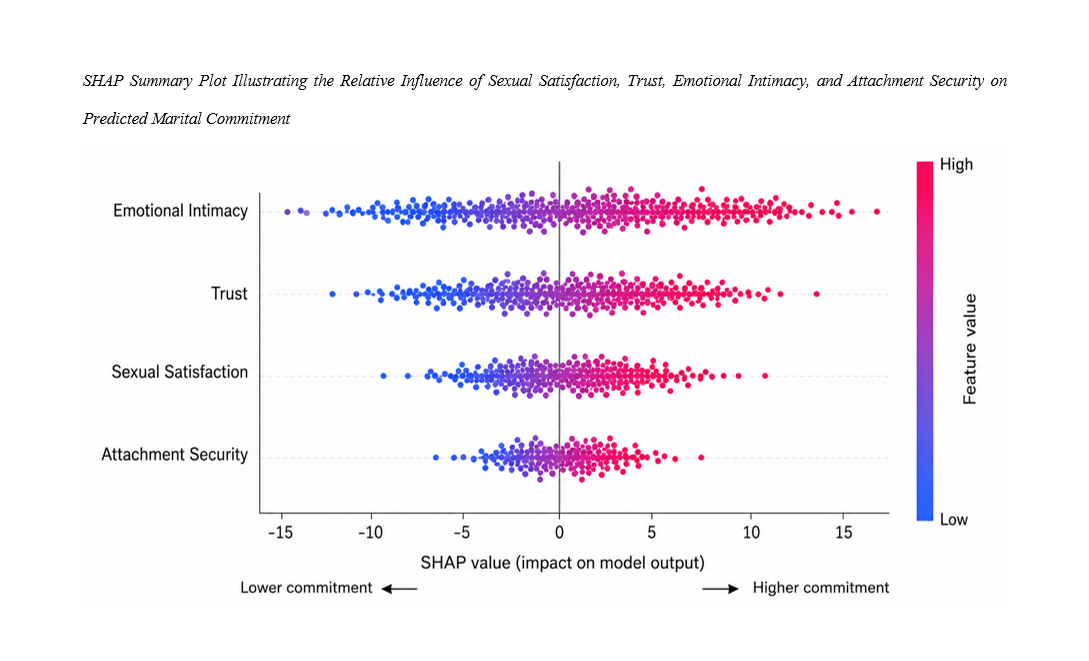
Findings: Correlation analyses revealed significant positive associations between marital commitment and emotional intimacy (r = .79, p < .001), trust (r = .76, p < .001), sexual satisfaction (r = .71, p < .001), and attachment security (r = .68, p < .001). The LightGBM model demonstrated excellent predictive performance, explaining 88.4% of the variance in the training dataset and 84.2% in the testing dataset (R² = .842). Error metrics indicated high prediction accuracy (Testing RMSE = 5.38, MAE = 4.09, MAPE = 5.91%). Feature importance analysis showed that emotional intimacy was the strongest predictor (34.7%), followed by trust (29.3%), sexual satisfaction (22.2%), and attachment security (13.8%). SHAP analysis confirmed the dominant influence of emotional intimacy and trust on model predictions.
Conclusion: The findings demonstrate that marital commitment can be predicted with high accuracy using sexual satisfaction, trust, emotional intimacy, and attachment security. Emotional intimacy and trust emerged as the most influential predictors, highlighting the central role of emotional connection and relational security in sustaining committed marital relationships. The study further illustrates the utility of machine learning approaches, particularly LightGBM, for advancing predictive research in family and relationship psychology.
Downloads
References
Adhikari, A., & Shilpa, K. S. (2025). Understanding Romantic Relationships Using Strength and Strain Model in the Context of COVID-19. Couple and Family Psychology Research and Practice, 14(4), 309-327. https://doi.org/10.1037/cfp0000267
Buchanan, D. A. (2022). Examining the Marital Relationship After the Death of a Child. The Family Journal, 31(1), 165-173. https://doi.org/10.1177/10664807221104129
Busby, D. M., Allen, C., Leavitt, C. E., & Jensen, A. C. (2025). Physical Aspects of Sexuality, Attachment, and Sexual Satisfaction. Journal of marital and family therapy, 51(1). https://doi.org/10.1111/jmft.12760
Chursina, A. (2023). The Impact of Romantic Attachment Styles on Jealousy in Young Adults. Psychology in Russia State of Art, 16(3), 222-232. https://doi.org/10.11621/pir.2023.0315
Crawford, M. D., Butler, M. H., Marks, L. D., & Leavitt, C. J. (2023). Married Women's Response to Spousal Pornography Use: A Grounded Theory. Journal of marital and family therapy, 50(1), 95-119. https://doi.org/10.1111/jmft.12672
Das, K., & Rao, T. S. (2022). Love, Veritably—A Mélange of Love, Intimacy, Attraction, and Sensuality. Journal of Psychosexual Health, 4(3), 195-202. https://doi.org/10.1177/26318318221102126
Doorn, G. V., Teese, R., & Dye, J. (2024). Adverse Childhood Experiences and Infidelity: The Mediating Roles of Anxious and Avoidant Attachment Styles. Family Process, 64(1). https://doi.org/10.1111/famp.13088
Farhan, S., & Ismail, Y. (2022). The Relationship of Body Shape Satisfaction With Personal Intimacy and Sexual Satisfaction Among Married Females. Pakistan Journal of Gender Studies, 22(1), 135-156. https://doi.org/10.46568/pjgs.v22i1.597
Fernandes, M. I. A., Sousa, C., Conde, A. R., Silva, F. F. d., & Ferreira, M. J. (2023). Exploring the Relationship Between Capacity to Love and Well-Being: A Comparative Study of Emerging Adults and Middle-Aged Adults. Sexuality & Culture, 28(4), 1424-1445. https://doi.org/10.1007/s12119-023-10184-x
Ghasemi, Y. (2023). The Relationship Between Attachment Symbols, Attachment Styles and Self-Differentiation With Marital Intimacy. Obstetrics Gynecology and Reproductive Sciences, 7(4), 01-08. https://doi.org/10.31579/2578-8965/168
Griffes, S. E., Hardy, N., Gregson, T. J., Brosi, M. W., & Gardner, B. C. (2024). Couple Relationship Education Content: What We Have and What We Are Missing. Family Process, 63(4), 1790-1806. https://doi.org/10.1111/famp.13043
Hasim, M. J. M., Hashim, N. H., & Mustafa, H. (2023). Married Life: Measuring Adult Romantic Attachment and Satisfaction. Couple and Family Psychology Research and Practice, 12(3), 119-131. https://doi.org/10.1037/cfp0000188
Henry, M. C., Burks, M., & Robertson, D. L. (2025). Emotionally Focused Therapy in Sexually Diverse Intimate Partnerships. The Family Journal, 34(1), 146-153. https://doi.org/10.1177/10664807251378706
Ibrahim, M., Palit, M., & Matthews, R. (2023). Intergenerational Attachment Styles, Emotional Regulation and Relational Outcomes in Couples Therapy. https://doi.org/10.5772/intechopen.108492
Kanth, D. B. (2022). Effects of Personal Relationships on Physical and Mental Health Among Young Adults- A Scoping Review. The Open Psychology Journal, 15(1). https://doi.org/10.2174/18743501-v15-e2208180
Miri, N., Bahri, M. Z., & Shiroudi, S. G. (2024). Structural Modeling of Trust in Couples Affected by Infidelity Based on Emotional Schemas With the Mediation of Communication Patterns. Jarac, 6(2), 79-85. https://doi.org/10.61838/kman.jarac.6.2.10
Nazemi, M., Majd, M. A., Ghamari, M., & Asadi, M. (2023). Qualitative Comparison of Satisfactory Stable Marriages and Marriages With Dissatisfaction in Infertile Couples. Jayps, 4(7), 1-13. https://doi.org/10.61838/kman.jayps.4.7.1
Nezamalmolki, M., Bahrainian, S. A., & Shahabizadeh, F. (2023). Effectiveness of Emotion-Focused Couples Therapy on Sexual Function, Marital Intimacy, and Impulsivity in Women Affected by Marital Infidelity. PWJ, 4(4), 39-47. https://doi.org/10.61838/kman.pwj.4.4.5
Ogwuche, C. H., Tyav-Tersoo, K. I., Onah, C., & Orafa, D. T. (2024). Marital Infidelity Among Married Couples: Roles of Emotional Intelligence and Narcissistic Personality Traits in Makurdi, Benue State. Journal of Innovation in Psychology Education and Didactics, 28(1), 27-26. https://doi.org/10.29081/jiped.2024.28.1.03
Park, C., & Harris, V. W. (2022). The Impact of Attachment Styles on Attitudes Toward Marriage: The Mediating Role of Emotional Intimacy. The Family Journal, 31(2), 269-277. https://doi.org/10.1177/10664807221124271
Ricafrente, G. R., Sumicad, R., Lirazan, M. E., & Gerzon, K. J. (2024). Correlations of Personality Traits and Romantic Relationship Satisfaction. Journal of Psychology and Behavior Studies, 4(1), 38-50. https://doi.org/10.32996/jpbs.2024.1.5
Rokach, A., & Chan, S. H. (2023). Love and Infidelity: Causes and Consequences. International journal of environmental research and public health, 20(5), 3904. https://doi.org/10.3390/ijerph20053904
Rokach, A., & MacFarlane, K. (2021). Abused Children and Their Relationships as Adults. Psychology and Mental Health Care, 5(3), 01-14. https://doi.org/10.31579/2637-8892/144
Salehzadeh, S., Bahram Ali Ghanbari Hashem, A., & Nejat, H. (2024). Structural Equation Modeling Modeling of the Tendency Toward Marital Infidelity Based on Significant Five Personality Factors Mediated by Attachment Styles and Sexual Satisfaction. Journal of Health Reports and Technology, 10(1). https://doi.org/10.5812/jhrt-142998
Shahrier, M. A. (2025). Development and Validation of the Gift Reciprocation Anxiety Scale (GRAS) for Youths and Adults in Intimate Relationships. Heliyon, 11(2), e41956. https://doi.org/10.1016/j.heliyon.2025.e41956
Shrestha, P. S., Shaver, S. R., Perlman, T. T., & Walsham, W. (2023). Emotional Dimensions of Infidelity: An Analysis of Psychological and Emotional Factors Affecting Relationship Infidelity. Jurnal Sosial Sains Terapan Dan Riset (Sosateris), 11(2), 88-103. https://doi.org/10.35335/85rbw180
Thorpe, S., Vigil, K., Duroseau, B., Iyiewuare, P., Malone, N., Dogan, J. N., & Ross, J. (2025). Superwoman Schema and Relationship Satisfaction Among Black Women in the United States: The Mediating Role of Relationship Attachment. Journal of marital and family therapy, 51(3). https://doi.org/10.1111/jmft.70036
Wendołowska, A., Czyżowska, N., & Czyżowska, D. (2022). The Role of Attachment and Dyadic Coping in Shaping Relational Intimacy: Actor–Partner Interdependence Model. International journal of environmental research and public health, 19(23), 16211. https://doi.org/10.3390/ijerph192316211
Downloads
Additional Files
Publication Timeline
- Submitted
- Revised
- Accepted