Explainable LightGBM Analysis of Adolescent Family Adjustment Based on Parenting Style, Family Communication, Emotional Security, and Self-Esteem
DOI:
https://doi.org/10.61838/kman.aftj.5647Keywords:
Adolescent Family Adjustment, LightGBM, Explainable Artificial Intelligence, SHAP Analysis, Parenting StyleAbstract
Objective: The present study aimed to predict adolescent family adjustment based on parenting style, family communication, emotional security, and self-esteem using an Explainable Light Gradient Boosting Machine (LightGBM) model and SHapley Additive exPlanations (SHAP) analysis among Colombian adolescents.
Methods and Materials: This cross-sectional predictive study was conducted among 1,248 adolescents aged 13 to 18 years recruited from public and private secondary schools in Colombia through multistage cluster sampling. Data were collected using standardized measures of family adjustment, parenting style, family communication, emotional security, and self-esteem. Following data preprocessing and quality assessment, the dataset was randomly divided into training (80%) and testing (20%) subsets. A LightGBM algorithm was developed to predict family adjustment scores, and model hyperparameters were optimized using five-fold cross-validation. Model performance was evaluated using the coefficient of determination (R²), Root Mean Square Error (RMSE), Mean Absolute Error (MAE), and Mean Absolute Percentage Error (MAPE). To enhance model interpretability and identify the relative importance of predictors, SHAP analyses were performed to examine both global and local feature contributions.
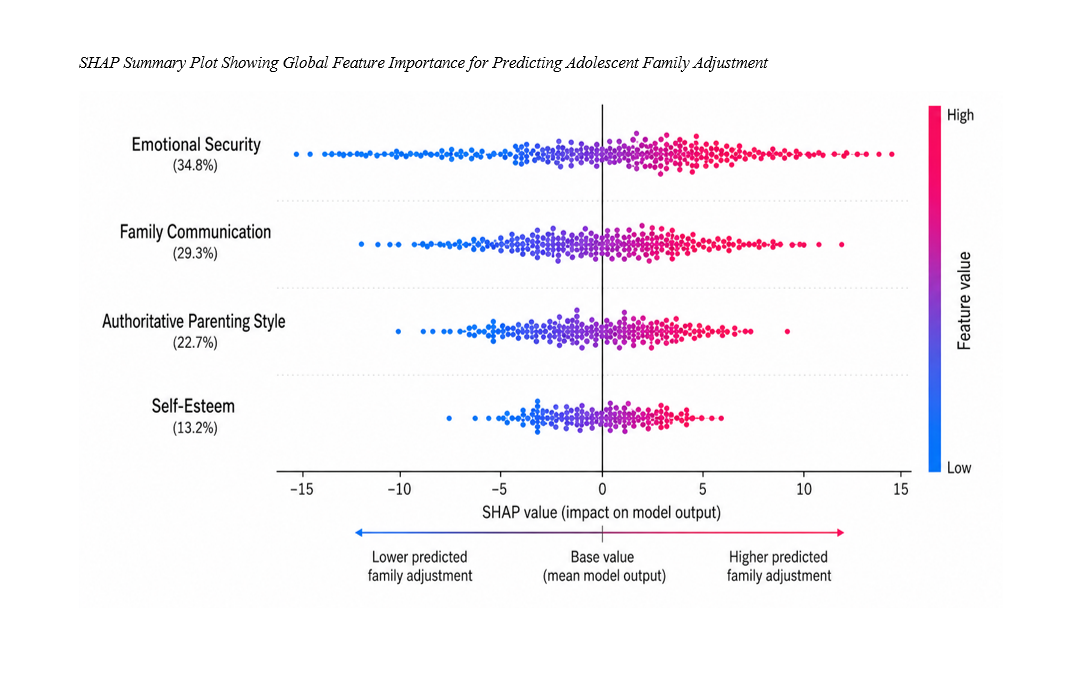
Findings: The Explainable LightGBM model demonstrated excellent predictive performance, accounting for 89.2% of the variance in family adjustment in the training dataset and 84.6% in the testing dataset (R² = .892 and .846, respectively). Cross-validation analyses confirmed model stability (Mean R² = .839, SD = .021). SHAP-based feature importance analyses revealed that emotional security was the strongest predictor of adolescent family adjustment, accounting for 34.8% of total predictive importance, followed by family communication (29.3%), authoritative parenting style (22.7%), and self-esteem (13.2%). SHAP summary analyses further indicated that higher levels of emotional security, more effective family communication, stronger authoritative parenting practices, and greater self-esteem were consistently associated with higher predicted family adjustment scores. The explainable machine learning framework successfully identified both the magnitude and direction of predictor contributions, highlighting the predominance of family relational factors in explaining adjustment outcomes.
Conclusion: The findings demonstrate that adolescent family adjustment can be accurately predicted through explainable machine learning approaches and that emotional security, family communication, authoritative parenting style, and self-esteem are significant contributors to adjustment outcomes.
Downloads
References
Abbaspour, Z., Laki, P. S., & Rajabi, G. (2022). The Predictors of Mother Abuse in Male Students: Domestic Violence, Marital Conflict, Family Coherence, Parenting Styles, and Self-Esteem. Iranian journal of psychiatry and behavioral sciences, 16(1). https://doi.org/10.5812/ijpbs.115767
Adewuyi, H. O. (2023). Social Adjustment, a Necessity Among Students With Negative Body-Image: The Roles of Parenting Processes and Self Esteem. Journal of Culture and Values in Education, 6(3), 62-80. https://doi.org/10.46303/jcve.2023.20
Alcaide, M., García, Ó. F., & Gómez‐Ortiz, O. (2025). Raising to Conformity Without Strictness: Is It Achievable? Frontiers in psychology, 16. https://doi.org/10.3389/fpsyg.2025.1568132
Bahmani, T., Naseri, N. S., & Fariborzi, E. (2022). Relation of Parenting Child Abuse Based on Attachment Styles, Parenting Styles, and Parental Addictions. Current Psychology, 42(15), 12409-12423. https://doi.org/10.1007/s12144-021-02667-7
Basharpoor, S., Heidari, F., Narimani, M., & Barahmand, U. (2022). School Adjustment, Engagement and Academic Self-Concept: Family, Child, and School Factors. Journal of Psychologists and Counsellors in Schools, 32(1), 23-38. https://doi.org/10.1017/jgc.2020.6
C., V., & Yadava, V. (2024). Exploring the Effect of Parenting Style on Self-Esteem and Emotional Regulation Among Young Adults. International Journal for Multidisciplinary Research, 6(3). https://doi.org/10.36948/ijfmr.2024.v06i03.19493
Chen, F., García, Ó. F., & Alcaide, M. (2024). Do We Know Enough About Negative Parenting? Recent Evidence on Parenting Styles and Child Maladjustment. The European Journal of Psychology Applied to Legal Context, 16(1), 37-48. https://doi.org/10.5093/ejpalc2024a4
Chen, Y. (2022). The Psychological Impact of Authoritarian Parenting on Children and the Youth. 888-896. https://doi.org/10.2991/978-2-494069-45-9_107
Climent-Galarza, S., Alcaide, M., García, Ó. F., Chen, F., & Pérez, J. F. G. (2022). Parental Socialization, Delinquency During Adolescence and Adjustment in Adolescents and Adult Children. Behavioral Sciences, 12(11), 448. https://doi.org/10.3390/bs12110448
Delgado, E., Sarrato, C. S., Martínez, I., & Cruise, E. (2022). Parental Attachment and Peer Relationships in Adolescence: A Systematic Review. International journal of environmental research and public health, 19(3), 1064. https://doi.org/10.3390/ijerph19031064
Esnaola, I., Martínez‐Gregorio, S., Azpiazu, L., Antonio‐Agirre, I., & Oliver, A. (2025). Do Parent Trust and Trait Emotional Intelligence Predict Self‐Concept? A Longitudinal Study. Psychology in the Schools, 62(12), 5020-5037. https://doi.org/10.1002/pits.70057
Feng, X., Hu, Z., & Wang, L. (2023). An Analysis of the Factors Influencing Psychological Resilience of Chinese Gay Men Based on Qualitative Research Perspectives. Journal of Higher Education Research, 4(4), 128. https://doi.org/10.32629/jher.v4i4.1477
García, Ó. F., Alcaide, M., Pons-Benavent, L., & Pérez, J. F. G. (2024). Parental Socialization Based on Warmth and Strictness Among Adolescents and Young Adults: Which Parenting Dimension Is Related to Greater Adjustment? Sage Open, 14(4). https://doi.org/10.1177/21582440241289684
Kiing, J. S. H., Ragen, E. S., Sulaiman, M., Goh, W. S., Tan, N. J. H., Ng, S. H., Luo, Y., Samuel, M., Young, D., & Loh, V. W. K. (2025). Bullying and Depression Among Adolescents in East Asia: A Scoping Review on Prevalence Rates, Risk and Protective Factors. Frontiers in Psychiatry, 16. https://doi.org/10.3389/fpsyt.2025.1497866
Kim, Y. H. (2022). Maternal Responsive Parenting Trajectories From Birth to Age 3 and Children’s Self-Esteem at First Grade. Frontiers in psychology, 13. https://doi.org/10.3389/fpsyg.2022.870669
Lee, Y. E. (2022). Relations Between Childhood Emotional Insecurity, Self‐esteem, and Adulthood Marital Conflict in South Korea. Family Relations, 72(4), 1926-1941. https://doi.org/10.1111/fare.12743
Lin, J., & Guo, W. (2024). The Research on Risk Factors for Adolescents’ Mental Health. Behavioral Sciences, 14(4), 263. https://doi.org/10.3390/bs14040263
Liu, Z. (2023). Exploring the Influence of Family Environment and Positive Personality on the Sense of Meaning in Life. Journal of Education Humanities and Social Sciences, 8, 1540-1545. https://doi.org/10.54097/ehss.v8i.4516
Mittal, E., & Rani, T. (2022). Association Between Secure Attachment Style and Subjective Well-Being: Examining the Sequential Mediation Effects. Asia Pacific Journal of Health Management, 17(2). https://doi.org/10.24083/apjhm.v17i2.1549
Nie, T., Qiao, Y., & Chen, Y. (2022). Authoritative Parenting Style and Proactive Behaviors: Evidence From China? Sustainability, 14(6), 3435. https://doi.org/10.3390/su14063435
Özyürek, A., & Çetin, A. (2022). The Investigation of the Effect of Secure Attachment to Mother on Self-Perception in Middle Childhood. International Journal of Contemporary Educational Research, 9(2), 272-282. https://doi.org/10.33200/ijcer.1031115
Qian, W. (2024). Exploring the Impact of Parenting Styles on Children’s Academic and Mental Health. Journal of Ecohumanism, 3(7). https://doi.org/10.62754/joe.v3i7.4615
Quintana, J. C. M., Ramos, P. F. A., & Almeida, P. M. (2023). The Influence of Perceived Security in Childhood on Adult Self-Concept: The Mediating Role of Resilience and Self-Esteem. Healthcare, 11(17), 2435. https://doi.org/10.3390/healthcare11172435
Reyes-Wapano, M. R. (2021). Literature Review: Gender, Parenting Style and Temperament Influence the Development of Emotional Intelligence. International Journal of Research and Innovation in Social Science, 05(08), 595-605. https://doi.org/10.47772/ijriss.2021.5832
Sembiring, T. B., Yusuf, S. R., Sudarmanto, E., & Murthada, M. (2023). The Influence of Parenting Patterns, Self-Perception, and Social Support on the Emotional Well-Being of Adolescents in Indonesia. The Eastasouth Journal of Social Science and Humanities, 1(01), 10-18. https://doi.org/10.58812/esssh.v1i01.143
Şiţoiu, A., & Pânişoară, G. (2023). The Emotional Intelligence of Today’s Parents – Influences on Parenting Style and Parental Competence. Frontiers in Public Health, 11. https://doi.org/10.3389/fpubh.2023.1120994
Velasco-Rauda, V., & Castillo-Martínez, J. Á. (2024). Relationship Between Parenting Styles and Socio-Emotional Skills in Childhood: Documented Review. Journal of Basic and Applied Psychology Research, 5(10), 8-13. https://doi.org/10.29057/jbapr.v5i10.7752
Wei, R.-j., & Chen, Y. (2022). The Associations of Family Functioning With Learned Helplessness: A Moderated Mediating Model. 1092-1104. https://doi.org/10.2991/978-94-6463-064-0_114
Yan, B. (2024). Analysis of the Impact of Family Education on Children's Mental Health. Lecture Notes in Education Psychology and Public Media, 39(1), 175-180. https://doi.org/10.54254/2753-7048/39/20240721
Yassin, W. A., Daoud, S., & Farhat, N. (2022). Parenting Styles and Self-Esteem: A Study of Lebanese Adolescents. Middle Eastern Journal of Research in Education and Social Sciences, 3(1), 87-101. https://doi.org/10.47631/mejress.v3i1.444
Zhu, Z. (2022). A Literature Review on the Influence of Parents on Children’s Academic and Cognitive Development. 1722-1728. https://doi.org/10.2991/978-2-494069-89-3_198
Downloads
Additional Files
Publication Timeline
- Submitted
- Revised
- Accepted