CatBoost Modeling of Parenting Effectiveness Based on Mindfulness, Emotional Intelligence, Psychological Flexibility, and Reflective Functioning
DOI:
https://doi.org/10.61838/kman.aftj.5654Keywords:
Parenting effectiveness, CatBoost, machine learning, mindfulness, emotional intelligence, psychological flexibilityAbstract
Objective: The present study aimed to develop and evaluate a CatBoost machine learning model for predicting parenting effectiveness based on mindfulness, emotional intelligence, psychological flexibility, and reflective functioning among parents in Thailand.
Methods and Materials: This cross-sectional predictive study was conducted among 742 parents recruited from Bangkok, Chiang Mai, Phuket, Khon Kaen, and Nakhon Ratchasima, Thailand. Participants completed the Parenting Sense of Competence Scale, Five Facet Mindfulness Questionnaire, Wong and Law Emotional Intelligence Scale, Acceptance and Action Questionnaire-II, and Reflective Functioning Questionnaire. Following data screening and preprocessing procedures, a CatBoost machine learning algorithm was implemented to predict parenting effectiveness. The dataset was divided into training (80%) and testing (20%) subsets, and hyperparameter optimization was performed using five-fold cross-validation. Model performance was evaluated using the coefficient of determination (R²), root mean squared error (RMSE), mean absolute error (MAE), and mean absolute percentage error (MAPE). SHAP (Shapley Additive Explanations) analyses were additionally conducted to examine feature importance and interpret predictor contributions.
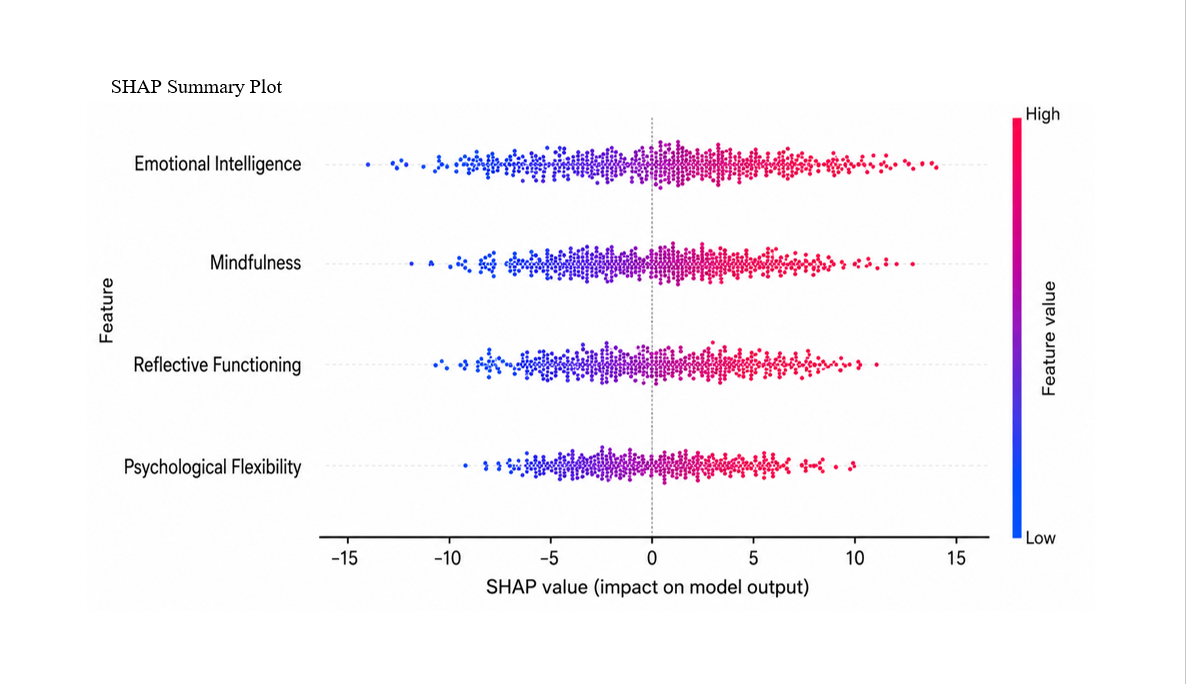
Findings: The results revealed significant positive associations between parenting effectiveness and mindfulness (r = .69, p < .001), emotional intelligence (r = .72, p < .001), psychological flexibility (r = .65, p < .001), and reflective functioning (r = .67, p < .001). The CatBoost model demonstrated strong predictive performance, explaining 84.2% of the variance in parenting effectiveness in the training dataset (R² = .842) and 81.6% in the testing dataset (R² = .816), with a cross-validation R² of .808. Feature importance analysis indicated that emotional intelligence was the strongest predictor (32.8%), followed by mindfulness (28.6%), reflective functioning (21.7%), and psychological flexibility (16.9%). SHAP analyses confirmed that higher levels of all four predictors contributed positively to parenting effectiveness predictions, with emotional intelligence exerting the greatest overall influence on model outputs.
Conclusion: The findings demonstrate that parenting effectiveness is strongly influenced by emotional, cognitive, and self-regulatory psychological capacities. Emotional intelligence emerged as the most important determinant, followed by mindfulness, reflective functioning, and psychological flexibility. The high predictive accuracy of the CatBoost model highlights the utility of machine learning approaches for understanding complex parenting processes and identifying key psychological resources that may serve as targets for intervention. Strengthening these capacities may enhance parenting effectiveness and contribute to healthier family functioning and child development outcomes.
Downloads
References
Abdelrasheed, N. S. G., & Saeed, M. A. (2024). The Impact of Mindfulness-Based Cognitive Therapy in Enhancing Psychological Resilience Among Basic Education Teachers in Oman: Longitudinal Study. International Journal of Linguistics Literature & Translation, 7(4), 163-176. https://doi.org/10.32996/ijllt.2024.7.4.19
Călinici, M. S., Călinici, T., & Crişan, H. (2024). Mindfulness Based Emotional Intelligence Training to Reduce Emotional Vulnerability for Medical Students. Revista Romaneasca pentru Educatie Multidimensionala, 16(2), 581-593. https://doi.org/10.18662/rrem/16.2/873
Chen, Y. (2022). The Psychological Impact of Authoritarian Parenting on Children and the Youth. 888-896. https://doi.org/10.2991/978-2-494069-45-9_107
Chorão, A. L., Canavarro, M. C., & Pires, R. (2022). Explaining Parenting Stress Among Adoptive Parents: The Contribution of Mindfulness, Psychological Flexibility, and Self-Compassion. International journal of environmental research and public health, 19(21), 14534. https://doi.org/10.3390/ijerph192114534
Dąbkowska, M., Kobierecka-Dziamska, A., & Prusaczyk, M. (2021). Anxiety, Coping Strategies and Resilience Among Children and Adolescents During COVID-19 Pandemic: A Systematic Review. https://doi.org/10.5772/intechopen.97828
Delgado, S., Pedapati, E. V., & Strawn, J. R. (2022). Promoting the Emotional and Behavioral Success of Youths. https://doi.org/10.1007/978-3-030-88075-0
Dewi, P. Y. A., & Primayana, K. H. (2023). The Importance of the Spiritual Quotient in Society Life. Purwadita Jurnal Agama Dan Budaya, 7(1), 93. https://doi.org/10.55115/purwadita.v7i1.3148
Flores, C. P. (2024). Emotional Foundations and Educational Development. https://doi.org/10.5772/intechopen.1004010
Flujas-Contreras, J. M., García‐Palacios, A., & Becerra, I. G. (2021). Effectiveness of a Web-Based Intervention on Parental Psychological Flexibility and Emotion Regulation: A Pilot Open Trial. International journal of environmental research and public health, 18(6), 2958. https://doi.org/10.3390/ijerph18062958
Gannamraju, S. K. (2025). Lived Experiences of Spiritual Emotional Intelligence: A Bhagavad Gitā-Based Indigenous Model of Psychological Wellbeing. Frontiers in psychology, 16. https://doi.org/10.3389/fpsyg.2025.1730103
Happaney, K., & Zelazo, P. D. (2022). Development of Executive Function Skills in Childhood. 427-451. https://doi.org/10.1017/9781108399838.023
Laifer, L. M., Ramsdell, E. L., Stasik-O’Brien, S. M., Martin, R. C. B., & Brock, R. L. (2024). Trajectories of Maternal and Paternal Internalizing Symptoms From Pregnancy to 2 Years Postpartum: Identifying Modifiable Risk and Protective Factors. Depression and Anxiety, 2024(1). https://doi.org/10.1155/2024/5164261
Lee, J. Y. S., Whittingham, K., & Mitchell, A. E. (2024). Parental Insightfulness, Parental Sensitivity, Parent and Child Mental Health, and Attachment in Autistic Children: A Systematic Review. Review Journal of Autism and Developmental Disorders. https://doi.org/10.1007/s40489-024-00482-x
Lobato, D., Montesinos, F., Polín, E., Flujas-Contreras, J. M., Becerra, I. G., & Budziszewska, L. (2025). Psychological Intervention in Parents of Children With Neurodevelopmental Disorders Using a Brief Protocol Based on Acceptance and Commitment Therapy. Journal of Applied Research in Intellectual Disabilities, 38(5). https://doi.org/10.1111/jar.70131
Mitsea, E., Drigas, A., & Skianis, C. (2024). Well-Being Technologies and Positive Psychology Strategies for Training Metacognition, Emotional Intelligence and Motivation Meta-Skills in Clinical Populations: A Systematic Review. Psych, 6(1), 305-344. https://doi.org/10.3390/psych6010019
Moreira, A., Vives, J., & Ballespí, S. (2024). Transgenerational Association of Mentalization With Child Mental Health: A Scoping Review. Family Process, 64(1). https://doi.org/10.1111/famp.13085
Reich, A., Lifshitz, H., Shnitzer-Meirovich, S., & Gur, A. (2025). Psychological Flexibility, Parental Reflective Functioning, Parental Efficacy and Coping in Parents of Children With Autism. Research and Practice for Persons With Severe Disabilities, 50(3), 177-194. https://doi.org/10.1177/15407969251316501
Ruskin, D., Young, M., Sugar, C., & Nofech‐Mozes, J. (2021). Mindfulness and Acceptance Interventions for Parents of Children and Adolescents Diagnosed With Chronic Medical Conditions: A Systematic Review. The Journal of Alternative and Complementary Medicine, 27(2), 120-135. https://doi.org/10.1089/acm.2020.0191
Sairanen, E., Lappalainen, R., Lappalainen, P., & Hiltunen, A. J. (2022). Effects of an Online Acceptance and Commitment Therapy Intervention on Children’s Quality of Life. Journal of Child and Family Studies, 31(4), 1079-1093. https://doi.org/10.1007/s10826-022-02234-z
Salicru, S. (2023). The Healthy Adult in Schema Therapy: Using the Octopus Metaphor. Psychology, 14(06), 932-951. https://doi.org/10.4236/psych.2023.146050
Sánchez, J. G. S. (2023). Benefits of Emotional Intelligence in School Adolescents: A Systematic Review. Revista De Psicología Y Educación - Journal of Psychology and Education, 18(2), 83. https://doi.org/10.23923/rpye2023.02.237
Sansone, A. (2024). The Central Role of Mindful Parenting in Child’s Emotional Regulation and Human Flourishing: A Blueprint Perspective. Frontiers in psychology, 15. https://doi.org/10.3389/fpsyg.2024.1420588
Shafik, W. (2024). Science of Emotional Intelligence. 284-310. https://doi.org/10.4018/979-8-3693-4453-8.ch015
Sparpana, A., & Brock, R. L. (2025). The Interplay Between Prenatal Psychological Flexibility and Couple Secure Base in Promoting Postpartum Parenting. Journal of Family Psychology, 39(7), 929-941. https://doi.org/10.1037/fam0001389
Taştekin, E., Kaymaz, Ç., Işik‐Uslu, A. E., Yüksel‐Doğan, R., Bozkurt‐Yükçü, Ş., & Tok, A. İ. (2025). Coparenting and Mindful Parenting Partially Mediate the Relationship Between Mothers' Stress and Parental Burnout. Family Relations. https://doi.org/10.1111/fare.70027
Taukeni, S. G. (2021). The Science of Emotional Intelligence. https://doi.org/10.5772/intechopen.90978
Teräsahjo, T. (2025). Mentalization and Mindfulness: A Scoping Review. Journal of Psychotherapy Integration. https://doi.org/10.1037/int0000380
Todosijević, M., & Kojić, D. (2022). Differentiation of Self as a Predictor of Capacity for Mentalization. Годишњак За Психологију, 19(1), 65-79. https://doi.org/10.46630/gpsi.19.2022.04
Trindade, I. A., Vagos, P., Moreira, H., Fernandes, D. V., & Tyndall, I. (2022). Further Validation of the 18-Item Portuguese CompACT Scale Using a Multi-Sample Design: Confirmatory Factor Analysis and Correlates of Psychological Flexibility. Journal of Contextual Behavioral Science, 25, 1-9. https://doi.org/10.1016/j.jcbs.2022.06.003
Wang, X., Yang, X., & Li, X. (2025). The Influence of Mentalization and Psychological Flexibility on the Mental Health of Graduate Students in China: A Cross-Sectional Study. Frontiers in Psychiatry, 16. https://doi.org/10.3389/fpsyt.2025.1482079
Żmuda, A. (2024). Self-Compassion as a Resource in the Parenting Role. Kwartalnik Naukowy Fides et Ratio, 58(2), 9-17. https://doi.org/10.34766/fetr.v58i2.1267
Асланова, М. С., Gavrilova, M., & Iurina, E. (2024). Does Sibling Family Structure Matter in the Emotion Understanding Development in Preschoolers? Frontiers in psychology, 15. https://doi.org/10.3389/fpsyg.2024.1428087
Downloads
Additional Files
Publication Timeline
- Submitted
- Revised
- Accepted