The Role of Artificial Intelligence in Media Communications
DOI:
https://doi.org/10.61838/kman.aitech.3.3.3Keywords:
Artificial Intelligence, Media Communications, Content Creation, Audience EngagementAbstract
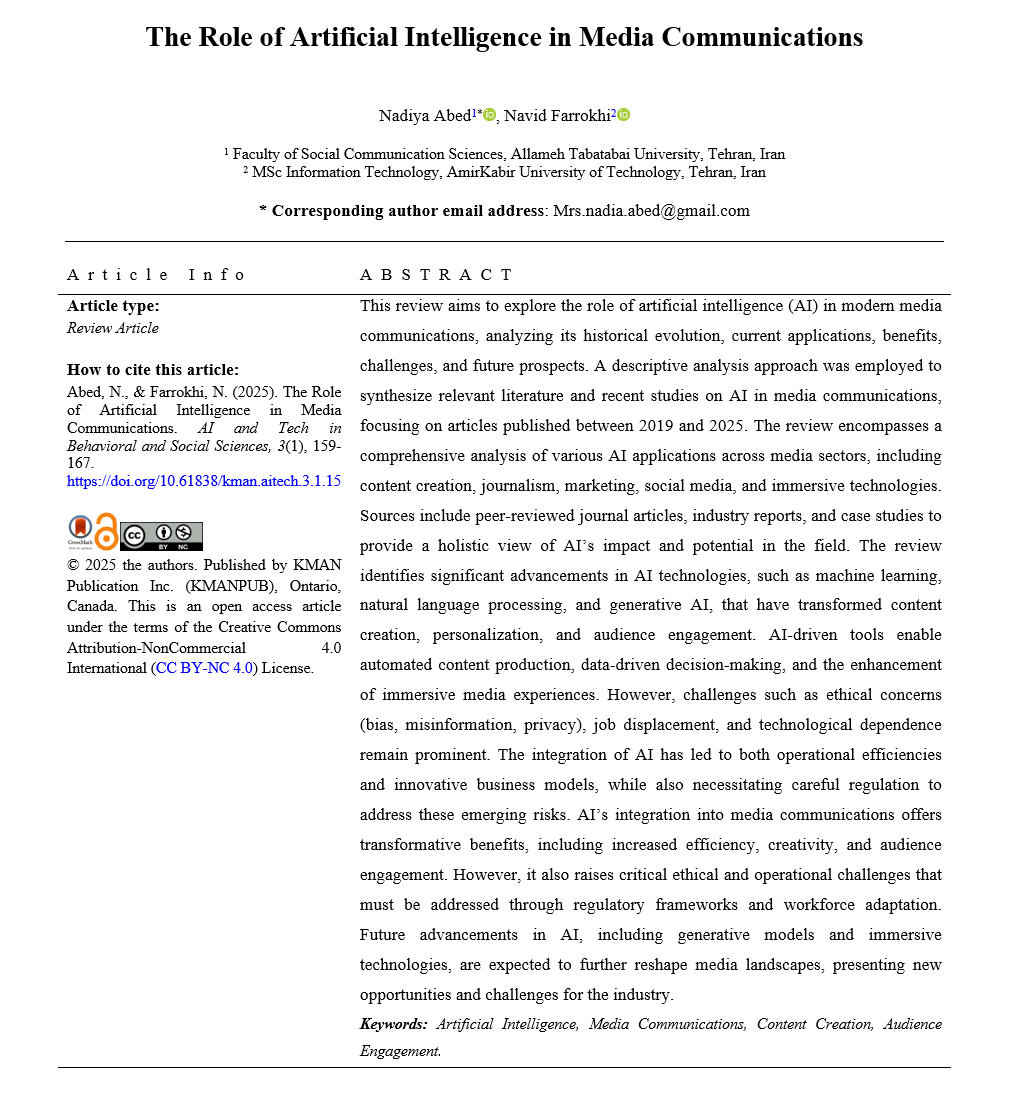
This review aims to explore the role of artificial intelligence (AI) in modern media communications, analyzing its historical evolution, current applications, benefits, challenges, and future prospects. A descriptive analysis approach was employed to synthesize relevant literature and recent studies on AI in media communications, focusing on articles published between 2019 and 2025. The review encompasses a comprehensive analysis of various AI applications across media sectors, including content creation, journalism, marketing, social media, and immersive technologies. Sources include peer-reviewed journal articles, industry reports, and case studies to provide a holistic view of AI’s impact and potential in the field. The review identifies significant advancements in AI technologies, such as machine learning, natural language processing, and generative AI, that have transformed content creation, personalization, and audience engagement. AI-driven tools enable automated content production, data-driven decision-making, and the enhancement of immersive media experiences. However, challenges such as ethical concerns (bias, misinformation, privacy), job displacement, and technological dependence remain prominent. The integration of AI has led to both operational efficiencies and innovative business models, while also necessitating careful regulation to address these emerging risks. AI’s integration into media communications offers transformative benefits, including increased efficiency, creativity, and audience engagement. However, it also raises critical ethical and operational challenges that must be addressed through regulatory frameworks and workforce adaptation. Future advancements in AI, including generative models and immersive technologies, are expected to further reshape media landscapes, presenting new opportunities and challenges for the industry.
Downloads
References
Behl, A., Chavan, M., Jain, K., Sharma, I., Pereira, V., & Zhang, Z. (2021). The Role of Organizational Culture and Voluntariness in the Adoption of Artificial Intelligence for Disaster Relief Operations. International Journal of Manpower, 43(2), 569-586. https://doi.org/10.1108/ijm-03-2021-0178
Chen, J. (2024). The Application and Development of Artificial Intelligence and High Technology in Sports Event. Highlights in Business Economics and Management, 30, 247-255. https://doi.org/10.54097/n7dhp396
Chiang, T. H. C., Liao, C.-S., & Wang, W.-C. (2022). Impact of Artificial Intelligence News Source Credibility Identification System on Effectiveness of Media Literacy Education. Sustainability, 14(8), 4830. https://doi.org/10.3390/su14084830
Du, S. (2024). The Opportunities and Challenges of Theater Stage Design in the Era of Artificial Intelligence. Communications in Humanities Research, 34(1), 216-220. https://doi.org/10.54254/2753-7064/34/20240187
Esch, P. v., & Black, J. S. (2021). Artificial Intelligence (AI): Revolutionizing Digital Marketing. Australasian Marketing Journal (Amj), 29(3), 199-203. https://doi.org/10.1177/18393349211037684
Fteiha, B. (2024). Revolutionizing Video Production: An AI-Powered Cameraman Robot for Quality Content. 19. https://doi.org/10.3390/engproc2024060019
Goar, V. (2022). The Impact and Transformation of Artificial Intelligence. International Journal on Recent and Innovation Trends in Computing and Communication, 10(8), 67-75. https://doi.org/10.17762/ijritcc.v10i8.5677
Grech, A., Mehnen, J., & Wodehouse, A. (2023). An Extended AI-Experience: Industry 5.0 in Creative Product Innovation. Sensors, 23(6), 3009. https://doi.org/10.3390/s23063009
Gu, X. (2024). Enhancing Social Media Engagement Using AI-modified Background Music: Examining the Roles of Event Relevance, Lyric Resonance, AI-singer Origins, Audience Interpretation, Emotional Resonance, and Social Media Engagement. Frontiers in psychology, 15. https://doi.org/10.3389/fpsyg.2024.1267516
Kamkankaew, P. (2024). How Artificial Intelligence Is Helping Businesses Grow and Thrive: The Transformative Role of Artificial Intelligence in Thai B2C Digital Marketing. Ijsasr, 4(1), 137-164. https://doi.org/10.60027/ijsasr.2024.3651
Kar, S. (2023). Impact of Artificial Intelligence on Digital Marketing. Interantional Journal of Scientific Research in Engineering and Management, 07(07). https://doi.org/10.55041/ijsrem25001
Lan, C. (2023). Artificial Intelligence Technology in the Field of Broadcasting and Hosting. https://doi.org/10.3233/faia230790
Li, Q. (2024). Reviving Ecological Environments: Strategies for AI and VR Applications in Immersive Cultural Exhibitions. SHS Web of Conferences, 183, 01010. https://doi.org/10.1051/shsconf/202418301010
Liu, X., & Pan, H. (2022). The Path of Film and Television Animation Creation Using Virtual Reality Technology Under the Artificial Intelligence. Scientific Programming, 2022, 1-8. https://doi.org/10.1155/2022/1712929
Orosa, B. G. (2021). Disinformation, Social Media, Bots, and Astroturfing: The Fourth Wave of Digital Democracy. El Profesional De La Información. https://doi.org/10.3145/epi.2021.nov.03
Ponomarenko, I. (2023). Ai-Powered Logistics and Digital Marketing for Business Optimisation. Economics & Education, 8(4), 27-33. https://doi.org/10.30525/2500-946x/2023-4-4
Rožman, M., Oreški, D., & Tominc, P. (2022). Integrating Artificial Intelligence Into a Talent Management Model to Increase the Work Engagement and Performance of Enterprises. Frontiers in psychology, 13. https://doi.org/10.3389/fpsyg.2022.1014434
Salvetti, F. (2024). Fostering Inclusive Recruitment Interviews With Intelligent Digital Humans. International Journal of Advanced Corporate Learning (Ijac), 17(3), 78-84. https://doi.org/10.3991/ijac.v17i3.45431
Sayoh, M. (2023). Utilizing Artificial Intelligence in Digital Out-of-Home Advertising. التصميم الدولية, 13(4), 417-425. https://doi.org/10.21608/idj.2023.305380
Shah, N., Chauhan, H., & Shah, M. (2020). Research Trends on the Usage of Machine Learning and Artificial Intelligence in Advertising. Augmented Human Research, 5(1). https://doi.org/10.1007/s41133-020-00038-8
Ughulu, J. (2022). The Role of Artificial Intelligence (AI) in Starting, Automating and Scaling Businesses for Entrepreneurs. https://doi.org/10.14293/s2199-1006.1.sor-.pp5zkwj.v1
Verma, S., Sharma, R., Deb, S., & Maitra, D. (2021). Artificial Intelligence in Marketing: Systematic Review and Future Research Direction. International Journal of Information Management Data Insights, 1(1), 100002. https://doi.org/10.1016/j.jjimei.2020.100002
Xie, Z. (2020). The Symmetries in Film and Television Production Areas Based on Virtual Reality and Internet of Things Technology. Symmetry, 12(8), 1377. https://doi.org/10.3390/sym12081377
Downloads
Additional Files
Publication Timeline
Issue
Section
License
Copyright (c) 2024 AI and Tech in Behavioral and Social Sciences

This work is licensed under a Creative Commons Attribution-NonCommercial 4.0 International License.