Virtual Reality (VR) for Mental Skills Training in Elite Athletes: A Quasi-Experimental Study
DOI:
https://doi.org/10.61838/kman.aitech.3.3.10Keywords:
virtual reality, mental skills training, elite athletes, biofeedback, sport psychologyAbstract
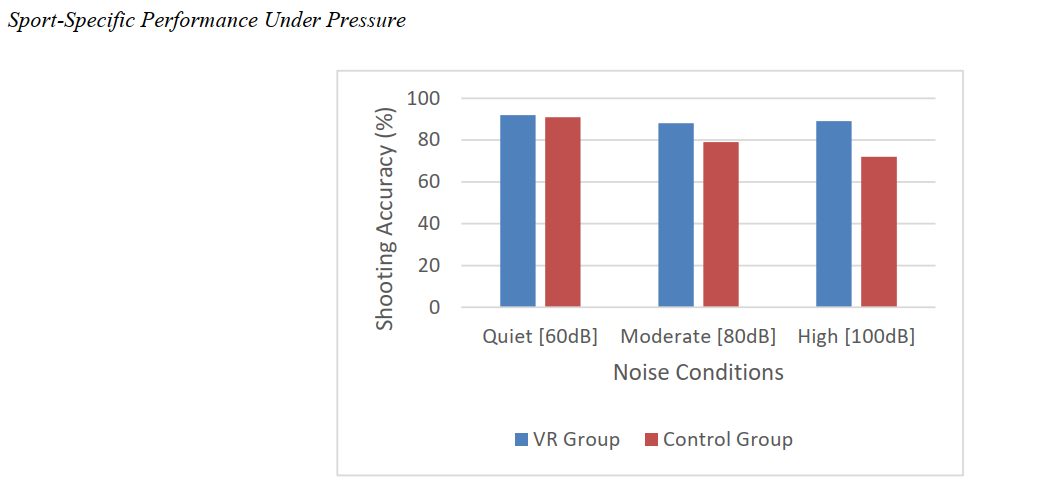
This Quasi-Experimental Study examined the efficacy of virtual reality (VR)-enhanced mental skills training compared to traditional methods in improving psychological resilience, physiological regulation, and sport-specific performance among elite athletes. Eighty elite athletes (40 male, 40 female) from football, basketball, swimming, and track and field were randomly assigned to either a VR training group (n=40) or a traditional mental skills training group (n=40). The VR group completed six weeks of immersive, biofeedback-assisted sessions using the Meta Quest Pro headset with sport-specific scenarios, while the control group received conventional mental training. Psychological (SMTQ, CSAI-2R), physiological (HRV, EDA), and performance metrics were assessed at baseline, post-intervention, and three-month follow-up. The VR group demonstrated significantly greater improvements in mental toughness (28.6% vs. 12.4%, p < 0.001), faster autonomic recovery (40% reduction in stress recovery time, p = 0.003), and enhanced decision-making under pressure (23% faster correct responses, p < 0.001) compared to controls. Team sport athletes showed larger benefits than individual sport athletes (p = 0.02), and effects were maintained at follow-up with minimal decay (<5%). VR-based mental training outperforms traditional methods, particularly when integrated with biofeedback and sport-specific simulations. These findings support VR as a transformative tool for elite athlete preparation, offering scalable, data-driven psychological training with lasting effects.
Downloads
References
Akbaş, A., Marszałek, W., Kamieniarz, A., Polechoński, J., Słomka, K. J., & Juras, G. (2019). Application of Virtual Reality in Competitive Athletes - A Review. Journal of Human Kinetics, 69, 5-16. https://doi.org/10.2478/hukin-2019-0023
Arthur, T., Loveland-Perkins, T., Williams, C., & et al. (2023). Examining the validity and fidelity of a virtual reality simulator for basic life support training. BMC Digital Health, 1, 16. https://doi.org/10.1186/s44247-023-00016-1
Bedir, D., & Erhan, S. E. (2021). The Effect of Virtual Reality Technology on the Imagery Skills and Performance of Target-Based Sports Athletes. Frontiers in psychology, 11, 2073. https://doi.org/10.3389/fpsyg.2020.02073
Bedir, F., Bedir, D., Yılmaz, H. H., Ağduman, F., Şen, İ., Kıyıcı, F., Korkmaz, O. E., Yıldız, M. O., & Çelik, E. (2025). Investigation of the effect of a virtual reality-based imagery training model on muscle activation in athletes. Frontiers in psychology, 16, 1553327. https://doi.org/10.3389/fpsyg.2025.1553327
Brizzi, G., Pupillo, C., Rastelli, C., Greco, A., Bernardelli, L., Di Natale, A. F., Pizzoli, S. F. M., Sajno, E., Frisone, F., Di Lernia, D., & Riva, G. (2025). Cyberdelics: Virtual reality hallucinations modulate cognitive-affective processes. Dialogues in clinical neuroscience, 27(1), 1-12. https://doi.org/10.1080/19585969.2025.2499459
Catania, V., Rundo, F., Panerai, S., & Ferri, R. (2023). Virtual Reality for the Rehabilitation of Acquired Cognitive Disorders: A Narrative Review. Bioengineering (Basel, Switzerland), 11(1), 35. https://doi.org/10.3390/bioengineering11010035
Corrado, S., Tosti, B., Mancone, S., Di Libero, T., Rodio, A., Andrade, A., & Diotaiuti, P. (2024). Improving Mental Skills in Precision Sports by Using Neurofeedback Training: A Narrative Review. Sports (Basel, Switzerland), 12(3), 70. https://doi.org/10.3390/sports12030070
Demeco, A., Salerno, A., Gusai, M., Vignali, B., Gramigna, V., Palumbo, A., Corradi, A., Mickeviciute, G. C., & Costantino, C. (2024). The Role of Virtual Reality in the Management of Football Injuries. Medicina (Kaunas, Lithuania), 60(6), 1000. https://doi.org/10.3390/medicina60061000
Drigas, A., & Sideraki, A. (2024). Brain Neuroplasticity Leveraging Virtual Reality and Brain–Computer Interface Technologies. Sensors, 24(17), 5725. https://doi.org/10.3390/s24175725
Egiziano, M., Chomienne, L., Hervet, V., Mascret, N., Kulpa, R., & Montagne, G. (2025). Virtual Reality as a Perceptual-Motor Training Tool: Validity and Fidelity Assessments of a 4 × 100 m Relay Simulator. Applied Sciences, 15(6), 3224. https://doi.org/10.3390/app15063224
Gangemi, A., De Luca, R., Fabio, R. A., Lauria, P., Rifici, C., Pollicino, P., Marra, A., Olivo, A., Quartarone, A., & Calabrò, R. S. (2023). Effects of Virtual Reality Cognitive Training on Neuroplasticity: A Quasi-Randomized Clinical Trial in Patients with Stroke. Biomedicines, 11(12), 3225. https://doi.org/10.3390/biomedicines11123225
Gray, R. (2017). Transfer of Training from Virtual to Real Baseball Batting. Frontiers in psychology, 8, 2183. https://doi.org/10.3389/fpsyg.2017.02183
Halkiopoulos, C., & Gkintoni, E. (2025). The Role of Machine Learning in AR/VR-Based Cognitive Therapies: A Systematic Review for Mental Health Disorders. Electronics, 14(6), 1110. https://doi.org/10.3390/electronics14061110
Harris, D. J., Bird, J. M., Smart, P. A., Wilson, M. R., & Vine, S. J. (2020). A Framework for the Testing and Validation of Simulated Environments in Experimentation and Training. Frontiers in psychology, 11, 605. https://doi.org/10.3389/fpsyg.2020.00605
Huang, Z., Choi, D. H., Lai, B., Lu, Z., & Tian, H. (2022). Metaverse-based virtual reality experience and endurance performance in sports economy: Mediating role of mental health and performance anxiety. Frontiers in Public Health, 10, 991489. https://doi.org/10.3389/fpubh.2022.991489
Huygelier, H., Mattheus, E., Abeele, V. V., van Ee, R., & Gillebert, C. R. (2021). The Use of the Term Virtual Reality in Post-Stroke Rehabilitation: A Scoping Review and Commentary. Psychologica Belgica, 61(1), 145-162. https://doi.org/10.5334/pb.1033
Imperiali, L., Borghi, S., Bizzozero, S., Prandoni, E., Bisio, A., La Torre, A., & Codella, R. (2025). Visual attention and response time to distinguish athletes from non-athletes: A virtual reality study. PLoS One, 20(5), e0324159. https://doi.org/10.1371/journal.pone.0324159
Jia, Y., Zhou, X., Yang, J., & Fu, Q. (2024). Animated VR and 360-degree VR to assess and train team sports decision-making: a scoping review. Frontiers in psychology, 15, 1410132. https://doi.org/10.3389/fpsyg.2024.1410132
Khan, A., Imam, Y. Z., Muneer, M., Al Jerdi, S., & Gill, S. K. (2024). Virtual reality in stroke recovery: a meta-review of systematic reviews. Bioelectronic Medicine, 10(1), 23. https://doi.org/10.1186/s42234-024-00150-9
Khan, A., Podlasek, A., & Somaa, F. (2023). Virtual reality in post-stroke neurorehabilitation - a systematic review and meta-analysis. Topics in Stroke Rehabilitation, 30(1), 53-72. https://doi.org/10.1080/10749357.2021.1990468
Kisker, J., Johnsdorf, M., Sagehorn, M., Hofmann, T., Gruber, T., & Schöne, B. (2025). Visual information processing of 2D, virtual 3D and real-world objects marked by theta band responses: Visuospatial processing and cognitive load as a function of modality. European Journal of Neuroscience, 61(1), e16634. https://doi.org/10.1111/ejn.16634
Lemmens, J. S. (2023). Persistence and pleasure in VR: Enhancing Exercise Endurance and Enjoyment through Virtual Environments. Psychology of Sport and Exercise, 69, 102494. https://doi.org/10.1016/j.psychsport.2023.102494
Manzi, V., Cardinale, D. A., Perrone, M. A., Bovenzi, A., Iellamo, F., Savoia, C., Caminiti, G., & Laterza, F. (2025). Physiological Benchmarks and Player Profiling in Elite Football: A Role-Specific Analysis Using T-Scores. Sports, 13(6), 181. https://doi.org/10.3390/sports13060181
Mao, F., Yin, A., Zhao, S., & Fang, Q. (2024). Effects of football training on cognitive performance in children and adolescents: a meta-analytic review. Frontiers in psychology, 15, 1449612. https://doi.org/10.3389/fpsyg.2024.1449612
Pagé, C., Bernier, P. M., & Trempe, M. (2019). Using video simulations and virtual reality to improve decision-making skills in basketball. Journal of Sports Sciences, 37(21), 2403-2410. https://doi.org/10.1080/02640414.2019.1638193
Richlan, F., Weiß, M., Kastner, P., & Braid, J. (2023). Virtual training, real effects: a narrative review on sports performance enhancement through interventions in virtual reality. Frontiers in psychology, 14, 1240790. https://doi.org/10.3389/fpsyg.2023.1240790
Trpkovici, M., Makai, A., Prémusz, V., & Ács, P. (2025). The possible application of virtual reality for managing anxiety in athletes. Frontiers in Sports and Active Living, 7, 1493544. https://doi.org/10.3389/fspor.2025.1493544
Weiß, M., Büttner, M., & Richlan, F. (2024). The Role of Sport Psychology in Injury Prevention and Rehabilitation in Junior Athletes. Behavioral sciences (Basel, Switzerland), 14(3), 254. https://doi.org/10.3390/bs14030254
Witte, K., Bürger, D., & Pastel, S. (2025). Sports training in virtual reality with a focus on visual perception: a systematic review. Frontiers in Sports and Active Living, 7, 1530948. https://doi.org/10.3389/fspor.2025.1530948
Zhu, R., Zheng, M., Liu, S., Guo, J., & Cao, C. (2024). Effects of Perceptual-Cognitive Training on Anticipation and Decision-Making Skills in Team Sports: A Systematic Review and Meta-Analysis. Behavioral Sciences, 14(10), 919. https://doi.org/10.3390/bs14100919
Downloads
Additional Files
Publication Timeline
Issue
Section
License
Copyright (c) 2024 Francisco Tomas Gonzalez-Fernandes (Author); Mahdi Fahimi (Corresponding Author); Seifeddine Brini (Author)

This work is licensed under a Creative Commons Attribution-NonCommercial 4.0 International License.