Toward Intelligent Governance of Healthy Digital Learning Systems: A Future-Oriented Model of AI-Supported Blended Learning in Higher Education
DOI:
https://doi.org/10.61838/kman.aitech.5154Abstract
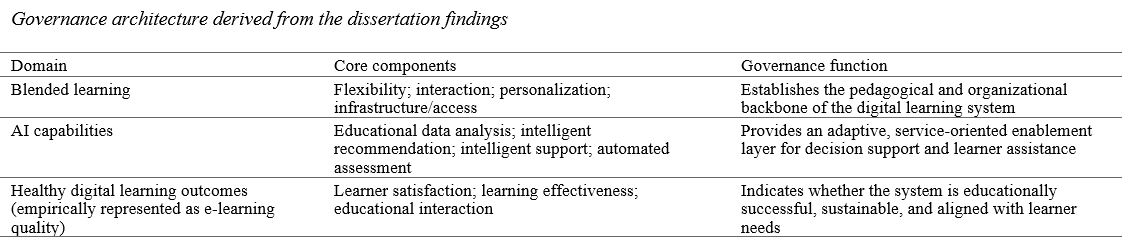
This article develops a future-oriented model for the intelligent governance of healthy digital learning systems in higher education, drawing on doctoral research conducted at Islamic Azad University. While the original dissertation established a blended learning model supported by artificial intelligence to improve e-learning quality, the present article reinterprets those findings through a governance lens. Rather than treating artificial intelligence as an autonomous driver of educational transformation, the study argues that AI should be governed as an enabling layer that strengthens pedagogical coherence, learner support, and institutional responsiveness within blended environments. A sequential mixed-methods design was used. In the qualitative phase, semi-structured interviews with 15 experts in education, e-learning, and educational technology were analyzed through thematic analysis to identify the core dimensions of the proposed model. In the quantitative phase, data from 384 faculty members and university experts were analyzed using partial least squares structural equation modeling (PLS-SEM), artificial neural networks (ANN), and the MABAC multi-criteria decision-making technique. The findings indicate that the governance architecture of a healthy digital learning system consists of three interrelated domains: blended learning (flexibility, interaction, personalization, and infrastructure/access), AI capabilities (educational data analysis, intelligent recommendation, intelligent support, and automated assessment), and healthy digital learning outcomes, operationalized in the dissertation as e-learning quality (learner satisfaction, learning effectiveness, and educational interaction). The model showed substantial explanatory capacity (R² = 0.712 in the dissertation summary). Blended learning had a stronger direct effect on e-learning quality (β = 0.574) than AI capabilities alone (β = 0.437), whereas AI exerted a very strong enabling effect on blended learning (β = 0.926). ANN results prioritized learner satisfaction (0.2772) and learning effectiveness (0.1780), while MABAC ranked intelligent support first, intelligent recommendation second, automated assessment third, and educational data analysis fourth. The article concludes that universities should adopt pedagogy-first, support-centered, and ethically governed AI strategies to build resilient and healthy digital learning systems.
Downloads
Downloads
Publication Timeline
- Submitted
- Revised
- Accepted