The Effectiveness of a Digital Art-Based Social-Emotional Learning (SEL) Program on Reducing Aggression in Elementary School Students: An Intervention Study
DOI:
https://doi.org/10.61838/kman.aitech.5307Keywords:
aggression, digital art, elementary school students, intervention, social-emotional learningAbstract
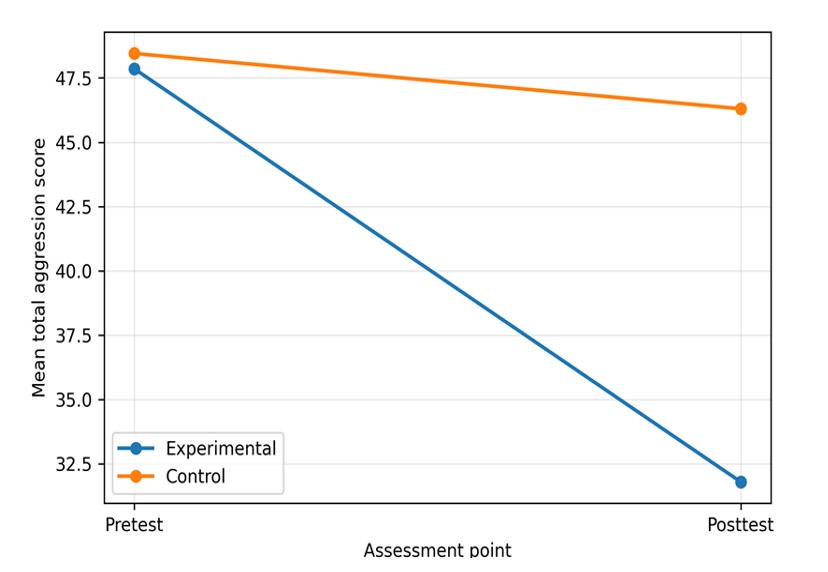
Aggression during the early school years interferes with peer relationships, classroom adjustment, and academic functioning. School-based social-emotional learning (SEL) programs can reduce behavioral problems, yet children may benefit most from formats that are developmentally engaging and expressive. This study examined whether a digital art-based SEL program could reduce aggression in second-grade students.A quasi-experimental pretest-posttest design with a control group was used. Fifty-two second-grade students from public elementary schools in Mazandaran Province, Iran, were selected through cluster sampling and assigned to an experimental group (n = 28) or a control group (n = 24). Aggression was assessed at baseline and post-intervention using the Persian version of the Buss-Perry Aggression Questionnaire. The experimental group participated in an eight-week intervention comprising 16 sessions (two 60-minute sessions per week) integrating CASEL-based SEL competencies with digital art activities, whereas the control group continued routine instruction. Descriptive statistics and mixed-design ANOVA were used for analysis. The groups were comparable at baseline on demographic characteristics and aggression scores. From pretest to posttest, the experimental group showed marked reductions in total aggression (47.85 ± 5.20 to 31.80 ± 4.50), physical aggression (12.45 ± 2.10 to 8.30 ± 1.85), verbal aggression (11.80 ± 2.40 to 7.50 ± 1.90), anger (13.10 ± 2.60 to 9.20 ± 2.10), and hostility (10.50 ± 2.30 to 6.80 ± 1.70), whereas changes in the control group were small. Mixed ANOVA showed a significant group × time interaction for total aggression, F(1, 50) = 26.07, p = .001, η² = .34, as well as for physical aggression, F(1, 50) = 22.15, p = .001, η² = .31; verbal aggression, F(1, 50) = 18.92, p = .001, η² = .27; anger, F(1, 50) = 24.56, p = .001, η² = .33; and hostility, F(1, 50) = 19.45, p = .001, η² = .28. A digital art-based SEL program appears to be an effective and engaging school-based approach for reducing aggression in elementary school students. Larger multi-site studies with follow-up assessments are recommended.
Downloads
References
Buss, A. H., & Perry, M. (1992). The aggression questionnaire. Journal of Personality and Social Psychology, 63(3), 452-459. https://doi.org/10.1037/0022-3514.63.3.452
Crick, N. R., & Dodge, K. A. (1994). A review and reformulation of social information-processing mechanisms in children's social adjustment. Psychological Bulletin, 115(1), 74-101. https://doi.org/10.1037/0033-2909.115.1.74
Denham, S. A. (2006). Social-emotional competence as support for school readiness: What is it and how do we assess it? Early Education and Development, 17(1), 57-89. https://doi.org/10.1207/s15566935eed1701_4
Durlak, J. A., Weissberg, R. P., Dymnicki, A. B., Taylor, R. D., & Schellinger, K. B. (2011). The impact of enhancing students' social and emotional learning: A meta-analysis of school-based universal interventions. Child Development, 82(1), 405-432. https://doi.org/10.1111/j.1467-8624.2010.01564.x
Garrido, S., Millington, C., Cheers, D., Boydell, K., Schubert, E., Meade, T., & Nguyen, Q. V. (2019). What works and what doesn't work? A systematic review of digital mental health interventions for depression and anxiety in young people. Frontiers in Psychiatry, 10. https://doi.org/10.3389/fpsyt.2019.00759
Hollis, C., Falconer, C. J., Martin, J. L., Whittington, C., Stockton, S., Glazebrook, C., & Davies, E. B. (2017). Annual research review: Digital health interventions for children and young people with mental health problems-A systematic and meta-review. Journal of Child Psychology and Psychiatry, 58(4), 474-503. https://doi.org/10.1111/jcpp.12663
Jones, D. E., Greenberg, M., & Crowley, M. (2015). Early social-emotional functioning and public health: The relationship between kindergarten social competence and future wellness. American Journal of Public Health, 105(11), 2283-2290. https://doi.org/10.2105/AJPH.2015.302630
Kaimal, G., Ray, K., & Muniz, J. (2016). Reduction of cortisol levels and participants' responses following art making. Art Therapy, 33(2), 74-80. https://doi.org/10.1080/07421656.2016.1166832
Malchiodi, C. A. (2012). Handbook of art therapy (2nd ed.). Guilford Press.
Samani, S. (2008). Study of reliability and validity of the Buss and Perry's aggression questionnaire. Iranian Journal of Psychiatry and Clinical Psychology, 13(4), 359-365.
Slayton, S. C., D'Archer, J., & Kaplan, F. (2010). Outcome studies on the efficacy of art therapy: A review of findings. Art Therapy, 27(3), 108-118. https://doi.org/10.1080/07421656.2010.10129660
Taylor, R. D., Oberle, E., Durlak, J. A., & Weissberg, R. P. (2017). Promoting Positive Youth Development through School-Based Social and Emotional Learning Interventions: A Meta-Analysis of Follow-Up Effects. Child development, 88(4), 1156-1171. https://doi.org/10.1111/cdev.12864