Predicting Emotional Dysregulation Using Machine Learning: The Role of Digital Rumination, Sleep Variability, Cognitive Load Reactivity, and Social Micro-Withdrawal
DOI:
https://doi.org/10.61838/kman.jarac.131Keywords:
Emotional Dysregulation, Machine Learning, Digital Rumination, Sleep Variability, Cognitive Load Reactivity, Social Micro-WithdrawalAbstract
Objective: The present study aimed to develop and validate a machine learning model to predict emotional dysregulation based on digital rumination, sleep variability, cognitive load reactivity, and social micro-withdrawal among young adults.
Methods and Materials: This quantitative predictive study was conducted on a sample of 428 young adults in Japan using a multimodal data collection approach integrating self-report measures, ecological momentary assessment, and passive digital tracking over a six-week period. Emotional dysregulation was assessed using a validated scale, while predictor variables included digital rumination, sleep variability derived from wearable actigraphy, cognitive load reactivity measured through task-based and self-report indices, and social micro-withdrawal operationalized via behavioral smartphone data. Data preprocessing involved normalization, missing data imputation, and feature engineering. Multiple machine learning algorithms, including random forest, support vector machine, gradient boosting, and XGBoost, were trained and evaluated using a 70-15-15 data split. Model performance was assessed using RMSE, MAE, and R², and interpretability was enhanced through SHAP analysis to determine feature importance and interaction effects.
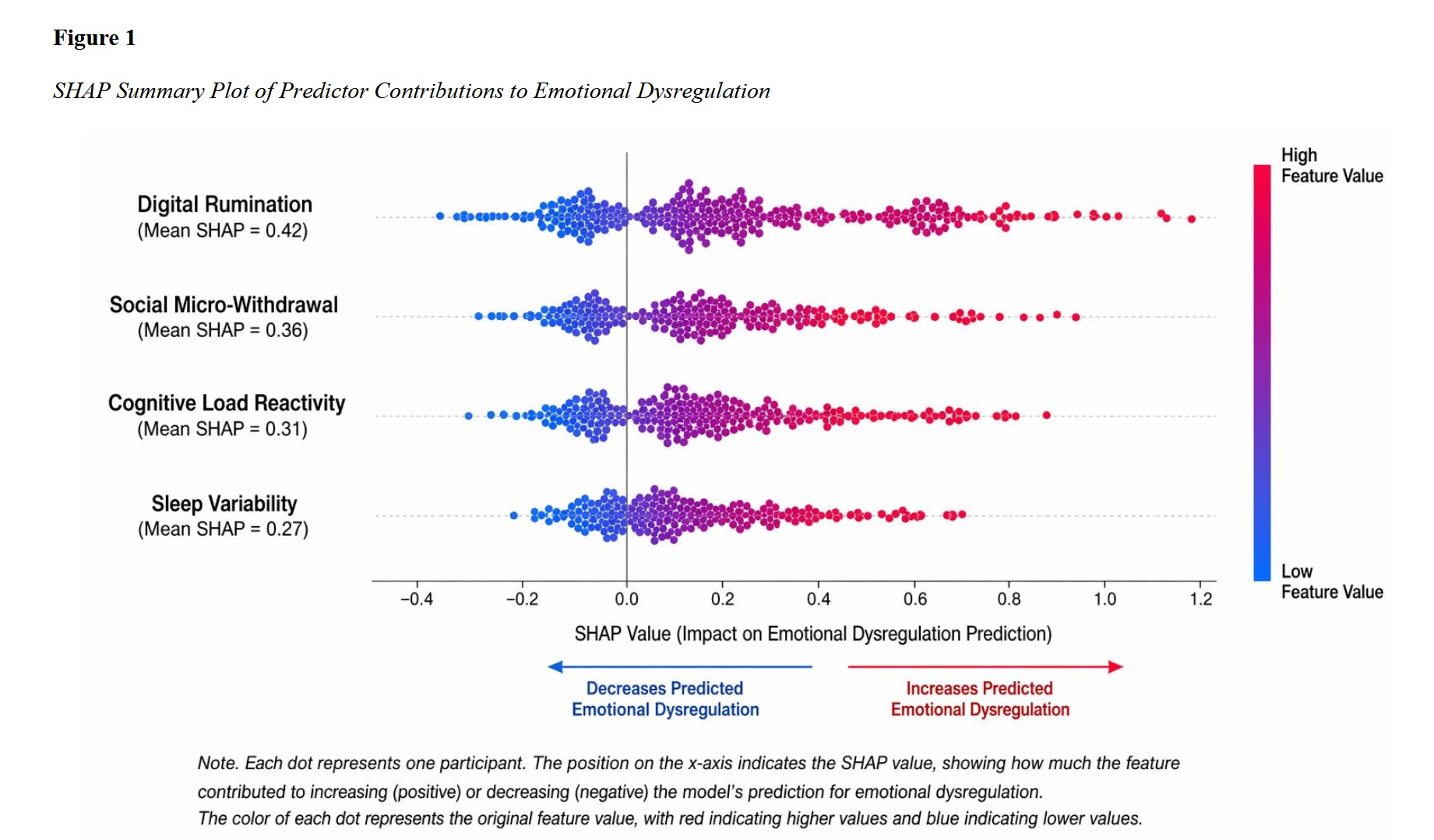
Findings: The results indicated that the XGBoost model achieved the highest predictive accuracy (R² = 0.76), outperforming other algorithms. Digital rumination emerged as the strongest predictor, followed by social micro-withdrawal, cognitive load reactivity, and sleep variability. Significant interaction effects were observed, particularly between digital rumination and social micro-withdrawal, as well as between digital rumination and sleep variability, indicating synergistic influences on emotional dysregulation. SHAP analysis revealed nonlinear relationships and threshold effects, demonstrating that higher levels of digital rumination and behavioral disengagement substantially increased the likelihood of elevated emotional dysregulation.
Conclusion: The findings highlight the effectiveness of machine learning approaches in capturing the complex and interactive determinants of emotional dysregulation, emphasizing the central role of digitally mediated cognitive and behavioral processes alongside physiological variability. Integrating digital rumination, sleep patterns, cognitive load sensitivity, and micro-level social behaviors provides a comprehensive framework for understanding emotional dysregulation in contemporary contexts and offers valuable implications for targeted, data-driven mental health interventions.
Downloads
References
Abdolmohamadi, K. (2025). Validating the Adult Concentration Inventory for Measuring Cognitive Disengagement Syndrome in an Iranian Population: Insights Into Mental Health and Cognitive Functioning. Brain and Behavior, 15(11). https://doi.org/10.1002/brb3.71033
Adawi, T. R., & Waseem, S. (2025). The Mediating Role of Compulsive Internet Use in the Relationship Between Depressive Symptoms and Sleep Quality Among Qatar University Students: A Path Analysis. https://doi.org/10.21203/rs.3.rs-6692326/v1
Arouch, S., Silva, K. M. d., Edgcumbe, D. R., & Pezaro, S. (2025). The Impact of Short-Form Video Use on Cognitive and Mental Health Outcomes: A Systematic Review. https://doi.org/10.1101/2025.08.27.25334540
Carter, M. C., Powell, N., Bediou, B., Tsappis, M., Bickham, D. S., & Rich, M. (2025). Placing Problematic Media Use in Context: A Research Synthesis, Person-Centric Framework, and Chart Review Among a Clinical Sample of US Youth. Frontiers in Psychiatry, 16. https://doi.org/10.3389/fpsyt.2025.1574502
Chen, X. (2025). The Interrelation Between Major Depressive Symptoms and Ambivalence Over Emotional Expression Among College Students: A Network Perspective on Gender Differences. Frontiers in Psychiatry, 16. https://doi.org/10.3389/fpsyt.2025.1658159
Conway, P., Redmond, T., Lundrigan, S., Davy, D., Bailey, S. K., & Lee, P. (2024). Protecting the Protectors: Moral Injury, Coping Styles, and Mental Health of UK Police Officers and Staff Investigating Child Sexual Abuse Material. Depression and Anxiety, 2024(1). https://doi.org/10.1155/da/1854312
Daros, A. R., & Ruocco, A. C. (2021). Which Emotion Regulation Strategies Are Most Associated With Trait Emotion Dysregulation? A Transdiagnostic Examination. Journal of psychopathology and behavioral assessment, 43(3), 478-490. https://doi.org/10.1007/s10862-020-09864-x
Doom, J. R., Rozenman, M., Fox, K. R., Phu, T., Subar, A. R., Seok, D., & Rivera, K. (2021). The Transdiagnostic Origins of Anxiety and Depression During the Pediatric Period: Linking NIMH Research Domain Criteria (RDoC) Constructs to Ecological Systems. Development and Psychopathology, 33(5), 1599-1619. https://doi.org/10.1017/s0954579421000559
Giannakopoulos, G., & Prassou, A. (2025). Mediating and Moderating Mechanisms in the Relationship Between Social Media Use and Adolescent Aggression: A Scoping Review of Quantitative Evidence. European Journal of Investigation in Health Psychology and Education, 15(6), 98. https://doi.org/10.3390/ejihpe15060098
Giletta, M. (2026). Peer Relationships and Depression. 601-619. https://doi.org/10.1037/0000437-033
Howard, R. P., Manohar, H., Seshadri, S., & Sharma, A. (2024). Coping Strategies in Young People During the COVID-19 Pandemic: Rapid Review. BJPsych Bulletin, 49(4), 249-258. https://doi.org/10.1192/bjb.2024.49
Huang, L. H., Chen, L., & Ma, S. (2025). The Relationship Between Social Media Fatigue and Online Trolling Behavior Among College Students: The Mediating Roles of Relative Deprivation and Hostile Attribution Bias. Frontiers in psychology, 15. https://doi.org/10.3389/fpsyg.2024.1495235
Jiang, L. (2025). How Does Emotional Exhaustion Among Chinese College Students Affect Mental Health? A Mixed-Methods Study in Zhejiang, China. Frontiers in Public Health, 13. https://doi.org/10.3389/fpubh.2025.1669092
Lu, Y., Chang, H., Meng, X., Li, Y., Liu, J., Yuan, W., Ni, J., Li, C., Li, L., Liu, L., Niu, Z., Zhong, H., Mei, S., Griffiths, M. D., Yang, T., He, Y., He, C., Yang, Y., Wu, L., . . . Rahardjo, W. (2024). Addictive Behaviors Among Youth and Adolescents in the Digital Age. https://doi.org/10.3389/978-2-8325-4853-0
Lunov, V., Matiash, M. M., Yevdokymova, N., Tkach, B., Ilin, M., Pavlov, A., & Prints, V. (2025). Metacognition, Network-Linked Behavioural Indices, and Psychosocial Functioning: A Multi-Group Esem–sem Study. https://doi.org/10.1101/2025.09.12.25335642
Marano, G., Lisci, F. M., Rossi, S., Marzo, E. M., Boggio, G., Brisi, C., Traversi, G., Mazza, O., Pola, R., Gaetani, E., & Mazza, M. (2025). Connected but at Risk: Social Media Exposure and Psychiatric and Psychological Outcomes in Youth. Children, 12(10), 1322. https://doi.org/10.3390/children12101322
Melvin, H., Cano, I., & Millar, C. (2025). Adapting Safety Planning for Autistic Adults With Trauma Histories: A Thematic Analysis From a UK Community Service. https://doi.org/10.21203/rs.3.rs-6602818/v1
Ntumi, S., Amos, P. M., Danquah, S. A., Amoako, B. M., Hansen, A., & Amezugbe, C. (2025). From Likes to Lows: A Serial Mediation Analysis of How Social Media Addiction, Fear of Missing Out (FoMO), Emotional Regulation, Assessment Engagement, and Assessment Anxiety Influence Depression Among Adolescents in Ghana. https://doi.org/10.21203/rs.3.rs-6916786/v1
Peçanha, A., Silveira, B. d., Krahe, T. E., & Landeira‐Fernandez, J. (2025). Can Social Isolation Alleviate Symptoms of Anxiety and Depression Disorders? Frontiers in Psychiatry, 16. https://doi.org/10.3389/fpsyt.2025.1561916
Tagliaferri, G., Vilar, M. M., Frisari, F. V., Quaglieri, A., Mari, E., Burrai, J., Giannini, A. M., & Cricenti, C. (2025). Connected by Boredom: A Systematic Review of the Role of Trait Boredom in Problematic Technology Use. Brain Sciences, 15(8), 794. https://doi.org/10.3390/brainsci15080794
Vedechkina, M., Holmes, J., & Bennett, M. (2022). Dimensions of Internalising Symptoms Are Stable Across Early Adolescence and Predicted by Executive Functions: Longitudinal Findings From the Adolescent Brain and Cognitive Development (ABCD) Study. https://doi.org/10.31234/osf.io/4nbfj
Wang, H., Wang, J., Li, Z., Sun, H., Zhong, T., Zheng, J., & Zhao, Z. (2025). The Relationship Between Insomnia and Non-Suicidal Self-Injury(NSSI) Among College Students: Parallel Mediation Effect of Subjective Well-Being and Rumination. BMC psychology, 13(1). https://doi.org/10.1186/s40359-025-03335-2
Webb, A. J. (2023). Anxiety and Sleep: The Bidirectional Relationship and Strategies for Improved Sleep. https://doi.org/10.22541/au.169531401.15330883/v1
Wong, S. M. Y., Chen, E., Lee, M. C. Y., Suen, Y. N., & Hui, C. L. M. (2023). Rumination as a Transdiagnostic Phenomenon in the 21st Century: The Flow Model of Rumination. Brain Sciences, 13(7), 1041. https://doi.org/10.3390/brainsci13071041
Xu, J. (2025). Parental Psychological Control and Cyberbullying Among Adolescents: The Mediating Roles of Sleep Quality and Moral Disengagement and the Moderating Role of Grade. Frontiers in psychology, 16. https://doi.org/10.3389/fpsyg.2025.1664970
Yao, Y., Wang, M., & Zhang, Y. (2025). Unravelling the Mechanisms of Student Negative Emotions in Technology-Mediated Intermittent Dropout: A Mixed-Methods fsQCA Study. https://doi.org/10.21203/rs.3.rs-6971678/v1
Yousef, A. M. F., Alshamy, A., Tlili, A., & Metwally, A. H. S. (2025). Demystifying the New Dilemma of Brain Rot in the Digital Era: A Review. Brain Sciences, 15(3), 283. https://doi.org/10.3390/brainsci15030283
Yu, Y., Su, X., Yang, Y., Xue, H., Liu, B., Sun, Y., Wang, R., Mo, X., Luo, H., Li, L., Tian, X. J., Yang, Y., Qiao, Z., Li, L., Xie, T., Li, S., Liu, L., Zhang, Y., & Lau, J. T. F. (2025). Emotional Dysregulation-Mediated Associations Between Guilt Proneness, Shame Proneness, and Internet Gaming Disorder Among Chinese University Students: Cross-Sectional Survey. Journal of medical Internet research, 27, e74052-e74052. https://doi.org/10.2196/74052
Yun, M., & Kwak, J. (2025). The Ripple Effect of Martial Law: Unveiling the Path to Unethical Behaviour. Journal of Occupational and Organizational Psychology, 98(2). https://doi.org/10.1111/joop.70035
Downloads
Additional Files
Publication Timeline
- Submitted
- Revised
- Accepted