The Effectiveness of Compassion-focused Therapy on Integrative self-knowledge, Self-destructive behaviors and Fatigue in Drug Users
DOI:
https://doi.org/10.61838/kman.jarac.1934Abstract
Objective: The purpose of this study was to examine the efficacy of compassion-focused therapy in addressing psychological coherence, self-destructive behavior, and fatigue among drug users.
Methods and Materials: The present study was semi-randomized in terms of its purpose, application, and research method, with a pre-test, post-test, and follow-up design with a control group. Among the addicts referred to the Paris addiction treatment center in Tehran in 2021, 30 people which was included in the study were selected and replaced randomly (by lottery) in the experimental group (15 people) and the control group (15 people). The experimental group received compassion-focused therapy during eight sessions, and the control group did not receive therapy. To collect data, the short form of Antonoski's psychological coherence scale (SOC-13), the self-destruction questionnaire of Sanson et al. (SHI), and the fatigue questionnaire of Smets et al. (MFI) were used.
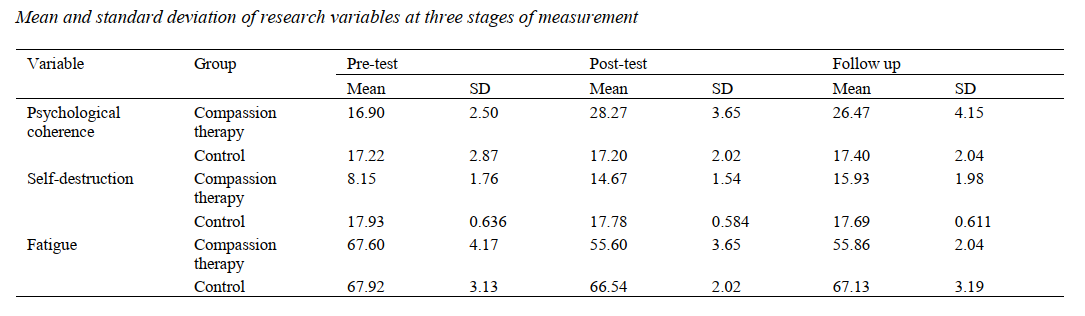
Findings: The results of the research showed that between the scores of psychological coherence, self-destruction, and fatigue in the treatment group focused on compassion and the control group in the post-test, there was a significant difference in follow-up (p < 0.05). Therefore, is effective in increasing psychological coherence and reducing self-destruction and fatigue in drug users.
Conclusion: As mentioned, the results indicate that compassion -focused therapy is effective for enhancing psychological cohesion, reducing self-destructive tendencies, and addressing fatigue among substance abusers. Additionally, based on the effect size analysis, it was determined that this treatment has a particularly significant impact on psychological cohesion and self-destructive behavior. Therefore, its utilization is strongly recommended for clinical psychologists and psychotherapists aiming to enhance psychological coherence and decrease self-destructive tendencies in individuals with substance use issues.
Downloads
References
Aminoff, M. J. (2013). Aminoff's Electrodiagnosis in Clinical Neurology. Saunders. https://books.google.com/books?hl=en&lr=&id=ask7iOrvjJIC&oi=fnd&pg=PP1&dq=Aminoff,+M.+J.+(2013).+Aminoff%27s+Electrodiagnosis+in+Clinical+Neurology.+USA,+Saunders.+%09&ots=3iYZm1uwKL&sig=ZIEulOZEi23RCu9ycRq-OK0kN_4
Angelis, D. (2015). Factors affecting repeated cessations of injecting drug use and relapses during the entire injecting career among the Edinburgh Addiction cohort. Journal of Drug and Alcohol Dependence, 151, 76-83. https://doi.org/10.1016/j.drugalcdep.2015.03.005
Antonovsky, A. (1993). The structure and properties of the sense of coherence scale. Social Science & Medicine, 36(6), 725-733. https://doi.org/10.1016/0277-9536(93)90033-Z
Attarian, M. (2015). A Comparison of Loneliness, Rumination, and Fatigue in Individuals with Substance Use Disorder and Normal Individuals Islamic Azad University, Borujerd Branch]. https://jpc.uma.ac.ir/article_3527.html
Au, T. M., Sauer-Zavala, S., King, M. W., Petrocchi, N., Barlow, D. H., & Litz, B. T. (2017). Compassion-based therapy for trauma-related shame and posttraumatic stress: Initial evaluation using a multiple baseline design. Behavior Therapy, 48(2), 207-221. https://doi.org/10.1016/j.beth.2016.11.012
Bagheri, M., & Tagvaei, D. (2017). Investigation of relationship between addictive substances abuse and psychological hardiness, quality of life, and self-concept in addicts. Qom University of Medical Sciences Journal, 11(3), 50-56. https://www.cabidigitallibrary.org/doi/full/10.5555/20173369013
Baker, D. A., Caswell, H. L., & Eccles, F. J. R. (2019). Self-compassion and depression, anxiety, and resilience in adults with epilepsy. Epilepsy Behavior, 90, 154-161. https://doi.org/10.1016/j.yebeh.2018.11.025
Ballestar-Tarín, M. L., Ibáñez-del-Valle, V., Cauli, O., & Navarro-Martínez, R. (2022). Personal and social consequences of psychotropic substance use: a population-based internet survey. Medicina, 58(1), 65. https://doi.org/10.3390/medicina58010065
Bell, T., Montague, J., Elander, J., & Gilbert, P. (2020). A definite feel-it moment: Embodiment, externalisation and emotion during chair-work in compassion-focused therapy. Counselling and Psychotherapy Research, 20(1), 143-153. https://doi.org/10.1002/capr.12248
Bishop, S. R. (2009). Self-compassion & Mindfulness: A proposed operational definition. Clinical Psychology: Science and Practice, 11, 191-206. https://psycnet.apa.org/fulltext/2004-15972-002.html
Borm, G. F., Fransen, J., & Lemmens, W. A. (2007). A simple sample size formula for analysis of covariance in randomized clinical trials. Journal of Clinical Epidemiology, 60(12), 1234-1238. https://doi.org/10.1016/j.jclinepi.2007.02.006
Cohen, J. (1992). Statistical power analysis. Current Directions in Psychological Science, 1(3), 98-101. https://doi.org/10.1111/1467-8721.ep10768783
Davoodi, M., Shameli, L., & Hadianfard, H. (2019). The effectiveness of acceptance and commitment therapy on chronic fatigue syndrome and pain perception in people with multiple sclerosis. Iranian Journal of Psychiatry and Clinical Psychology, 25(3), 250-265. https://doi.org/10.32598/ijpcp.25.3.250
Ehret, A. M., Joormann, J., & Berking, M. (2018). Self-compassion is more effective than acceptance and reappraisal in decreasing depressed mood in currently and formerly depressed individuals. Journal of Affective Disorders, 226, 220-226. https://doi.org/10.1016/j.jad.2017.10.006
Eriksson, M. (2022). The sense of coherence: the concept and its relationship to health. In The Handbook of Salutogenesis (pp. 61-68). https://doi.org/10.1007/978-3-030-79515-3_9
Ghorbani, N., Cunningham, C. J., & Watson, P. J. (2010). Comparative analysis of integrative self-knowledge, mindfulness, and private self-consciousness in predicting responses to stress in Iran. International Journal of Psychology, 45(2), 147-154. https://doi.org/10.1080/00207590903473768
Gilbert, P. (2014). The origins and nature of compassion focused therapy. British Journal of Clinical Psychology, 53(1), 6-41. https://doi.org/10.1111/bjc.12043
Grodin, J., Clark, J. L., Kolts, R., & Lovejoy, T. I. (2019). Compassion focused therapy for anger: A pilot study of a group intervention for veterans with PTSD. Journal of Contextual Behavioral Science. https://psycnet.apa.org/record/2019-51847-004
Huisman, S., Mulder, P., Kuijk, J., Kerstholt, M., van Eeghen, A., Leenders, A., & Hennekam, R. (2018). Self-injurious behavior. Neuroscience & Biobehavioral Reviews, 84, 483-491. https://doi.org/10.1016/j.neubiorev.2017.02.027
Khorsavi, M. (2018). The Effectiveness of Self-Compassion Training on Fatigue and Psychological Health of Substance Use Disorder Patients Islamic Azad University, Khomein Branch].
Krieger, T., Reber, F., von Glutz, B., Urech, A., Moser, C. T., Schulz, A., & Berger, T. (2019). An internet-based compassion-focused intervention for increased self-criticism: a randomized controlled trial. Behavior Therapy, 50(2), 430-445. https://doi.org/10.1016/j.beth.2018.08.003
Liu, M., Xiao, J., Kamper-DeMarco, K. E., & Fu, Z. (2023). Problematic internet use and suicidality and self-injurious behaviors in adolescents: Effects of negative affectivity and social support. Journal of Affective Disorders, 325, 289-296. https://doi.org/10.1016/j.jad.2023.01.019
Mahammadzadeh, A., Poursharifi, H., & Alipour, A. (2010). Validation of Sense of Coherence (SOC) 13-item scale in Iranian sample. Procedia - Social and Behavioral Sciences, 5, 1451-1455. https://doi.org/10.1016/j.sbspro.2010.07.306
Moe, F. D., Moltu, C., McKay, J. R., Nesvåg, S., & Bjornestad, J. (2022). Is the relapse concept in studies of substance use disorders a 'one size fits all' concept? A systematic review of relapse operationalisations. Drug and Alcohol Review, 41(4), 743-758. https://doi.org/10.1111/dar.13401
Neff, K. D. (2009). The role of self-compassion in development: A healthier way to relate to oneself. Human development, 52, 211-214. https://doi.org/10.1159/000215071
Neff, K. D. (2011). Self-compassion, self-esteem, and well-being. Social and Personality Psychology Compass, 5, 1-12. https://doi.org/10.1111/j.1751-9004.2010.00330.x
Nilsson, K. W., Leppert, J., Simonsson, B., & Starrin, B. (2010). Sense of coherence and psychological well-being: improvement with age. Journal of Epidemiology & Community Health, 64(4), 347-352. https://doi.org/10.1136/jech.2008.081174
Riahi nia, A., & Safari, Y. (2020). The effectiveness of compassion-focused therapy on attachment style, marital adjustment, and social adjustment in drug abusive men. Medical Journal of Mashhad. https://mjms.mums.ac.ir/article_17628_en.html
Sansone, R. A., Wiederman, M. W., & Sansone, L. A. (1998). The self-harm inventory (SHI): Development of a scale for identifying self-destructive behaviors and borderline personality disorder. Journal of Clinical Psychology, 54(7), 973-983. https://doi.org/10.1002/(SICI)1097-4679(199811)54:7<973::AID-JCLP11>3.0.CO;2-H
Shams, G., Pashang, S., & Sedaghat, M. (2021). Comparison of the effectiveness of compassion-based therapy and reality therapy on self-efficacy of patients with multiple sclerosis. Journal of Preventive Medicine, 8(1), 80-70. https://doi.org/10.52547/jpm.8.1.80
Smeets, E., Neff, K. D., Alberts, H., & Peters, M. (2014). Meeting suffering with kindness: Effects of a brief self-compassion intervention for female college students. Psychiatry Research, 190(1), 72-78. https://doi.org/10.1016/j.psychres.2011.08.006
Tahbaz Hosseinzadeh, S., Ghorbani, N., & Nabavi, M. (2011). A Comparison of Self-Destructive and Self-Integrative Personality Orientations in Patients with Multiple Sclerosis and Healthy Individuals. Contemporary Psychology Journal, 6(2), 35-44. https://jpc.uma.ac.ir/article_3527.html
Tian, J., & Hong, J. S. (2012). Validation of the Chinese version of Multidimensional Fatigue Inventory-20 in Chinese patients with cancer. Supportive Care in Cancer, 20, 2379-2383. https://doi.org/10.1007/s00520-011-1357-8
Downloads
Additional Files
Publication Timeline
- Submitted
- Revised
- Accepted
Issue
Section
License
Copyright (c) 2026 Fatemeh Alijani (Author)

This work is licensed under a Creative Commons Attribution-NonCommercial 4.0 International License.