Shame Proneness and Fear of Intimacy Predicting Sexual Avoidance in Couples
DOI:
https://doi.org/10.61838/kman.jarac.7.2.24Keywords:
sexual avoidance, shame proneness, fear of intimacy, romantic relationshipsAbstract
Objective: This study aimed to investigate the predictive roles of shame proneness and fear of intimacy in explaining sexual avoidance among romantic couples.
Methods and Materials: Using a correlational descriptive design, the study sampled 417 adult participants in romantic relationships from Peru, with sample size determined based on the Morgan and Krejcie table. Standardized instruments were used to measure sexual avoidance, shame proneness, and fear of intimacy. Data were analyzed using SPSS-27, applying Pearson correlation to assess the relationships between variables and multiple linear regression to examine the predictive power of the independent variables on sexual avoidance.
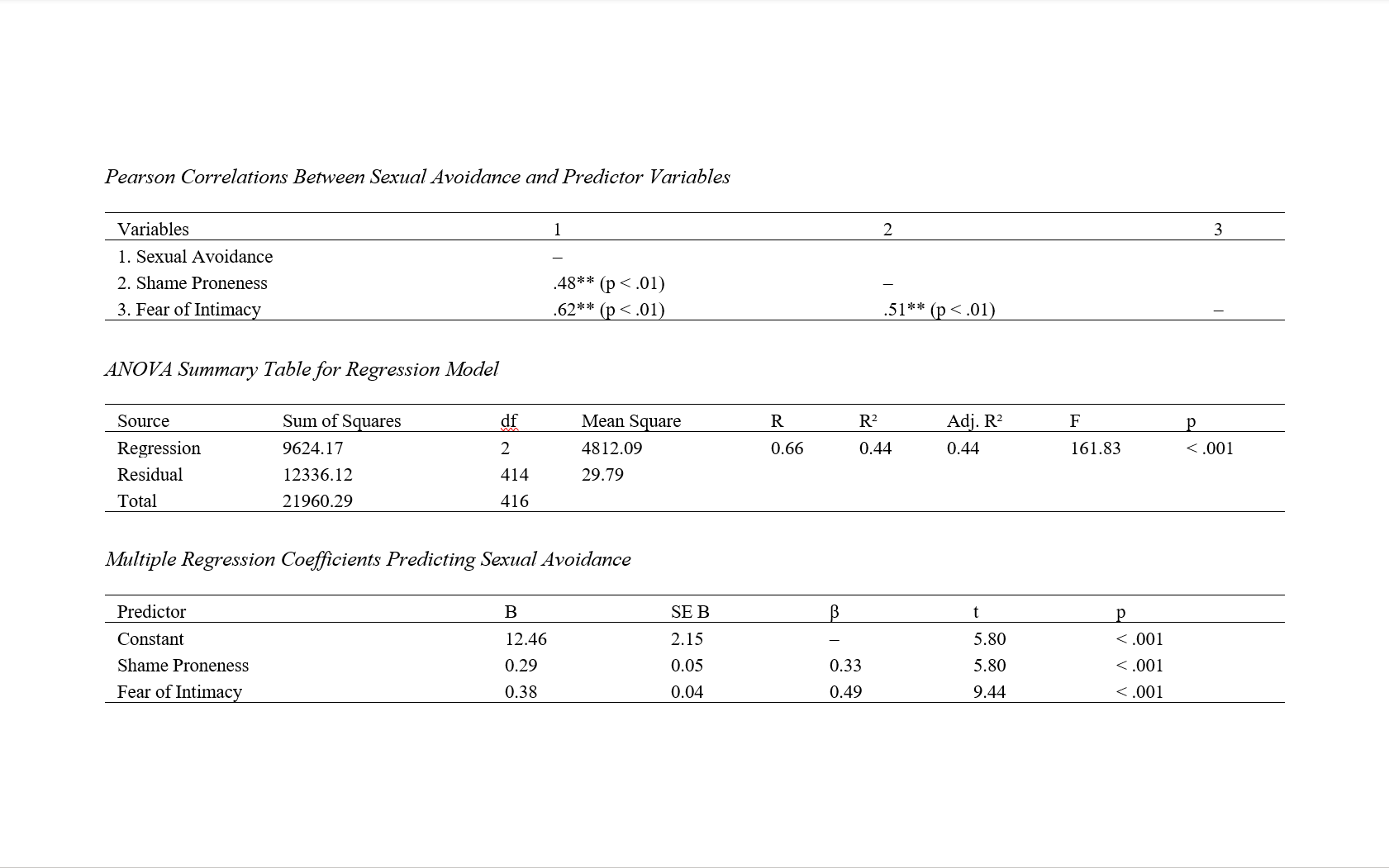
Findings: Pearson correlation analysis revealed significant positive associations between sexual avoidance and both shame proneness (r = .48, p < .01) and fear of intimacy (r = .62, p < .01). The regression model was statistically significant, F(2, 414) = 161.83, p < .001, with an R² value of .44, indicating that the predictors jointly accounted for 44% of the variance in sexual avoidance. In the multivariate regression, both shame proneness (β = 0.33, t = 5.80, p < .001) and fear of intimacy (β = 0.49, t = 9.44, p < .001) significantly predicted sexual avoidance, with fear of intimacy emerging as the stronger predictor.
Conclusion: The findings underscore the substantial influence of psychological factors—particularly fear of intimacy and shame proneness—on sexual avoidance behaviors in couples. These results highlight the need for emotionally focused and vulnerability-informed therapeutic interventions that target underlying emotional barriers to intimacy. Addressing these psychological dimensions may be essential for restoring sexual engagement and relational satisfaction in distressed couples.
Downloads
References
Albert, S. C., Martinelli, J. E., & Pessoa, M. S. C. (2022). Dementia and Its Impacts on the Intimate, Sexual Couple Relationship: A Systematic Review of Qualitative Research Studies. Dementia, 21(4), 1449-1466. https://doi.org/10.1177/14713012211073205
Brassard, A., Perron-Laplante, J., Lachapelle, É., Pierrepont, C. d., & Péloquin, K. (2018). Oversexualization Among Emerging Adults: Preliminary Associations With Romantic Attachment and Intimacy. The Canadian Journal of Human Sexuality, 27(3), 235-247. https://doi.org/10.3138/cjhs.2017-0031
Brassard, A., Vallée-Destrempes, M., Binet, M.-A., Brault‐Labbé, A., Lafontaine, M. F., & Péloquin, K. (2023). Attachment, Sexual Motives, and Sexual Satisfaction Among Couples Expecting Their First Child. Journal of sex & marital therapy, 49(7), 755-771. https://doi.org/10.1080/0092623x.2023.2193190
Finzi‐Dottan, R., Riff, A. R., & Dagan, G. (2025). Mirror, Mirror on the Wall, Who Loves You Above All: Navigating Vulnerable Narcissism, Intimacy, and Marital &Amp; Sexual Satisfaction. The Family Journal. https://doi.org/10.1177/10664807251321510
Gewirtz‐Meydan, A., & Finzi‐Dottan, R. (2017). Sexual Satisfaction Among Couples: The Role of Attachment Orientation and Sexual Motives. The Journal of Sex Research, 55(2), 178-190. https://doi.org/10.1080/00224499.2016.1276880
Ghasemi, Y. (2023). The Relationship Between Attachment Symbols, Attachment Styles and Self-Differentiation With Marital Intimacy. Obstetrics Gynecology and Reproductive Sciences, 7(4), 01-08. https://doi.org/10.31579/2578-8965/168
Giraldi, A., Jannini, E. A., Vignesh, S. O., Aguilera, A., & Hassan, T. (2024). Double Pause: Understanding Couple Intimacy Through Health Care Provider Lens – A Qualitative Survey. Journal of Sexual Medicine, 21(Supplement_2). https://doi.org/10.1093/jsxmed/qdae002.129
Guzmán-González, M., Gómez, F., Bahamondes, J., Barrientos, J., Garrido-Rojas, L., Espinoza-Tapia, R., & Casu, G. (2023). Internalized Homonegativity Moderates the Association Between Attachment Avoidance and Emotional Intimacy Among Same-Sex Male Couples. Frontiers in psychology, 14. https://doi.org/10.3389/fpsyg.2023.1148005
Jones, S., Albuquerque, S., & Pascoal, P. M. (2024). Grief and Sexual Intimacy: Exploring Therapists’ Views of Bereaved Clients. International Journal of Sexual Health, 36(3), 425-437. https://doi.org/10.1080/19317611.2024.2354815
Khazaeian, S., Navidian, A., Payandeh, A., & Niatmoghadam, N. (2021). The Impact of Couple Therapy Based on Relationship Enrichment Approach on Couples’ Intimacy and Sexual Function. Health Scope, 10(2). https://doi.org/10.5812/jhealthscope.111561
Kim, H. E., & Yeo, J. H. (2017). Impact of Sexual Attitude and Marital Intimacy on Sexual Satisfaction in Pregnant Couples: An Application of the Actor-Partner Interdependence Model. Korean Journal of Women Health Nursing, 23(3), 201. https://doi.org/10.4069/kjwhn.2017.23.3.201
Lankveld, J. v., Dewitte, M., Verboon, P., & Susan, A. H. v. H. (2021). Associations of Intimacy, Partner Responsiveness, and Attachment-Related Emotional Needs With Sexual Desire. Frontiers in psychology, 12. https://doi.org/10.3389/fpsyg.2021.665967
Manjula, V., Manjula, M., Janardhana, N., & Philip, M. (2021). Quality of Marital Relationship and Sexual Interaction in Couples With Sexual Dysfunction: An Exploratory Study From India. Journal of Psychosexual Health, 3(4), 332-341. https://doi.org/10.1177/26318318211047547
Mizrahi, M., Hirschberger, G., Mikulincer, M., Szepsenwol, O., & Birnbaum, G. E. (2016). Reassuring Sex: Can Sexual Desire and Intimacy Reduce Relationship‐specific Attachment Insecurities? European Journal of Social Psychology, 46(4), 467-480. https://doi.org/10.1002/ejsp.2184
Pascoal, P. M., Jones, S., & Albuquerque, S. (2024). Grief and Sexual Intimacy: Exploring Therapists’ Views of Bereaved Clients. Journal of Sexual Medicine, 21(Supplement_6). https://doi.org/10.1093/jsxmed/qdae161.076
Ruark, A., Kajubi, P., Ruteikara, S., Green, E. C., & Hearst, N. (2017). Couple Relationship Functioning as a Source or Mitigator of HIV Risk: Associations Between Relationship Quality and Sexual Risk Behavior in Peri-Urban Uganda. AIDS and Behavior, 22(4), 1273-1287. https://doi.org/10.1007/s10461-017-1937-9
Salari, H., pour, R. N., & Zahrakar, K. (2022). A Comparison of the Effectiveness of Integrative Couple Therapy and Integrative Behavioral Couple Therapy on Increasing Emotional and Sexual Intimacy of Couples Traumatized by Infidelity. Journal of counseling research. https://doi.org/10.18502/qjcr.v22i81.10111
Sandberg, L. (2020). Too Late for Love? Sexuality and Intimacy in Heterosexual Couples Living With an Alzheimer’s Disease Diagnosis. Sexual & Relationship Therapy, 38(1), 118-139. https://doi.org/10.1080/14681994.2020.1750587
Schensul, S. L., Brault, M. A., Prabhughate, P., Bankar, S., Ha, T., & Foster, D. (2018). Sexual Intimacy and Marital Relationships in a Low-Income Urban Community in India. Culture Health & Sexuality, 20(10), 1087-1101. https://doi.org/10.1080/13691058.2018.1491060
Stead, A., & White, J. G. (2019). Loss of Intimacy. Topics in Language Disorders, 39(1), 55-70. https://doi.org/10.1097/tld.0000000000000175
Štulhofer, A., Hinchliff, S., & Træen, B. (2019). Relationship Intimacy, Sexual Distress, and Help-Seeking for Sexual Problems Among Older European Couples: A Hybrid Dyadic Approach. International Journal of Impotence Research, 32(5), 525-534. https://doi.org/10.1038/s41443-019-0214-z
Turner, J. J., Crapo, J. S., Kopystynska, O., Bradford, K., & Higginbotham, B. J. (2023). Economic Distress and Perceptions of Sexual Intimacy in Remarriage. Frontiers in psychology, 13. https://doi.org/10.3389/fpsyg.2022.1056180
Wickrama, K. A. S., O’Neal, C. W., & Klopack, E. T. (2022). Midlife Financial Strain and Later‐life Health and Wellbeing of Husbands and Wives: Linking and Moderating Roles of Couple Intimacy Trajectories. Family Process, 61(4), 1593-1609. https://doi.org/10.1111/famp.12749
Downloads
Additional Files
Publication Timeline
- Submitted
- Revised
- Accepted
Issue
Section
License

This work is licensed under a Creative Commons Attribution-NonCommercial 4.0 International License.