Family Stress and Physical Rehabilitation Adherence in Adolescents: The Mediating Role of Health Beliefs
DOI:
https://doi.org/10.61838/kman.jarac.4374Keywords:
Family stress, health beliefs, rehabilitation adherence, adolescentsAbstract
Objective: The objective of this study was to examine the relationship between family stress and physical rehabilitation adherence among adolescents, with health beliefs considered as a mediating variable.
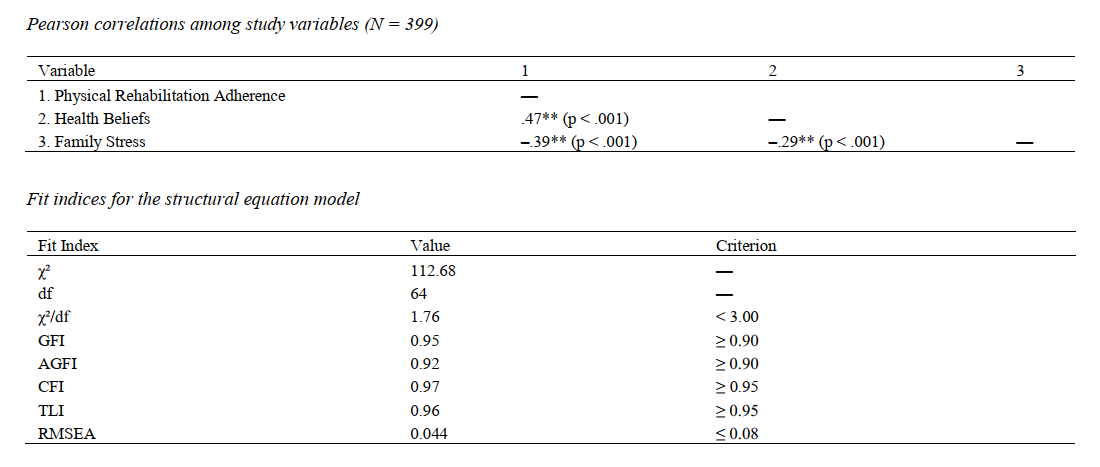
Methods and Materials: This descriptive correlational study included 399 adolescents aged 12–18 years who were undergoing physical rehabilitation programs in Minnesota. The sample size was determined using the Krejcie and Morgan table to ensure sufficient statistical power. Data were collected using standardized and validated instruments: the Medical Outcomes Study General Adherence Scale for adherence, the Health Belief Model Scale for health beliefs, and the Family Inventory of Life Events and Changes for family stress. Data analysis was conducted using SPSS version 27 and AMOS version 21. Descriptive statistics were computed, Pearson’s correlations were used to examine bivariate associations, and a structural equation model (SEM) was applied to test the hypothesized mediating role of health beliefs.
Findings: Results indicated that family stress was significantly and negatively associated with physical rehabilitation adherence (r = –.39, p < .001) and health beliefs (r = –.29, p < .001). Health beliefs were positively correlated with adherence (r = .47, p < .001). Family stress had a significant negative direct effect on adherence (β = –0.26, p < .001) and an indirect effect through health beliefs (β = –0.12, p = .002), with a total effect of β = –0.38 (p < .001), confirming partial mediation.
Conclusion: Strengthening adolescents’ health beliefs may serve as a buffer against the adverse effects of family stress and improve rehabilitation outcomes.
Downloads
References
Ahsan, M. R., Makbul, S., & Sarkar, P. K. (2020). Effectiveness of a Multidisciplinary Lifestyle Intervention to Reduce Obesity Among Children and Adolescents. Dhaka Shishu (Children) Hospital Journal, 35(2), 111-118. https://doi.org/10.3329/dshj.v35i2.49691
Alexander, K. (2025). Managing the Challenges of Adolescence Through Improved Family Functioning. The Brown University Child and Adolescent Behavior Letter, 41(6), 1-4. https://doi.org/10.1002/cbl.30871
Almeida, A. C., Leandro, M. E., & Pereira, M. G. (2020). Individual and Family Management in Portuguese Adolescents With Type 1 Diabetes: A Path Analysis. International Journal of Behavioral Medicine, 27(4), 455-465. https://doi.org/10.1007/s12529-020-09884-7
Almeida, A. C., Tavares, F. d. C., & Pereira, M. G. (2023). Metabolic Control and Quality of Life in Type 1 Diabetes: Do Adherence, Family Support, and School Support Matter? Nursing and Health Sciences, 25(3), 456-465. https://doi.org/10.1111/nhs.13042
Amalia, S. (2021). Diabetes Mellitus Type-1 and Psychosocial Intervention to Improve Quality of Life. Open Access Indonesian Journal of Medical Reviews, 1(4), 80-85. https://doi.org/10.37275/oaijmr.v1i4.565
Amaricăi, E. (2018). Functional and Adherence Assessment in Children and Adolescents With Thoracic Kyphosis. Cbu International Conference Proceedings, 6, 860-862. https://doi.org/10.12955/cbup.v6.1261
Azar, S., Jaoude, N. M. A., Kędzia, A. W., & Niechciał, E. (2024). Barriers to Type 1 Diabetes Adherence in Adolescents. Journal of clinical medicine, 13(19), 5669. https://doi.org/10.3390/jcm13195669
Bombaci, B., Torre, A., Longo, A., Pecoraro, M. T., Papa, M., Sorrenti, L., Rocca, M. L., Lombardo, F., & Salzano, G. (2024). Psychological and Clinical Challenges in the Management of Type 1 Diabetes During Adolescence: A Narrative Review. Children, 11(9), 1085. https://doi.org/10.3390/children11091085
Condeço, L. M. (2025). Fatores Influenciadores Da Adesão Terapêutica Nos Adolescentes Com Diabetes Mellitus Tipo 1. Egitania Sciencia, 34(1), 25-38. https://doi.org/10.46691/p7ne6237
Damulira, C., Mukasa, M., Byansi, W., Nabunya, P., Kivumbi, A., Namatovu, P., Namuwonge, F., Dvalishvili, D., Bahar, O. S., & Ssewamala, F. M. (2019). Examining the Relationship of Social Support and Family Cohesion on ART Adherence Among HIV-positive Adolescents in Southern Uganda: Baseline Findings. Vulnerable Children and Youth Studies, 14(2), 181-190. https://doi.org/10.1080/17450128.2019.1576960
Foster, C., Ayers, S., & Fidler, S. (2020). Antiretroviral Adherence for Adolescents Growing Up With HIV: Understanding Real Life, Drug Delivery and Forgiveness. Therapeutic Advances in Infectious Disease, 7. https://doi.org/10.1177/2049936120920177
García, J. E. M., Agraso-López, A. D., Ramos‐Morcillo, A. J., Jiménez, A., & Eguizábal, J. A. J. (2020). The Influence of Physical Activity, Diet, Weight Status and Substance Abuse on Students’ Self-Perceived Health. International journal of environmental research and public health, 17(4), 1387. https://doi.org/10.3390/ijerph17041387
Ibrahim, M., Levy, S., Gallop, B., Ewing, E. S. K., Hogue, A., Chou, J. L., & Diamond, G. (2021). Therapist Adherence to Two Treatments for Adolescent Suicide Risk: Association to Outcomes and Role of Therapeutic Alliance. Family Process, 61(1), 183-197. https://doi.org/10.1111/famp.12660
Mohamed, R., Rahman, A. H. A., Masra, F., & Latiff, Z. A. (2022). Barriers to Adherence to Iron Chelation Therapy Among Adolescent With Transfusion Dependent Thalassemia. Frontiers in Pediatrics, 10. https://doi.org/10.3389/fped.2022.951947
Nabunya, P., Bahar, O. S., Chen, B., Dvalishvili, D., Damulira, C., & Ssewamala, F. M. (2020). The Role of Family Factors in Antiretroviral Therapy (ART) Adherence Self-Efficacy Among HIV-infected Adolescents in Southern Uganda. BMC public health, 20(1). https://doi.org/10.1186/s12889-020-8361-1
Okawa, S., Kabaghe, S. M., Mwiya, M., Kikuchi, K., Jimba, M., Kankasa, C., & Ishikawa, N. (2018). Psychological Well-Being and Adherence to Antiretroviral Therapy Among Adolescents Living With HIV in Zambia. AIDS care, 30(5), 634-642. https://doi.org/10.1080/09540121.2018.1425364
Papadaki, S., & Carayanni, V. (2022). Health-Related Quality of Life, Mediterranean Diet, Physical Activity and Socioeconomic Factors of Greek Adolescents During COVID-19: A Cross Sectional Study. Mediterranean Journal of Nutrition and Metabolism, 15(4), 479-491. https://doi.org/10.3233/mnm-220008
Rathleff, M. S., Rathleff, C. R., Holden, S., Thorborg, K., & Olesen, J. (2018). Exercise Therapy, Patient Education, and Patellar Taping in the Treatment of Adolescents With Patellofemoral Pain: A Prospective Pilot Study With 6 months Follow-Up. Pilot and Feasibility Studies, 4(1). https://doi.org/10.1186/s40814-017-0227-7
Rencken, C. A., Harrison, A., Mtukushe, B., Bergam, S., Pather, A., Sher, R., Davidson, B., Carrihill, M., Matiwane, M., Kuo, C. Y., Galárraga, O., & Hoare, J. (2021). “Those People Motivate and Inspire Me to Take My Treatment.” Peer Support for Adolescents Living With HIV in Cape Town, South Africa. Journal of the International Association of Providers of Aids Care (Jiapac), 20. https://doi.org/10.1177/23259582211000525
Wright, M., Twose, D., & Gorter, J. W. (2021). Scootering for Children and Youth Is More Than Fun: Exploration of a Feasible Approach to Improve Function and Fitness. Pediatric Physical Therapy, 33(4), 218-225. https://doi.org/10.1097/pep.0000000000000829
Zuo, C., Ren, Y., Ming, H., Mei, K., & Huang, S. (2024). The Double-Edged Effect of Social Mobility Belief on Socioeconomically Disadvantaged Adolescents’ Health: The Mediating Role of Intentional Self-Regulation. Health Psychology, 43(8), 570-578. https://doi.org/10.1037/hea0001375
Downloads
Additional Files
Publication Timeline
- Submitted
- Revised
- Accepted
Issue
Section
License
Copyright (c) 2025 Seyed Amir Saadati (Corresponding Author); Seyed Alireza Saadati , James Ma (Author)

This work is licensed under a Creative Commons Attribution-NonCommercial 4.0 International License.