Online Sexual Exposure and Risky Behaviors: The Mediating Role of Sensation Seeking
DOI:
https://doi.org/10.61838/kman.jarac.7.3.22Keywords:
Online sexual exposure, risky behaviors, sensation seeking, adolescentsAbstract
Objective: The objective of this study was to examine the relationship between online sexual exposure and risky sexual behaviors among Canadian adolescents and young adults, with sensation seeking tested as a mediating variable.
Methods and Materials: A descriptive–correlational design was employed with a sample of 400 adolescents and young adults in Canada, selected based on Morgan and Krejcie’s sample size determination table. Participants completed validated self-report questionnaires measuring risky sexual behaviors, online sexual exposure, and sensation seeking. Descriptive statistics, Pearson correlation analyses using SPSS version 27, and Structural Equation Modeling (SEM) using AMOS version 21 were applied to test the hypothesized mediation model. Model fit was evaluated using chi-square, CFI, TLI, GFI, AGFI, and RMSEA indices.
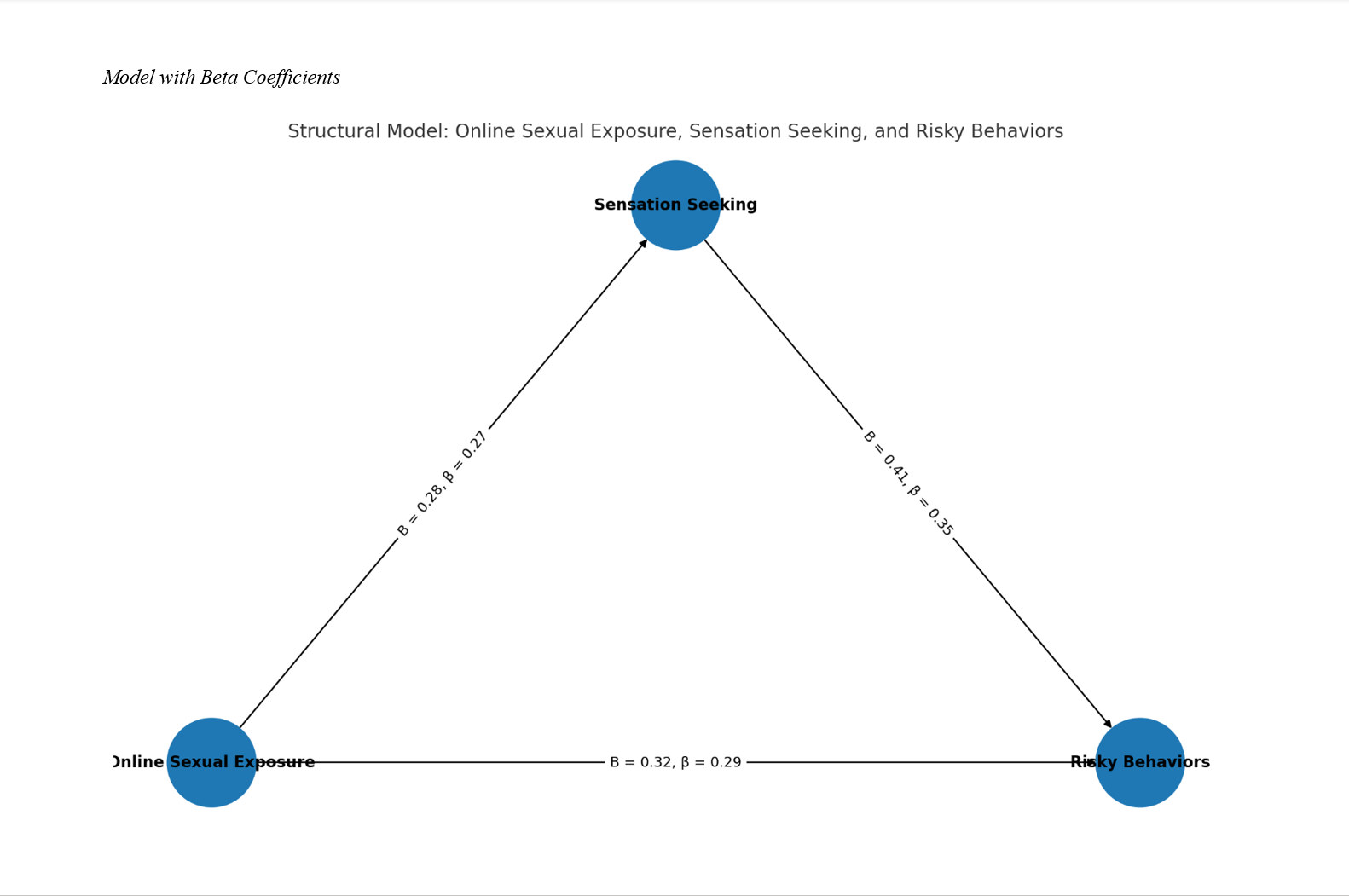
Findings: The results revealed that online sexual exposure was significantly and positively correlated with risky behaviors (r = .46, p < .001), while sensation seeking also showed a significant correlation with risky behaviors (r = .52, p < .001). SEM analysis demonstrated good model fit (χ² = 142.83, df = 71, χ²/df = 2.01, CFI = 0.96, TLI = 0.95, GFI = 0.94, RMSEA = 0.051). Online sexual exposure had a significant direct effect on risky behaviors (β = .29, p < .001) and an indirect effect through sensation seeking (β = .09, p = .002). The total effect of online sexual exposure on risky behaviors was β = .38 (p < .001), confirming partial mediation.
Conclusion: These findings highlight that sensation seeking plays a crucial mediating role in linking online sexual exposure to risky sexual behaviors. Digital platforms not only increase exposure opportunities but also align with sensation-seeking tendencies, thereby heightening vulnerability to sexual risk.
Downloads
References
Azhari, K. N., & Nugrahawati, E. N. (2025). Pengaruh Sensation Seeking Terhadap Risk Taking Behavior Pada Pengguna Aplikasi Kencan Online. Bandung Conference Series Psychology Science, 5(1), 325-334. https://doi.org/10.29313/bcsps.v5i1.16423
Berdychevsky, L. (2017). Toward the Tailoring of Sexual Health Education Messages for Young Women: A Focus on Tourist Experiences. The Journal of Sex Research, 54(9), 1171-1187. https://doi.org/10.1080/00224499.2017.1280720
Byck, G. R., Swann, G., Schalet, B. D., Bolland, J. M., & Mustanski, B. (2014). Sensation Seeking Predicting Growth in Adolescent Problem Behaviors. Child Psychiatry & Human Development, 46(3), 466-473. https://doi.org/10.1007/s10578-014-0486-y
Charnigo, R., Noar, S. M., Garnett, C., Crosby, R., Palmgreen, P., & Zimmerman, R. S. (2012). Sensation Seeking and Impulsivity: Combined Associations With Risky Sexual Behavior in a Large Sample of Young Adults. The Journal of Sex Research, 50(5), 480-488. https://doi.org/10.1080/00224499.2011.652264
Dekkers, T. J., Popma, A., Bosch, J. A., Zadelaar, J. N., & Huizenga, H. M. (2025). Driven by Hormones? An Investigation of the Joint Influence of Testosterone and Cortisol on Risk Taking, Aggression and Sensation Seeking in Adolescents With and Without ADHD. https://doi.org/10.31234/osf.io/ujzs3_v1
Derefinko, K. J., Peters, J. R., Eisenlohr‐Moul, T. A., Walsh, E. C., Adams, Z. W., & Lynam, D. R. (2014). Relations Between Trait Impulsivity, Behavioral Impulsivity, Physiological Arousal, and Risky Sexual Behavior Among Young Men. Archives of Sexual Behavior, 43(6), 1149-1158. https://doi.org/10.1007/s10508-014-0327-x
Erdiansyah, M., Khumas, A., & Ismail, I. (2023). The Effect of Self-Control on Sensation Seeking in Adolescents Who Play Online Games in Makassar. Journal of Correctional Issues, 6(2), 297-306. https://doi.org/10.52472/jci.v6i2.274
Espinoza, L., Richardson, J. L., Ferguson, K. M., Chou, C. P., Báezconde‐Garbanati, L., & Stacy, A. W. (2019). Adolescent Substance Use and Sensation-Seeking on Sexual Behaviors Among Young Adults From Continuation High Schools. Substance Use & Misuse, 54(3), 373-383. https://doi.org/10.1080/10826084.2018.1496453
Garner, A. R., Spiller, L., & Williams, P. (2017). Sexual Coercion in the College Population: A Form of Risk-Taking Behavior. Journal of interpersonal violence, 35(23-24), 5276-5291. https://doi.org/10.1177/0886260517720736
Grosskopf, N. A., Harris, J. K., Wallace, B. C., & Nanín, J. (2010). Online Sex-Seeking Behaviors of Men Who Have Sex With Men in New York City. American Journal of Men S Health, 5(5), 378-385. https://doi.org/10.1177/1557988310372801
Jiang, S.-M., Xiang, F., & Yang, I. (2023). Sensation Seeking and Automobile Insurance Coverage Decisions: A Moderated Mediation Model of Gender and Risk Perception. Social Behavior and Personality an International Journal, 51(11), 1-9. https://doi.org/10.2224/sbp.127774
KiylioĞLu, L., & Dönmez, A. (2021). Risky Sexual Behavior Among Heterosexual Male Turkish University Students. Abant İzzet Baysal Üniversitesi Sosyal Bilimler Enstitüsü Dergisi. https://doi.org/10.11616/basbed.vi.901233
Luo, R., Zhi, X., Silenzio, V., Kuang, Y., & Luo, D. (2023a). Gay App Use, Sexuality Traits, and High-Risk Sexual Behaviors Among Men Who Have Sex With Men in China: Mediation Analysis. Journal of medical Internet research, 25, e49137. https://doi.org/10.2196/49137
Luo, R., Zhi, X., Silenzio, V., Kuang, Y., & Luo, D. (2023b). Gay App Use, Sexuality Traits, and High-Risk Sexual Behaviors Among Men Who Have Sex With Men in China: Mediation Analysis (Preprint). https://doi.org/10.2196/preprints.49137
McKie, R. M., Levere, D., & Humphreys, T. P. (2016). The Mediating Role of Technology and the Prevalence of Sexual Sensation Seeking Behaviours Among Men of Varying Sexual Orientations in Canada, the United States, and Western Europe. The Canadian Journal of Human Sexuality, 25(3), 199-207. https://doi.org/10.3138/cjhs.253-a3
Negredo, A. d. M. (2020). Relevance of Temperament Traits in Sexual Fluidity in a Sample of Spanish Young University Students. Advances in Social Sciences Research Journal, 7(5), 369-381. https://doi.org/10.14738/assrj.75.8257
Northey, L., Dunkley, C. R., Klonsky, E. D., & Gorzalka, B. B. (2016). Borderline Personality Disorder Traits and Sexuality: Bridging a Gap in the Literature. The Canadian Journal of Human Sexuality, 25(2), 158-168. https://doi.org/10.3138/cjhs.252-a8
O’Hara, R. E., Gibbons, F. X., Gerrard, M., Li, Z., & Sargent, J. D. (2012). Greater Exposure to Sexual Content in Popular Movies Predicts Earlier Sexual Debut and Increased Sexual Risk Taking. Psychological Science, 23(9), 984-993. https://doi.org/10.1177/0956797611435529
Palacios, J. (2018). Predictors of Personality and Self-Efficacy of Sexual Risk Behavior in Mexican Adolescents. Anales de Psicología, 35(1), 131-139. https://doi.org/10.6018/analesps.35.1.319471
Pirani, E., & Matera, C. (2020). Who Is at Risk? Gendered Psychological Correlates in Italian Students’ Sexual Risk Profiles. Genus, 76(1). https://doi.org/10.1186/s41118-020-00080-9
Silverstein, M. W., Fix, R. L., & Alexander, A. A. (2017). Risky Sex: Testing Moderated Mediation Among College Students. Journal of Aggression Conflict and Peace Research, 9(4), 246-256. https://doi.org/10.1108/jacpr-05-2017-0296
Turchik, J. A., Garske, J. P., Probst, D. R., & Irvin, C. R. (2010). Personality, Sexuality, and Substance Use as Predictors of Sexual Risk Taking in College Students. The Journal of Sex Research, 47(5), 411-419. https://doi.org/10.1080/00224490903161621
Downloads
Additional Files
Publication Timeline
- Submitted
- Revised
- Accepted
Issue
Section
License
Copyright (c) 2025 Leila Saeidtaleshi (Corresponding Author); Shiva Sherkat, Niki Nourbakhsh (Author)

This work is licensed under a Creative Commons Attribution-NonCommercial 4.0 International License.