Exploring Components of Intergenerational Transmission of Stress in Adolescents
DOI:
https://doi.org/10.61838/kman.jarac.4437Keywords:
Intergenerational stress, adolescents, family functioning, resilience, copingAbstract
Objective: The objective of this study was to explore the components and mechanisms through which stress is transmitted across generations within families and how adolescents experience and respond to these dynamics.
Methods and Materials: This study employed a qualitative research design using semi-structured interviews to capture adolescents’ lived experiences of intergenerational stress. A purposive sample of 18 adolescents, aged 13–18 years, was recruited from diverse socio-economic and family backgrounds in Ireland. Data collection continued until theoretical saturation was achieved. Interviews lasted between 45 and 60 minutes, were audio-recorded with informed consent, and transcribed verbatim. Thematic analysis was conducted using NVivo 14 software, following a systematic coding process that progressed from open codes to subthemes and broader categories. Credibility was enhanced through peer debriefing and member checking.
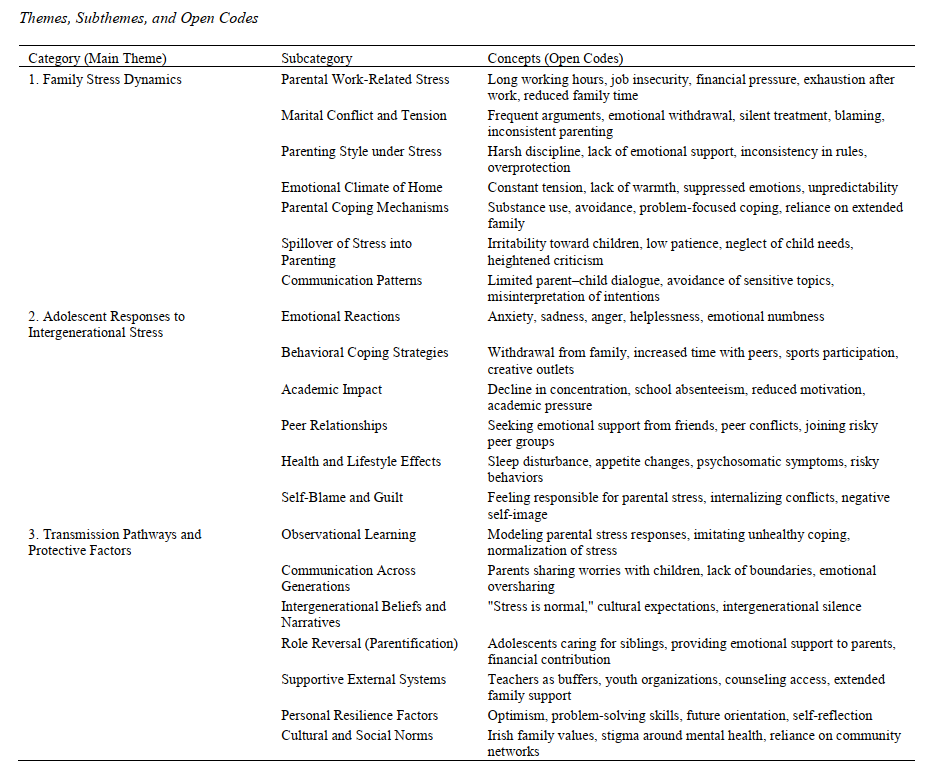
Findings: Three overarching themes emerged from the analysis. The first, family stress dynamics, captured the spillover of parental work stress, marital conflict, and parental coping strategies into the home environment, shaping parenting practices and communication patterns. The second, adolescent responses to stress, included emotional reactions such as anxiety, sadness, and guilt, as well as behavioral outcomes including withdrawal, academic decline, risky peer relationships, and health complaints. The third, transmission pathways and protective factors, highlighted observational learning, role reversal, and cultural narratives as mechanisms of stress transfer, while also identifying personal resilience, external supports, and family warmth as protective buffers. Adolescents’ voices emphasized both the risks of internalizing parental stress and the potential for resilience-building interventions.
Conclusion: The study demonstrates that intergenerational transmission of stress is a multifaceted process shaped by family functioning, communication patterns, cultural narratives, and resilience mechanisms. While family conflict and parental distress intensify adolescent vulnerability, protective factors such as resilience and external supports mitigate adverse outcomes. These findings underscore the need for family-centered and culturally sensitive interventions to disrupt cycles of stress transmission and promote adolescent well-being.
Downloads
References
Alpysbekova, A., Lee, S. W., Scaramutti, C., Bochkina, E. V., Lee, T. K., Cobb, C. L., Montero‐Zamora, P., Vo, D. H., Sahbaz, S., Ertanir, B., Watkins, L., Gualdron, E. O., Benish‐Weisman, M., Ohana, H., Elizarov, E., & Schwartz, S. J. (2025). Navigating Cultural Stress and Mental Health: A Longitudinal Study of Parent‐Adolescent Dynamics Among Former Soviet Union Families. Journal of adolescence. https://doi.org/10.1002/jad.12522
Bjørndal, L. D., Ebrahimi, O. V., & Bauermeister, S. (2024). The Dynamic Interplay Between Mental Health Difficulties and the Family Environment in Early Adolescence. https://doi.org/10.31234/osf.io/9j4hp
Boele, S., Bülow, A., Beltz, A. M., Haan, A. D. d., Denissen, J. J. A., & Keijsers, L. (2023). Who Influences Whom? The Directionality of Effects Between Parenting and Adolescent Affective Well-Being in Everyday Life Is Family Specific. https://doi.org/10.31234/osf.io/8uw93
Chen, J.-H., Huang, C.-H., Wu, C. F., Jonson‐Reid, M., & Drake, B. (2023). The Application of Family Stress Model to Investigating Adolescent Problematic Behaviors: The Moderating Role of Assets. Journal of Family and Economic Issues, 45(1), 174-183. https://doi.org/10.1007/s10834-023-09902-2
Chronopoulou, N., Zaravinos-Tsakos, F., Kolaitis, G., & Giannakopoulos, G. (2025). Maternal Psychopathology and Family Functioning as Predictors of Externalizing Behavior in Adolescents: A Cross-Sectional Study in Greece. Adolescents, 5(2), 17. https://doi.org/10.3390/adolescents5020017
Dahlia, I., & Hastuti, D. (2022). Family Climate, Perception, and Adolescents' Stress Prior to and During Covid-19 Pandemic. Journal of Child Family and Consumer Studies, 1(2), 60-70. https://doi.org/10.29244/jcfcs.1.2.60-70
Danilova, M. (2023). Adolescents’ Hardiness and the Ways to Respond to Stressful Situations in Relation to Child-Parent Relationship. National Psychological Journal, 49(1), 32-43. https://doi.org/10.11621/npj.2023.0103
Hamza, E. A., Gladding, S. T., & Moustafa, A. A. (2021). The Impact of Adolescent Substance Abuse on Family Quality of Life, Marital Satisfaction, and Mental Health in Qatar. The Family Journal, 30(1), 85-90. https://doi.org/10.1177/10664807211000720
Handayani, A. (2025). Mothers’ Parenting of Adolescents in the VUCA Era: A Phenomenological Analysis. Jurnal Konseling dan Pendidikan, 13(2), 48-63. https://doi.org/10.29210/1148500
Maglica, T., Ercegovac, I. R., & Ljubetić, M. (2021). Family Characteristics as Determinants of Mental Health in Adolescents. European Journal of Mental Health, 16(2), 7-30. https://doi.org/10.5708/ejmh.16.2021.2.1
Maulina, Y., Fitriani, W., Yeni, P., & Maharjan, K. (2024). Analysis Dynamics of Adolescents' Lack of Openness to Parents: A Qualitative Study. Agenda Jurnal Analisis Gender Dan Agama, 6(2), 103. https://doi.org/10.31958/agenda.v6i2.12823
Meanley, S., Flores, D. D., Listerud, L., Chang, C. J., Feinstein, B. A., & Watson, R. J. (2021). The Interplay of Familial Warmth and LGBTQ+ Specific Family Rejection on LGBTQ+ Adolescents’ Self‐esteem. Journal of adolescence, 93(1), 40-52. https://doi.org/10.1016/j.adolescence.2021.10.002
Novak, M., Parr, N. J., Ferić, M., Mihić, J., & Kranželić, V. (2021). Positive Youth Development in Croatia: School and Family Factors Associated With Mental Health of Croatian Adolescents. Frontiers in psychology, 11. https://doi.org/10.3389/fpsyg.2020.611169
Okońska, A., Hakało, D., Ignatiuk-Chilkiewicz, M., Kałuska, J., Jelska, W., Kozakiewicz, J., Ziemba, M., & Kiślak, M. (2025). Risk Factors for Depression in Adolescents. Quality in Sport, 39, 58314. https://doi.org/10.12775/qs.2025.39.58314
Pizarro, K. W., Surkan, P. J., & Bustamante, I. V. (2020). The Social Ecology of Parental Monitoring: Parent–Child Dynamics in a High‐Risk Peruvian Neighborhood. Family Process, 60(1), 199-215. https://doi.org/10.1111/famp.12542
Rahimi, V. A., Babapour, J., Khanjani, Z., Hashemi, T., & Rudsari, A. B. (2024). The Structural Relationships Between Family Functioning, Positive Development, Psychological Distress and Social Media Addiction With the Mediating of Cognitive Emotion Regulation Strategies in Adolescents. Depiction of Health, 15(3), 341-357. https://doi.org/10.34172/doh.2024.26
Rahman, R. A., & Paryontri, R. A. (2023). Stress Coping in Adolescents Who Have Disharmonious Families in Sidoarjo. Indonesian Journal of Education Methods Development, 21(4). https://doi.org/10.21070/ijemd.v21i4.795
Rayan, A., Harb, A., Baqeas, M. H., Al.khashashneh, O. Z., & Harb, E. (2022). The Relationship of Family and School Environments With Depression, Anxiety, and Stress Among Jordanian Students: A Cross-Sectional Study. Sage Open Nursing, 8. https://doi.org/10.1177/23779608221138432
Rudolphi, J. M., & Berg, R. L. (2023). Mental Health of Agricultural Adolescents and Adults: Preliminary Results of a Five-Year Study. Frontiers in Public Health, 11. https://doi.org/10.3389/fpubh.2023.1056487
Windarwati, H. D., Budiman, A. A., Nova, R., Ati, N. A. L., & Kusumawati, M. W. (2020). The Relationship Between Family Harmony With Stress, Anxiety, and Depression in Adolescents. Jurnal Ners, 15(2), 185-193. https://doi.org/10.20473/jn.v15i2.21495
Wong, R. S., Tung, K. T. S., Li, X., Chui, C. S. L., Tso, W. W. Y., Lee, T. M., Chan, K. L., Wing, Y. K., Fu, K. W., Wong, I. C. K., & lp, P. (2022). Examining Family Pre-Pandemic Influences on Adolescent Psychosocial Wellbeing During the COVID-19 Pandemic. Current Psychology, 43(13), 12034-12044. https://doi.org/10.1007/s12144-022-02736-5
Yang, L., Tsai, Y.-L., Yang, P.-L., Lu, C. C., Liaw, J. J., & Lan, H. Y. (2023). Path Analysis of the Effects of Life Stress and Social Support on Rural Adolescents' Quality of Life in Taiwan. Journal of Medical Sciences, 43(2), 67-73. https://doi.org/10.4103/jmedsci.jmedsci_7_22
Yang, Y., Liu, Q., & Wang, Z. (2025). The Relationship Between Family Functioning and Adolescents' Symptoms of Generalized Stress Response: The Mediating Roles of Character Strengths and Perceived Stress. Journal of adolescence. https://doi.org/10.1002/jad.12485
Yu, L., Zhou, X. H., Shek, D. T. L., & Wang, Y. (2025). Family Resilience and Adolescent Mental Health in Chinese Families: The Mediating Role of Personal Strengths. Applied Research in Quality of Life. https://doi.org/10.1007/s11482-025-10453-x
Downloads
Additional Files
Publication Timeline
- Submitted
- Revised
- Accepted
Issue
Section
License
Copyright (c) 2025 Armin Khadem Fini (Author); Seyed Milad Saadati (Corresponding Author); Sergii Boltivets (Author)

This work is licensed under a Creative Commons Attribution-NonCommercial 4.0 International License.