Exploring the Role of Peer Collaboration in Enhancing Adolescent Motivation to Learn
DOI:
https://doi.org/10.61838/kman.jarac.4495Keywords:
Peer collaboration, Adolescent motivation, Qualitative research, Peer-assisted learningAbstract
Objective: The objective of this study was to explore how peer collaboration contributes to enhancing motivation to learn among adolescents in Malaysian secondary schools.
Methods and Materials: This research employed a qualitative design with an exploratory approach to capture adolescents’ lived experiences of peer collaboration. A total of 29 participants (15 females and 14 males) aged 13–17 years were recruited using purposive sampling to ensure diversity in academic performance and background. Data were collected through semi-structured interviews guided by open-ended questions on peer interactions, motivational influences, challenges, and facilitators of collaboration. Interviews were conducted face-to-face and online, lasting between 45 and 60 minutes each, until theoretical saturation was reached. All interviews were transcribed verbatim and analyzed thematically using NVivo 14 software, following iterative cycles of coding, categorization, and theme development.
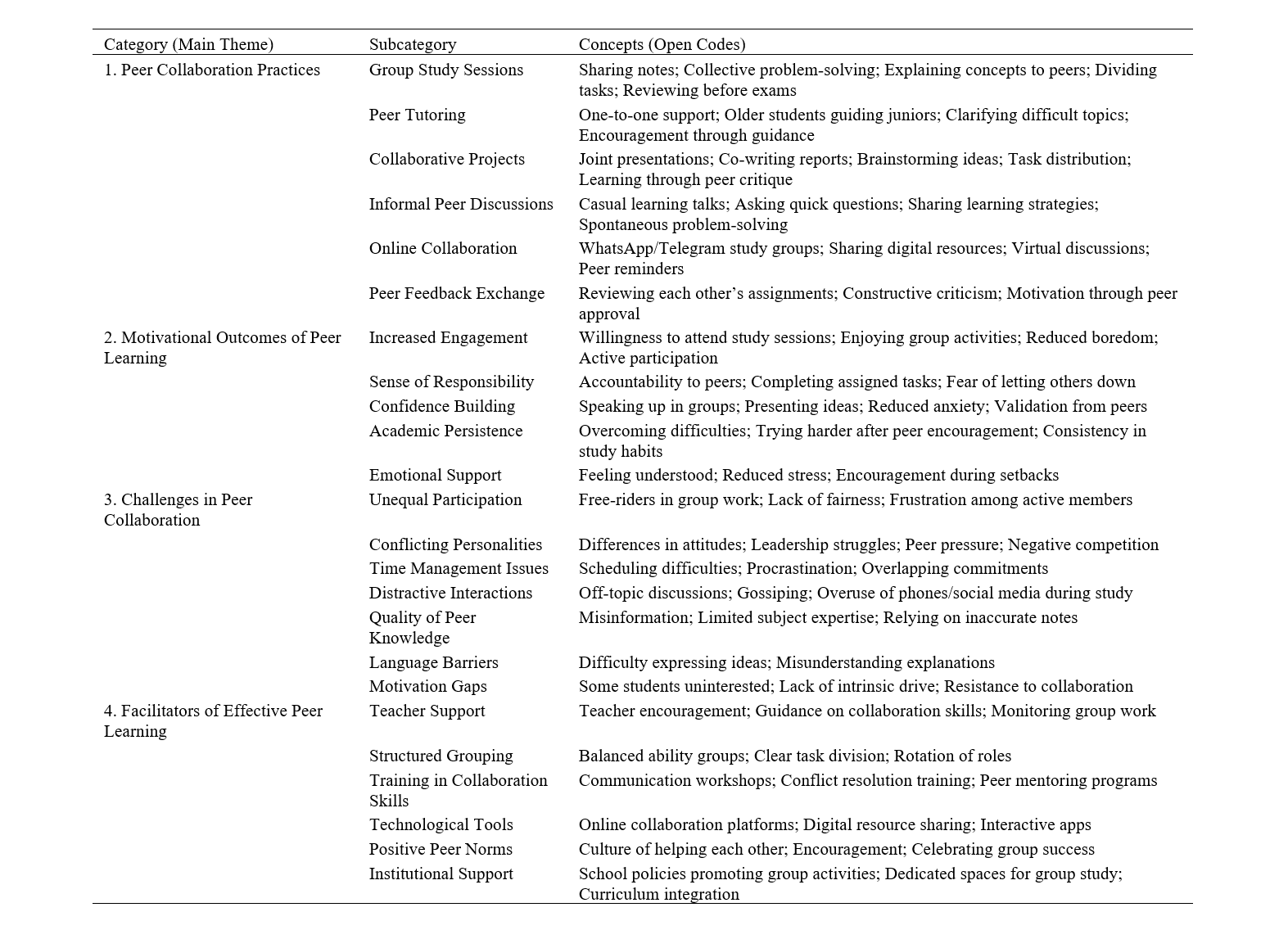
Findings: Analysis revealed four major themes with multiple subthemes. First, peer collaboration practices included group study sessions, peer tutoring, collaborative projects, informal peer discussions, online collaboration, and peer feedback exchange. Second, motivational outcomes of collaboration involved increased engagement, sense of responsibility, confidence building, academic persistence, and emotional support. Third, challenges to peer collaboration were identified as unequal participation, conflicting personalities, time management difficulties, distractive interactions, misinformation, language barriers, and motivational gaps. Finally, facilitators of effective peer learning included teacher support, structured grouping, collaboration skill training, technological tools, positive peer norms, and institutional support. Participants’ narratives highlighted both the empowering and constraining aspects of peer collaboration in shaping motivation.
Conclusion: The study concludes that peer collaboration is a powerful driver of adolescent motivation to learn, operating through academic, emotional, and social pathways. However, its effectiveness is contingent on the quality of peer relationships, structural support from teachers and institutions, and the ability to manage challenges within collaborative contexts. Practical implications include the need for structured facilitation, training in collaboration skills, and leveraging digital tools to optimize motivational benefits.
Downloads
References
Ali, N., Kulsoom, S., & Younas, Z. (2025). Contextual Learning as a Catalyst for Enhancing Intrinsic Motivation in Secondary School Students. Journal of Social & Organizational Matters, 4(2), 27-44. https://doi.org/10.56976/jsom.v4i2.204
Amemiya, J., & Wang, M. T. (2016). Transactional Relations Between Motivational Beliefs and Help Seeking From Teachers and Peers Across Adolescence. Journal of youth and adolescence, 46(8), 1743-1757. https://doi.org/10.1007/s10964-016-0623-y
Ayhan, A. B., Beyazıt, U., & Yurdakul, Y. (2019). An Examination of the Relationship Between Peer Bullying and Academic Motivation in Secondary School Students. https://doi.org/10.33422/ics21.2019.07.364
Cummings, D. J., & Sheeran, N. (2019). Do Academic Motivation and Personality Influence Which Students Benefit the Most From Peer-Assisted Study Sessions? Psychology Learning & Teaching, 18(3), 244-258. https://doi.org/10.1177/1475725719840502
Engels, D., Haupt, C., Kugelmann, D., & Dethleffsen, K. (2021). The Peer Teachers’ Perception of Intrinsic Motivation and Rewards. Ajp Advances in Physiology Education, 45(4), 758-768. https://doi.org/10.1152/advan.00023.2021
Fahriza, I., Baitillah, N., Aini, N. Q., & Rayaginansih, S. F. (2023). Trend of Academic Flow in Adolescence. Journal of Education and Counseling (Jeco), 1-7. https://doi.org/10.32627/jeco.v3i1.649
Fanaqi, C., Nurkalam, F., Tias, D. A., Syahputri, S. D., & Octaviani, N. (2020). Komunikasi Kesehatan Bagi Pelajar Dengan Pendekatan Peer Education. Yumary Jurnal Pengabdian Kepada Masyarakat, 1(1), 1-9. https://doi.org/10.35912/jpm.v1i1.62
Febriyani, S., Firman, A., Prastyo, W. T., Zamzami, Z., & Wiskarni, W. (2022). Hubungan Conformity Dengan Motivasi Belajar Siswa Kelas X SMKN 2 Kota Solok. Pakar Pendidikan, 20(1), 108-117. https://doi.org/10.24036/pakar.v20i1.266
Fitri, N., & Astuti, R. (2024). The Power of Peers Unleashed in Motivating Elementary Learning Around the World. Indonesian Journal of Innovation Studies, 25(2). https://doi.org/10.21070/ijins.v25i2.1099
Jagenow, D., Raufelder, D., & Eid, M. (2015). The Development of Socio-Motivational Dependency From Early to Middle Adolescence. Frontiers in psychology, 6. https://doi.org/10.3389/fpsyg.2015.00194
Juvina, I., Carson, J., Menke, P., & Crowe, P. (2022). Knowledge Spillover, Trust, Effort, and Error Exposure in Peer-Assisted Learning. https://doi.org/10.31234/osf.io/4rp6y
Juvina, I., Carson, J., Menke, P., Crowe, P., Wong, C. H., & McNett, H. (2025). Knowledge Spillover, Trust, Effort, and Error Exposure in Peer‐Assisted Learning. Topics in Cognitive Science. https://doi.org/10.1111/tops.70009
Knickenberg, M. (2025). Examining Students' Current Academic Motivation in Relation to Peer Interactions and Social Environment in the Classroom Using the Experience Sampling Method. British Journal of Educational Psychology. https://doi.org/10.1111/bjep.70002
Knox, P. (2024). Examining the Influence and Implications of Peer Relationships on the Academic Motivation and College and Career Readiness of Rural Adolescents. Theory & Practice in Rural Education, 14(1), 73-98. https://doi.org/10.3776/tpre.2024.v14n1p73-98
Kong, K. H., & Kong, W. (2024). The Role of Self-Efficacy in Motivating Middle School Students' Learning. International Journal of Education and Humanities, 17(1), 273-275. https://doi.org/10.54097/qsq0q663
Lee, J. (2022). Structural Relationships Between Cognitive Achievement and Learning-Related Factors Among South Korean Adolescents. Journal of Intelligence, 10(4), 81. https://doi.org/10.3390/jintelligence10040081
Mitola, R. (2017). Peer-Assisted Learning in Academic Libraries. https://doi.org/10.5040/9798400695896
Moradi, S., & Mardani, F. (2023). The Impact of Peer Attachment on Academic Motivation: A Quantitative Analysis. KMAN Counsel and Psych Nexus, 1(2), 4-9. https://doi.org/10.61838/kman.psynexus.1.2.2
Nisak, C., Munir, Z., & Hafifah, V. N. (2024). Hubungan Tingkat Stress Dengan Motivasi Belajar Mahasiswa Fakultas Kesehatan Dalam Pembelajaran Online Pada Masa Pandemi Covid-19 Di Universitas Nurul Jadid Paiton Kabupaten Probolinggo. Trilogi Jurnal Ilmu Teknologi Kesehatan Dan Humaniora, 5(3). https://doi.org/10.33650/trilogi.v5i3.8975
Nuryana, I. K. D., & Wahyuni, D. (2025). The Role of Learning Motivation in Mediating the Influence of Self-Regulated Learning and Peer Social Support on Academic Burnout in Grade XI Boarding School Students at Madrasah Aliyah, Sleman Regency. Ijems, 2(1), 219-237. https://doi.org/10.61132/ijems.v2i1.451
Pipitcahyani, T. (2025). Peer Relationships With Achievement Events: Cross Sectional Approach. Public Health of Indonesia, 11(2), 43-50. https://doi.org/10.36685/phi.v11i2.926
Rachmawati, N. S. A., Nurlaili, E. I., & Dewi, R. M. (2024). Peer Relationships, Academic Motivation, Academic Self-Efficacy, and Student Achievement: Moderated Mediation Model. Dinamika Pendidikan, 19(1), 77-93. https://doi.org/10.15294/dp.v19i1.2680
Ratumbuisang, L. W., Mardi, & Zulaihati, S. (2024). Parental Support and Peer Environment on Academic Achievement Through Learning Motivation Mediation. Jurnal Pendidikan Ekonomi Perkantoran Dan Akuntansi, 5(1), 185-196. https://doi.org/10.21009/jpepa.0501.18
Shao, Y., & Kang, S. (2022). The Association Between Peer Relationship and Learning Engagement Among Adolescents: The Chain Mediating Roles of Self-Efficacy and Academic Resilience. Frontiers in psychology, 13. https://doi.org/10.3389/fpsyg.2022.938756
Shao, Y., Kang, S., Lu, Q., Zhang, C., & Li, R. (2024). How Peer Relationships Affect Academic Achievement Among Junior High School Students: The Chain Mediating Roles of Learning Motivation and Learning Engagement. BMC psychology, 12(1). https://doi.org/10.1186/s40359-024-01780-z
Sheffler, P., & Cheung, C. (2023). Growth Mindset and Social Comparison Effects in a Peer Virtual Learning Environment. Social Psychology of Education, 27(2), 493-521. https://doi.org/10.1007/s11218-023-09850-7
Siska, D., & Hanif, M. m. (2024). Peran Teman Sebaya Dalam Menyelesaikan Tugas Kuliah Mahasiswa Semester 3 PAI UIN Gusdur. Mutiara, 2(6), 53-62. https://doi.org/10.59059/mutiara.v2i6.1733
Yulianda, M., & Syofyan, R. (2018). Pengaruh Motivasi Belajar, Teman Sebaya Terhadap Prokratinasi Akademik Dan Prestasi Belajar Mahasiswa Pendidikan Ekonomi Universitas Negeri Padang. Jurnal Ecogen, 1(2), 450. https://doi.org/10.24036/jmpe.v1i2.4767
Макарова, Е. А. (2018). Teaching Foreign Language Speaking Skills Through Peer-Tutoring. Integration of Education(3), 551-568. https://doi.org/10.15507/1991-9468.092.022.201803.551-568
Downloads
Additional Files
Publication Timeline
- Submitted
- Revised
- Accepted
Issue
Section
License
Copyright (c) 2025 Ye Mu (Author); Pei-Yin Shin (Corresponding Author); Qi Shen (Author)

This work is licensed under a Creative Commons Attribution-NonCommercial 4.0 International License.