The Counseling Relationship Assessment Measure (CRAM): Initial Validation and Psychometric Properties
DOI:
https://doi.org/10.61838/kman.jarac.4536Keywords:
Relationship Assessment, Framework Consensus, Collaborative Motivation, Collaborative ActionAbstract
Purpose: A new assessment of the counseling relationship is presented, which is needed given the limitations of current assessments in the literature.
Method: The research team developed 100 items to assess these three factors from the perspective of the counselor (50 items) and the client (50 items) then had 12 professional counselors serve as content validity judges. Based on their feedback, several items were deleted or modified. The modified assessment measures were then sent to 168 counselors and to 252 clients. Exploratory Structural Equation Modeling (ESEM) and then Confirmatory Factor Analysis (CFA) were used to examine their factors structure.
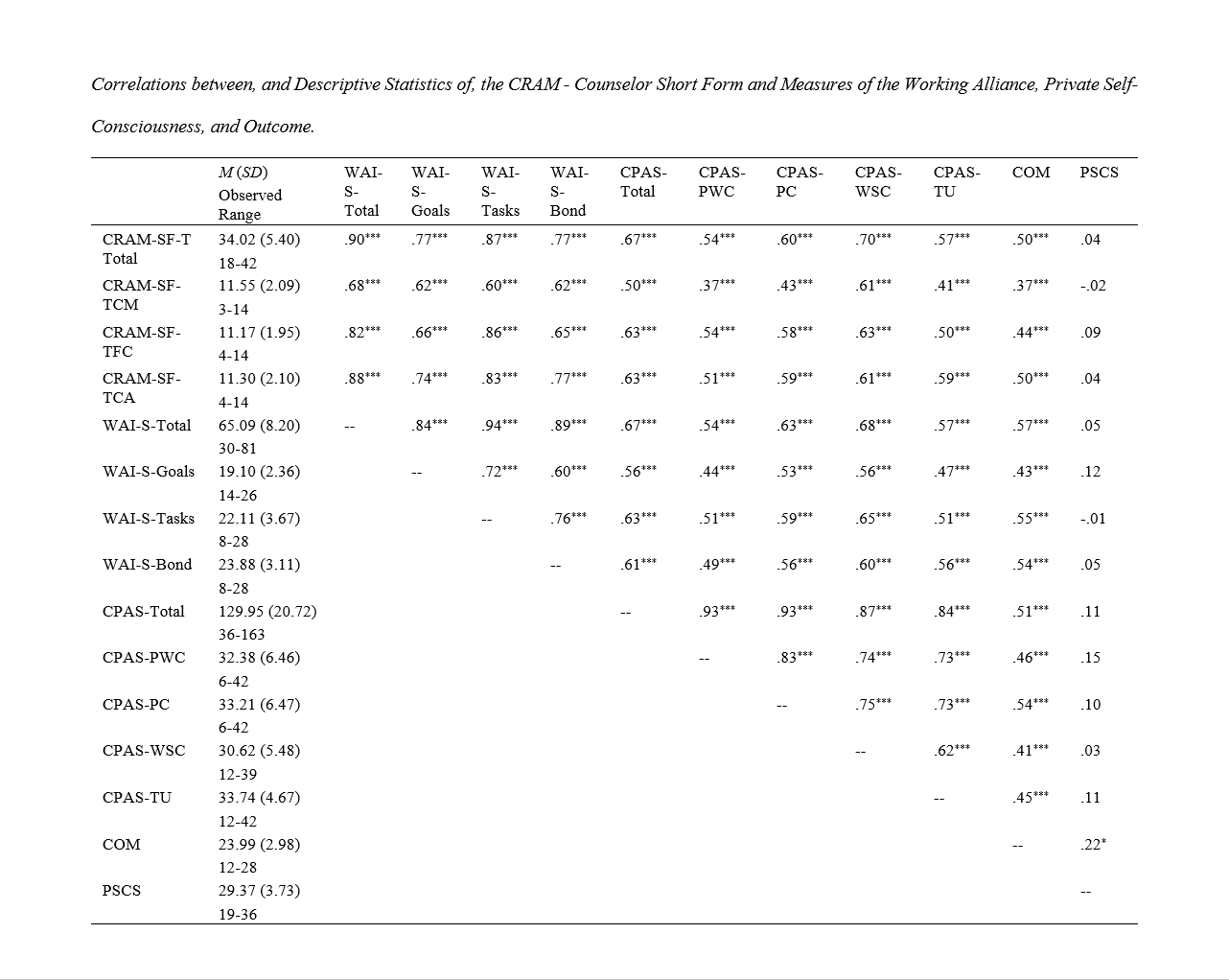
Results: Analyses yielded two 6 items versions of the assessment measure (i.e., client and counselor forms), comprised of the underlying constructs of Frame Consensus, Collaborative Motivation, and Collaborative Action. Both forms displayed strong psychometric properties indicative of reliability and validity.
Conclusions: The new measure can be used as a complement to or as an alternative to existing measures of the counseling relationship in research or practice.
Downloads
References
Asparouhov, T., & Muthén, B. (2009). Exploratory structural equation modeling. Structural Equation Modeling: A Multidisciplinary Journal, 16(3), 397-438. https://doi.org/10.1080/10705510903008204
Bordin, E. S. (1979). The generalizability of the psychoanalytic concept of the working alliance. Psychotherapy: Theory, Research & Practice, 16(3), 252-260. https://doi.org/10.1037/h0085885
Browne, V., & Cudeck, R. (1993). Alternative Ways of Assessing Model Fit. In K. A. Bollen & J. S. Long (Eds.), Testing Structural Equation Models (pp. 136-162). Sage. https://books.google.com/books?hl=en&lr=&id=FvIxxeYDLx4C&oi=fnd&pg=PA136&dq=Browne,+V.+and+R.+Cudeck+(1993).+Alternative+Ways+of+Assessing+Model+Fit.+Testing+Structural+Equation+Models.+K.+A.+Bollen+and+J.+S.+Long,+Sage:+136-162.+%09&ots=_O-BG2SzAJ&sig=DJI0RK1xe8ulZ5kId7btOBHsvUE
Chandler, J., Rosenzweig, C., Moss, A. J., & et al. (2019). Online panels in social science research: Expanding sampling methods beyond Mechanical Turk. Behavioral Research, 51, 2022-2038. https://doi.org/10.3758/s13428-019-01273-7
Cohen, J. (1992). A power primer. Psychological bulletin, 112(1), 155-159. https://doi.org/10.1037/0033-2909.112.1.155
Comrey, A., & Lee, H. (1992). A First Course in Factor Analysis. Hillsdale, NJ: Erlbaum. https://www.taylorfrancis.com/books/mono/10.4324/9781315827506/first-course-factor-analysis-andrew-comrey-howard-lee
Doukani, A., Quartagno, M., Sera, F., Free, C., Kakuma, R., Riper, H., Kleiboer, A., Cerga-Pashoja, A., van Schaik, A., Botella, C., Berger, T., Chevreul, K., Matynia, M., Krieger, T., Hazo, J. B., Draisma, S., Titzler, I., Topooco, N., Mathiasen, K., . . . Araya, R. (2024). Comparison of the Working Alliance in Blended Cognitive Behavioral Therapy and Treatment as Usual for Depression in Europe: Secondary Data Analysis of the E-COMPARED Randomized Controlled Trial. J Med Internet Res, 26, e47515. https://doi.org/10.2196/47515
Flückiger, C., Re, A. C. D., Wampold, B. E., & Horvath, A. O. (2018). The alliance in adult psychotherapy: A meta-analytic synthesis. Psychotherapy, 55(4), 316-340. https://doi.org/10.1037/pst0000172
Fuertes, J. N., Moore, M. T., & Pagano-Stalzer, C. C. (2020). Consensus and Collaboration in the Working Alliance. In J. Fuertes (Ed.), Working Alliance Skills for Mental Health Professionals (pp. 91-109). Oxford University Press. https://doi.org/10.1093/med-psych/9780190868529.003.0005
Gaston, L., & Marmar, C. (1994). The California Psychotherapy Alliance Scales
The Working Alliance: Theory, Research, and Practice. Wiley. https://psycnet.apa.org/record/1994-97518-004
Gelso, C. J. (2006). Working alliance: Current status and future directions: Editor's introduction. Psychotherapy: Theory, Research, Practice, Training, 43(3), 257-257. https://doi.org/10.1037/0033-3204.43.3.257
Gelso, C. J. (2011). The Real Relationship in Psychotherapy: The Hidden Foundation of Change. Washington, DC: American Psychological Association. https://doi.org/10.1037/12349-000
Gelso, C. J. (2019). The Therapeutic Relationship in Psychotherapy Practice: An Integrative Perspective. Taylor & Francis. https://doi.org/10.4324/9781315658063
Gelso, C. J., & Hayes, J. A. (1998). The Psychotherapy Relationship: Theory, Research, and Practice. Wiley.
Gelso, C. J., & Johnson, D. H. (1983). Explorations in Time-Limited Counseling and Psychotherapy. New York: Columbia University, Teachers College Press. https://cir.nii.ac.jp/crid/1130282270573741056
Hatcher, R. L., & Barends, A. W. (2006). How a return to theory could help alliance research. Psychotherapy: Theory, Research, Practice, Training, 43(3), 292-299. https://doi.org/10.1037/0033-3204.43.3.292
Hill, C. E. (2014). Helping Skills: Facilitating Exploration, Insight, and Action (4th ed.). APA. https://doi.org/10.1037/14345-000
Hu, L. T., & Bentler, P. M. (1999). Cutoff criteria for fit indexes in covariance structure analysis: Conventional criteria versus new alternatives. Structural Equation Modeling: A Multidisciplinary Journal, 6(1), 1-55. https://doi.org/10.1080/10705519909540118
Mallinckrodt, B. (2022). Clients' experiences of attachment in the psychotherapy relationship. In J. N. Fuertes (Ed.), The Other Side of Psychotherapy: Understanding Clients' Experiences and Contributions in Treatment (pp. 125-158). American Psychological Association. https://doi.org/10.1037/0000303-006
Mercadal, J., Coromina, L., & Cabré, V. (2025). Effectiveness and therapeutic alliance between face-to-face and online psychological interventions: A longitudinal study. Frontiers in Psychology, 16, 1624438. https://doi.org/10.3389/fpsyg.2025.1624438
Muthén, L. K., & Muthén, B. O. (2017). Mplus: Statistical Analysis with Latent Variables: User's Guide (Version 8). Los Angeles, CA: Authors.
Nystedt, L., & Ljungberg, A. (2002). Facets of private and public self‐consciousness: construct and discriminant validity. European Journal of Personality, 16(2), 143-159. https://doi.org/10.1002/per.440
Oliveira, J. T., Gómez-Penedo, J. M., & grosse Holtforth, M. (2022). Understanding and Enhancing Client Motivation. In J. N. Fuertes (Ed.), The Other Side of Psychotherapy: Understanding Clients' Experiences and Contributions. American Psychological Association. https://doi.org/10.1037/0000303-003
Opland, C., & Torrico, T. J. (2024). Psychotherapy and Therapeutic Relationship. StatPearls Publishing. https://www.ncbi.nlm.nih.gov/books/NBK608012/
Prochaska, J. O., & Norcross, J. C. (2018). Systems of Psychotherapy: A Transtheoretical Analysis (9th ed.). Oxford University Press.
Prochaska, J. O., Norcross, J. C., & DiClemente, C. C. (1995). Changing for Good. HarperCollins.
Safran, J. D., & Muran, J. C. (2006). Has the concept of the therapeutic alliance outlived its usefulness? Psychotherapy: Theory, Research, Practice, Training, 43, 286-291. https://doi.org/10.1016/B978-012088416-2/50003-7
Scheier, M. F., & Carver, C. S. (2013). Self-Consciousness Scale--(SCS-R). Measurement Instrument Database for the Social Science. www.midss.ie
Tracey, T. J., & Kokotovic, A. M. (1989). Factor structure of the Working Alliance Inventory. Psychological Assessment: A Journal of Consulting and Clinical Psychology, 1, 207-210. https://doi.org/10.1037/0022-0167.35.3.330
Wampold, B. E., & Imel, Z. E. (2015). The Great Psychotherapy Debate: The Evidence for What Makes Psychotherapy Work (2nd ed.). Routledge. https://doi.org/10.4324/9780203582015
Westermann, S., grosse Holtforth, M., & Michalak, J. (2019). Motivation in Psychotherapy. In R. M. Ryan (Ed.), The Oxford Handbook of Human Motivation (pp. 417-462). Oxford University Press, Inc. https://doi.org/10.1093/oxfordhb/9780190666453.013.23
Downloads
Additional Files
Publication Timeline
- Submitted
- Revised
- Accepted