AI Anxiety and Technostress: The Buffering Role of Growth Mindset
DOI:
https://doi.org/10.61838/kman.jarac.4802Keywords:
AI anxiety, technostress, growth mindset, psychological resilience, structural equation modeling, South AfricaAbstract
Objective: This study aimed to examine the relationship between AI anxiety and technostress among South African technology users and to determine whether a growth mindset moderates the impact of AI anxiety on technostress.
Methods and Materials: A descriptive correlational design was applied with a sample of 440 participants recruited across various professional and academic sectors in South Africa, selected based on the Morgan and Krejcie sampling table to ensure adequate statistical power. Data were collected using standardized instruments: the Technostress Creators Scale (TCS), the AI Anxiety Scale (AIAS), and the Implicit Theories of Intelligence Scale to measure growth mindset. Descriptive statistics were calculated, and Pearson’s correlation examined relationships between variables. Structural Equation Modeling (SEM) with maximum likelihood estimation was performed using AMOS 21 to test the hypothesized moderating effect of growth mindset on the AI anxiety–technostress link.
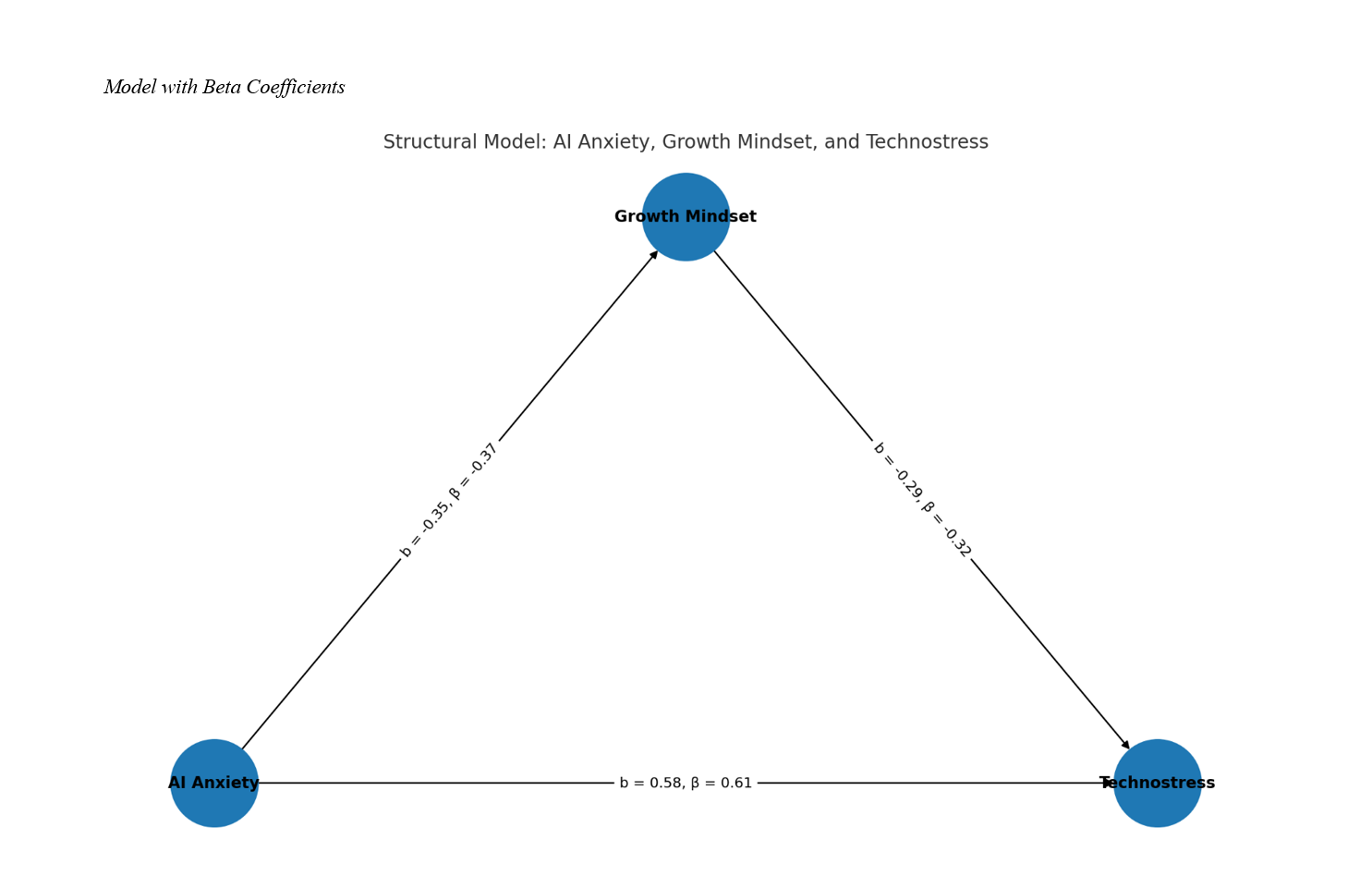
Findings: AI anxiety demonstrated a strong, positive correlation with technostress (r = .63, p < .001), whereas growth mindset was negatively correlated with both technostress (r = –.42, p < .001) and AI anxiety (r = –.47, p < .001). The SEM analysis yielded excellent fit indices (χ²/df = 2.20, GFI = .93, AGFI = .91, CFI = .96, TLI = .95, RMSEA = .052). AI anxiety had a significant positive direct effect on technostress (β = .61, p < .001), while growth mindset showed a significant negative direct effect (β = –.32, p < .001). A significant indirect effect of AI anxiety on technostress through growth mindset (β = –.11, p < .001) confirmed the moderating role of growth mindset.
Conclusion: Findings highlight AI anxiety as a critical predictor of technostress and demonstrate that fostering a growth mindset can meaningfully buffer the psychological strain associated with AI-driven environments.
Downloads
References
Boyer-Davis, S., Berry, K., & Cooper, A. (2023). The Effect of Technostress on the Motivation to Teach Online in Higher Education Before and During the COVID-19 Pandemic: Perceptions of Business Faculty. International Journal for Business Education, 165(1). https://doi.org/10.30707/ijbe165.1.1690384197.882912
Butnaru, A. M., Scaioli, G., Lodin, M., Toffanin, C., Cataldo, A., Moro, G. L., Bert, F., & Siliquini, R. (2024). Digital Communication and Techno-Stress Among Health Professionals: A Cross-Sectional Study in Italy. European journal of public health, 34(Supplement_3). https://doi.org/10.1093/eurpub/ckae144.1184
Callado, M. L., Arandilla, C. M., & Macalingang, M. R. (2025). Factors of Techno-Stress and Job Performance of Library Professionals in Municipalities of PPALMA. Pemj, 39(8), 1062-1071. https://doi.org/10.70838/pemj.390807
Elcano, C. K. J. (2025). Impact of Technostress on Job Satisfaction of Laguna State Polytechnic University Faculty. International Journal of Research and Innovation in Social Science, IX(III), 4106-4115. https://doi.org/10.47772/ijriss.2025.90300328
Enggriani, Y. T., Handiyani, H., & Kuntarti, K. (2025). Technostress Pada Perawat Dan Instrumen Pengukurannya: Tinjauan Sistematis. Holistik Jurnal Kesehatan, 19(2), 392-402. https://doi.org/10.33024/hjk.v19i2.863
Gupta, P., Lakhera, G., Sharma, M., & Joshi, S. K. (2024). Health Economics and Sustainability in the Era of Digital Transformation. 241-266. https://doi.org/10.4018/979-8-3373-0240-9.ch011
Issa, H., Lakkis, H., Dakroub, R., & Jaber, J. (2023). Examining User Engagement and Experience in Agritech. International Journal of Contemporary Management, 59(2), 17-32. https://doi.org/10.2478/ijcm-2023-0003
Kaltenegger, H. C., Becker, L., Rohleder, N., Nowak, D., Quartucci, C., & Weigl, M. (2023). Associations of Technostressors at Work With Burnout Symptoms and Chronic Low-Grade Inflammation: A Cross-Sectional Analysis in Hospital Employees. International Archives of Occupational and Environmental Health, 96(6), 839-856. https://doi.org/10.1007/s00420-023-01967-8
Mondo, M., Pileri, J., Barbieri, B., Bellini, D., & Simone, S. D. (2023). The Role of Techno-Stress and Psychological Detachment in the Relationship Between Workload and Well-Being in a Sample of Italian Smart Workers: A Moderated Mediated Model. Social Sciences, 12(10), 530. https://doi.org/10.3390/socsci12100530
Persia, L. R., & Chariuni, D. (2025). Tekanan Komunikasi Digital Dalam Pengelolaan Media Sosial Pemerintah Kota Bogor Dalam Implementasi Keterbukaan Informasi Publik. Jurnal Penelitian Inovatif, 5(3), 1939-1946. https://doi.org/10.54082/jupin.1608
Qiong, W., & Zhao, G. (2023). Exploring the Influence of Technostress Creators on In‐service Teachers' Attitudes Toward ICT and ICT Adoption Intentions. British Journal of Educational Technology, 54(6), 1771-1789. https://doi.org/10.1111/bjet.13315
Ram, R., & Kannaujiya, P. S. (2025a). A Study of Relationship Techno Stress and Well Being Among Primary School Teachers. The Voice of Creative Research, 7(1), 248-255. https://doi.org/10.53032/tvcr/2025.v7n1.28
Ram, R., & Kannaujiya, P. S. (2025b). A Study of the Relationship Between Techno Stress and Well-Being Among Primary School Teachers. The Voice of Creative Research, 7(1), 317-324. https://doi.org/10.53032/tvcr/2025.v7n1.36
Rosado, M. E. B., Suárez, L. M. C., Gino Félix Dodero Ortiz de, Z., & Espinosa‐Cristia, J. F. (2023). Technostress at Work During the COVID-19 Lockdown Phase (2020–2021): A Systematic Review of the Literature. Frontiers in psychology, 14. https://doi.org/10.3389/fpsyg.2023.1173425
Rošková, E., Schraggerová, M., Urukovičová, N., & Smoroň, J. (2023). Regulating Role of Technostressors and Personality in Prediction of Engagement and Burnout at Work. https://doi.org/10.33542/ppo-0265-7-08
Sabzwari, M., Suqlain, S., & Khan, F. (2023). Exploring the Role of Techno-Stress in Job Performance of Academic Librarians of Lahore Pakistan. Pakistan Journal of Humanities and Social Sciences, 11(3). https://doi.org/10.52131/pjhss.2023.1103.0629
Sadaf, S. (2025). Does Technostress Undermine Employees’ Work-Life Balance? Testing the Moderated-Mediation Effects of Employee Resilience And psychological Distress. Asia-Pacific Journal of Business Administration, 1-20. https://doi.org/10.1108/apjba-08-2024-0447
Techmanska, A., Ortner, E., & Stöckmann, C. (2024). Mastering Computing in the Presence of Functional vs. Emotional Technostress: The Moderating Influence of Technology and Task Dependency. Zagreb International Review of Economics and Business, 27(2), 327-351. https://doi.org/10.2478/zireb-2024-0030
Tofan, C. M., & Şoitu, D. (2025). Assessing the Psychometric Properties of the Technostress Scale Among Female Social Workers. Scientific Annals of the “Alexandru Ioan Cuza” University Iaşi New Series Sociology and Social Work Section, 18(1). https://doi.org/10.47743/asas-2025-1-811
Ulumiyah, S., Saputra, M. C., & Setiawan, B. (2025). Technostress and Student Well-Being in Islamic Boarding Schools: The Impact of Restricted Gadget Use on Academic Performance and Life Satisfaction. Journal of Information Technology and Computer Science, 10(1), 1-13. https://doi.org/10.25126/jitecs.2025101679
Valiao, A. (2025). Technostress and Its Impact on the Job Performance of Teachers. Jip, 3(2). https://doi.org/10.69569/jip.2024.0692
Wang, Q., & Yao, N. (2025). Understanding the Impact of Technology Usage at Work on Academics’ Psychological Well-Being: A Perspective of Technostress. BMC psychology, 13(1). https://doi.org/10.1186/s40359-025-02461-1
Yusuf, M. J., Daung, A. E., & Mahdi, A. (2024). Techno-Stressors and Productivity Among University Students. International Journal of Academic Research in Business and Social Sciences, 14(1). https://doi.org/10.6007/ijarbss/v14-i1/20080
Downloads
Additional Files
Publication Timeline
- Submitted
- Revised
- Accepted