Modeling Social Anxiety, Attentional Bias, and Metacognitive Beliefs with Supervised Learning Algorithms
DOI:
https://doi.org/10.61838/kman.jarac.5181Keywords:
Social Anxiety, Metacognitive Beliefs, Attentional Bias, Supervised Machine LearningAbstract
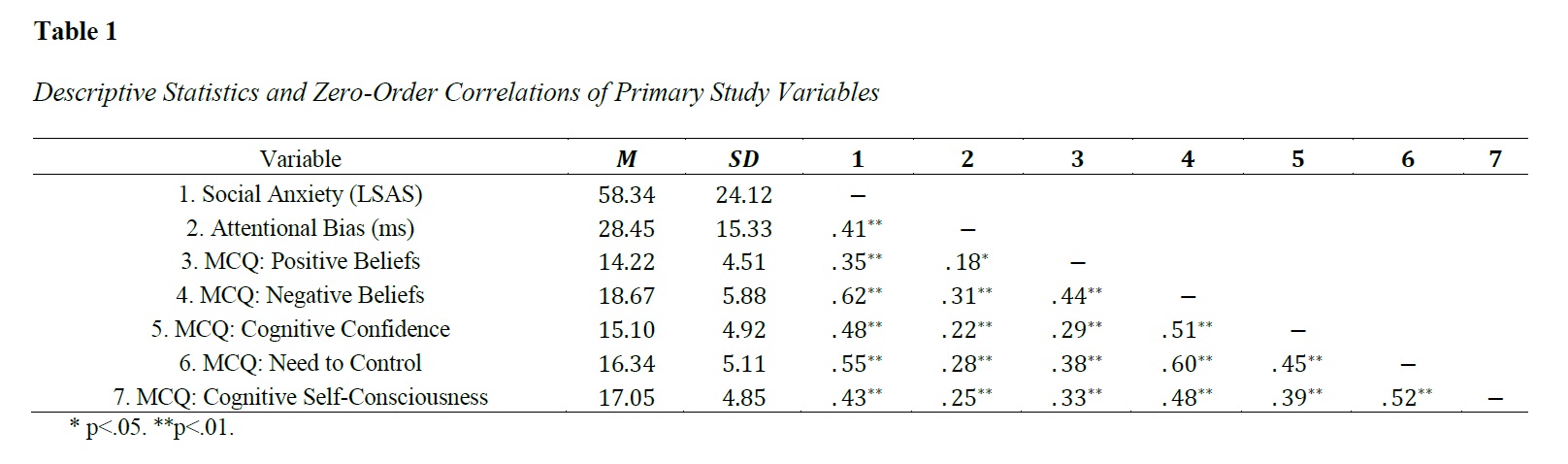
Objective: The objective of this study was to utilize supervised machine learning algorithms to model and predict the severity of social anxiety based on the complex, non-linear interplay between multidimensional metacognitive beliefs and objective chronometric measures of attentional bias.
Methods and Materials: A cross-sectional, predictive study design was employed with 854adult participants (mean age 34.52years) recruited from the USA via online crowdsourcing. Social anxiety was assessed using the Liebowitz Social Anxiety Scale (LSAS), and metacognitive beliefs were measured via the Metacognitions Questionnaire-30 (MCQ-30). Attentional bias was quantified using a computerized visual dot-probe paradigm, measuring reaction times in milliseconds. Following preprocessing and k-nearest neighbors imputation for missing values (approximately 2%), the data were split into an 80%training and 20%testing set. Supervised learning algorithms, including Random Forest, Support Vector Machines, and Gradient Boosting Regressors, were trained using 10-fold cross-validation. Model evaluation relied on R^2, Root Mean Square Error (RMSE), and Mean Absolute Error (MAE), while feature importance was interpreted using SHapley Additive exPlanations (SHAP) values.
Findings: On the unseen testing set (n=171), the Gradient Boosting Regressor emerged as the optimal model, demonstrating superior predictive performance (R^2=.68, RMSE=13.65, MAE=10.42) compared to the Random Forest Regressor (R^2=.63, RMSE=14.68, MAE=11.55) and the Support Vector Machine (R^2=.55, RMSE=16.18, MAE=12.89). Feature importance analysis using SHAP values indicated that Negative Beliefs about uncontrollability and danger had the highest predictive influence (Mean ∣SHAP∣=6.84), closely followed by the Attentional Bias Score (Mean ∣SHAP∣=4.72) and the Need to Control thoughts (Mean ∣SHAP∣=3.55). Furthermore, SHAP dependence plots revealed a distinct non-linear interaction wherein the predictive impact of attentional bias was exponentially magnified in the presence of high negative metacognitive beliefs.
Conclusion: Advanced machine learning algorithms successfully captured the complex architecture of social anxiety, demonstrating that clinical severity is predominantly driven by a synergistic, non-linear interaction between severe negative metacognitions and bottom-up visual hyper-vigilance toward threat.
Downloads
References
Abbasi, A., Aghaei Jeshvaghani, A., & Ebrahimi moghasam, H. (2020). Effectiveness of metacognition therapy on the anxiety and psychological wellbeing of the patients with generalized anxiety. medical journal of mashhad university of medical sciences, 63(5), 2745-2756. https://doi.org/10.22038/mjms.2021.17348
Asdolahzadeh, P., Sadeghi, J., & Abbasi Asfajir, A. A. (2021). Modeling the Structural Equations of Mode Metacognition with a Tendency to Cyberspace Mediated by Self-efficacy in Gifted Students [Research Article]. Iranian Journal of Educational Sociology, 4(2), 14-23. https://doi.org/10.52547/ijes.4.2.14
Aydın, S., Batmaz, S., & Aslan, E. A. (2025). Comparison of Cognitive Attentional Syndrome and Generic and Psychosis-Specific Metacognitive Beliefs in Remitted Patients with Schizophrenia, Schizoaffective Disorder, and Bipolar Disorder Type I with Psychotic Features with Healthy Controls. Journal of Rational-Emotive & Cognitive-Behavior Therapy, 43(2), 1-17. https://doi.org/10.1007/s10942-025-00586-1
Bagheri, A., Goodarzi, K., Rouzbehani, M., & Kakabraei, K. (2024). Comparing the effectiveness of metacognitive therapy, solution-focused therapy, and endurance exercises on self-efficacy beliefs in female students with social anxiety disorder. Journal of Psychological Science, 23(137), 133-153. https://psychologicalscience.ir/article-1-2420-en.html
Diop, S., Turmes, L., Specht, C., Seehagen, S., Juckel, G., & Mavrogiorgou, P. (2022). Capacities for meta-cognition, social cognition, and alexithymia in postpartum depression. Psychiatry research, 309, 114430. https://doi.org/10.1016/j.psychres.2022.114430
Esbjørn, B. H., Falch, A., Walczak, M., Normann, N., & Breinholst, S. (2020). Social Anxiety Disorder in Children: Investigating the Relative Contribution of Automatic Thoughts, Repetitive Negative Thinking and Metacognitions. Behavioural and Cognitive Psychotherapy, 49(2), 159-171. https://doi.org/10.1017/s1352465820000430
Ghaderi, B., Yazdanbakhsh, K., & Karami, J. (2022). Development and testing of a structural model of social anxiety based on maladaptive early schemas and metacognitive beliefs, with the mediating role of cognitive emotion regulation strategies in adolescent girls. Psychological Sciences Monthly, 21(109), 123-144. https://doi.org/10.52547/JPS.21.109.123
Hashemi, Z., Aini, S., & Shahjouei, T. (2022). Effectiveness of Metacognitive Therapy Based on Executive Function Training on Cognitive-Attentional Syndrome in Students with Social Anxiety. Clinical Psychology, 14(2), 1-11. http://edcbmj.ir/files/site1/user_files_944f39/zohreh-A-10-2348-4-3b83f2e.pdf
Hashemi, Z., Eyni, S., & Shahjoee, T. (2022). The Effectiveness of Metacognitive Therapy Brain-Based Executive Functioning
Training on Cognitive-Attention Syndrome in Students with Social Anxiety. Education Strategies in Medical Sciences, 15(2), 122-130. https://www.sid.ir/paper/1021490/en
Nateghi, N., Dadashi, M., & Mahmoud Alilou, M. (2019). Metacognitive Therapy in Improving sign, Metacognitive Beliefs and Thought Fusion in Patients with Obsessive-Compulsive Disorder [Original Research Article]. Middle Eastern Journal of Disability Studies, 9(0), 112-112. http://jdisabilstud.org/article-1-991-en.html
Nematollahi, S., Afshari Nia, K., Alsadat Hosseini, S., Kakabraei, K., & Parandin, S. (2023). The Effectiveness of Metacognitive Therapy and Compassion-Based Therapy on Reducing Rumination, Anxiety and Worry in Obsessive-Compulsive Patients. Journal of Psychological Dynamics in Mood Disorders (PDMD), 2(3), 50-61. https://doi.org/10.22034/pdmd.2023.188277
Olivari, C., Mansueto, G., Marino, C., Candellari, G., Cericola, J., Binnie, J., & Caselli, G. (2025). Metacognitive beliefs and desire thinking as potential maintenance factors of compulsive sexual behavior. Addictive behaviors, 161, 108214. https://doi.org/10.1016/j.addbeh.2024.108214
Qarali, Z., & saberi, h. (2020). Relationship between Metacognition and Delusional Beliefs with Obsessive-Compulsive Symptoms. Thoughts and Behavior in Clinical Psychology, 15(56), 17-27. https://jtbcp.roudehen.iau.ir/article_1854_eb87d9ae095ceeaeb1c5afed396eaa56.pdf
Rabat Mili, S., & Karimi, M. (2018). The predictive role of metacognitive beliefs, mindfulness, and fear of negative evaluation in social anxiety among adolescents. Social Psychology Research, 8(31), 51-68. https://www.socialpsychology.ir/article_87485.html?lang=en
Rajabi, M. (2018). Comparing the effectiveness of metacognitive therapy, Acceptance and Commitment Therapy, and problem-solving therapy on the symptoms of social anxiety, quality of life, and feelings of loneliness Master's thesis in Psychology, Lorestan University].
Reshadat, S., Morovati, F., Zakiei, A., & Rajabi Gilan, N. (2019). Predicting social anxiety based on components of mindfulness, experiential avoidance, and metacognitive beliefs among adolescents. Journal of Mazandaran University of Medical Sciences, 29(176), 92-104. https://jmums.mazums.ac.ir/article-1-13162-en.html
Samia Shahani, S. S., Ahmadi, O., Nemati, A., & Hajizade Sanzighi, A. (2020). The mediating role of metacognitive beliefs in the relationship between the cognitive order of emotion and mindfulness. Applied Research in Consulting, 3(1), 83-103. https://www.jarci.ir/article_704282_bfae31d3c8978e5458e0dddf6fb89dc2.pdf
Strand, E. R., Nordahl, H., Hjemdal, O., & Nordahl, H. M. (2023). Metacognitive Beliefs Predict Interpersonal Problems in Patients With Social Anxiety Disorder. Scandinavian journal of psychology, 64(6), 819-824. https://doi.org/10.1111/sjop.12943
Williams, M., Honan, C., & Matthews, A. J. (2024). Attentional bias to threat: an investigation of psychological predictors beyond trait anxiety. Current Psychology. https://doi.org/10.1007/s12144-024-05641-1
Xu, Y., Zheng, P., Feng, W., Chen, L., Sun, S., Liu, J., Tang, W., Bao, C., Xu, L., Xu, D., & Zhao, K. (2023). Patterns of Attentional Bias in Antenatal Depression: An Eye-Tracking Study. Frontiers in Behavioral Neuroscience, 17. https://doi.org/10.3389/fnbeh.2023.1288616
Zhang, F., Huang, C. W., Yan, W., Ouyang, H., & Liu, W. (2024). Attentional Bias Modification and Attention Control Training in PTSD: A Systematic Review and Meta-Analysis. Therapeutic Advances in Psychopharmacology, 14. https://doi.org/10.1177/20451253241243260
Zhu, S., Zhao, Y., Lu, H., Guo, F., Lin, C., Qiu, H., & Jiang, K. (2024). Examining the Role of Negative Attentional Bias in Patients With Adolescent Depressive Disorders: An Emotion-Attention Blink Task Study. https://doi.org/10.21203/rs.3.rs-3865806/v1
Downloads
Additional Files
Publication Timeline
- Submitted
- Revised
- Accepted