Identifying Predictors of Therapy Responsiveness from Meta-Emotion Beliefs and Cognitive Flexibility Using ML
DOI:
https://doi.org/10.61838/kman.jarac.5191Keywords:
Therapy Responsiveness, Meta-Emotion, Cognitive Flexibility, Machine LearningAbstract
Objective: This study aimed to identify transdiagnostic cognitive and affective predictors of therapy responsiveness by applying machine learning algorithms to evaluate meta-emotion beliefs and cognitive flexibility in an outpatient clinical sample.
Methods and Materials: A prospective, longitudinal predictive design was employed with a sample of N=514 adult participants from Malaysia. Baseline data were collected utilizing the Meta-Emotion Scale and the Cognitive Flexibility Inventory, while treatment outcomes were measured using the Outcome Questionnaire-45.2. Data analysis was conducted in Python using Scikit-Learn, which involved handling missing values, Z-score standardization, and an 80/20train-test split. Machine learning models underwent hyperparameter optimization via 10-fold cross-validation and were thoroughly evaluated using accuracy, precision, recall, F1-score, and ROC-AUC metrics, with SHAP (Shapley Additive Explanations) values utilized to determine explicit feature interpretability.
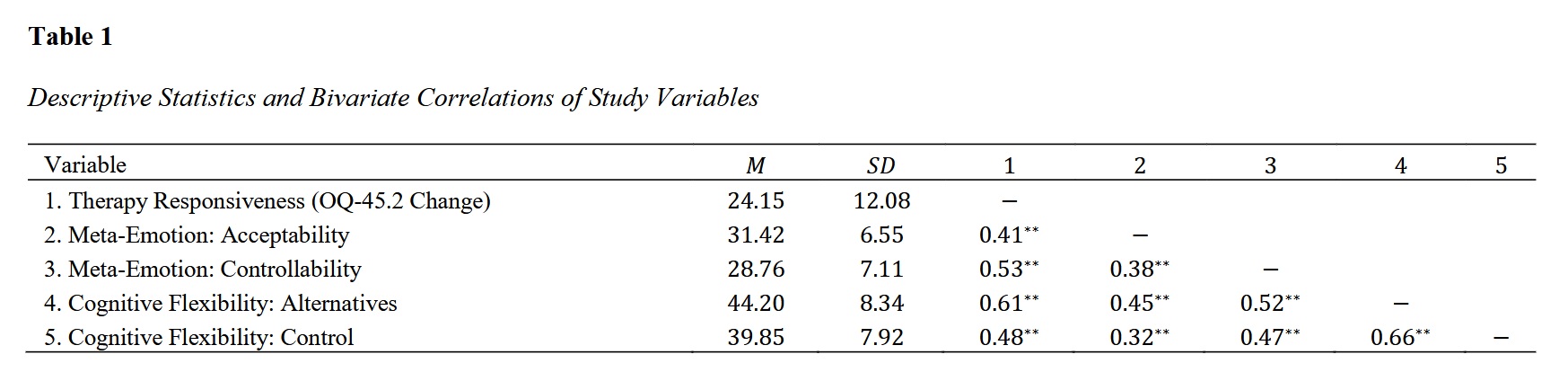
Findings: Results indicated that 62.4%of the participants (N=514) demonstrated clinically significant improvement following therapeutic intervention. Therapy responsiveness exhibited significant positive correlations with meta-emotion facets (acceptability: r=〖0.41〗^(**); controllability: r=〖0.53〗^(**)) and cognitive flexibility domains (alternatives: r=〖0.61〗^(**); control: r=〖0.48〗^(**)). Among the evaluated machine learning classifiers, the XGBoost model achieved the highest predictive performance on the test set (n=103), yielding an overall accuracy of 85.4%and an ROC-AUC of 0.91. Furthermore, SHAP value analysis explicitly identified the Alternatives facet of Cognitive Flexibility (Mean Abs SHAP: 1.24) and the Controllability facet of Meta-Emotion (Mean Abs SHAP: 0.98) as the most highly significant positive predictors of successful therapeutic outcomes.
Conclusion: Assessing cognitive flexibility and meta-emotion utilizing advanced algorithmic modeling provides a highly accurate framework for predicting therapy responsiveness, thereby directly facilitating the crucial transition toward proactive, personalized mental health care.
Downloads
References
Acikgoz, F., & Karaca, A. (2025). The effect of a mindfulness-based cognitive therapy program on depression, anxiety, stress, and cognitive flexibility in nursing students: A randomized clinical trial. Journal of Professional Nursing, 56(1), 94-103. https://doi.org/10.1016/j.profnurs.2024.12.005
Bagheri, S., & Hosseini Harandehi, S. F. (2025). Comparison of the effectiveness of cognitive behavioral therapy and intensive short-term dynamic psychotherapy on conflict resolution styles and cognitive flexibility in incompatible couples. KMAN Counseling & Psychology Nexus, 3, 1-9. https://doi.org/10.61838/kman.fct.psynexus.3.16
Baniasadi, K., Gerdooie, R., Gorji, M., Shahbazi, G., Babaahmadi, F., Ghafourian, G., & Pourmohammad Ghouchani, K. (2025). Comparison of Cognitive Behavioral Therapy and Acceptance and Commitment Therapy on Enhancing Resilience, Cognitive Flexibility, and Distress Tolerance in Adolescents with Obsessive-Compulsive Disorder. Journal of Adolescent and Youth Psychological Studies (JAYPS), 6(6), 1-10. https://doi.org/10.61838/kman.jayps.6.6.6
Dafeian, F., & Yousefi, Z. (2024). The Effectiveness of Narrative Therapy on Meta-Emotion and Reflective Functioning Among Adolescent Girls in Isfahan. Journal of Sabzevar University of Medical Sciences, 31(2), 146-157. https://www.magiran.com/paper/2732857/the-effectiveness-of-narrative-therapy-on-meta-emotion-and-reflective-functioning-among-adolescent-girls-in-isfahan?lang=en
Johnson, H. J. (2023). Teachers' meta-emotion profiles and their relationship quality with high- and low-compliant students https://figshare.mq.edu.au/ndownloader/files/43173883
Khodadad, F., Heris, M. A., Rahmanian, M., & Nikoozadeh, E. K. (2025). Effectiveness of Short-Term Psychodynamic Therapy on Negative Meta-Emotion and Marital Burnout in Betrayed Women. PWJ, 6(3). https://doi.org/10.61838/kman.pwj.6.3.11
Mardani, P., & Tabaghdehi, A. F. (2025). The Effectiveness of Compassion-Focused Therapy on Negative Meta-Emotions and Sexual Self-Efficacy in Women Affected by Extramarital Relationships. PWJ, 6(3). https://doi.org/10.61838/kman.pwj.6.3.3
Mendonça, D. (2024). Meta-emotions. In A Deweyan Philosophical Take on Emotions: A Layered Theory (pp. 57-73). Springer Nature Switzerland. https://doi.org/10.1007/978-3-031-63199-3_4
Mirzaei, F., & Hefzabad, S. B. (2024). The Effectiveness of Acceptance and Commitment Therapy on Anxiety, Metacognitive and Meta-Emotional Beliefs in Obese Women With Eating Disorders in Khomain City. PDMD, 3(3), 292-310. https://doi.org/10.61838/kman.pdmd.3.3.21
Mohammadi, Z., & Ghamarani, A. (2024). The Effectiveness of Mother-Child Interaction Training Based on the PRECEDE Model on the Meta-Emotion Philosophy of Mothers and the Emotional-Behavioral Problems of Their Children. Psychology of Exceptional Individuals, 14(55), 99-136. https://jpe.atu.ac.ir/article_18076.html?lang=en
Nemati, N. (2024). Effectiveness of imago therapy on cognitive flexibility and post-traumatic growth in women affected by extramarital affairs. Aftj, 5(4), 148-155.
Norouzi, H., Hatami, N., & Sadri, D. (2024). The effectiveness of group psychodrama therapy and cognitive-behavioral play therapy on executive functions (working memory, response inhibition, cognitive flexibility, and emotional self-regulation) in male students with social anxiety disorder. Neuropsychology, 9(35), 1-17. https://www.pachjournal.com
Rafiei, M., Masoudi, S., & Khakpour, M. (2025). The effectiveness of positive psychotherapy on cognitive flexibility, marital frustration, and post-traumatic growth in women with cancer. A New Approach to Child Education, 7(1), 10–21. https://mjms.mums.ac.ir/article_24591.html
Rahmanian, Z. (2024). The relationship between metacognition and positive meta-emotion with autonomy and goal orientation in male and female athletes. Sports Psychology Studies, 14(48). https://spsyj.ssrc.ac.ir/article_4401_en.html
Rasoulian, B., Janbozorgi, M., Noohi, S., & Rezvani, A. (2024). The Effectiveness of Cognitive Behavioral Therapy on Emotional and Cognitive Flexibility in Individuals with Psychological Distress. Journal of Disability Studies. https://jdisabilstud.org/article-1-3003-en.html
Rasoulian, B., Nouhi, S., Jan Bozorgi, M., & Rezvani, A. (2024). Determining the effectiveness of a spiritual multidimensional therapy focused on emotion regulation on cognitive flexibility and ego strength in individuals with psychological distress. Disability Studies, 14, 78-78. https://jdisabilstud.org/browse.php?a_id=3162&slc_lang=en&sid=1&printcase=1&hbnr=1&hmb=1
Razaei, M., & Pourmohammad Ghouchani, K. (2025). Effectiveness of cognitive behavioral therapy and acceptance and commitment therapy on cognitive flexibility in adolescents with generalized anxiety disorder.
Shabani, H. (2024). Examining the Effectiveness of Mentalization Therapy on Cognitive Flexibility, Mental Well-Being, and Anxiety in Adolescent Girls. Scientific Journal of New Research Approaches in Management and Accounting, 8(28), 16-30. https://majournal.ir/index.php/ma/article/view/2398
Shao, R., Liu, S., Coplan, R. J., Chen, X., & Liu, J. (2023). Examining a Complex Model Linking Maternal Reflective Functioning, Maternal Meta-Emotion Philosophies, and Child Emotion Regulation. Children (Basel, Switzerland), 10(7), 1161. https://doi.org/10.3390/children10071161
Sistani Pour, N., Asghari Ebrahim Abad, M. J., & Ghanbari Hashem Abadi, B. (2024). The effectiveness of group emotional schema therapy on balancing dark personality traits, increasing flourishing, and cognitive flexibility in female heads of households. Clinical Psychology Studies, 14(53), 1-18. https://jcps.atu.ac.ir/article_17013.html
Soucie, K., Scott, S. A., Partridge, T., Hakim-Larson, J., Babb, K. A., & Voelker, S. (2024). Meta-Emotion and emotion socialization by mothers of preschoolers during storytelling tasks. Journal of Child and Family Studies, 33(5), 1618-1631. https://doi.org/10.1007/s10826-023-02736-4
Strodl, E., & Sorensen, P. (2023). The role of metacognitive beliefs versus meta-emotion beliefs in disordered eating. Australian Psychologist, 58(3), 179-189.
Tavakoli, S., Abbasi, F., Heydari, B., & Akhondzadeh, M. (2024). Comparing the Effectiveness of Cognitive Behavioral Play Therapy and Gestalt Play Therapy on Vandalistic Behaviors, Impulsivity, and Cognitive Flexibility in Aggressive Male Elementary Students. Journal of Assessment and Research in Applied Counseling (JARAC), 6(3), 28-36. https://doi.org/10.61838/kman.jarac.6.3.4
Tenore, K., Granziol, U., Luppino, O. I., Mancini, F., & Mancini, A. (2024). Group Imagery Imagery Rescripting via Telehealth Decreases Dysfunctional Personality Beliefs and the Meta-Emotional Problem but Does Not Increase Positive Self-Compassion. Current Psychology, 43(23), 20614-20625. https://doi.org/10.1007/s12144-024-05815-x
Timko, C. A., Schnabel, J., & Orloff, N. C. (2024). The importance of improving cognitive flexibility in adolescents with anorexia nervosa: The case for cognitive remediation therapy. International Journal of Eating Disorders, 57(5), 1109-1118. https://doi.org/10.1002/eat.24164
Yaghoubi, M., Ebrahimi, F., Pour Mohammad Ghochani, K., & Noorouziani, Z. (2026). A Comparison of the Effectiveness of Cognitive Behavioral Therapy and Acceptance and Commitment Therapy on Referential Thoughts, Cognitive Flexibility, and Distress Tolerance in Patients with Major Depression. Psychological Dynamics in Mood Disorders, 1-18. https://doi.org/10.1002/da.22878
Yaqubi, M., Ebrahimi, F., Pourmohammad Ghouchani, K., & Norouziani, Z. (2026). Comparison of cognitive behavioral therapy and acceptance and commitment therapy on referential thoughts, cognitive flexibility, and distress tolerance in patients with major depressive disorder. Psychological Dynamics in Emotional Disorders, 1-18. https://doi.org/https://maherpub.com/pdmd/article/view/628
Zerwas, F. K., Ford, B. Q., John, O. P., & Mauss, I. B. (2024). Unpacking the pursuit of happiness: Being concerned about happiness but not aspiring to happiness is linked with negative meta-emotions and worse well-being. Emotion. https://doi.org/10.1037/emo0001381
Downloads
Additional Files
Publication Timeline
- Submitted
- Revised
- Accepted