LSTM-Based Longitudinal Prediction of Psychological Resilience: The Role of Self-Compassion, Meaning in Life, Cognitive Reappraisal, and Social Support
DOI:
https://doi.org/10.61838/kman.jarac.5237Keywords:
psychological resilience, self-compassion, meaning in life, cognitive reappraisal, social supportAbstract
Objective: The present study aimed to investigate the longitudinal prediction of psychological resilience using an LSTM-based deep learning model by examining the dynamic contributions of self-compassion, meaning in life, cognitive reappraisal, and social support over time.
Methods and Materials: This longitudinal study was conducted on 428 participants recruited from Canada, with 392 retained for final analysis across four time points over a 12-month period. Data were collected using validated self-report instruments, including the Connor–Davidson Resilience Scale, Self-Compassion Scale, Meaning in Life Questionnaire, Emotion Regulation Questionnaire (cognitive reappraisal subscale), and the Multidimensional Scale of Perceived Social Support. Data preprocessing included multiple imputation and sequence structuring for time-series analysis. The primary analytical approach involved the application of Long Short-Term Memory (LSTM) neural networks implemented in Python using TensorFlow and Keras. The dataset was divided into training, validation, and test sets (70/15/15), and model performance was evaluated using Mean Squared Error (MSE), Root Mean Squared Error (RMSE), and R². SHAP analysis was conducted to determine the temporal importance of predictors.
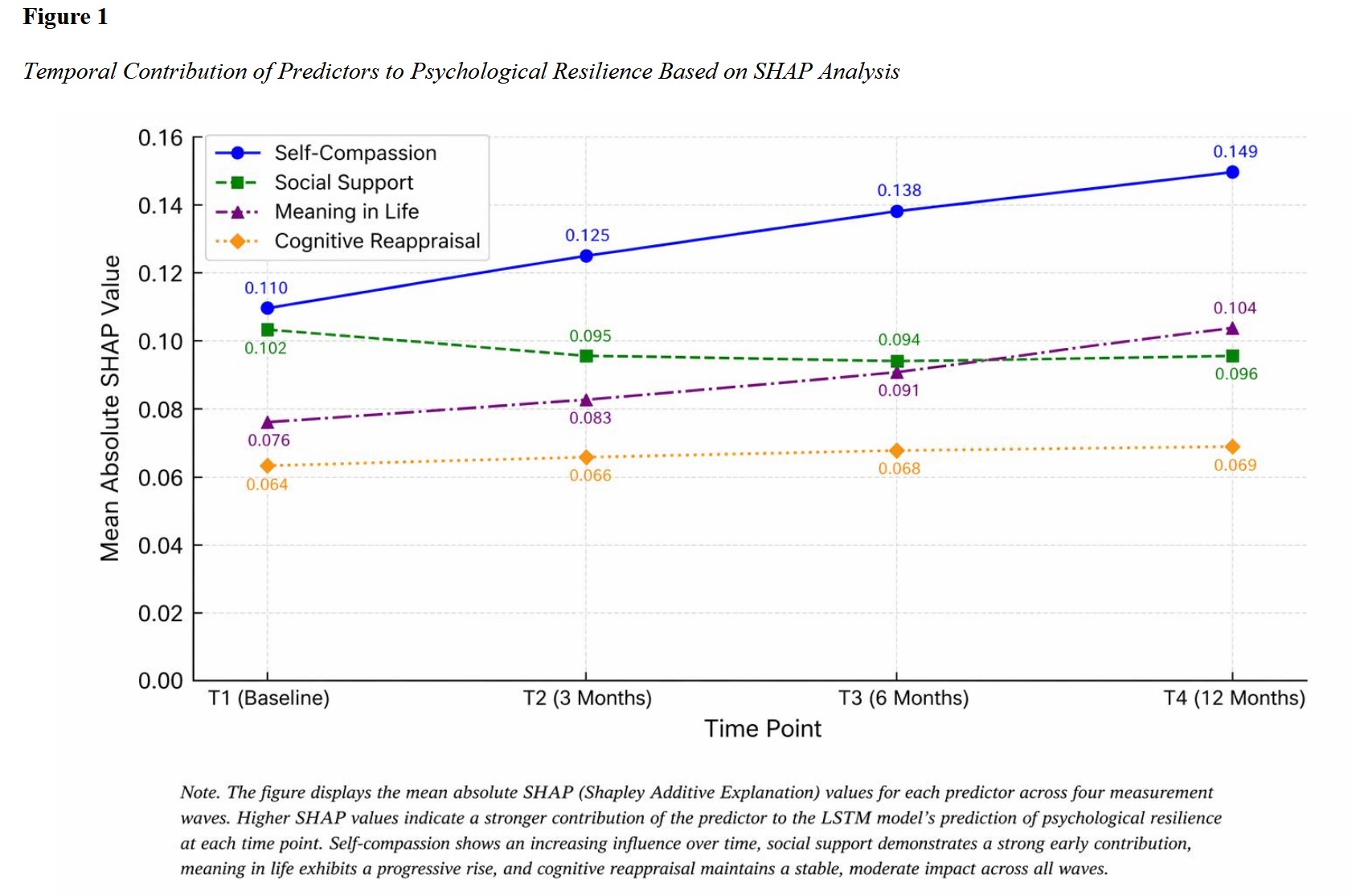
Findings: The LSTM model demonstrated strong predictive performance (R² = 0.66, RMSE = 2.52), indicating substantial explained variance in psychological resilience. Self-compassion emerged as the most significant predictor (β ≈ .54, p < .001), followed by social support (β ≈ .51, p < .001), meaning in life (β ≈ .49, p < .001), and cognitive reappraisal (β ≈ .43, p < .001). Longitudinal analyses revealed significant increases in resilience and all predictor variables across time (p < .01). SHAP results indicated that self-compassion and meaning in life showed increasing contributions over time, whereas social support demonstrated stronger early influence and cognitive reappraisal maintained a stable effect across all time points.
Conclusion: The findings highlight the dynamic and multifactorial nature of psychological resilience, emphasizing the central role of self-compassion and the evolving contributions of internal and external resources over time. The integration of LSTM modeling with explainable AI provides a robust framework for capturing temporal patterns and enhancing predictive accuracy in psychological research.
Downloads
References
Avdiu, F., & Duraku, Z. H. (2024). Emotional Regulation, Self-Compassion and Adaptive Functioning in Parents: A Comparative Study in Families of Neurodevelopmental Disorder and Typically Developing Children. Advances in Mental Health and Intellectual Disabilities, 18(4), 149-160. https://doi.org/10.1108/amhid-11-2023-0042
Cutajar, K., & Bates, G. (2025). Australian Women in the Perinatal Period During COVID-19: The Influence of Self-Compassion and Emotional Regulation on Anxiety, Depression, and Social Anxiety. Healthcare, 13(2), 120. https://doi.org/10.3390/healthcare13020120
Ding, C., Mortillaro, M., & Ramdas, M. (2024). Emotional Intelligence in Applied Settings: Approaches to Its Theoretical Model, Measurement, and Application. https://doi.org/10.3389/978-2-8325-4623-9
Ding, R., He, W., Liu, T., Yang, Y., Qiu, F., & Wang, Q. (2024). Unpacking Maternal Minimization Responses to Children’s Negative Emotions: “Person-Oriented” Versus “Emotion-Oriented”. Emotion, 24(4), 1049-1067. https://doi.org/10.1037/emo0001324
Huang, P., Lin, Z.-J., Wang, B. C., & Du, Z. (2025). A Mixed Methods Exploration of the Interrelationships Among Self-Compassion, Stress Management, Psychological Capital, and Life Satisfaction in Chinese University Students. Frontiers in psychology, 16. https://doi.org/10.3389/fpsyg.2025.1510987
Koehler, F., Schäfer, S. K., Lieb, K., & Wessa, M. (2023). Differential Associations of Leisure Music Engagement With Resilience: A Network Analysis. International Journal of Clinical and Health Psychology, 23(3), 100377. https://doi.org/10.1016/j.ijchp.2023.100377
Kupferberg, A., & Hasler, G. (2024). From Antidepressants and Psychotherapy to Oxytocin, Vagus Nerve Stimulation, Ketamine and Psychedelics: How Established and Novel Treatments Can Improve Social Functioning in Major Depression. Frontiers in Psychiatry, 15. https://doi.org/10.3389/fpsyt.2024.1372650
Lee, A., Fung, W. K., & Chung, K. K. H. (2024). Empowering the Helping Hands: A Positive Psychological Intervention for Enhancing Work Engagement and Reducing Stress Among Preschool Social Workers in Hong Kong. Stress and Health, 40(5). https://doi.org/10.1002/smi.3471
Leong, C. A., Summers, A., Grote, V., Jackson, K., Dowling, G., Snowberg, K., Cotten, P. D., Cheung, E. O., Yang, D., Addington, E. L., & Moskowitz, J. T. (2024). Randomized Controlled Trial of a Positive Emotion Regulation Intervention to Reduce Stress in Family Caregivers of Individuals With Alzheimer’s Disease: Protocol and Design for the LEAF 2.0 Study. BMC Geriatrics, 24(1). https://doi.org/10.1186/s12877-024-04817-5
Liu, C., Chen, H., Zhang, A., Gong, X. G., Wu, K., Liu, C.-Y., & Chiou, W. K. (2023). The Effects of Short Video App-Guided Loving-Kindness Meditation on College Students’ Mindfulness, Self-Compassion, Positive Psychological Capital, and Suicide Ideation. Psicologia Reflexão E Crítica, 36(1). https://doi.org/10.1186/s41155-023-00276-w
Logoz, F., Eggenberger, L., Komlenac, N., Schneeberger, M., Ehlert, U., & Walther, A. (2023). How Do Traditional Masculinity Ideologies and Emotional Competence Relate to Aggression and Physical Domestic Violence in Cisgender Men? Frontiers in psychology, 14. https://doi.org/10.3389/fpsyg.2023.1100114
Lowe, M. X., Kettner, H., Jolly, D. R. P., Carhart‐Harris, R. L., & Jackson, H. (2024). Long-Term Benefits to Psychological Health and Well-Being After Ceremonial Use of Ayahuasca in Middle Eastern and North African Immigrants and Refugees. Frontiers in Psychiatry, 15. https://doi.org/10.3389/fpsyt.2024.1279887
McConnell, S., Silva, B. R. O., & Silva, C. O. (2024). Cultivating Empathy and Compassion: Lived Experiences of Engagement With Cognitively‐based Compassion Training in the US. Ethos, 52(2), 206-224. https://doi.org/10.1111/etho.12424
Mistretta, E. G., & Davis, M. C. (2025). Self-Compassion Versus Detached Reappraisal for Emotion Regulation in Individuals Exposed to Interpersonal Trauma. Psychology of Consciousness Theory Research and Practice, 12(2), 232-252. https://doi.org/10.1037/cns0000408
P., U., & P., R. (2024). The Impact of Forgiveness in Emotional Regulation and Resilience in the Face of Adversity Among Young Adults. International Journal for Multidisciplinary Research, 6(2). https://doi.org/10.36948/ijfmr.2024.v06i02.19263
Pilárik, Ľ., Mikoška, P., Helvich, J., & Melišíková, A. (2024). Effective Emotion Regulation as a Protective Factor of Depression Symptoms in Slovak Adolescents During a COVID-19 Pandemic. Polish Psychological Bulletin, 37-46. https://doi.org/10.24425/ppb.2024.150355
Polat, S. (2025). The Correlation Between Suicide Risk and Emotion Regulation Strategies in Patients With Bipolar Disorder: A Cross‐Sectional Study. Journal of Psychiatric and Mental Health Nursing, 32(6), 1380-1391. https://doi.org/10.1111/jpm.70034
Salsman, J. M., & Rosenberg, A. R. (2024). Fostering Resilience in Adolescence and Young Adulthood: Considerations for Evidence‐based, Patient‐centered Oncology Care. Cancer, 130(7), 1031-1040. https://doi.org/10.1002/cncr.35182
Snodgrass, N., Mistretta, E. G., & Davis, M. C. (2025). How People Talk About Rejection: Linguistic Profiles of Self-Compassion, Reappraisal, and Control Writing Conditions. https://doi.org/10.21203/rs.3.rs-6857482/v1
Song, Y., Xiao, Z., Zhang, L., & Shi, W. (2023). Trait Depression and Subjective Well-Being: The Chain Mediating Role of Community Feeling and Self-Compassion. Behavioral Sciences, 13(6), 448. https://doi.org/10.3390/bs13060448
Syafitri, N., Lubis, R., Indrawan, Y. F., & Choong, T. C. (2024). Self-Compassion: Unveiling Mental Health Through Emotion Regulation in High-School Students. Tazkiya Journal of Psychology, 12(1), 1-16. https://doi.org/10.15408/tazkiya.v12i1.37794
Tao, T. J., Yung, Y. Y. Y., Lau, A. Y. T., Liu, H., Liang, L., Bryant, F. B., & Hou, W. K. (2023). Savoring Mediates the Mental Health Benefits of Positive Coping Processes: A Prospective Population‐based Analysis. Applied Psychology Health and Well-Being, 16(1), 158-178. https://doi.org/10.1111/aphw.12476
Ünal, İ. Ö., & Ordu, Ç. (2023). Alexithymia, Self-Compassion, Emotional Resilience, and Cognitive Emotion Regulation: Charting the Emotional Journey of Cancer Patients. Current Oncology, 30(10), 8872-8887. https://doi.org/10.3390/curroncol30100641
Wang, J., Drossaert, C. H., Knevel, M., Chen, L., Bohlmeijer, E. T., & Schroevers, M. J. (2025). The Mechanisms Underlying the Relationship Between Self‐Compassion and Psychological Outcomes in Adult Populations: A Systematic Review. Stress and Health, 41(4). https://doi.org/10.1002/smi.70090
Watson, T., Watts, L., Waters, R., & Hodgson, D. (2023). The Benefits of Loving Kindness Meditation for Helping Professionals: A Systematic Review. Health & Social Care in the Community, 2023, 1-14. https://doi.org/10.1155/2023/5579057
Wu, Q., Zhou, N., Cao, H., & Wang, S. (2025). Implications of Childhood Psychological Maltreatment and Peer Victimization for COVID-19 PTSD Symptoms Among Adolescents: Mindfulness and Self-Compassion as Explanatory Mechanisms in Trauma Transmission. Psychological Trauma Theory Research Practice and Policy. https://doi.org/10.1037/tra0002004
Downloads
Additional Files
Publication Timeline
- Submitted
- Revised
- Accepted