Modeling Internet Addiction Severity Using Deep Learning: Effects of Impulsivity, Emotional Dysregulation, Reward Sensitivity, and Fear of Missing Out
DOI:
https://doi.org/10.61838/kman.jarac.5247Keywords:
Internet addiction, deep learning, impulsivity, emotional dysregulation, reward sensitivity, fear of missing out, predictive modelingAbstract
Objective: The present study aimed to model internet addiction severity using deep learning techniques by examining the combined effects of impulsivity, emotional dysregulation, reward sensitivity, and fear of missing out.
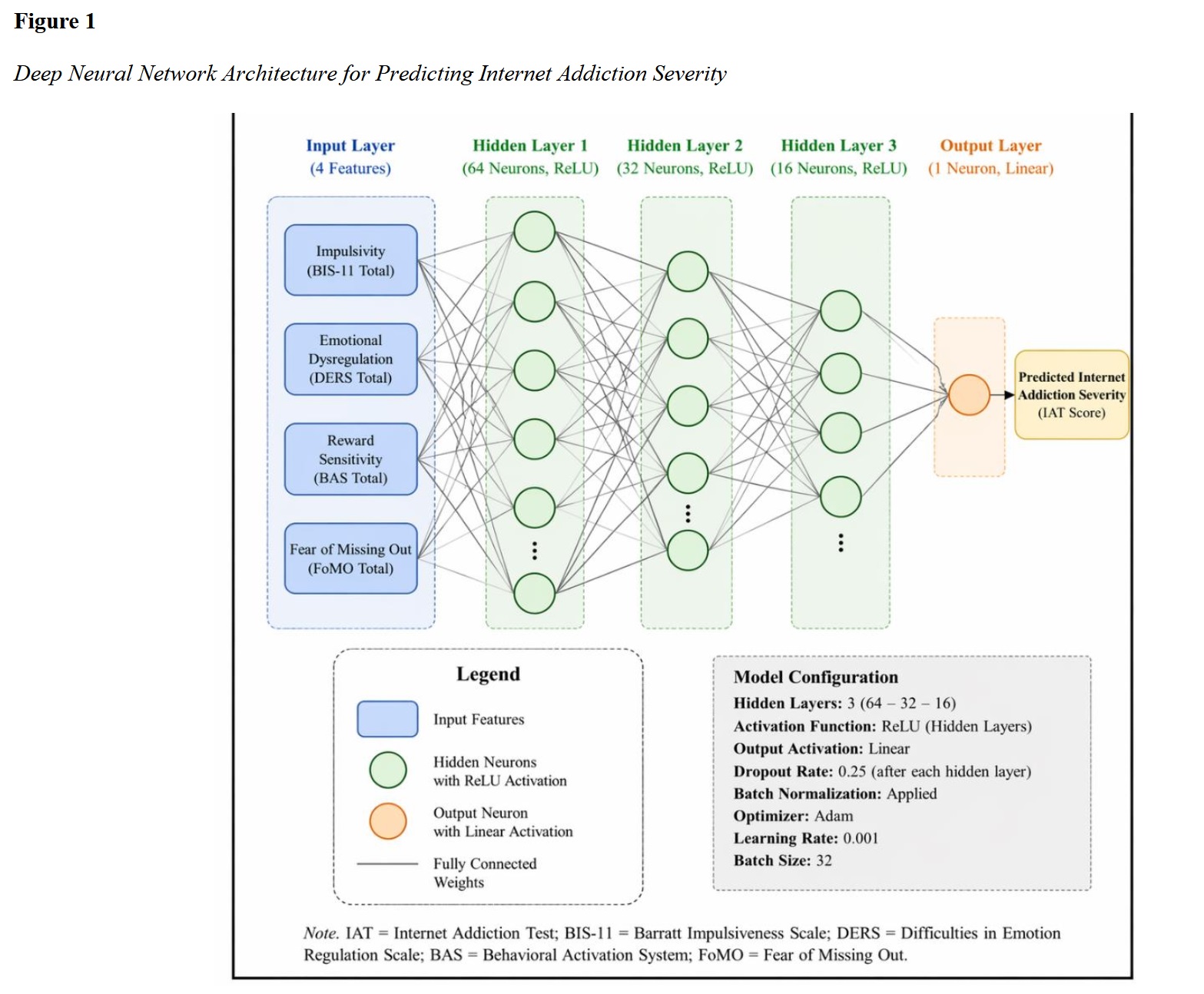
Methods and Materials: This quantitative cross-sectional study was conducted on 412 university students from Mexico selected through stratified convenience sampling. Participants completed standardized self-report measures including the Internet Addiction Test (IAT), Barratt Impulsiveness Scale (BIS-11), Difficulties in Emotion Regulation Scale (DERS), Behavioral Activation System (BAS) scale, and Fear of Missing Out (FoMO) scale. Data were collected via an online survey platform. After preprocessing, including handling missing values and standardization, a deep neural network model was developed to predict internet addiction severity. The dataset was divided into training (70%), validation (15%), and test (15%) sets. Model performance was evaluated using mean squared error (MSE), root mean squared error (RMSE), and coefficient of determination (R²), and hyperparameters were optimized using grid search techniques.
Findings: The deep learning model demonstrated strong predictive performance, with R² values of 0.72, 0.69, and 0.68 in the training, validation, and test sets, respectively, indicating high explanatory power and generalizability. All predictor variables showed significant positive associations with internet addiction severity, with fear of missing out emerging as the strongest predictor, followed by emotional dysregulation, impulsivity, and reward sensitivity. Shapley value analysis confirmed the relative importance of these variables, highlighting a multidimensional pattern of influence. The model exhibited low error rates across datasets, supporting its robustness and stability in predicting internet addiction severity.
Conclusion: The findings indicate that internet addiction severity is best understood as a multidimensional construct influenced by interrelated psychological factors, with fear of missing out and emotional dysregulation playing central roles. The application of deep learning provides a powerful and accurate approach for modeling complex behavioral phenomena, offering both theoretical insights and practical implications for prevention and intervention strategies.
Downloads
References
Arouch, s., Silva, K. M. d., Edgcumbe, D. R., & Pezaro, S. (2025). The Impact of Short-Form Video Use on Cognitive and Mental Health Outcomes: A Systematic Review. https://doi.org/10.1101/2025.08.27.25334540
Benedetto, L., Rollo, S., Cafeo, A., Rosa, G. D., Pino, R., Gagliano, A., Germanò, E., & Ingrassia, M. (2024). Emotional and Behavioural Factors Predisposing to Internet Addiction: The Smartphone Distraction Among Italian High School Students. International journal of environmental research and public health, 21(4), 386. https://doi.org/10.3390/ijerph21040386
Chang, R. S., Lee, M., Im, J. J., Choi, K. H., Kim, J., Chey, J., Shin, S.-H., & Ahn, W. Y. (2021). Biopsychosocial Factors of Gaming Disorder: A Systematic Review Employing Screening Tools With Well-Defined Psychometric Properties. https://doi.org/10.31234/osf.io/b8fxr
Deng, X., Gao, Q., Hu, L., Zhang, L., Li, Y., & Bu, X. (2021). Differences in Reward Sensitivity Between High and Low Problematic Smartphone Use Adolescents: An ERP Study. International journal of environmental research and public health, 18(18), 9603. https://doi.org/10.3390/ijerph18189603
Elhai, J. D., Yang, H., & Montag, C. (2021). Fear of Missing Out (FOMO): Overview, Theoretical Underpinnings, and Literature Review on Relations With Severity of Negative Affectivity and Problematic Technology Use. Brazilian Journal of Psychiatry, 43(2), 203-209. https://doi.org/10.1590/1516-4446-2020-0870
Flack, M., Burton, W. H., & Caudwell, K. M. (2024). I Rely on a Little Help From My Friends: The Effect of Interpersonal and Intrapersonal Emotion Regulation on the Relationship Between FOMO and Problematic Internet Use. BMC psychiatry, 24(1). https://doi.org/10.1186/s12888-024-05834-9
Flayelle, M., Brevers, D., King, D. L., Maurage, P., Perales, J. C., & Billieux, J. (2023). A Taxonomy of Technology Design Features That Promote Potentially Addictive Online Behaviours. Nature Reviews Psychology, 2(3), 136-150. https://doi.org/10.1038/s44159-023-00153-4
Guan, J., Ma, W., & Liu, C. (2023). Fear of Missing Out and Problematic Smartphone Use Among Chinese College Students: The Roles of Positive and Negative Metacognitions About Smartphone Use and Optimism. PLoS One, 18(11), e0294505. https://doi.org/10.1371/journal.pone.0294505
Li, J., & Yang, H. (2024). Unveiling the Grip of Mobile Phone Addiction: An in-Depth Review. Frontiers in Psychiatry, 15. https://doi.org/10.3389/fpsyt.2024.1429941
Maghraoui, S., & Khrouf, L. (2024). Cyberaddiction to TikTok During the COVID-19 Pandemic. Spanish Journal of Marketing - Esic, 29(3), 293-311. https://doi.org/10.1108/sjme-01-2023-0023
Marano, G., Lisci, F. M., Rossi, S., Marzo, E. M., Boggio, G., Brisi, C., Traversi, G., Mazza, O., Pola, R., Gaetani, E., & Mazza, M. (2025). Connected but at Risk: Social Media Exposure and Psychiatric and Psychological Outcomes in Youth. Children, 12(10), 1322. https://doi.org/10.3390/children12101322
Marciano, L., Camerini, A.-L., & Morese, R. (2021). The Developing Brain in the Digital Era: A Scoping Review of Structural and Functional Correlates of Screen Time in Adolescence. Frontiers in psychology, 12. https://doi.org/10.3389/fpsyg.2021.671817
Ndayambaje, E., & Udohchukwu, O. P. (2025). The Psychopathology of Problematic Smartphone Use (PSU): A Narrative Review of Burden, Mediating Factors, and Prevention. Health Science Reports, 8(5). https://doi.org/10.1002/hsr2.70843
Ntumi, S., Amos, P. M., Danquah, S. A., Amoako, B. M., Hansen, A., & Amezugbe, C. (2025). From Likes to Lows: A Serial Mediation Analysis of How Social Media Addiction, Fear of Missing Out (FoMO), Emotional Regulation, Assessment Engagement, and Assessment Anxiety Influence Depression Among Adolescents in Ghana. https://doi.org/10.21203/rs.3.rs-6916786/v1
Quaglieri, A., Biondi, S., Roma, P., Varchetta, M., Fraschetti, A., Burrai, J., Lausi, G., Vilar, M. M., González‐Sala, F., Domenico, A. D., Giannini, A. M., & Mari, E. (2021). From Emotional (Dys)Regulation to Internet Addiction: A Mediation Model of Problematic Social Media Use Among Italian Young Adults. Journal of clinical medicine, 11(1), 188. https://doi.org/10.3390/jcm11010188
Servidio, R. (2021). Fear of Missing Out and Self-Esteem as Mediators of the Relationship Between Maximization and Problematic Smartphone Use. Current Psychology, 42(1), 232-242. https://doi.org/10.1007/s12144-020-01341-8
Totur, G., Üzüm, Ö., Eliaçık, K., Çam, O., Elmalı, F., Kanık, A., & Helvacı, M. A. (2025). Healthy Lifestyle in Adolescents With Digital Addictions: A Comparative Study of Gaming and Social Media Addiction. Clinical Pediatrics, 64(11), 1613-1621. https://doi.org/10.1177/00099228251350811
Ünübol, H., & Sayar, G. H. (2020). Investigation of the Association of the Fear of Missing Out With Attention Deficit and Impulsivity in Terms of Age, Gender, and Tobacco Dependence. Online Türk Sağlık Bilimleri Dergisi, 5(2), 260-270. https://doi.org/10.26453/otjhs.572671
Varchetta, M., Tagliaferri, G., Mari, E., Quaglieri, A., Cricenti, C., & Vilar, M. M. (2024). Cross-Cultural Examination of Problematic Internet Use and Associated Psychological Variables: A Comparative Study in Italy, Spain, Ecuador, and Peru. Journal of clinical medicine, 13(12), 3451. https://doi.org/10.3390/jcm13123451
Wacks, Y., & Weinstein, A. (2021). Excessive Smartphone Use Is Associated With Health Problems in Adolescents and Young Adults. Frontiers in Psychiatry, 12. https://doi.org/10.3389/fpsyt.2021.669042
Wan, Z. (2025). Exploring the Relationship Between Boredom Proneness and Short-Form Videos Addiction Among Chinese College Students Through a Moderated Mediation Model. Scientific reports, 15(1). https://doi.org/10.1038/s41598-025-22313-7
Wang, J., & Shen, W. (2025). The Emotional Reinforcement Mechanism of and Phased Intervention Strategies for Social Media Addiction. Behavioral Sciences, 15(5), 665. https://doi.org/10.3390/bs15050665
Wang, L., Zhou, X., Song, X., Gan, X., Zhang, R., Liu, X., Xu, T., Jiao, G., Ferraro, S., Bore, M. C., Yu, F., Zhao, W., Montag, C., & Becker, B. (2022). Fear of Missing Out (FOMO) Associates With Reduced Cortical Thickness in Core Regions of the Posterior Default Mode Network and Higher Levels of Problematic Smartphone and Social Media Use. https://doi.org/10.1101/2022.10.24.513508
Wang, Y., Liu, B., Zhang, L., & Zhang, P. (2022). Anxiety, Depression, and Stress Are Associated With Internet Gaming Disorder During COVID-19: Fear of Missing Out as a Mediator. Frontiers in Psychiatry, 13. https://doi.org/10.3389/fpsyt.2022.827519
Weinstein, A. (2023). Problematic Social Networking Site Use-Effects on Mental Health and the Brain. Frontiers in Psychiatry, 13. https://doi.org/10.3389/fpsyt.2022.1106004
Xiao, B., Zhao, H., Hein‐Salvi, C., Parent, N., & Shapka, J. D. (2025). Exploring the Trajectories of Problematic Smartphone Use in Adolescence: Insights From a Longitudinal Study. British Journal of Developmental Psychology, 43(4), 1010-1026. https://doi.org/10.1111/bjdp.12570
Downloads
Additional Files
Publication Timeline
- Submitted
- Revised
- Accepted