AI-Based Prediction of Social Anxiety: Interactions Among Intolerance of Uncertainty, Self-Focused Attention, Safety Behaviors, and Fear of Evaluation
DOI:
https://doi.org/10.61838/kman.jarac.5260Keywords:
Social Anxiety, Intolerance of Uncertainty, Self-Focused Attention, Safety Behaviors, Fear of EvaluationAbstract
Objective: The present study aimed to develop and evaluate an artificial intelligence-based predictive model of social anxiety severity by examining the individual and interactive effects of intolerance of uncertainty, self-focused attention, safety behaviors, and fear of evaluation.
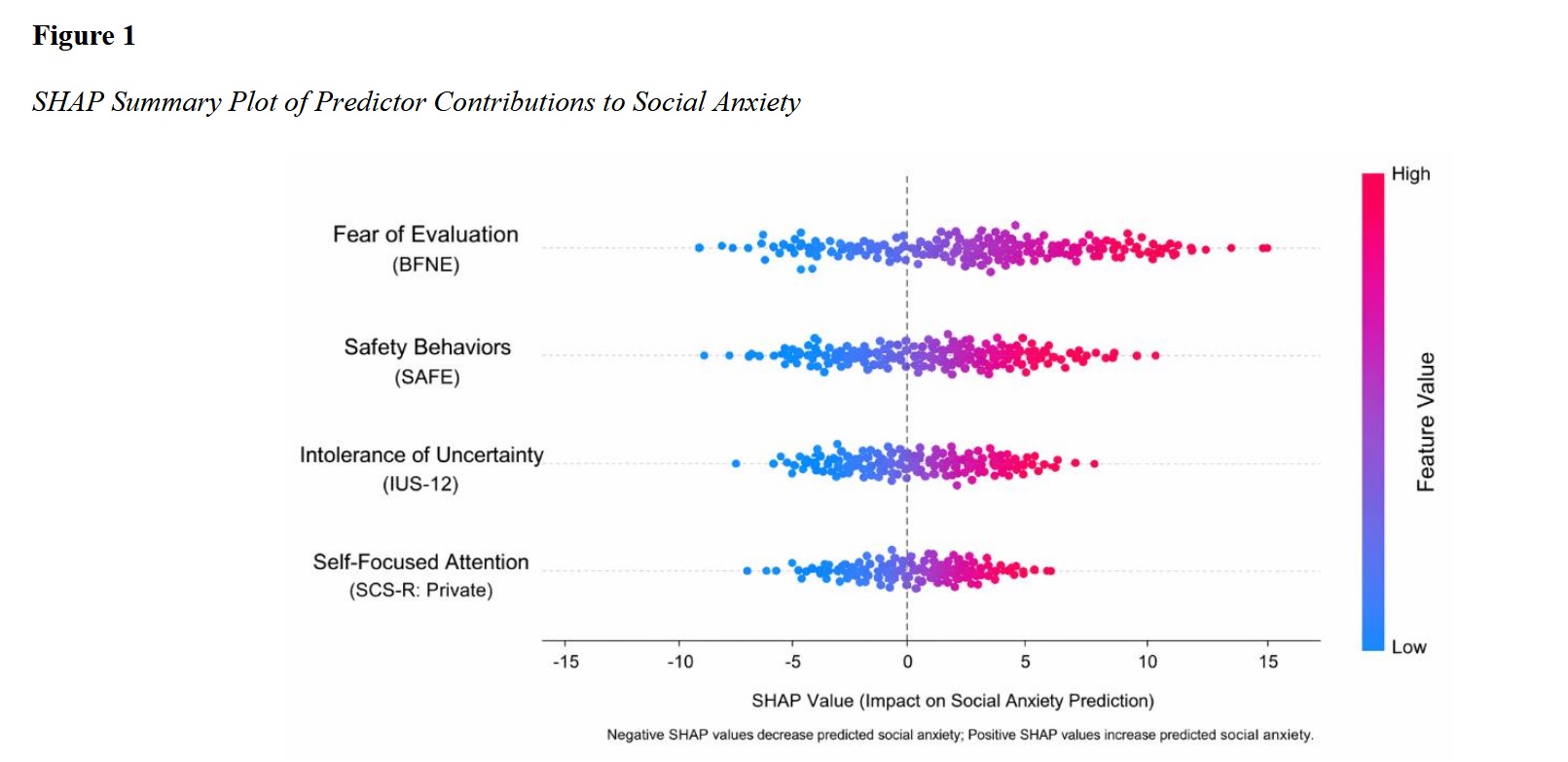
Methods and Materials: This cross-sectional predictive study was conducted on a sample of 412 young adults recruited from universities and community settings in Canada. Participants completed standardized self-report measures assessing social anxiety, intolerance of uncertainty, self-focused attention, safety behaviors, and fear of evaluation. Data were collected through an online survey platform and subjected to preprocessing procedures including missing data imputation, outlier management, and feature standardization. The dataset was divided into training and testing subsets, and multiple machine learning algorithms, including Random Forest, Support Vector Machine, and Extreme Gradient Boosting (XGBoost), were implemented to predict social anxiety severity. Model performance was evaluated using R², root mean square error (RMSE), and mean absolute error (MAE), while SHAP (Shapley Additive Explanations) analysis was employed to interpret feature importance and interaction effects among predictors.
Findings: The results indicated that all predictors were significantly associated with social anxiety, with fear of evaluation emerging as the strongest predictor, followed by safety behaviors, intolerance of uncertainty, and self-focused attention. Among the tested models, XGBoost demonstrated the highest predictive accuracy (R² = 0.74), outperforming Random Forest and Support Vector Machine. Interaction analyses revealed that fear of evaluation combined with safety behaviors, as well as intolerance of uncertainty combined with self-focused attention, exerted the strongest synergistic effects on social anxiety severity, indicating the presence of nonlinear and interaction-based relationships among variables.
Conclusion: The findings underscore the importance of integrating cognitive and behavioral mechanisms in understanding social anxiety and highlight the utility of machine learning approaches in capturing complex interactions among psychological predictors. The study provides evidence for the central role of fear of evaluation and safety behaviors, particularly in interaction with intolerance of uncertainty and self-focused attention, and suggests that AI-based models can enhance predictive accuracy and inform personalized intervention strategies for social anxiety.
Downloads
References
Akan, Ş. (2024). Anxiety During the COVID-19 Pandemic: Prevalence, Effects and Predisposing Factors. Psikiyatride Guncel Yaklasimlar - Current Approaches in Psychiatry, 16(1), 111-125. https://doi.org/10.18863/pgy.1263730
Andreatta, M., Jongerling, J., & Wieser, M. J. (2023). Context-Dependent Responses to the Spread of COVID-19 Among National and International Students During the First Lockdown: An Online Survey. Disaster Medicine and Public Health Preparedness, 17. https://doi.org/10.1017/dmp.2023.118
Assaf, M. (2025). Mediating Effect of Intolerance of Uncertainty Between Feeling of Unsafety and Depression/Well-Being Among a Sample of Lebanese Adults. Archives of Public Health, 83(1). https://doi.org/10.1186/s13690-025-01551-1
Bui, V., & Moscovitch, D. A. (2024). Predictors of Excessive Reassurance Seeking in Social Anxiety. Cognitive therapy and research, 48(2), 292-302. https://doi.org/10.1007/s10608-024-10473-1
Bulut, M. B. (2022). Relationship Between COVID-19 Anxiety and Fear of Death: The Mediating Role of Intolerance of Uncertainty Among a Turkish Sample. Current Psychology, 42(10), 8441-8450. https://doi.org/10.1007/s12144-022-03281-x
Chigwedere, C., & Moran, J. (2022). Further Development of the Intolerance of Uncertainty Model of GAD: A Case Series. The Cognitive Behaviour Therapist, 15. https://doi.org/10.1017/s1754470x21000374
Church, L., Bounoua, N., Rodriguez, S. N., Bredemeier, K., & Spielberg, J. M. (2022). Longitudinal Relationships Between COVID-19 Preventative Behaviors and Perceived Vulnerability to Disease. Journal of anxiety disorders, 88, 102561. https://doi.org/10.1016/j.janxdis.2022.102561
Craske, M. G., Treanor, M., Zbozinek, T. D., & Vervliet, B. (2022). Optimizing Exposure Therapy With an Inhibitory Retrieval Approach and the OptEx Nexus. Behaviour Research and Therapy, 152, 104069. https://doi.org/10.1016/j.brat.2022.104069
Grant, D. M., Nagel, K. M., & Deros, D. E. (2021). Evaluating the Influence of Cognitive Mechanisms on Fear Expectancies: A Commentary on Hilleke Et Al. (2021). Clinical Psychology Science and Practice, 28(2), 161-163. https://doi.org/10.1037/cps0000017
Gu, S., Zheng-ming, H. E., Sun, L., Jiang, Y., Xu, M., Feng, G., Ma, X., Wang, F., & Huang, J. H. (2021). Effects of Coronavirus-19 Induced Loneliness on Mental Health: Sleep Quality and Intolerance for Uncertainty as Mediators. Frontiers in Psychiatry, 12. https://doi.org/10.3389/fpsyt.2021.738003
Han, L., Bai, H., Lun, B., Li, Y., Wang, Y., & Ni, Q. (2022). The Prevalence of Fear of Childbirth and Its Association With Intolerance of Uncertainty and Coping Styles Among Pregnant Chinese Women During the COVID-19 Pandemic. Frontiers in Psychiatry, 13. https://doi.org/10.3389/fpsyt.2022.935760
Hudson, K., Fenley, A. R., Pincus, D. B., & Leyfer, O. (2022). Intensive Cognitive-Behavioral Therapy for Anxiety Disorders in Adolescents: A Case Study. Clinical Case Studies, 22(2), 99-119. https://doi.org/10.1177/15346501221113523
Jessup, S. C., Knowles, K. A., & Olatunji, B. O. (2022). Linking the Estimation of Threat and COVID-19 Fear and Safety Behavior Use: Does Intolerance of Uncertainty Matter? International Journal of Cognitive Therapy, 15(4), 479-491. https://doi.org/10.1007/s41811-022-00148-8
Mestre‐Bach, G., & Potenza, M. N. (2023). Cyberchondria: A Growing Concern During the COVID-19 Pandemic and a Possible Addictive Disorder? Current Addiction Reports, 10(1), 77-96. https://doi.org/10.1007/s40429-022-00462-3
Meulders, A., Vlaeyen, J. W., Evers, A. W., Köke, A., Smeets, R., Zundert, J. H. V., Verbunt, J. M., & Ryckeghem, D. V. (2021). Chronic Primary Pain in the COVID-19 Pandemic: How Uncertainty and Stress Impact on Functioning and Suffering. Pain, 163(4), 604-609. https://doi.org/10.1097/j.pain.0000000000002428
Moloodi, R., Mohebban, F., Taremian, F., & Poursharifi, H. (2021). Evaluation of Hierarchical Model of Trait and Disorder- Specific Intolerance of Uncertainty in Anxiety Disorder Symptoms. https://doi.org/10.21203/rs.3.rs-418012/v1
Morriss, J., Abend, R., Zika, O., Bradford, D. E., & Mertens, G. (2022). Neural and Psychophysiological Markers of Intolerance of Uncertainty. https://doi.org/10.31234/osf.io/kpbn2
Nishikawa, Y., Fracalanza, K., Rector, N. A., & Laposa, J. M. (2022). Social Anxiety and Negative Interpretations of Positive Social Events: What Role Does Intolerance of Uncertainty Play? Journal of Clinical Psychology, 78(12), 2513-2524. https://doi.org/10.1002/jclp.23363
Reilly, E. E., Bohrer, B. K., Sullivan, D. J., Essayli, J. H., Farrell, N. R., Brown, T. A., Gorrell, S., Anderson, L. M., Cooper, M., Schreyer, C. C., Olesnycky, O. S., Peros, O., & Schaumberg, K. (2021). Registered Report: Initial Development and Validation of the Eating Disorders Safety Behavior Scale. International Journal of Eating Disorders, 54(4), 660-667. https://doi.org/10.1002/eat.23479
Schenkel, S. K., Jungmann, S. M., Gropalis, M., & Witthöft, M. (2021). Conceptualizations of Cyberchondria and Relations to the Anxiety Spectrum: Systematic Review and Meta-Analysis. Journal of medical Internet research, 23(11), e27835. https://doi.org/10.2196/27835
Shabani, M. J., Mohsenabadi, H., Gharraee, B., Shayanfar, F., Corcoran, V., & McKay, D. (2022). Psychological Correlates of Health Anxiety in Response to the Coronavirus (COVID-19) Pandemic: A Cross-Sectional Online Study in Iran. International Journal of Cognitive Therapy, 16(1), 103-122. https://doi.org/10.1007/s41811-022-00152-y
Spiroiu, F. I., & Maranzan, K. A. (2025). Cognitive‐Emotional Impact of Negative Interpretations of Ambiguous Social Information and Fear of Negative Evaluation on the Association Between Intolerance of Uncertainty and Social Anxiety Subtypes: A Cross‐Sectional Mediation Analysis. Scandinavian journal of psychology. https://doi.org/10.1111/sjop.13115
Uzun, K., Ünlü, S., & Arslan, G. (2025). Does Intolerance of Uncertainty Influence Social Anxiety Through Rumination? A Mediation Model in Emerging Adults. Behavioral Sciences, 15(5), 687. https://doi.org/10.3390/bs15050687
White, K. S., & Cheung, V. (2021). Cognitive Behavioral Therapy for Anxiety Disorders. 33-65. https://doi.org/10.1037/0000219-002
Wong, A. H., Aslanidou, A., Malbec, M., Pittig, A., Wieser, M. J., & Andreatta, M. (2023). A Systematic Review of the Inter-Individual Differences in Avoidance Learning. https://doi.org/10.31234/osf.io/2xbwd
Wu, X., Nazari, N., & Griffiths, M. D. (2021). Using Fear and Anxiety Related to COVID-19 to Predict Cyberchondria: Cross-Sectional Survey Study. Journal of medical Internet research, 23(6), e26285. https://doi.org/10.2196/26285
Zhou, T., Bao, Y., Guo, D., Bai, Y., Wang, R., Cao, X., Li, H., & Hua, Y. (2022). Intolerance of Uncertainty and Future Career Anxiety Among Chinese Undergraduate Students During COVID-19 Period: Fear of COVID-19 and Depression as Mediators. Frontiers in Public Health, 10. https://doi.org/10.3389/fpubh.2022.1015446
Downloads
Additional Files
Publication Timeline
- Submitted
- Revised
- Accepted