Artificial Intelligence Modeling of Risk-Taking Behavior: Contributions of Sensation Seeking, Delay Discounting, Emotional Dysregulation, and Peer Influence
DOI:
https://doi.org/10.61838/kman.jarac.5278Keywords:
risk-taking behavior, sensation seeking, delay discounting, emotional dysregulation, peer influenceAbstract
Objective: The present study aimed to develop and evaluate an artificial intelligence-based model for predicting risk-taking behavior based on sensation seeking, delay discounting, emotional dysregulation, and peer influence.
Methods and Materials: This cross-sectional predictive study was conducted on 512 young adults aged 18 to 30 years in Canada, selected through stratified convenience sampling. Data were collected using validated psychometric instruments, including the Domain-Specific Risk-Taking Scale (DOSPERT), Brief Sensation Seeking Scale (BSSS), Delay Discounting Task, Difficulties in Emotion Regulation Scale (DERS), and Resistance to Peer Influence Scale (RPI). After preprocessing procedures such as normalization and missing data imputation, both traditional statistical analysis and machine learning approaches were applied. Multiple regression analysis was used to examine linear relationships, while machine learning models including Random Forest, Support Vector Machine, and XGBoost were implemented using 10-fold cross-validation. Model performance was evaluated using accuracy, precision, recall, F1-score, and AUC-ROC, and SHAP analysis was employed to interpret feature importance.
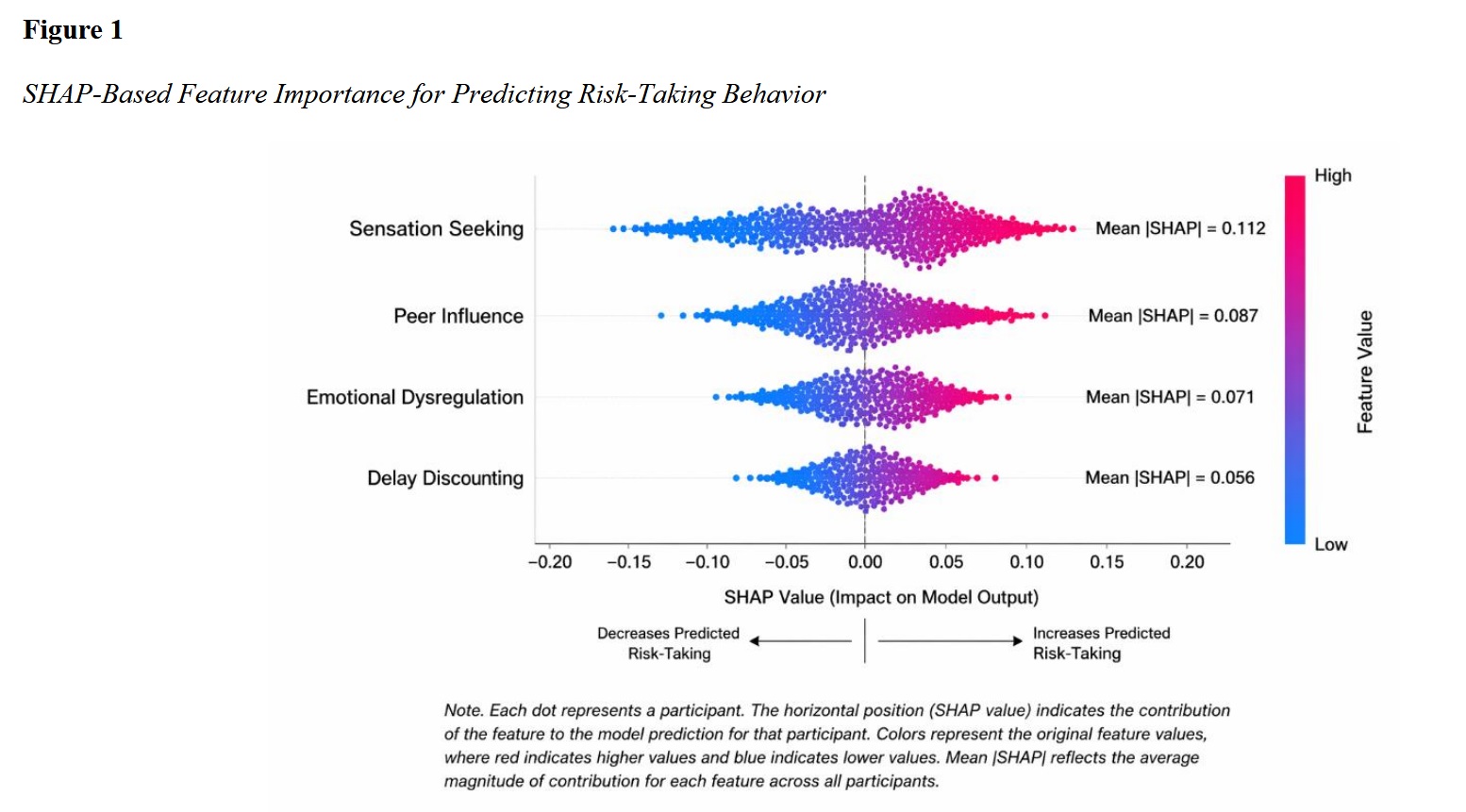
Findings (inferentials only): The regression model was statistically significant (F(4, 507) = 128.64, p < 0.001), explaining 50.38% of the variance in risk-taking behavior. Sensation seeking (β = 0.41, p < 0.001), peer influence (β = 0.34, p < 0.001), emotional dysregulation (β = 0.27, p < 0.001), and delay discounting (β = 0.22, p < 0.001) were all significant predictors. Among machine learning models, XGBoost demonstrated the highest performance (accuracy = 0.87, AUC-ROC = 0.92), followed by Random Forest and Support Vector Machine. SHAP analysis confirmed sensation seeking as the most influential predictor, followed by peer influence, emotional dysregulation, and delay discounting.
Conclusion: The findings indicate that risk-taking behavior can be effectively predicted using an integrative artificial intelligence framework that captures the combined effects of dispositional, cognitive, emotional, and social factors, with sensation seeking and peer influence were the most influential determinants.
Downloads
References
Aksen, D., Sleight, F. G., & Lynn, S. J. (2023). Mindfulness Intervention for Impulsivity as a Stand-Alone Treatment: A Qualitative Review of Emerging Evidence. Psychology of Consciousness Theory Research and Practice. https://doi.org/10.1037/cns0000367
Aquili, L., & Lim, L. W. (2025). Balancing Risk and Reward: Dopamine’s Central Role in Economic Decision-Making. Brain Sciences, 15(8), 857. https://doi.org/10.3390/brainsci15080857
Carucci, S., Narducci, C., Bazzoni, M., Balia, C., Donno, F., Gagliano, A., & Zuddas, A. (2022). Clinical Characteristics, Neuroimaging Findings, and Neuropsychological Functioning in Attention‐deficit Hyperactivity Disorder: Sex Differences. Journal of neuroscience research, 101(5), 704-717. https://doi.org/10.1002/jnr.25038
Chachar, A. S., & Shaikh, M. Y. (2024). Decision-Making and Attention Deficit Hyperactivity Disorder: Neuroeconomic Perspective. Frontiers in Neuroscience, 18. https://doi.org/10.3389/fnins.2024.1339825
Clay, J. M., Baker, K. A., Mezabrovschi, R., Berti, G., Shields, G. S., Slavich, G. M., Stafford, L. D., & Parker, M. O. (2023). Mediated and Moderated Associations Between Cumulative Lifetime Stressor Exposure, Emotional Dysregulation, Impulsivity, and Lifetime Alcohol Use: A Cross-Sectional Scoping Study of UK Drinkers. Journal of psychiatric research, 164, 140-149. https://doi.org/10.1016/j.jpsychires.2023.06.020
Edelson, S. M., & Reyna, V. F. (2023). Decision Making in Adolescence and Early Adulthood. 107-122. https://doi.org/10.1037/0000298-007
Finkenstaedt, M., Biedermann, D., Biedermann, S. V., & Fuß, J. (2025). Impaired Sexual Delay Discounting as a Potential Mechanism in Women's Compulsive Sexual Behavior: Evidence From a Mixed-Gender Experiment. Journal of Behavioral Addictions, 14(2), 1051-1063. https://doi.org/10.1556/2006.2025.00028
França, T. F. A., Segura, I. A., Dias, N. M., Miranda, M. C., & Pompéia, S. (2022). The Effect of Pubertal Status on Self-Regulation of Behavior and Executive Functions – A Systematic Review. https://doi.org/10.31234/osf.io/e2kjb
Houser, T. M. (2024). Rational Inattention as a Transdiagnostic Marker of Mental Disorders. https://doi.org/10.21203/rs.3.rs-5214690/v1
Icenogle, G., & Cauffman, E. (2021). Adolescent Decision Making: A Decade in Review. Journal of Research on Adolescence, 31(4), 1006-1022. https://doi.org/10.1111/jora.12608
Klinge, J. L., Warschburger, P., & Klein, A. M. (2025). Late Adolescent Outcomes of Childhood Trajectories of Internalizing Symptoms: An 8-Year Follow-Up of Depressive and Anxiety Symptoms and Cognitive, Emotion- And Behavior-Related Self-Regulation Facets. Child and adolescent psychiatry and mental health, 19(1). https://doi.org/10.1186/s13034-025-00958-6
Kübel, S. L., Deitzer, J. R., Frankenhuis, W. E., Ribeaud, D., Eisner, M., & Gelder, J. L. v. (2024). Beyond the Situation: Hanging Out With Peers Now Is Associated With Short-Term Mindsets Later. Journal of Developmental and Life-Course Criminology, 10(1), 51-72. https://doi.org/10.1007/s40865-024-00249-2
Lee, Y., Gilbert, J. R., Waldman, L. R., Zarate, C. A., & Ballard, E. D. (2025). Review: Suicide and Its Relationship to Aggression and Impulsivity. Cognitive Affective & Behavioral Neuroscience, 25(5), 1237-1260. https://doi.org/10.3758/s13415-025-01321-0
Mancone, S., Celia, G., Zanon, A., Gentile, A., & Diotaiuti, P. (2025). Psychosocial Profiles and Motivations for Adolescent Engagement in Hazardous Games: The Role of Boredom, Peer Influence, and Self-Harm Tendencies. Frontiers in Psychiatry, 16. https://doi.org/10.3389/fpsyt.2025.1527168
Mancone, S., Zanon, A., Marotta, G., Celia, G., & Diotaiuti, P. (2025). Temporal Perspectives, Sensation-Seeking, and Cognitive Distortions as Predictors of Adolescent Gambling Behavior: A Study in Italian High Schools. Frontiers in Psychiatry, 16. https://doi.org/10.3389/fpsyt.2025.1602316
Markus, J. T. d. R., Dahlén, A. D., Rukh, G., & Schiöth, H. B. (2023). Job Satisfaction Has Differential Associations With Delay Discounting and Risk-Taking. Scientific reports, 13(1). https://doi.org/10.1038/s41598-023-27601-8
McQuaid, G. A., Darcey, V. L., Patterson, A. E., Rose, E. J., VanMeter, J. W., & Fishbein, D. (2022). Baseline Brain and Behavioral Factors Distinguish Adolescent Substance Initiators and Non-Initiators at Follow-Up. Frontiers in Psychiatry, 13. https://doi.org/10.3389/fpsyt.2022.1025259
Mena-Moreno, T., Testa, G., Mestre‐Bach, G., Miranda‐Olivos, R., Granero, R., Fernández‐Aranda, F., Menchón, J. M., & Jiménez‐Múrcia, S. (2022). Delay Discounting in Gambling Disorder: Implications in Treatment Outcome. Journal of clinical medicine, 11(6), 1611. https://doi.org/10.3390/jcm11061611
Nicholls, K., Dean, P., & Ogden, J. (2024). Medical, Subjective and Objective Forms of Exercise Dependence and the Role of Learning, Cognitive and Emotional Biases. Journal of Health Psychology, 30(11), 3076-3091. https://doi.org/10.1177/13591053241304561
Peck, K., Nighbor, T., & Price, M. (2022). Examining Associations Between Impulsivity, Opioid Use Disorder, and Posttraumatic Stress Disorder: The Additive Relation Between Disorders. Experimental and Clinical Psychopharmacology, 30(5), 486-493. https://doi.org/10.1037/pha0000507
Ramírez, M., Ugedo, A., Fañanás, L., Cano-Escalera, G., Sáiz, P. A., Zorrilla, E. P., & González-Pinto, A. (2025). Scoping Review of Biological and Psychosocial Pathways That Lead From Childhood Adversity to Early-Onset Substance Use. Frontiers in Psychiatry, 16. https://doi.org/10.3389/fpsyt.2025.1612494
Shain, L. M., Nguyen, M., & Meadows, A. L. (2022). Relationships Among Adverse Childhood Experiences, Delay Discounting, Impulsivity, and Diabetes Self-Management. Health Psychology, 41(8), 566-571. https://doi.org/10.1037/hea0001209
Zhao, Q., Milecki, L., Kuceyeski, A., Grosenick, L., Brumback, T., Pfefferbaum, A., Sullivan, E. V., & Pohl, K. M. (2025). Socioemotional and Executive Control Mismatch in Adolescence and Risks for Initiating Drinking. JAMA Network Open, 8(9), e2531378. https://doi.org/10.1001/jamanetworkopen.2025.31378
Zmigrod, L. (2022). Individual-Level Cognitive and Personality Predictors of Ideological Worldviews: The Psychological Profiles of Political, Nationalistic, Dogmatic, Religious, and Extreme Believers. https://doi.org/10.31234/osf.io/srgup
Downloads
Additional Files
Publication Timeline
- Submitted
- Revised
- Accepted