Narratives of Orthopedic Residents on Vicarious Trauma: A Narrative Analysis of Therapeutic Meaning Reconstruction
DOI:
https://doi.org/10.61838/kman.jarac.5418Keywords:
Secondary traumatic stress, meaning reconstruction, orthopedic residents, phenomenology, vicarious resilience, vicarious traumaAbstract
Objective: The present study was conducted to explore and understand the lived experiences of orthopedic residents in confronting vicarious trauma and to elucidate the process of meaning reconstruction among them.
Methods and Materials: This study was conducted using a qualitative approach and descriptive phenomenological methodology. Five orthopedic residents working at the Bone and Joint Reconstruction Research Center of Shafa Yahyaeian Hospital were selected through purposive sampling. Data were collected through semi-structured interviews and analyzed using Colaizzi’s seven-step method. To ensure scientific rigor, Guba and Lincoln’s criteria, including credibility, transferability, dependability, and confirmability, were employed.
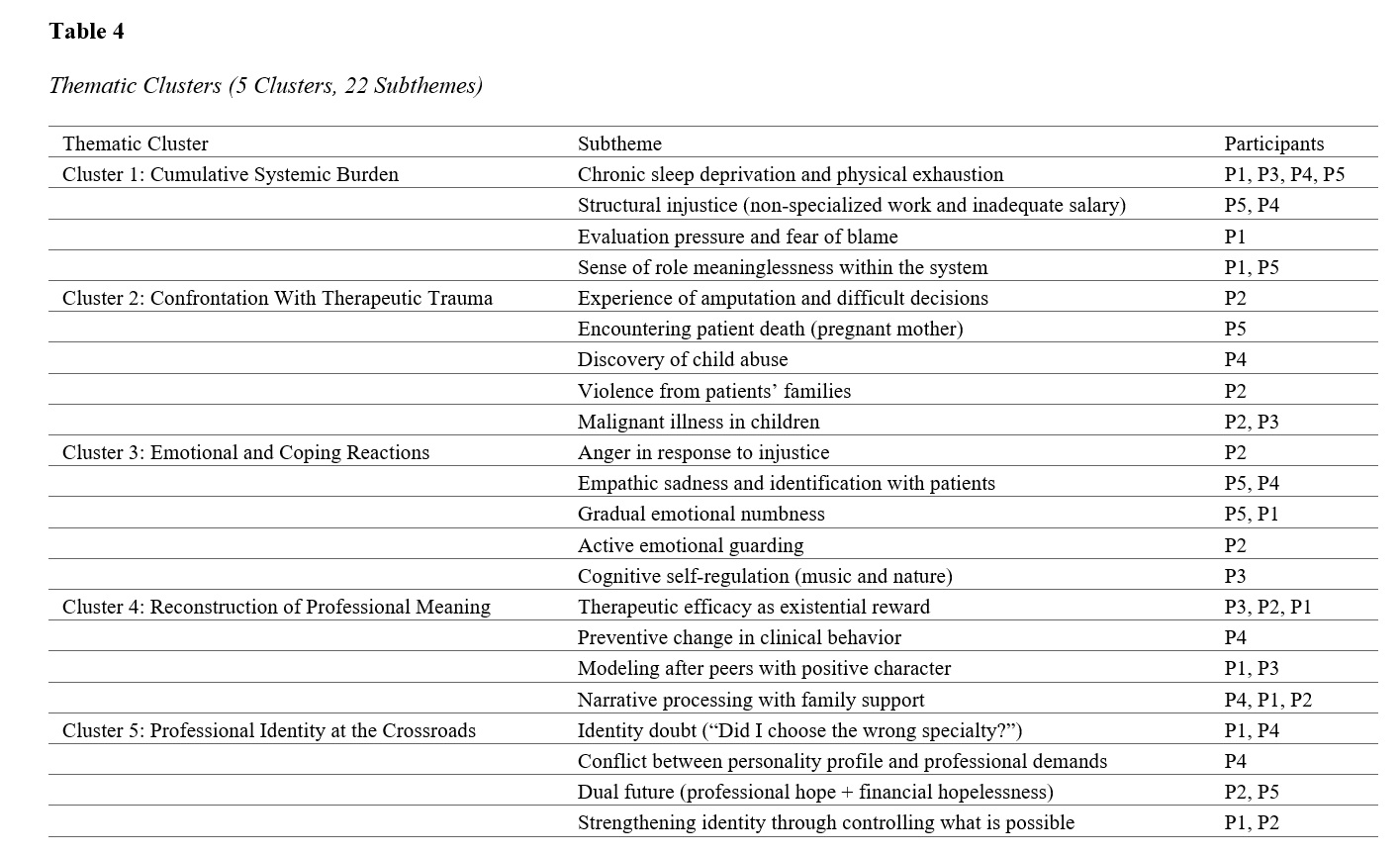
Findings: Data analysis resulted in the identification of five main thematic clusters: (1) cumulative systemic burden (burnout and structural injustice); (2) confrontation with therapeutic trauma (patient death and violence); (3) emotional and coping reactions (emotional numbness and anger); (4) reconstruction of professional meaning (therapeutic efficacy and family support); and (5) professional identity at the crossroads (doubt and a dual future). The findings demonstrated that trauma among orthopedic residents is a cumulative process that begins with systemic pressure and leads to a rupture in meaning; however, through intrinsic resources and feedback from patient recovery, processes of meaning reconstruction and vicarious resilience ultimately emerge.
Conclusion: Orthopedic residents encounter traumatic moments within a context of limited organizational support that challenges their framework of meaning. Nevertheless, the enduring core of their professional identity is preserved through spontaneous meaning-making processes.
Downloads
References
Adams, S. A., & Riggs, S. A. (2008). An exploratory study of vicarious trauma among therapist trainees. Training and Education in Professional Psychology, 2(1), 26-34. https://doi.org/10.1037/1931-3918.2.1.26
Beck, C. T., & Casavant, S. G. (2019). Vicarious Posttraumatic Growth in NICU Nurses. Advances in Neonatal Care, 20(4), 324-332. https://doi.org/10.1097/anc.0000000000000689
DelTosta, J., Ellis, M. V., & McNamara, M. L. (2019). Trainee Vicarious Traumatization: Examining Supervisory Working Alliance and Trainee Empathy. Training and Education in Professional Psychology. https://doi.org/10.1037/tep0000232
Harrison, R. L., & Westwood, M. J. (2009). Preventing Vicarious Traumatization of Mental Health Therapists: Identifying Protective Practices. Psychotherapy, 46(2), 203-219. https://doi.org/10.1037/a0016081
Hlomuka, N. (2024). Assessment of vicarious post-traumatic stress in nurses caring for victims of sexual abuse in Thuthuzela Care Centres in KwaZulu-Natal https://openscholar.dut.ac.za/items/f217db74-74fc-4566-9dcf-5adb777f9417/full
Kalaitzaki, A., & Rovithis, M. (2021). Secondary Traumatic Stress and Vicarious Posttraumatic Growth in Healthcare Workers During the First COVID-19 Lockdown in Greece: The Role of Resilience and Coping Strategies. Psychiatriki. https://doi.org/10.22365/jpsych.2021.001
Kim, G.-I., & Park, K. H. (2024). The Narrative on the Experience of Vicarious Trauma Experienced by Crime Victim Counselors. Korean Youth Counseling Association, 5(2), 151-174. https://doi.org/10.51613/jkyca.2024.5.2.151
Kim, J.-S., Chesworth, B. R., Franchino-Olsen, H., & Macy, R. J. (2021). A Scoping Review of Vicarious Trauma Interventions for Service Providers Working With People Who Have Experienced Traumatic Events. Trauma Violence & Abuse, 23(5), 1437-1460. https://doi.org/10.1177/1524838021991310
Kounenou, K., Kalamatianos, A., Nikoltsiou, P., & Kourmousi, N. (2023). The Interplay Among Empathy, Vicarious Trauma, and Burnout in Greek Mental Health Practitioners. International journal of environmental research and public health, 20(4), 3503. https://doi.org/10.3390/ijerph20043503
Li, Z., Ge, J., Yang, M., Feng, J., Qiao, M., Jiang, R., Bi, J., Zhan, G., Xu, X., Wang, L., Zhou, Q., Zhou, C., Pan, Y., Liu, S., Zhang, H., Yang, J., Zhu, B., Hu, Y., Hashimoto, K., . . . Yang, C. (2020). Vicarious traumatization in the general public, members, and non-members of medical teams aiding in COVID-19 control. Brain, behavior, and immunity, 88, 916-919. https://doi.org/10.1016/j.bbi.2020.03.007
McCormack, L., & Adams, E. L. (2016). Therapists, Complex Trauma, and the Medical Model: Making Meaning of Vicarious Distress From Complex Trauma in the Inpatient Setting. Traumatology an International Journal, 22(3), 192-202. https://doi.org/10.1037/trm0000024
Middleton, J., & Potter, C. C. (2015). Relationship Between Vicarious Traumatization and Turnover Among Child Welfare Professionals. Journal of Public Child Welfare, 9(2), 195-216. https://doi.org/10.1080/15548732.2015.1021987
Puvimanasinghe, T., Denson, L. A., Augoustinos, M., & Somasundaram, D. (2015). Vicarious Resilience and Vicarious Traumatisation: Experiences of Working With Refugees and Asylum Seekers in South Australia. Transcultural Psychiatry, 52(6), 743-765. https://doi.org/10.1177/1363461515577289
Riaz, S., & Fatima, S. M. (2026). Obsessive-Compulsive Symptoms as A Mediator Between Vicarious Trauma and The Quality of Nurse's Work Life: A Secondary Data Analysis. Regional Lens, 5(1), 1-8. https://doi.org/10.55737/rl.v5i1.26154
Sui, X., & Padmanabhanunni, A. (2016). Vicarious Trauma: The Psychological Impact of Working With Survivors of Trauma for South African Psychologists. Journal of Psychology in Africa, 26(2), 127-133. https://doi.org/10.1080/14330237.2016.1163894
Willcott-Benoit, W., & Cummings, J. A. (2024). Vicarious Growth, Traumatization, and Event Centrality in Loved Ones Indirectly Exposed to Interpersonal Trauma: A Scoping Review. Trauma Violence & Abuse, 25(5), 3643-3661. https://doi.org/10.1177/15248380241255736
Ye, T., Huang, Y., Chen, Y., Ni, Y., Zhang, X., Song, B., Lan, J., Feng, L., Liao, C., & Zheng, Y. (2025). The Mediating Role of Death Coping Between Moral Resilience and Vicarious Posttraumatic Growth Among ICU Nurses. Journal of Advanced Nursing. https://doi.org/10.1111/jan.70249
Downloads
Additional Files
Publication Timeline
- Submitted
- Revised
- Accepted