A Comparison of the Effectiveness of Mindfulness-Based Stress Reduction and Acceptance and Commitment Therapy on Sexual Dysfunction and Self-Care in Women with Type 2 Diabetes
DOI:
https://doi.org/10.61838/kman.jarac.5541Keywords:
Mindfulness-Based Stress Reduction, Acceptance and Commitment Therapy, Type 2 Diabetes, Self-Care, Sexual Function, WomenAbstract
Objective: The present study aimed to compare the effectiveness of two psychological interventions—Mindfulness-Based Stress Reduction (MBSR) and Acceptance and Commitment Therapy (ACT)—on sexual dysfunction and self-care behaviors in women with type 2 diabetes.
Methods and Materials: This study was conducted using a quasi-experimental design with a pretest–posttest control group. The statistical population consisted of all women with type 2 diabetes who referred to the National Diabetic Patients Support Charity Association in Tehran during the period from September to November 2024. A sample of 45 participants was selected through convenience sampling and randomly assigned to three groups: mindfulness, acceptance and commitment therapy, and control. Data collection instruments included the Diabetes Self-Care Questionnaire and the Female Sexual Function Index (FSFI). The experimental groups participated in eight 90-minute group intervention sessions. Data were analyzed using repeated measures analysis of variance.
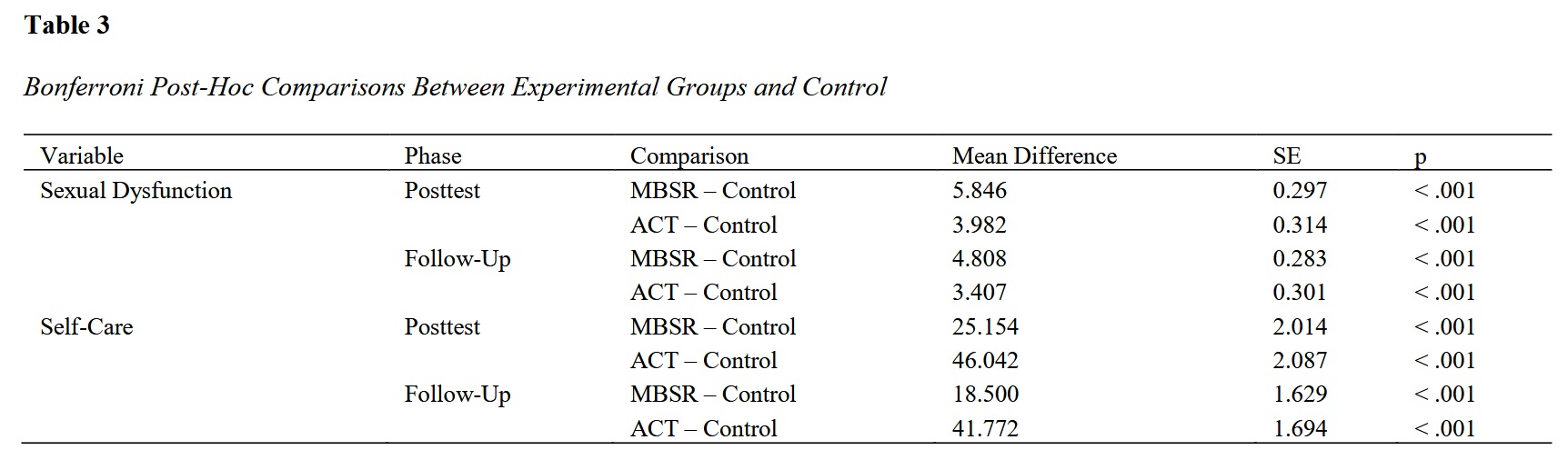
Findings: The results indicated that both interventions significantly improved sexual function and enhanced self-care behaviors compared with the control group (p < .01). Furthermore, significant differences were observed between the two interventions, such that the mindfulness-based intervention exerted a greater effect on improving self-care and sexual function compared with acceptance and commitment therapy.
Conclusion: The findings suggest that psychological interventions—particularly mindfulness-based stress reduction—can effectively improve psycho-behavioral outcomes associated with type 2 diabetes in women, and their integration into treatment programs for chronic patients is strongly recommended.
Downloads
References
Afshari, P., Yazdizadeh, S., Abedi, P., & Rashidi, H. (2017). The Relation of Type 2 Diabetes with Sexual Function Among Reproductive Age Women in Iran, a Case-Control Study. Advances in Medicine, 4838923. https://doi.org/10.1155/2017/4838923
Baumeister, H., Hutter, N., & Bengel, J. (2012). Psychological and Pharmacological Interventions for Depression in Patients with Diabetes Mellitus and Depression. Cochrane Database of Systematic Reviews, 12(12), CD008381. https://doi.org/10.1002/14651858.CD008381.pub2
Carter, N., Nalbant, G., Chahal, P., & Chattopadhyay, K. (2024). Effectiveness and Safety of Self-Management Interventions for Improving Glycemic Control and Health-Related Quality of Life Among Adults with Type 2 Diabetes Mellitus in Sub-Saharan Africa: A Systematic Review and Meta-Analysis. JBI Evidence Synthesis, 22(9), 1715-1788. https://doi.org/10.11124/JBIES-23-00273
Chawla, R., Madhu, S. V., Makkar, B. M., Ghosh, S., Saboo, B., Kalra, S., & Group, R.-E. C. (2020). RSSDI-ESI Clinical Practice Recommendations for the Management of Type 2 Diabetes Mellitus 2020. Indian Journal of Endocrinology and Metabolism, 24(1), 1-122. https://doi.org/10.4103/ijem.IJEM_225_20
Chew, B. H., Vos, R. C., Metzendorf, M. I., Scholten, R. J., & Rutten, G. E. (2017). Psychological Interventions for Diabetes-Related Distress in Adults with Type 2 Diabetes Mellitus. Cochrane Database of Systematic Reviews, 9(9), CD011469. https://doi.org/10.1002/14651858.CD011469.pub2
Ebrahimi, F., Barqi Irani, Z., Alizadeh Dehkhordi, M., & Akbari Dehkhordi, M. (2022). Investigating the Effectiveness of Acceptance and Commitment Therapy on Mood Swings, Sleep Quality, and Sexual Function in Menopausal Women. Health Psychology, 11(44), 73-88. https://doi.org/10.30473/hpj.2023.59513.5289
Gilbert, L., Gross, J., Lanzi, S., Quansah, D. Y., Puder, J., & Horsch, A. (2019). How Diet, Physical Activity, and Psychosocial Well-Being Interact in Women with Gestational Diabetes Mellitus: An Integrative Review. BMC Pregnancy and Childbirth, 19(1), 60. https://doi.org/10.1186/s12884-019-2185-y
Harbi Ansieh, O. M., Alipour, A., & Ghaemi, F. (2020). The Effectiveness of a Mindfulness-Based Stress Reduction Program on Self-Care and Diabetes-Related Quality of Life in Women with Type 2 Diabetes. Journal of Psychological Sciences, 19(95), 1453-1464. https://psychologicalscience.ir/article-1-782-fa.pdf
Hayes, S. C., Strosahl, K. D., & Wilson, K. G. (2012). Acceptance and Commitment Therapy: The Process and Practice of Mindful Change. The Guilford Press. https://psycnet.apa.org/record/2012-00755-000
Karimi, S., Moradi Manesh, F., Asgari, P., & Bakhtiarpour, S. (2020). Effectiveness of Acceptance and Commitment Therapy on Self-Care Behaviors and Treatment Adherence in Dialysis Patients. Mashhad University of Medical Sciences Journal, 63(3), 2324-2333. https://doi.org/10.22038/mjms.2020.16892
McGloin, H., Devane, D., McIntosh, C. D., Winkley, K., & Gethin, G. (2021). Psychological Interventions for Treating Foot Ulcers, and Preventing Their Recurrence, in People With Diabetes. Cochrane Database of Systematic Reviews, 2(2), CD012835. https://doi.org/10.1002/14651858.CD012835.pub2
Oyedeji, A. D., Ullah, I., Weich, S., Bentall, R., & Booth, A. (2022). Effectiveness of Non-Specialist Delivered Psychological Interventions on Glycemic Control and Mental Health Problems in Individuals with Type 2 Diabetes: A Systematic Review and Meta-Analysis. International Journal of Mental Health Systems, 16(1), 9. https://doi.org/10.1186/s13033-022-00521-2
Roberts, M. Z., Scheiber, F. A., Moskovich, A. A., & Merwin, R. M. (2025). A Scoping Review of the Relationship Between Psychological (In)flexibility and Living With and Managing Type 1 and Type 2 Diabetes. Behavioral Sciences, 15(6), 792. https://doi.org/10.3390/bs15060792
Taghavi Moradi, M., Fatemi, S., & Abutorabi, R. (2009). Study of Sexual Function in Women with Type 2 Diabetes. Iranian Journal of Diabetes and Metabolism, 8(4), 357-362. https://ijdld.tums.ac.ir/article-1-216-fa.html
Tully, P. J., Schutte, N., Guppy, M. P., Garatva, P., Wittert, G., & Baumeister, H. (2025). Psychological Interventions for Depression in People With Diabetes Mellitus. Cochrane Database of Systematic Reviews, 1(1), CD016005. https://doi.org/10.1002/14651858.CD016005
Upsher, R., Onabajo, D., Stahl, D., Ismail, K., & Winkley, K. (2021). The Effectiveness of Behavior Change Techniques Underpinning Psychological Interventions to Improve Glycemic Levels for Adults with Type 2 Diabetes: A Meta-Analysis. Frontiers in Clinical Diabetes and Health Care, 2, 699038. https://doi.org/10.3389/fcdhc.2021.699038
Wakelin, K. E., Read, R. K., Williams, A. Y., Francois-Walcott, R. R., O'Donnell, N., Satherley, R. M., Harrington, M. P., John, M., & Jones, C. J. (2025). The Effectiveness of Psychological Interventions for Families of Children with Type 1 Diabetes on Caregiver and Child Functioning: A Systematic Review and Meta-Analysis. Journal of diabetes, 17(6), e70112. https://doi.org/10.1111/1753-0407.70112
Zhu, W., Zhang, S., Du, L., Huang, X., Nie, W., & Wang, L. (2024). The Effectiveness of Psychological Interventions on Diabetes Distress and Glycemic Level in Adults with Type 2 Diabetes: A Systematic Review and Meta-Analysis. BMC psychiatry, 24(1), 660. https://doi.org/10.1186/s12888-024-06125-z
Downloads
Additional Files
Publication Timeline
- Submitted
- Revised
- Accepted