A Phenomenological Understanding of Adjustment in Remarriage: From Individual Transition to Social Acceptance After Divorce
Keywords:
remarriage, marital adjustment, phenomenology, divorceAbstract
Objective: The present study aimed to develop a phenomenological understanding of adjustment in remarriage, from individual transition to social acceptance following divorce.
Methods and Materials: The present study employed a descriptive phenomenological design. The research field comprised all women with experience of remarriage who had referred to the Ofogh Mehr Counseling Center in Shahriar during 2023–2024 to receive family and marriage counseling services. Participants were selected through purposive sampling, and data saturation was achieved after the fifteenth interview. For initial screening, the Satisfaction With Life Scale (Diener et al., 1985), the ENRICH Marital Satisfaction Scale (Olson et al., 1989), and the Dyadic Adjustment Scale (Spanier, 1976) were used. Data were analyzed using Colaizzi’s method, and the credibility of the findings was enhanced through peer review and member checking.
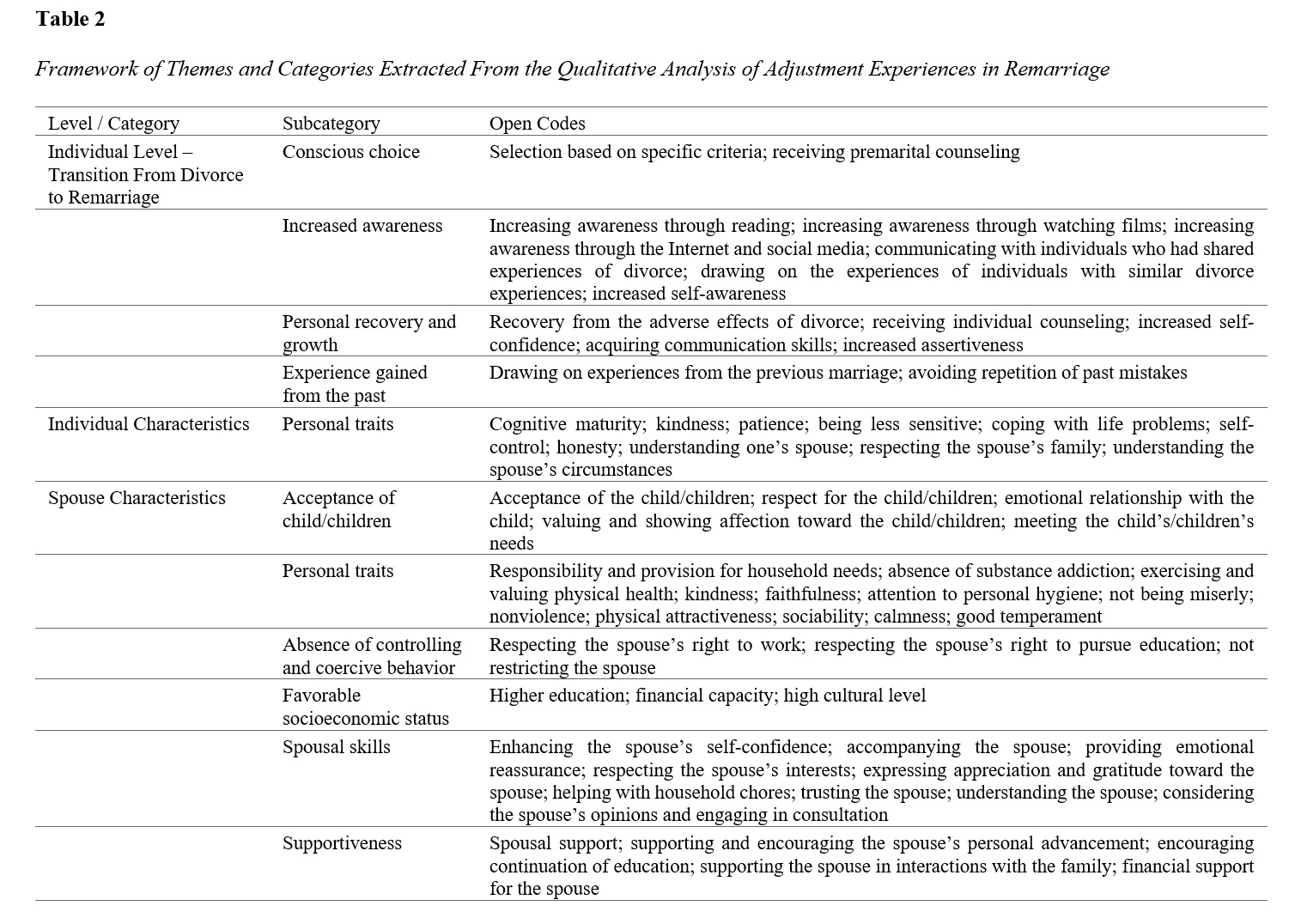
Findings: The phenomenological analysis resulted in the identification of six main themes and 21 subthemes, which were organized across the individual level (conscious transition and personality characteristics), marital level (communication skills and mutual support), family level (family acceptance and support), and social level (changes in societal attitudes).
Conclusion: Successful adjustment in remarriage results from the dynamic interaction among these four levels, extending from individual transformation to social support. The findings underscore the necessity of adopting a systemic approach in counseling and supportive interventions to enhance the stability and sustainability of remarriages
Downloads
References
Al-Shahrani, H. F., & Hammad, M. A. (2023). Relationship between Emotional Divorce and Alexithymia among Married Women in Saudi Arabia. BMC psychology, 11(1), 217.
Ayadi, N., Fatehizadeh, M., & Etemad, A. (2025). Identifying the Challenges and Issues of Remarriage after Divorce in Iran: A Systematic Qualitative Review. Journal of Applied Psychological Research, 16(3), 107-126. https://japr.ut.ac.ir/article_97574.html?lang=en
Baharami-Nejad, H., Shariatmadar, A., Farahbakhsh, K., & Asgari, M. (2025). Components Influencing the Stability of Remarriage: A Grounded Theory Study. Women's and Family Cultural-Educational Studies, 20(71), 111-134. https://cwfs.ihu.ac.ir/article_209490.html
Balachandran, L., & Jean Yeung, W. J. (2020). Old Bonds, New Ties: Contextualizing Family Transitions in Re-Partnerships, Remarriage and Stepfamilies in Asia. Journal of Family Issues, 41(7), 879-890.
Benton, S. E. (2026). Remarriage in Early Christianity by A. Andrew Das. The Catholic Biblical Quarterly, 88(1), 189-190.
Bir-Akturk, E., & Fisiloglu, H. (2009). Marital Satisfaction in Turkish Remarried Families: Marital Status, Stepchildren, and Contributing Factors. Journal of Divorce & Remarriage, 50(2), 119-147. https://doi.org/10.1080/10502550802365755
DeLongis, A., & Zwicker, A. (2017). Marital Satisfaction and Divorce in Couples in Stepfamilies. Current opinion in psychology, 13, 158-161. https://doi.org/10.1016/j.copsyc.2016.11.003
Ganong, L. H., & Coleman, M. (2017). Stepfamily Relationships: Development, Dynamics, and Interventions (2nd ed.). Springer-Verlag. https://doi.org/10.1007/s10680-006-9109-z
Garneau, C. L., Adler-Baeder, F., & Higginbotham, B. (2016). Validating the Remarriage Belief Inventory as a Dyadic Measure for Stepcouples. Journal of Family Issues, 37(1), 58-79. https://doi.org/10.1177/0192513X13517250
Geiger, A. W., & Livingston, G. (2019). 8 Facts about Love and Marriage in America. https://www.pewresearch.org/fact-tank/2019/02/13/8-facts-about-loveand-marriage/
Güngör, A. (2025). Remarriage After Divorce: Insights From the Turkish Context. https://doi.org/10.21203/rs.3.rs-7186587/v1
Güngör, A. (2026). Remarriage after Divorce in a Collectivist Context: Lived Experiences of Family Reorganization and Social Reintegration. Family Relations, 1-20. https://doi.org/10.1111/fare.70266
Higginbotham, B. J. (2005). The Remarriage Belief Inventory: Testing the Factorial Structure and Validity with a Remarried Sample Auburn University].
Higginbotham, B. J., & Adler-Baeder, F. (2008). Assessing Beliefs about Remarriages and Stepfamilies: The Remarriage Belief Inventory. Journal of Divorce & Remarriage, 48(3-4), 77-95. https://doi.org/10.1300/J087v48n03_05
Jikihara, Y., Nozawa, S., Ando, S., Schramm, D. G., Higginbotham, B. J., & Adler-Baeder, F. (2023). Exploring the Factor Structure and Concurrent Validity of Two Stepfamily Measures for Japanese Couples. Journal of Divorce & Remarriage, 64(2-4), 156-172. https://doi.org/10.1080/10502556.2023.2194797
Kakkar, A. (2026). Psychosocial Aspects of Remarriage Among the Elderly. In (pp. 759-769). Springer Nature Singapore.
Kane, J. B. (2016). Marriage Advantages in Perinatal Health: Evidence of Marriage Selection or Marriage Protection? Journal of marriage and family, 78(1), 212-229.
Kim, H. (2010). Exploratory Study on the Factors Affecting Marital Satisfaction among Remarried Korean Couples. Families in Society, 91(2), 193-200.
Kwon, H. S., Rueter, M. A., Lee, M. S., Koh, S., & Ok, S. W. (2007). Marital Relationships Following the Korean Economic Crisis: Applying the Family Stress Model. Journal of marriage and family, 69(5), 1290-1304. https://doi.org/10.1111/j.1741-3737.2007.00446.x
Nguyen, O. T., & Pawle, R. H. (2021). A Thematic Analysis Study about Remarriage of Elderly Men in Vietnam. Scholar: Human Sciences, 13(2), 286-286.
Papernow, P. L. (2018). Recoupling in Mid-Life and Beyond: From Love at Last to Not So Fast. Family Process, 57(1), 52-69. https://doi.org/10.1111/famp.12315
Papernow, P. L. (2023). Therapy with Stepfamily Couples. In (6th ed., pp. 492-511). The Guilford Press.
Rasheed, A., Amr, A., & Fahad, N. (2021). Investigating the Relationship between Emotional Divorce, Marital Expectations, and Self-Efficacy among Wives in Saudi Arabia. Journal of Divorce & Remarriage, 62(1), 19-40.
Sanctuary, G. (2023). Marriage under Stress: A Comparative Study of Marriage Conciliation. Routledge.
Santos, C., Costa, M. E., Higginbotham, B. J., & Martins, M. V. (2022). The Remarriage Belief Inventory: Psychometric Development and Validation in the Portuguese Remarried Population. Journal of Family Issues, 43(10), 2589-2612. https://doi.org/10.1177/0192513X221092052
Santos, C., Costa, M. E., Pedro, J., Higginbotham, B. J., & Martins, M. V. (2024). Marital Adjustment in Remarriage: A Systematic Review. Family Transitions, 65(4), 291-322.
Santos, J. T., Higginbotham, B. J., Costa, R., & Martins, F. (2023). Factor Structure and Validity of the Portuguese Version of the Remarriage Belief Inventory. Journal of Divorce & Remarriage, 64(1), 37-51. https://doi.org/10.1080/10502556.2022.2160938
Schramm, D. G., & Higginbotham, B. J. (2009). A Revision of the Questionnaire for Couples in Stepfamilies. Journal of Divorce & Remarriage, 50(5), 341-355. https://doi.org/10.1080/10502550902766449
Shapiro, D. N., & Stewart, A. J. (2012). Dyadic Support in Stepfamilies: Buffering against Depressive Symptoms among More and Less Experienced Stepparents. Journal of Family Psychology, 26(5), 833. https://doi.org/10.1037/a0029591
Sweeney, M. M. (2010). Remarriage and Stepfamilies: Strategic Sites for Family Scholarship in the 21st Century. Journal of marriage and family, 72(3), 667-684. https://doi.org/10.1111/j.1741-3737.2010.00724.x
Tao, H. L. (2019). Marriage and Happiness: Evidence from Taiwan. Journal of Happiness Studies, 20, 1843-1861.
Downloads
Additional Files
Publication Timeline
- Submitted
- Revised
- Accepted