When War Enters Work: Job Insecurity, Personal Resources, and War-Related Anxiety Among Iranian Mental Health Professionals
DOI:
https://doi.org/10.61838/kman.jarac.6525Keywords:
job insecurity, career adaptability, personal resources, war-related anxiety, armed conflictAbstract
Objective: This study examined the associations of quantitative and qualitative job insecurity, career adaptability, and agency-related personal resources with war-related anxiety among Iranian mental health professionals during a period of armed conflict.
Methods and Materials: A cross-sectional online survey was conducted in Iran from April 3 to April 19, 2026, using convenience recruitment among counselors and psychologists. Of 250 available records, five containing unexplained fractional item responses were excluded, yielding a primary analytic sample of 245 respondents. Measures assessed quantitative and qualitative job insecurity, career adaptability, an agency-related personal-resource composite comprising self-efficacy, optimism, and purposefulness, and war-related anxiety. Pearson correlations and standardized ordinary least-squares regression models were applied. Variance inflation factors, residual diagnostics, heteroskedasticity-consistent HC3 standard errors, post hoc coefficient contrasts, and sensitivity analyses were also conducted.
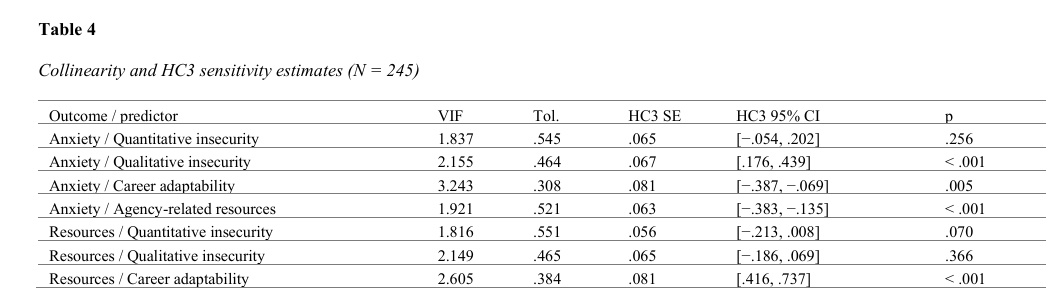
Findings: In the primary anxiety model, qualitative job insecurity was positively associated with war-related anxiety (β = .307, 95% CI [.183, .432], p < .001), whereas the association for quantitative job insecurity was not statistically significant (β = .074, 95% CI [−.041, .189], p = .206). Career adaptability (β = −.228, 95% CI [−.381, −.075], p = .004) and agency-related personal resources (β = −.259, 95% CI [−.376, −.141], p < .001) were negatively associated with anxiety. The model explained 55.3% of the variance. In the secondary model, career adaptability was positively associated with agency-related resources (β = .576, 95% CI [.429, .724], p < .001), whereas both insecurity dimensions were nonsignificant. HC3 and sensitivity analyses produced comparable patterns.
Conclusion: Qualitative threats to valued working conditions, rather than perceived job-loss risk alone, were associated with greater war-related anxiety, while career adaptability and agency-related personal resources were associated with lower anxiety. These findings support examining occupational threats and personal resources jointly during conflict, while the cross-sectional design precludes causal or mediational interpretations.
Downloads
References
Ben-Ezra, M., Goodwin, R., Leshem, E., & Hamama-Raz, Y. (2023). PTSD Symptoms among Civilians Being Displaced inside and outside the Ukraine during the 2022 Russian Invasion. Psychiatry research, 320, 115011. https://doi.org/10.1016/j.psychres.2022.115011
Chudzicka-Czupała, A., Hapon, N., Chiang, S. K., Żywiołek-Szeja, M., Karamushka, L., Lee, C. T., Grabowski, D., Paliga, M., Rosenblat, J. D., Ho, R., McIntyre, R. S., & Chen, Y. L. (2023). Depression, Anxiety and Post-Traumatic Stress during the 2022 Russo-Ukrainian War, a Comparison between Populations in Poland, Ukraine, and Taiwan. Scientific reports, 13, 3602. https://doi.org/10.1038/s41598-023-28729-3
De Witte, H., Pienaar, J., & De Cuyper, N. (2016). Review of 30 Years of Longitudinal Studies on the Association between Job Insecurity and Health and Well-Being: Is There Causal Evidence? Australian Psychologist, 51(1), 18-31. https://doi.org/10.1111/ap.12176
Edosomwan, H. S. (2022). Relationship between Workplace Fun and Job Satisfaction among University Administrative Staff: Does Perceived Organizational Support Matter? Asian Journal of Social Sciences and Management Studies, 9(2), 42-50. https://doi.org/10.20448/ajssms.v9i2.3902
Farahani, A., Yarmohammadian, A., Malekpour, M., & Abedi, A. (2018). Developing and Validating the Sense of Agency Inventory for Visually Impaired Individuals. Educational Measurement, 8(30), 165-188. https://doi.org/10.22054/jem.2018.24214.1594
Hobfoll, S. E., Halbesleben, J., Neveu, J. P., & Westman, M. (2018). Conservation of Resources in the Organizational Context: The Reality of Resources and Their Consequences. Annual Review of Organizational Psychology and Organizational Behavior, 5, 103-128. https://doi.org/10.1146/annurev-orgpsych-032117-104640
Hyland, P., Vallières, F., Shevlin, M., Karatzias, T., Ben-Ezra, M., McElroy, E., Vang, M. L., Lorberg, B., & Martsenkovskyi, D. (2023). Psychological Consequences of War in Ukraine: Assessing Changes in Mental Health among Ukrainian Parents. Psychological medicine, 53, 7466-7468. https://doi.org/10.1017/S0033291723000818
Kang, H., Esterlis, I., Chobanian, A. V., Boriak, O., Pietrzak, R. H., & Vus, V. (2023). Perceived Mental Health of Psychosocial Support Professionals in Ukraine. Psychiatry research, 326, 115320. https://doi.org/10.1016/j.psychres.2023.115320
Kang, H., Fischer, I. C., Vus, V., Chobanian, A., Kolyshkina, A., Ponomarenko, L., Esterlis, I., & Pietrzak, R. H. (2024). Well-Being of Mental Health Workers during the Russian-Ukrainian War. Mental Health: Global Challenges Journal, 7(1), 41-49. https://doi.org/10.56508/mhgcj.v7i1.189
Lim, I. C. Z. Y., Tam, W. W. S., Chudzicka-Czupała, A., McIntyre, R. S., Teopiz, K. M., Ho, R. C., & Ho, C. S. H. (2022). Prevalence of Depression, Anxiety and Post-Traumatic Stress in War- and Conflict-Afflicted Areas: A Meta-Analysis. Frontiers in Psychiatry, 13, 978703. https://doi.org/10.3389/fpsyt.2022.978703
Lushchak, O., Velykodna, M., Bolman, S., Strilbytska, O., Berezovskyi, V., & Storey, K. B. (2024). Prevalence of Stress, Anxiety, and Symptoms of Post-Traumatic Stress Disorder among Ukrainians after the First Year of Russian Invasion: A Nationwide Cross-Sectional Study. The Lancet Regional Health - Europe, 36, 100773. https://doi.org/10.1016/j.lanepe.2023.100773
Miller, K. E., & Rasmussen, A. (2010). War Exposure, Daily Stressors, and Mental Health in Conflict and Post-Conflict Settings: Bridging the Divide between Trauma-Focused and Psychosocial Frameworks. Social Science & Medicine, 70(1), 7-16. https://doi.org/10.1016/j.socscimed.2009.09.029
Pinchuk, I., Goto, R., Pimenova, N., Kolodezhny, O., Guerrero, A. P. S., & Skokauskas, N. (2022). Mental Health of Helpline Staff in Ukraine during the 2022 Russian Invasion. European Psychiatry, 65(1), e45. https://doi.org/10.1192/j.eurpsy.2022.2306
Raeisi, A., Shalbafan, M., Khadem, S., Farrokhi, B., Rahbar, M., Chegini, M., Ghoddousi, S. E., & Zarafshan, H. (2026). Integrating a National Crisis Counseling Hotline into Iran’s Primary Health Care Network to Provide Rapid Mental Health Support during Armed Conflict. Communications Medicine, 6, 375. https://doi.org/10.1038/s43856-026-01772-7
Rudolph, C. W., Lavigne, K. N., & Zacher, H. (2017). Career Adaptability: A Meta-Analysis of Relationships with Measures of Adaptivity, Adapting Responses, and Adaptation Results. Journal of Vocational Behavior, 98, 17-34. https://doi.org/10.1016/j.jvb.2016.09.002
Rudolph, C. W., & Zacher, H. (2023). Adapting to Involuntary, Radical, and Socially Undesirable Career Changes. Current Psychology, 42, 5015-5026. https://doi.org/10.1007/s12144-021-01859-5
Savickas, M. L. (2005). The Theory and Practice of Career Construction. In S. D. Brown & R. W. Lent (Eds.), Career development and counseling: Putting theory and research to work (pp. 42-70). Wiley.
Savickas, M. L., & Porfeli, E. J. (2012). Career Adapt-Abilities Scale: Construction, Reliability, and Measurement Equivalence across 13 Countries. Journal of Vocational Behavior, 80(3), 661-673. https://doi.org/10.1016/j.jvb.2012.01.011
Schmitt, A., Heihal, T. I., & Zacher, H. (2024). Financial Worries, Health Complaints, and Career Exploration: The Role of Action Crises. Occupational Health Science, 8, 613-635. https://doi.org/10.1007/s41542-024-00182-2
Shomali Ahmadabadi, M., & Barkhordari Ahmadabadi, A. (2025). Construction and Validation of the War Anxiety Scale. Scientific Journal of Social Psychology, 13(76), 1-17. https://doi.org/10.66224/jsp.1210160
Shoss, M. K. (2017). Job Insecurity: An Integrative Review and Agenda for Future Research. Journal of Management, 43(6), 1911-1939. https://doi.org/10.1177/0149206317691574
Synofzik, M., Vosgerau, G., & Newen, A. (2008). Beyond the Comparator Model: A Multifactorial Two-Step Account of Agency. Consciousness and Cognition, 17(1), 219-239. https://doi.org/10.1016/j.concog.2007.03.010
Urbanaviciute, I., Lazauskaite-Zabielske, J., & De Witte, H. (2021). Deconstructing Job Insecurity: Do Its Qualitative and Quantitative Dimensions Add Up? Occupational Health Science, 5, 415-435. https://doi.org/10.1007/s41542-021-00096-3
Downloads
Additional Files
Publication Timeline
- Submitted
- Revised
- Accepted